You know that voice in your head that whispers "I can beat the S&P 500 if I just had the right system"?
Yeah, we all have it. Most of the time, it's lying. But sometimes (just sometimes) that voice has a point.
Vulcan LDA is our attempt to figure out when.
Starting November 20, 2025, we're running a live experiment with real rules, real stocks, and a very clear scoreboard: Can a systematic, rules-based approach consistently beat the S&P 500 over rolling 3-6 month windows?
This isn't a back tested fantasy. It's a $100,000 paper portfolio with 24 stocks (each month we'll hold 20-30 stocks) that will be tracked, rebalanced monthly, and graded ruthlessly against the index. If it works, great. If it doesn't, you'll know that too.
You can follow along in real-time with our model portfolio tracker on GNG Research, where all holdings, performance, and monthly updates will be published transparently.
Here's everything you need to know about Vulcan LDA-1 and what we're actually trying to do.
What LDA Actually Is (No Jargon Version)
Think of your investment portfolio like a house. The S&P 500 is the foundation: broad, boring, nearly impossible to mess up. It's the part that holds everything together over decades.
Vulcan LDA isn't the foundation. It's the smart sidecar you bolt onto that house when you think you can add a bit of extra performance without turning the whole thing into a casino.
LDA stands for "Logic Dictates Alpha," which is our way of saying: we think systematic rules (not hunches, not hot tips, not what's trending on social media) can generate 3–6-month alpha versus the index.
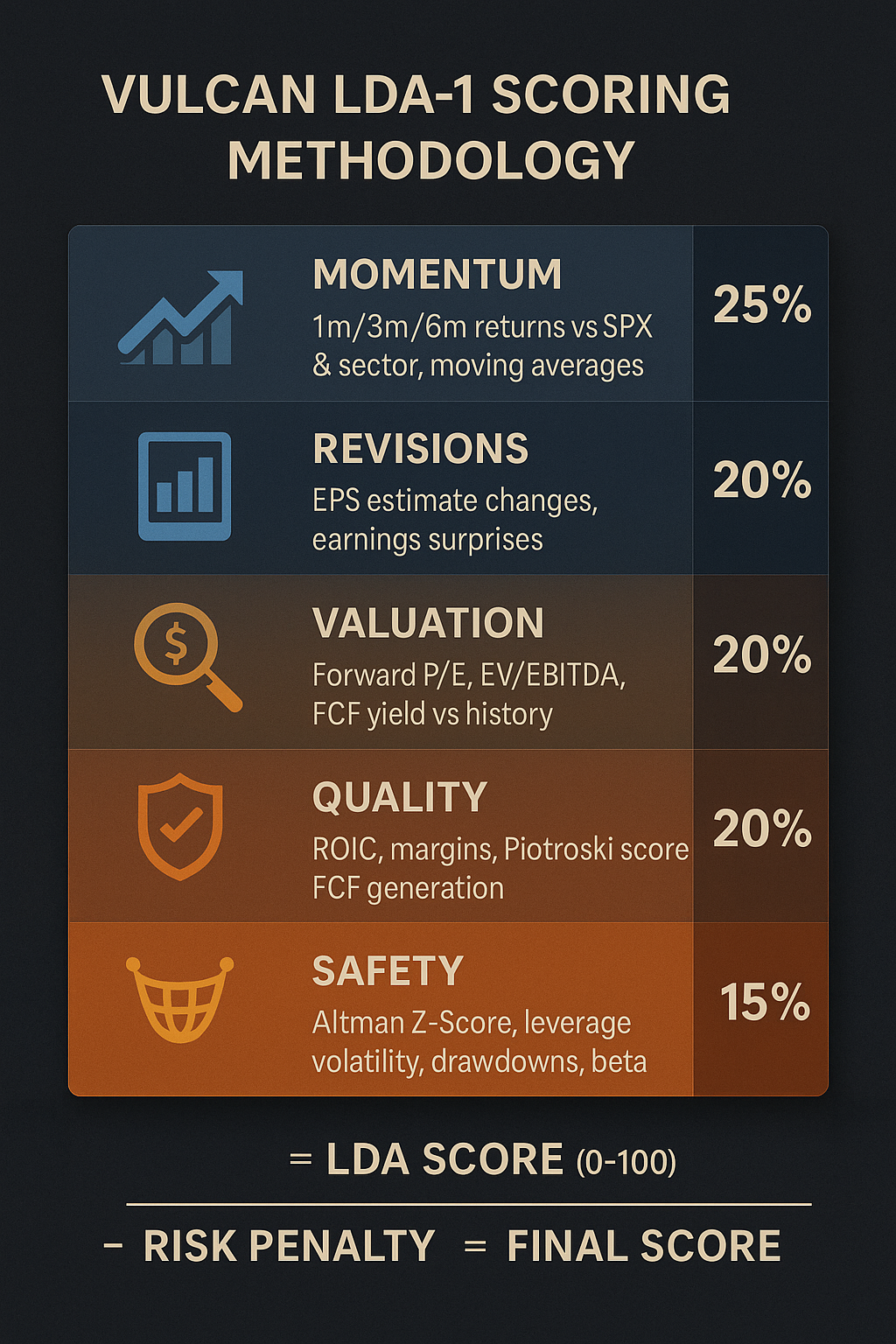
The approach combines five things:
Momentum - Which stocks are actually moving higher right now vs the market and their sectors?
Earnings revisions - Are analysts raising estimates or cutting them? Are companies beating expectations?
Valuation - Is the stock cheap enough that the next few months can benefit from a re-rating?
Quality - Can this business actually execute, or is it all PowerPoint slides and hope?
Safety - Is the balance sheet clean enough to survive a wobble, or are we one bad quarter from disaster?
These five factors get combined into a single LDA score (0-100), then we penalize the crazy stuff: the stocks with massive volatility, sketchy financials, or recent 40% drawdowns. This keeps lottery tickets from dominating the portfolio.
What's left is a shortlist of stocks that score well on "can this actually work over the next few months" without being reckless about risk.
How We Built LDA First Month (v1, The November 2025 Starting Lineup)
We didn't just run a magic black box and call it a day. Here's the actual build process:
Step 1: Cast a wide net
We started with three candidate pools:
The existing stock universe (names we've been tracking for a while)
The "high quality high conviction 90" list (stocks that keep showing up in institutional-favorite ETFs)
A fresh screener built specifically around LDA factors (91 stocks)
After running all those names through the LDA engine, we kept only stocks with LDA scores above 50, which gave us about 136 serious contenders.
Step 2: Score everything on the five factors
Each stock got graded on:
Momentum: How's it doing vs the S&P and its sector over 1, 3, and 6 months? Is it above or below key moving averages?
Revisions: Are analysts lifting EPS estimates or cutting them? Have recent earnings surprises been positive or disappointing?
Valuation: Is it cheap or expensive vs its own history and sector on forward P/E, EV/EBITDA, and free cash flow yield?
Quality: ROIC, margins, Piotroski scores, actual free cash flow. Is this a real business?
Safety: Altman Z-Score, leverage, interest coverage, volatility, recent drawdowns, beta. Are we walking into a minefield?
These roll up into a raw LDA score, then we subtract a risk penalty to push down the names with huge volatility or recent blow-ups, even if they're hot right now.
Step 3: Layer on Vulcan-mk5 valuation discipline
Every finalist went through our full valuation framework:
Greenwald-style earnings power value (EPV) + DCF to estimate fair value
A blended "Greenwald fair value" (mostly external data from FactSet/Stock Rover, with our own EPV/DCF as a sanity check)
Margin of safety vs today's price
A simple 1-year expected return with upside/downside bands
Buy/hold/trim/avoid zones defined around fair value
This layer doesn't veto the LDA picks. It mainly influences position size. Rich compounders like GOOG and LLY are capped at lower weights (~3.25%), while more attractively valued names with solid momentum can sit closer to 5-6%.
Step 4: Build the portfolio with sector balance
We ended up with 24 stocks ranging from about 3.25% to 5.86% weights, deliberately spread across healthcare, tech, energy, REITs, and a few financials/industrials.
A few examples to show the range:
Defensive healthcare: MRK, JNJ, LLY, AZN, GILD. Big, durable names that anchor the quality side.
Tech/semis: TSM, KLAC, MU, APH, CSCO, GOOG. Momentum + revisions in AI infrastructure and connectivity.
Energy/midstream: MPLX, EQT, CTRA, AM. Cash flow plays if energy holds up.
REITs: WELL, CTRE, EPRT. Healthcare and commercial real estate with income.
Diversifiers: GFI (gold exposure), CBOE (derivatives infrastructure), GD (defense/industrials).
The idea: this isn't a closet "all-AI-all-the-time" basket. We want exposure to multiple themes so the portfolio doesn't live or die on one sector.
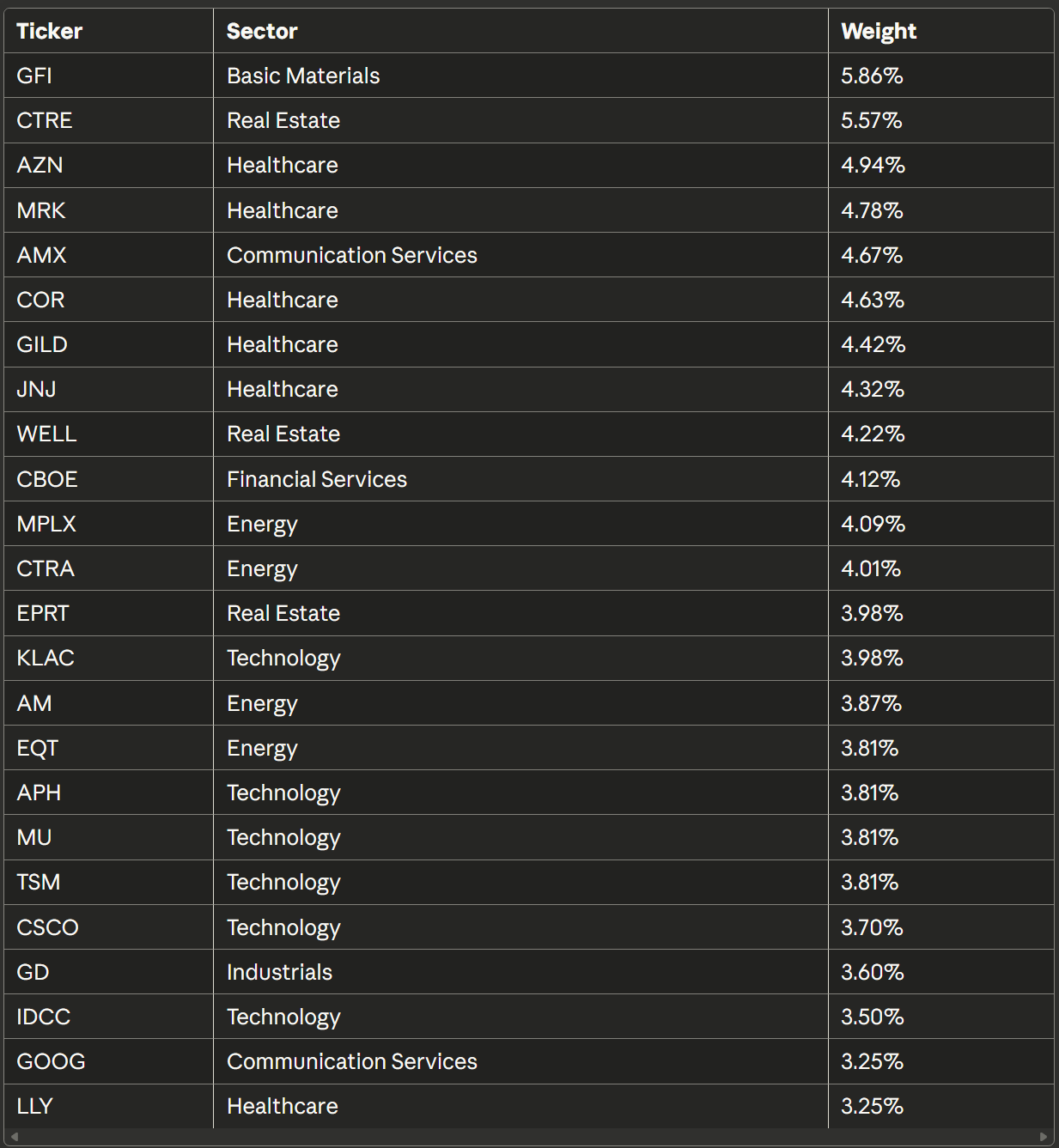
The Complete LDA-1 Starting Lineup
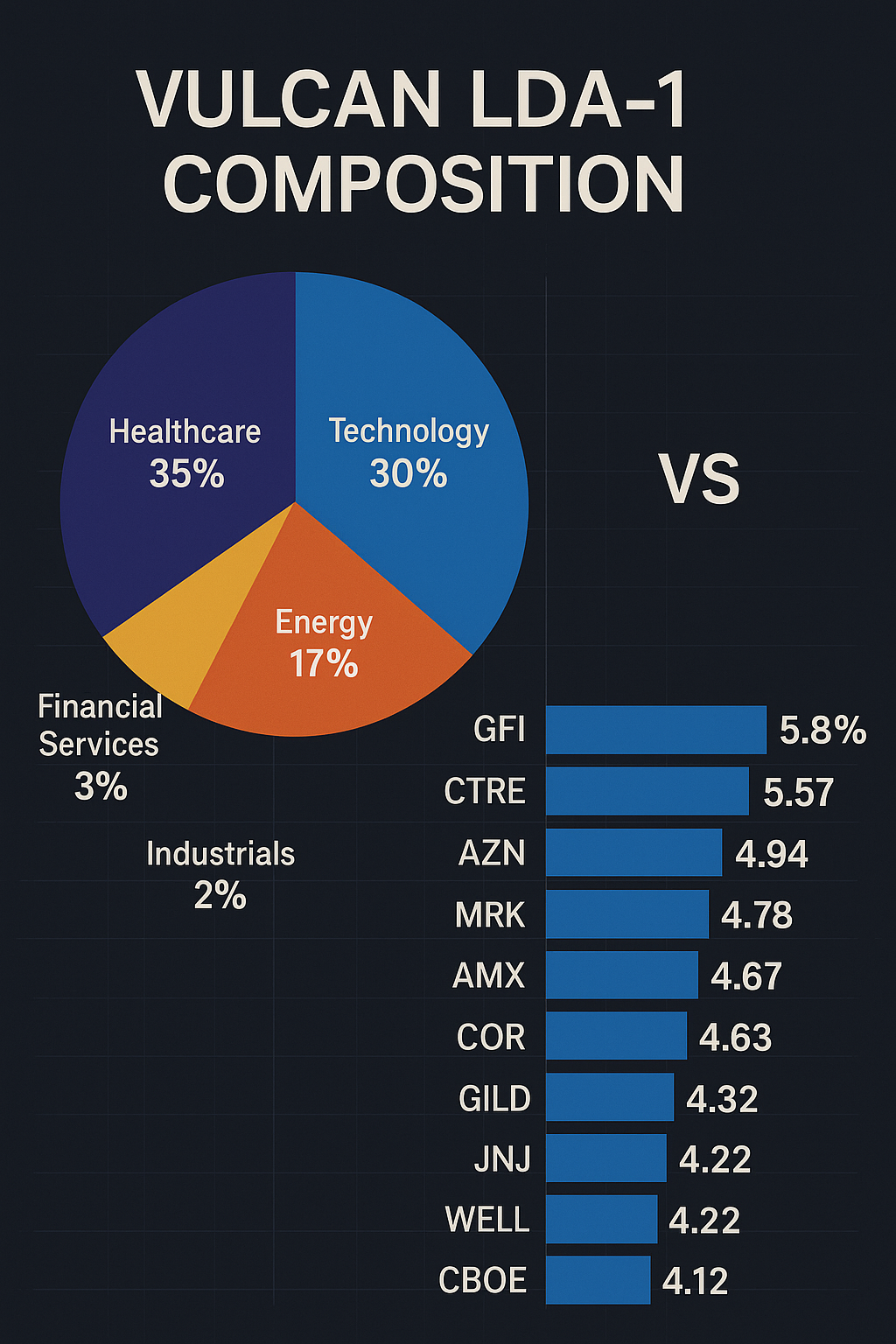
Here's what we're actually holding as of November 20, 2025:
Total: 24 stocks, $100,000 paper portfolio, equal-ish weights with slight tilts based on valuation and volatility.
Track live performance and monthly updates here
What to Actually Expect (The Honest Part)
Let's be clear about what LDA is and isn't:
Time Horizon: 3-6 Months, Not Forever
This isn't a "buy and forget for 30 years" portfolio. The engine is explicitly tuned to beat the S&P 500 over rolling 3-6 month windows, with a monthly rebalance where we re-run the scores and re-evaluate every holding.
Some names might stick around for multiple months if momentum and revisions stay strong. Others could rotate out quickly if earnings trends break or price momentum cracks (like falling below the 200-day moving average with negative excess returns).
There are guardrails to avoid hyper-trading, but this is still a tactical portfolio designed to respond to changes in fundamentals and price action.
Volatility: This Will Be Bumpier Than the Index
A 24-stock, equal-ish weight basket is naturally going to be more volatile than a 500-stock index. The risk filters (beta caps, drawdown penalties, Greenwald valuation floors) try to keep us away from obvious blow-ups, but they don't eliminate volatility.
There will be months where LDA-1 lags the S&P 500. If that's intolerable to you, this is not your primary portfolio.
We're not playing a daily race here. We're playing a multi-month series of decisions to see if systematic rules can compound small edges over time.
Turnover: Expect Real Rotation
Monthly rebalancing means you should expect actual changes:
Position sizes will drift with price, then get reset toward targets
New names will enter when they score well
Old names will exit when revisions turn or momentum dies
This isn't a passive index. It's an active, rules-based approach that adapts to changing market conditions.
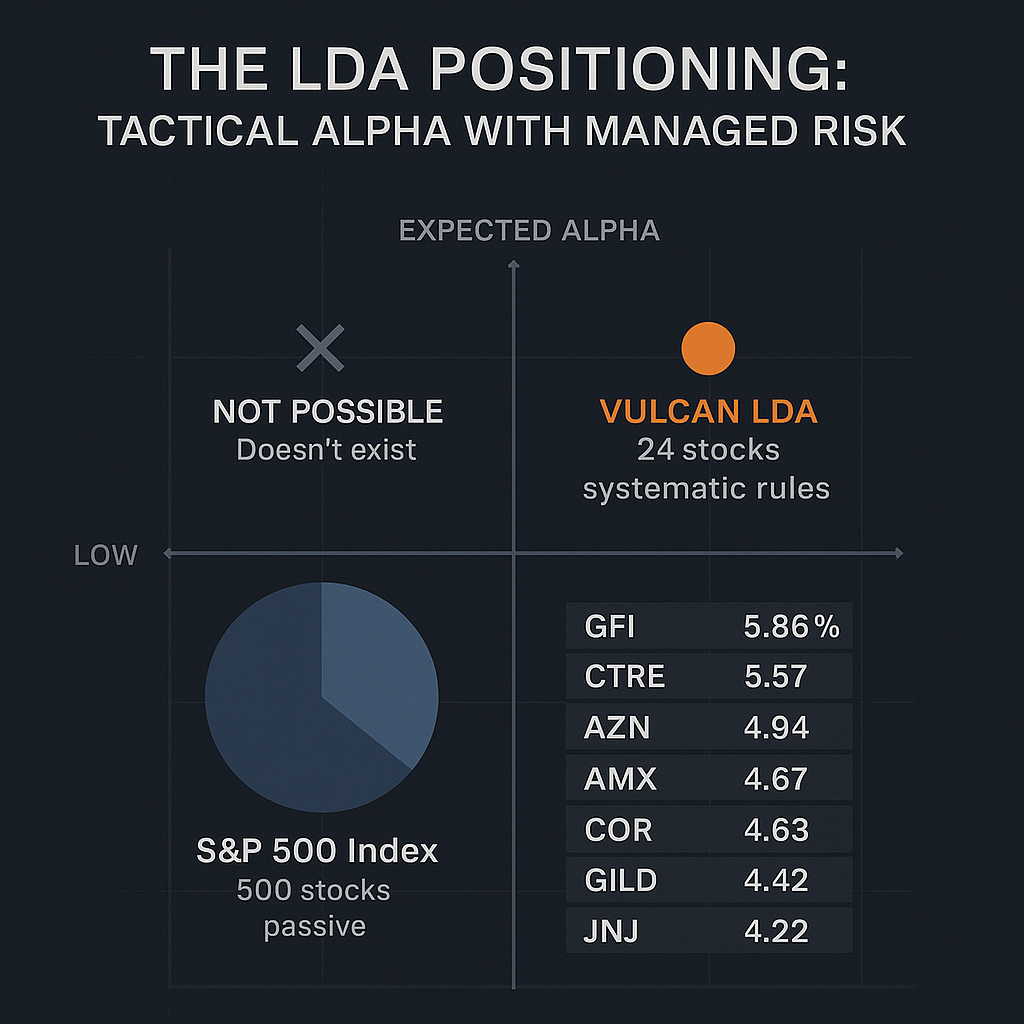
How to Use LDA-1 in Your Own Portfolio
Here are a few practical ways to think about this:
1. Idea farm, not instructions
The cleanest use: "I want a curated shortlist of names that score well on momentum, revisions, quality, and valuation right now."
You can:
Steal one or two ideas that fit your plan
Compare your current holdings against LDA names
Track how the rules perform over time
2. Tactical sleeve on top of core index exposure
For most investors, the S&P 500 (or similar ETF) should be the core. If you choose to implement something like LDA in real life, it probably lives as a smaller tactical sleeve on top of that foundation, not a replacement.
Think: 80% index, 20% tactical. Or 90/10. Whatever lets you sleep at night.
3. Educational scoreboard
Even if you never trade a single LDA stock, tracking this gives you a window into how systematic investing actually works in practice. Not backtested theory, but live decisions with real consequences.
The Scorecard (How We'll Actually Judge This)
We'll measure LDA-1 on:
3-month and 6-month alpha vs the S&P 500 (the main event)
Hit rate: How many individual names actually beat the index?
Drawdowns: How painful was the ride compared to just holding SPX?
There will be runs where the S&P 500 wins. That's fine. The question is whether a disciplined, rules-based approach can add value over many cycles, not whether it wins every month.
What Happens Next
Here's what you can expect going forward:
Monthly updates
LDA will be re-run every month, and the portfolio will be rebalanced on a fixed cadence. All changes, performance data, and updated holdings will be published on the live portfolio tracker. Expect:
Position sizes to reset toward targets
New names to enter when they score well
Old names to exit when revisions turn or momentum breaks
Evolving spec
This is Vulcan LDA v1. The rules, weights, and penalties are documented and versioned. They'll be refined over time as we accumulate live and backtest data, but changes will always be transparent and explained.
Greenwald Mode stays on
Even though LDA is short-horizon, the Greenwald asset/EPV floor runs in the background as a sanity check to avoid value traps and balance-sheet disasters.
The Risks You Need to Know About
A few plain-English caveats before you get too excited:
This is a paper model. No one is trading this for you. If you choose to mirror any part of it, that's entirely your decision and your responsibility.
No guarantees whatsoever. LDA-1 can absolutely underperform the S&P 500 over any time frame, including the full 3-6 month window it's targeting.
Short horizon ≠ low risk. Chasing 3-6 month alpha means you're taking on more tracking error and more bumps versus a broad index.
Not investment advice. This is research and education: a transparent look at how a rules-based engine might try to create an edge. It's not a personalized recommendation and doesn't consider your specific situation, risk tolerance, taxes, or time horizon.
Do your own work. If a name interests you, dig into its business, financials, and risk profile before putting real money at risk.
The Bottom Line
Vulcan LDA-1 is our live test of a straightforward idea: If you combine momentum, earnings revisions, reasonable valuation, solid quality, and real risk controls into one rules-based score, can you build a ~20-stock basket that beats the S&P 500 over rolling 3-6 month windows?
No magic. No hype. Just logic, data, and a clear scoreboard you can follow month by month.
Follow the live portfolio performance here and we'll see what happens together.
For more systematic analysis and research, visit GNG Research. To dive deeper into the Vulcan methodology, check out Vulcan Stock Research.
Disclosure: This analysis represents research and education, not personalized investment advice. The author may hold positions in securities discussed. Always conduct your own due diligence before making investment decisions.