GNG Analyst (Coming soon..)
Hey everyone, It’s been a while but I just wanted to give you an update.
I want to introduce something we've spent a lot of time on this year.
We're calling it the GNG Analyst. It's the AI research partner that lives inside our platform, and it's now in active testing.
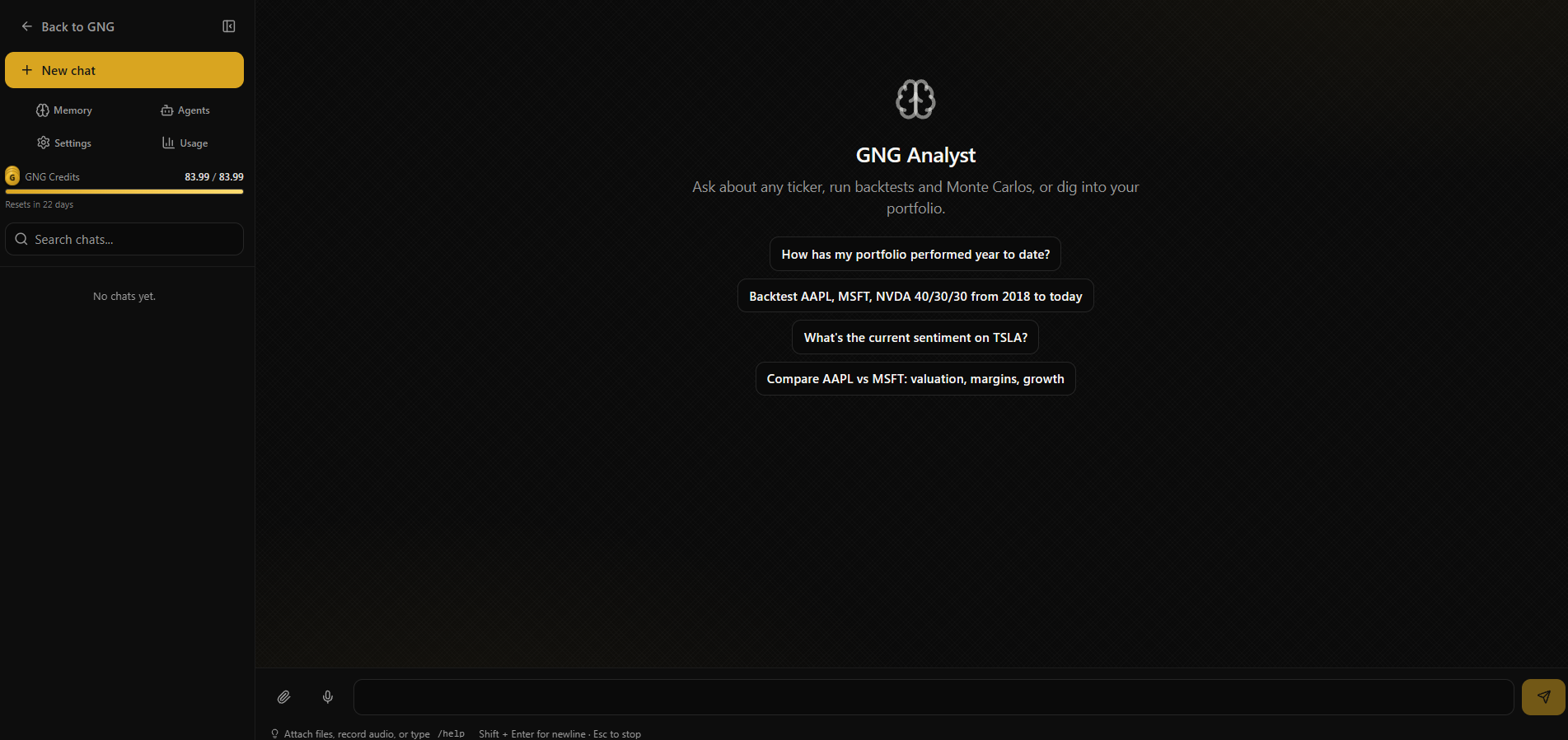
We're keeping the early group small on purpose so we can move fast on feedback. If you want in, drop a comment below and tell us what you'd want to use it for. I will add people until we hit the limit.
Why we built this
Every AI tool I've used in the last year has the same shape. A chat box, an answer, sometimes a citation. Useful for a quick look-up. Almost useless for the kind of work serious investors actually do.
The work we do is not chat. It's pulling fundamentals, comparing peers, running backtests, stress-testing a portfolio against a downturn, weighing dividend safety, scanning thousands of names against a thesis, reading insider activity, listening to a transcript, putting it all together into a view we can act on. That work does not fit inside a search bar. It needs hands, not just words.
So we asked ourselves a different question. Not "what would a smarter chatbot look like?" The question was: "what would it look like if every member had a real analyst built into the platform, available any time, who already knew their portfolio, already had every tool we use as a research team, and worked through tasks the way we do?"
The GNG Analyst is the answer to that question. It is not a chat box that talks about stocks. It is a research partner that does the work, shows you the work, and explains what it found.
What it actually does
When you ask the analyst about a company, it does not write you a paragraph. It pulls live company data, the dividend history, the earnings record, recent insider activity, and the news cycle, and it lays the whole picture out as charts and tables right inside the conversation, with its read on what matters underneath each one. The same is true for nearly every kind of question: ask the right thing and the analyst goes and does the research, then walks you through it.
A few examples of what that looks like in practice.
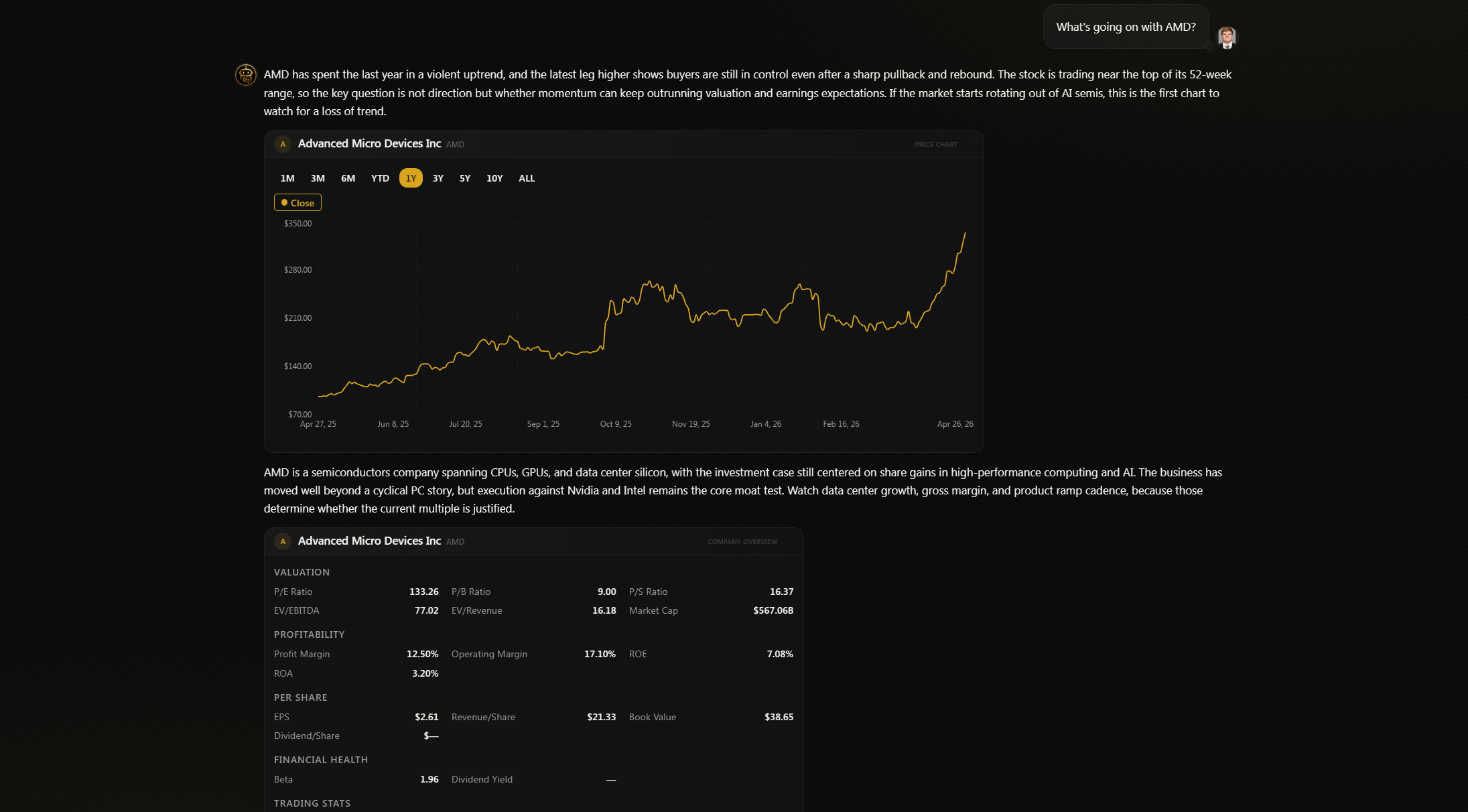
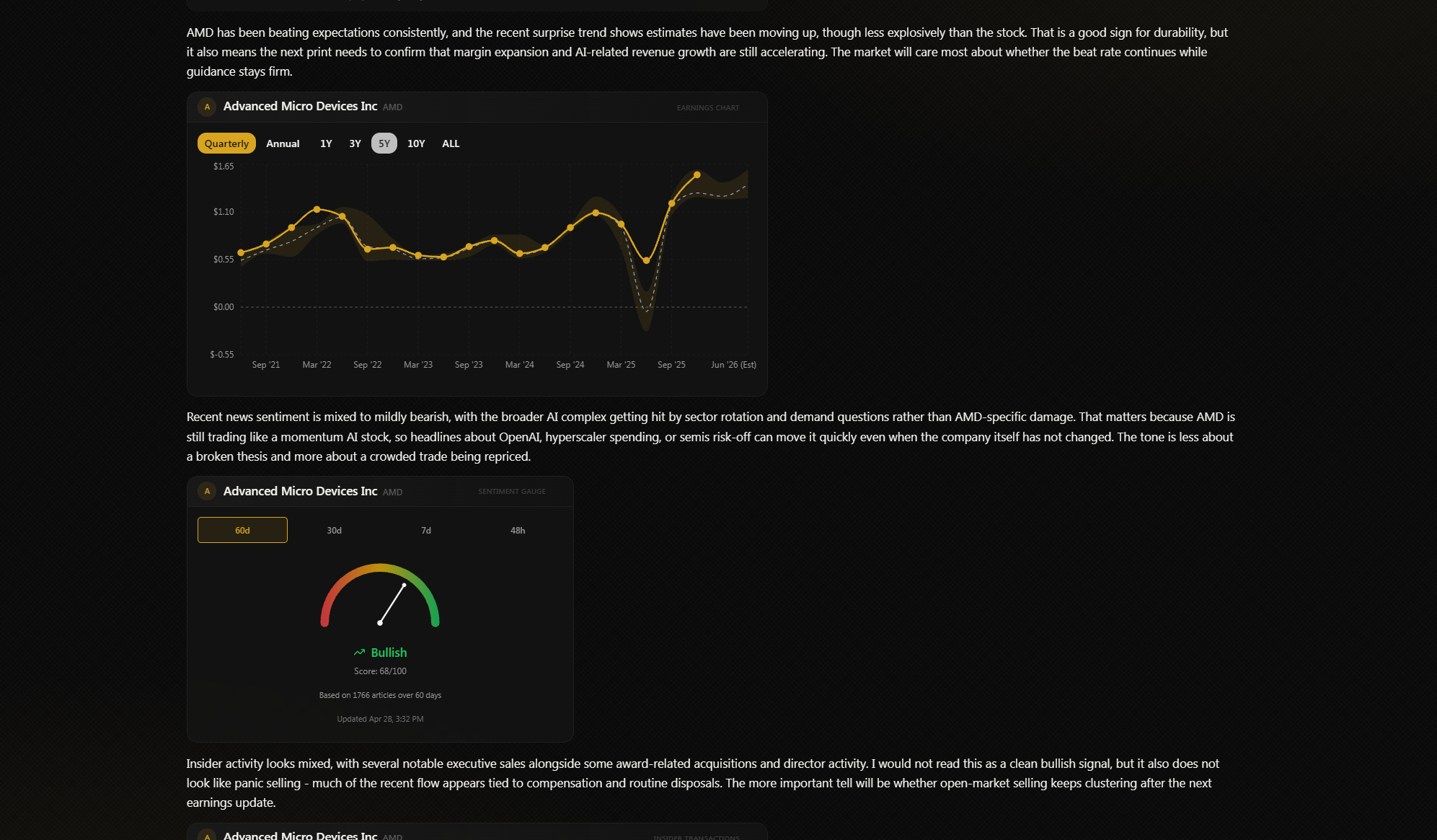
You ask, "What's going on with AMD?" The analyst pulls a price chart with the recent action and the 52-week context, a company snapshot with the business model and the metrics worth tracking, the earnings beat-and-miss pattern across recent quarters, the dividend picture if there is one, the tone of recent news, and a read on who has been buying or selling shares inside the company. All of it inline, all of it interactive, with a few sentences of analyst commentary on each one explaining what it sees.
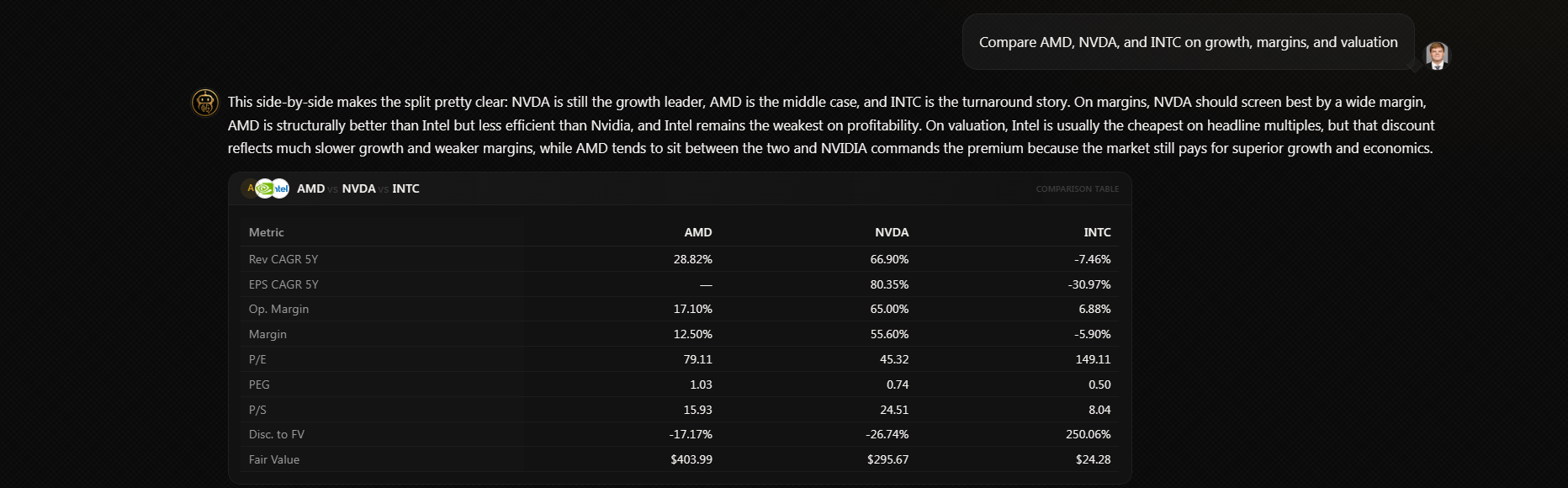
You ask, "Compare AMD, NVDA, and INTC on growth, margins, and valuation." It builds the comparison table for you, side by side, with the relevant metrics. You do not pick which metrics from a menu. It already knows which ones make that comparison meaningful.
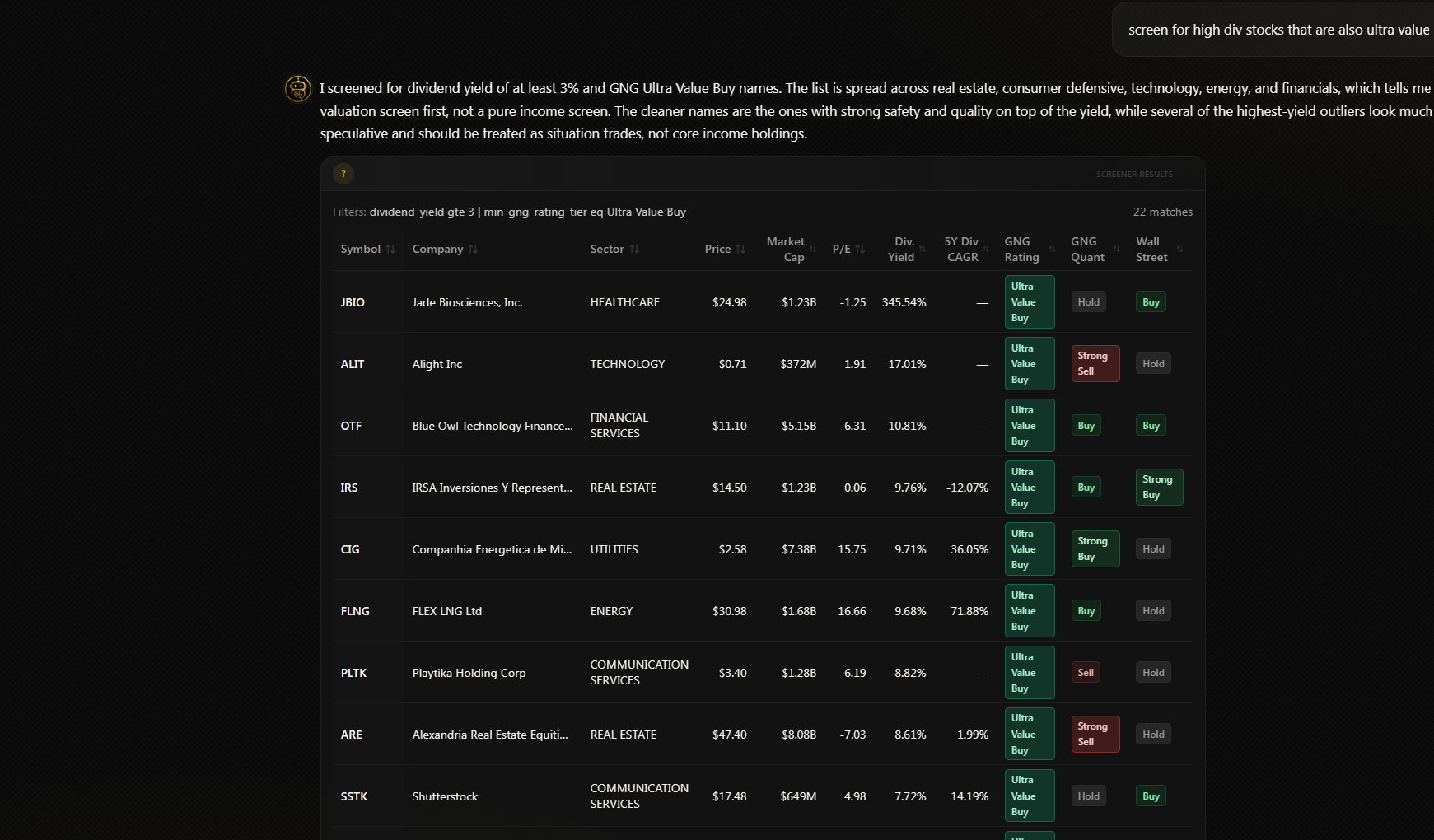
You ask, "Find me dividend payers under 30 times earnings, with a five-year payout growth above 8%, and a strong safety score." It runs the screen against thousands of names, returns the matches, and lays out which sectors are showing up, what stands out, and where the cleaner setups are.
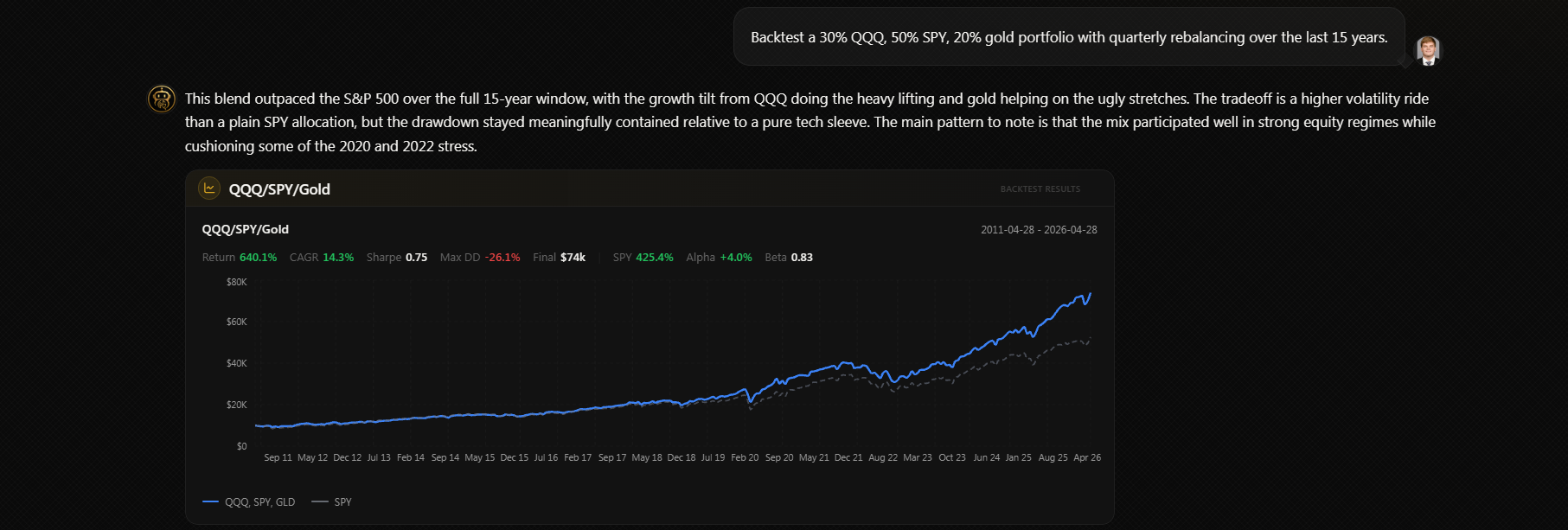
You ask, "Backtest a 30% QQQ, 50% SPY, 20% gold portfolio with quarterly rebalancing over the last 15 years." It runs the backtest. Not a guess. Real historical math. You get the return profile, the worst drawdown, the comparison to a benchmark, and the analyst's read on what the test is showing you. The same is true if you say, "Run a Monte Carlo simulation on my portfolio for the next year." Five thousand simulated paths, real probability cones, and the analyst telling you what range of outcomes you should mentally prepare for.
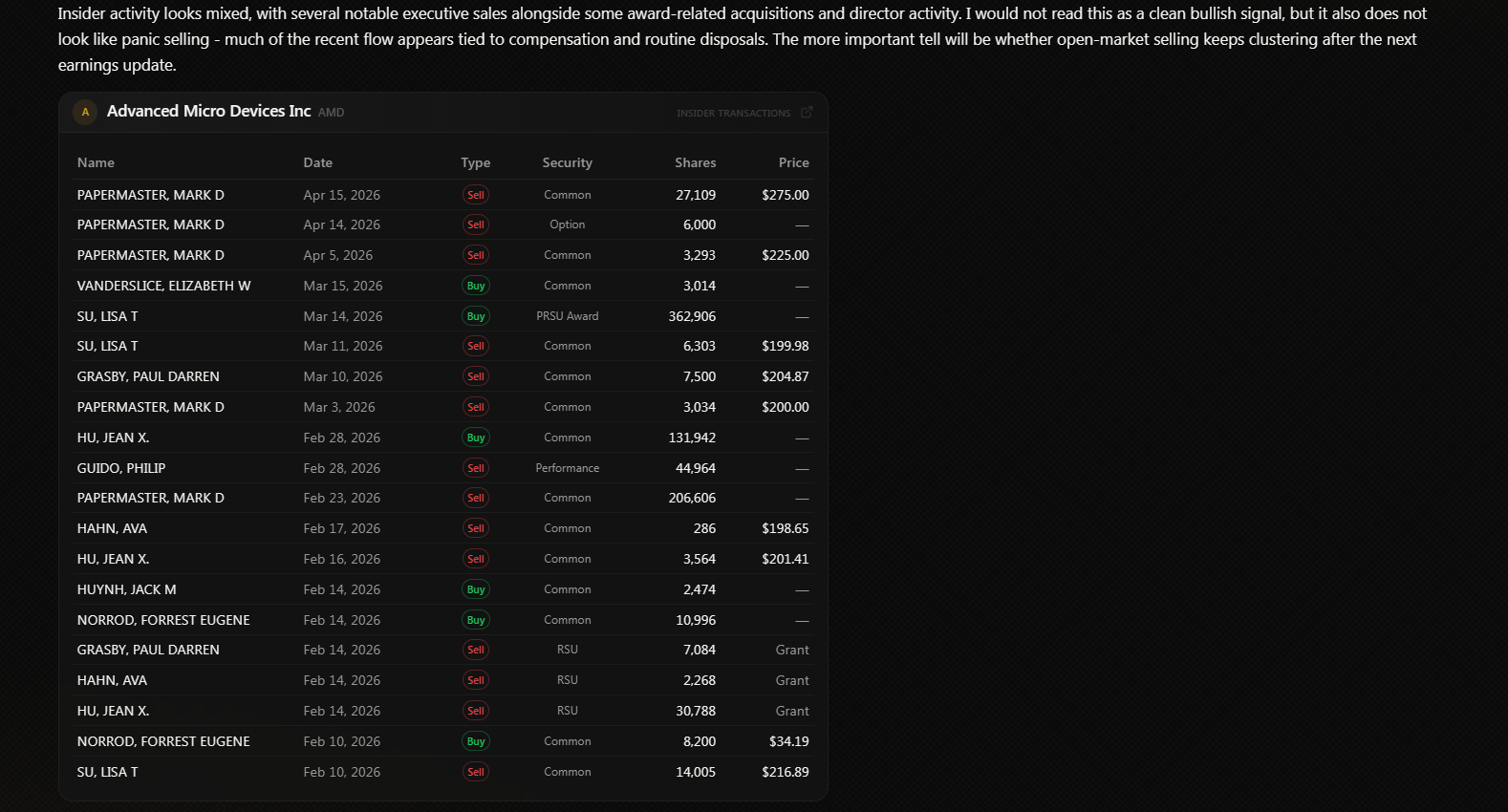
You ask, "Should I be worried about insider selling at this company?" It pulls the actual transactions, weighs them against the executive's history, and tells you whether the pattern is normal or a real signal.
Just a few other quick notes:
It also has the capabilities of searching the web, searching through our article database, finding recent news, and completing and assisting in modeling, screening the research terminal and much, much more.
This is the part that is different from any AI tool you have used before. The conversation is the surface. Underneath, real engines are running. Real data, real math, real context. The same engines we already use across the rest of GNG. The analyst is just the way to call on them. By the way, yes, most of the objects that you see in charts and graphs, et cetera, are interactive.
Why direct brokerage connectivity is the foundation
Most AI investing tools speak entirely in hypotheticals because they have no idea what you actually own. They cannot. They were never built to.
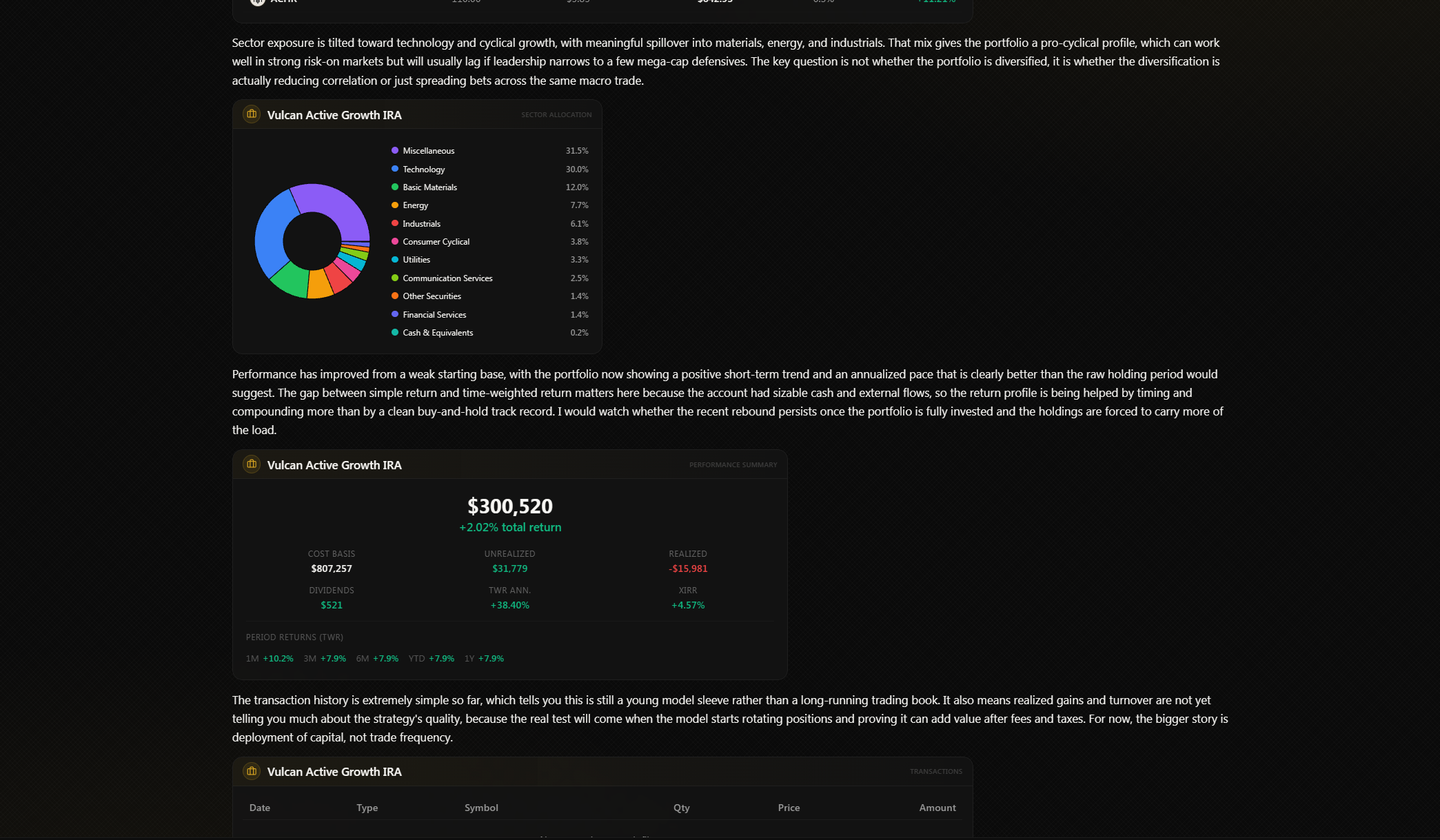
We took a different starting point. Through our brokerage link, the analyst can see the portfolio you have connected. Real holdings, real cost basis, real transaction history, real performance over time, real dividend income. And it can reason on top of all of it.
That changes the kind of question you can ask. Instead of, "Is META a good stock?" you can ask, "How does my current tech allocation compare to the rest of my portfolio's risk profile, and what would happen if I trimmed META in half?" Instead of, "What's a diversified retirement portfolio?" you can ask, "Stress test my actual retirement account through a 2008-style drawdown and tell me where the weak spots are." Instead of, "Explain dividend reinvestment," you can ask, "How much of my total return last year came from dividends being reinvested, and what is the projection for the next twelve months at the current pace?"
This is the lane I think the industry has been slow to enter, and it is the one we are committed to leading in. An assistant that does not know what you own can only ever talk in theory. One that does becomes something closer to a real research partner.
Personal memory and your own agents
The system has a memory layer, and this is one of the parts I am most excited about.
You can save research notes, observations from past conversations, watchlists, your investing rules, your risk tolerance, anything you would otherwise have to keep in a separate document and copy in every time. The system understands what you saved by meaning, not by the exact words you used, so when you come back a month later and ask something tangentially related, it actually finds the right context and brings it forward.
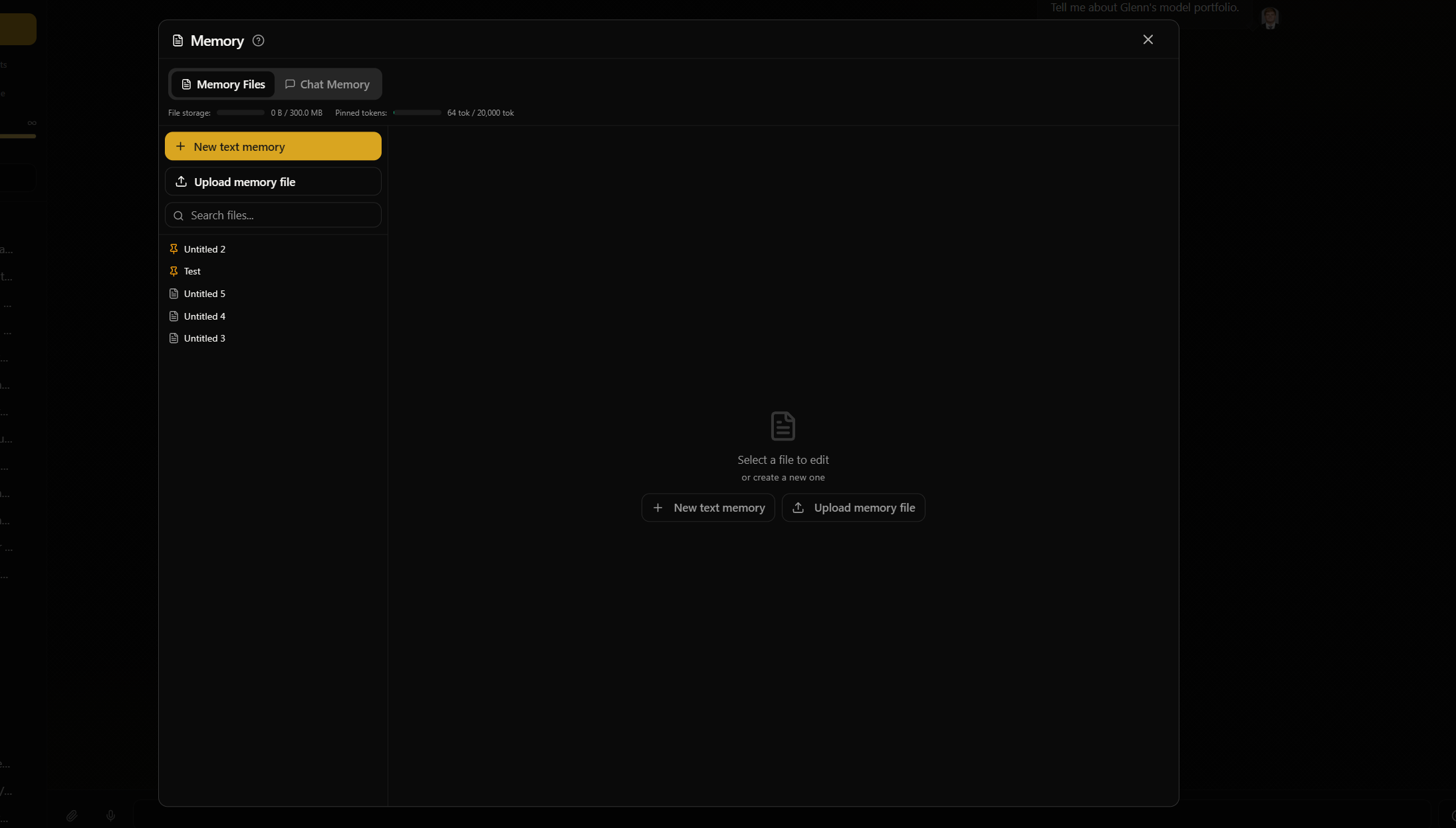
You can also upload your own files into that memory. PDFs, word documents, spreadsheets, slide decks, markdown notes. Drop in your own investing checklist. Drop in a research report you wrote. Drop in a list of companies you are tracking with your private notes on each one. The analyst can read them, search them, and use them whenever the moment calls for it.
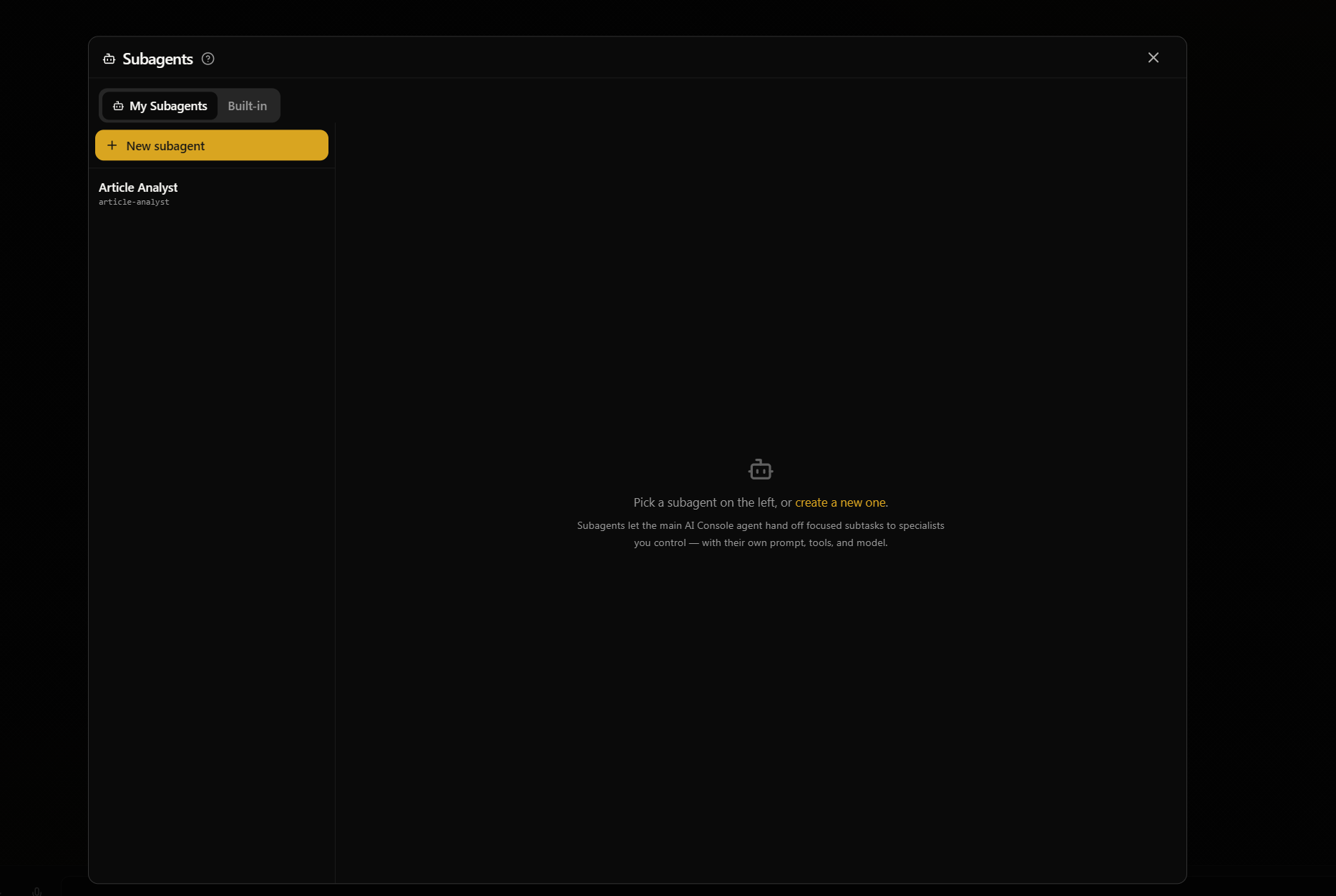
On top of that memory, you can spin up your own personalized analysts. Think of them as focused versions of the main one, shaped around the way you actually invest. A dividend-focused analyst that lives and breathes income strategies. A momentum-focused analyst tuned for technical setups. A "watch my retirement account and flag anything off" analyst. A sector specialist trained on your private notes about that sector. You give it a name, you give it a focus, you point it at the memory files that matter to it, you choose which abilities it has access to, and it shows up ready to work on its own beat.
In the long run, this is going to be the part that compounds the most. The longer you use the platform, the more your assistants know about how you think, what you own, what you have already researched, what you care about. They get more useful the longer you live in them.
What's already real, and what's coming
I want to be honest about where we are, because nothing is more annoying than a launch post that promises features that are not there yet.
What is live in testing today: company research, fundamentals, financials, news, earnings and transcripts, insider activity, options data, technicals, screening across the full universe of US stocks, our internal ratings and fair value views, peer comparisons, portfolio analysis through your brokerage link, dividends, full-strategy backtesting, Monte Carlo simulations, the memory system, your own personalized analysts, and inline charts and tables for nearly every type of question.
What is on the near roadmap and being worked on actively:
The addition of the dividend forecasting engine, joining the already integrated backtesting and Monte Carlos as a first-class simulation tool
Scheduling, so your assistants can run tasks on their own at the times you set, like a Sunday-night portfolio review or a Friday earnings recap
More chart and table types, and richer ways to view results inside the conversation
More specialist analyst templates we will publish so you can start from a known good shape
Beyond that, there is a longer roadmap I will share more of as we get closer. The short version: the analyst is going to keep getting more capable, more autonomous, and more personal.
How GNG Credits Will Work
A quick word on access, since that is going to be the most common question once people start using it. I really wish we could make it unlimited usage and free, but all things considered, at this point in time, it's not feasible. Please remember we do pay the model providers directly for token costs and usage on top of everything else already in place. On a company level, there isn’t any greed involved.
Pro members will get 1,000 GNG Credits every month included with their subscription. Anything you do not use stays available for up to three months before it rolls off, so a slow month is not wasted, but unused credits do eventually expire if they sit around too long.
If you run through your monthly GNG Credits and want more, you will be able to buy GNG Credit packs directly. Credits you purchase do not expire. They stay in your account until you actually use them.
Free users will get a very small GNG Credit allowance, just enough to try the analyst out and see how it feels before deciding whether to subscribe or pick up a pack. The point is to let you experience it firsthand instead of guessing whether it is worth your time.
The goal here is simple. Make sure the people who use the analyst the most feel like they are getting real value out of every credit, and make sure people who are just curious can poke around without committing to anything first.
How to join Testing
Simple.. comment below! I will reply to people and let them know if we have space or not, and confirm that they should have access. We also have a separate Rocket Chat room set up for testers, and we'd appreciate seeing the feedback there. Oh, and also during the testing phase, the token cost is on us ;)
As Always Thank you!
There is a version of this announcement that would have been three paragraphs and a screenshot. I wanted to do it the long way because I think this matters.
Most of the AI tooling pointed at retail investors right now is shallow. A search bar with a friendly voice. We have been building toward something else from the start. An actual research partner, real enough to plug into your brokerage, smart enough to handle the work, personal enough to learn how you invest, and honest enough to show its work along the way.
But I just wanted to again reiterate I appreciate all of you that have followed along our journey. For those who've been here since the beginning, I just want to tell you that it meant the world to us, and it still means the world to us that you trusted us and followed us here. Believe it or not, it has been about six or seven months since we were just a couple of pages and barely could figure out how to get articles posted. I would say our tech stack and team have grown rapidly. We hope to continue providing you greater and greater value, the best we can.
For those of you who are new, thank you for taking the chance on us. We are still a relatively small company, and we appreciate you joining our community.
I have sprinted this project now for a couple of months, hence why you haven't seen as many updates. After the testing phase completes, we will release the product to everyone. Please note I'm intending that right now to be within the next 0-2 weeks.