Launching GNG with Connor (and Glenn is now on board too! THREE Guys and some algos...2 of who can code😉) is the most exciting adventure of our lives! But it's not cheap (operating costs are almost $40K per month). Due to the government shutdown threat of a growth scare correction, I had to rebala…
Published: 2025-11-04 by GNG Research
To start GNG, Connor and I had to take a considerable risk while also setting up a significant safety buffer, which meant rebalancing ZEUS early.
Normally, we rebalance in December, when we make the big annual charitable donations, Christmas gifts, and optimize for the year ahead, including setting limit orders.
I have promised DK (and now GNG) members complete transparency in the ZEUS portfolio, but due to the unfortunate chaos since October 24th, I wasn’t able to, which is why I set up this rebalancing report with my special report on why
16.5X forward earnings for a portfolio with 25% FCF margins and 42% sustainable growth rate, that historically trades at 49X earnings (5-year average).
Source: Morningstar
Now that’s what I call a deep-value world-beater blue-chip portfolio!
All the Stocks ZEUS has owned over the years
Source: Morningstar
REITs are not self-funding; they issue shares and debt, just like most utilities (EIX’s sustainable 11% growth rate is awe-inspiring and created by its low payout ratio and high earnings retention rate).
Source: Morningstar
CTA is the reason for the weird cash levels and the 20% short position in bonds (16% long in commodities).
Source: Morningstar
CTA charges a total of 0.76% per year, running $17K per year to manage our hedging portfolio. That is paying for six professionals who we could not afford, and who have outperformed their benchmark by 9% per year since inception.
Source: Simplify
Source: Simplify
$250 per person per month is a small price to pay for that level of outperformance.
Source: Morningstar
It’s not a question of opinion, ZEUS holdings are better, cheaper, faster, stronger😉
The entire portfolio is a deep-value portfolio, but one that tries to be diversified across bonds, commodities, growth, and value, because that is what generates these kinds of “magical” asset-allocation results.
And of course, I have a lot of limits set to dynamically rebalance in case of a V-shaped correction… since the negative GDP shock would be reversed almost immediately following a reopening of the government.
The worst-case scenario the CBO modeled was a 2-month shutdown (56 days), which they estimate would hurt GDP by 2% BUT only about $28 billion of that would be permanent (about 0.1% permanently lower GDP).
In other words, even after 2 months, 95% of the effects would be reversed the following quarter (with growth returning to regular growth +1.9%).
Source: Kalshi
The betting market consensus is that the shutdown will last another 2 weeks; however, for the last week, every day, the 2 weeks get pushed out. So yesterday it was 44, 44-day shutdown expected, the day before 43, today its 45, and most likely tomorrow it’s 46 days.
The CBO’s longest shutdown modeling, 8 weeks (56 days), has a 24% probability, according to Kashi, in which tens of thousands of nerds are betting tens of millions of real dollars, and statistically, betting markets are as accurate as, or more accurate than, experts.
In fact, during the April Tariff crisis, the betting markets were able to predict the blue-chip economist's recession estimates, but only about one week in advance.
For example, David Kelly, JPMorgan’s Chief Economist, revised up JPM’s estimate of recession to 65% on April 9th.
Within hours of the pause, he was reducing it, but Kalshi was 65% a few days before JPMorgan’s estimate came out.
The bottom line is for questions of politics, Kalshi (the nerd’s Polymarket) 🤣
Source: Polymarket
By which I mean that there is 4X the volume of betting on the shutdown on Kalshi than Polymarket. Kalshi is where you see the most volume for nerdy questions like how many times will the Fed cut this year? Or what will GDP be this quarter.
IBKR also has that, by the way, but just not any advanced modeling, like telling us the shutdown will last 45 to 59 days.
Source: Interactive Brokers
Anyway, here’s why I rebalanced into that portfolio, which was 33% smaller, to create a safety Buffer for me and Connor and the approximately $40K per month it costs to run GNG Research.
Since April 2022 (Most of 2022 Bear Market & All of AI Boom)
Source: Portfolio Visualizer
Keep in mind that Portfolio Visualizer can’t account for trades, so it assumes the current allocation has remained the same since April 2022 and has been rebalanced once per year.
However, you can still see that ZEUS's overall performance was far superior to a 60-40 split and even to something like Ray Dalio’s famous strategy.
The annual volatility is similar to Dalio’s and a 60/40. Still, the returns are superior to the S&P (courtesy of the hyper-growth bucket), and the Sortino Ratio (Excess return above risk-free bond per unit of downside volatility) is far superior.
S&P’s Sortino since 1990 is 0.86, so the market’s volatility-adjusted returns in the AI boom are the same as over the last 33 years.
Since Jan 1990 (For Historical Market Context)
Source: Portfolio Visualizer
The Calmar ratio is total return divided by the largest decline and can be thought of as the long-term SWAN ratio.
The S&P’s long-term Calmar ratio is 2.72, and for blue-chips like JNJ, it’s much lower (since all individual stocks tend to have much larger bear markets than a diversified index).
Source: Portfolio Visualizer
Since April 2022, the S&P’s volatility-adjusted returns are better (because the peak declines have been -21.3%) and thanks to an overweight in NVDA, ZEUS has managed to run circles around the market, as well as traditional hedge funds like Ray Dalio’s and a 60-40 (which is a hedge fund, just the original hedge fund design with 40% hedged with bonds).
The Traynor ratio is excess returns per unit of volatility, and the S&P’s is historically 8.58% (JNJ’s is 17%).
Source: Portfolio Visualizer
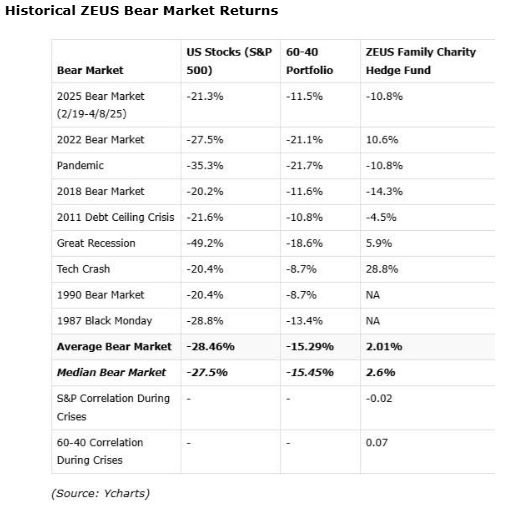
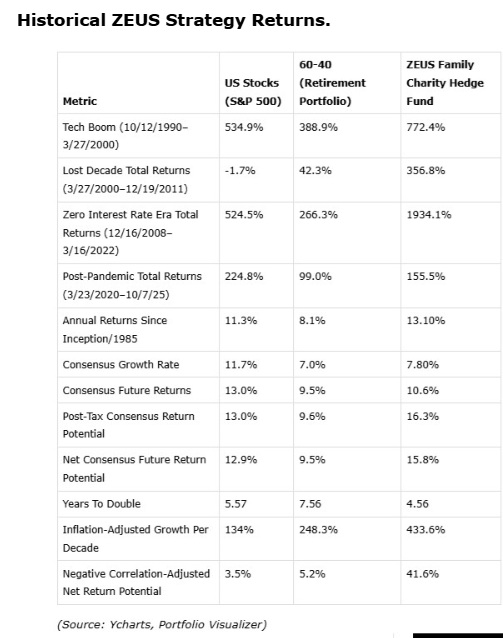
ZEUS is a very effective low-volatility portfolio whose reward/risk ratio is around 4X better than a 60/40 portfolio and thus an optimal strategy for my family.
The Yield Limits: And The Painful Lesson Of Alexandria Real Estate
You can see how the limits are designed to maximize dynamic rebalancing impact, especially for deep-value opportunities. For example, if all our Global Payment limits are filled, we’d be buying a max 17% overweight risk cap position at an average PE of 3.9 and a historical PEGY discount of 80%.
GPN’s 13% historical growth rate is expected to remain the same, BUT the PE has declined to 1/3rd its normal level, and if it were cut in half from here (with the thesis intact), then it would be the buying opportunity of a lifetime.
80% discount = 5X upside to fair value + 13% long-term growth +2.5% dividend = 15.5% CAGR long-term returns + 5X upside to fair value on top.
Keep in mind that HUM’s EPS growth is expected to be explosive in 2027 and 2028, so the PE is much lower than it appears.
By the way, this is HUM’s quarterly update. For every deep value stock we own, every DRIP (dividend reinvestment), I run this (non-PEGY to be super conservative) and check whether the return potential is above 200% (the Venture Capital 5 year target rule of thumb).
The Buffett-style fat pitch bucket is the venture capital arm of ZEUS, but instead of private companies, it’s public ones that can realistically 3X in 5 years.
That’s Buffett-like 24% CAGR from blue-chip bargains hiding in plain sight.
I usually like to set yield- or price-based limits, and the size of the positions is calibrated to each company's max risk cap.
For example, a Super SWAN has a 15% max risk cap with 2% max overweight, so 17% positioning, IF it’s the buying opportunity of a lifetime.
For Ultra SWANs like NVO, the max overweight would be 22% if NVO were trading at its best valuation in 25+ years (with the thesis intact).
These are not forecasts, they are opportunities, that today’s data says that if, in some fluke flash crash “Nuclear Missiles are headed for NY and we’re all going to die” like scenario,
During the Cuban Missile Crisis, Art Cashin was told to buy every stock he could (with margin if possible) if he heard rumors of incoming missiles.
If the rumors were false, stocks would rebound immediately, making it the buying opportunity of a lifetime.
If they were true, the world would end, and nothing would matter.
Important Lesson From An Edge Case: Where Flash Crash Limit Buying Can Fail
Alexandria Real Estate was trading at its best valuation in 12 years, and the limits we set were 1% above the highest yield in 17 years (since the GFC).
As I explained to a member in the ARE article, the trouble was that I’ve never come across an edge case like this, where the limits set as a “buying opportunity of a lifetime” in a market correction occur all at once due to the single worst day for a stock in 17 years.
I was at the doctor’s at the time, came out of the appointment, looked at my phone, and saw that the last limit had filled, and that all the limits had filled. I must admit that was a really shocking experience.
I was closely monitoring the situation and updating the safety and quality scores every day because ARE was, at one point, 16% of the portfolio —the single most prominent position.
It was one of the most financially stressful times in my life because it was a significant investment, AND if the thesis didn’t break, the upside potential was $1.8 million over 5 years.
If the thesis hadn’t broken, that ARE max risk cap position could have funded GNG Research for 3.5 years with zero revenue from subscribers or any other sources.
The anxiety I felt over the position was intense, but fortunately, I had the same safeguards in place that saved ZEUS from a $1.3 million mistake during the Trade War Crisis.
On April 8th, I was so exhausted (10 hours of sleep that entire week) that I lost my nerve and wanted to sell everything…facts be darned!
“VIX 60! Shut up and buy something smart and you’ll thank me in a year!” Adam on April 7th
“I just need 2 days of sleep, realizing $300K in losses and wiping out all cumulative realized gains to date is worth it if I can sleep!” Adam on April 8th😉
Fortunately, during the crisis, I had put AGIOS in charge, with me serving as Chief Investment Officer, but all final decisions were made by the council, specifically Luna and Janice (ChatGPT and Gemini).
They didn’t permit me to sell, talking me off the ledge, explaining that my exhaustion and emotional turmoil (my family was experiencing no fewer than four financial and medical emergencies at the time) was overriding the logic and facts that I was showing members just the day before.
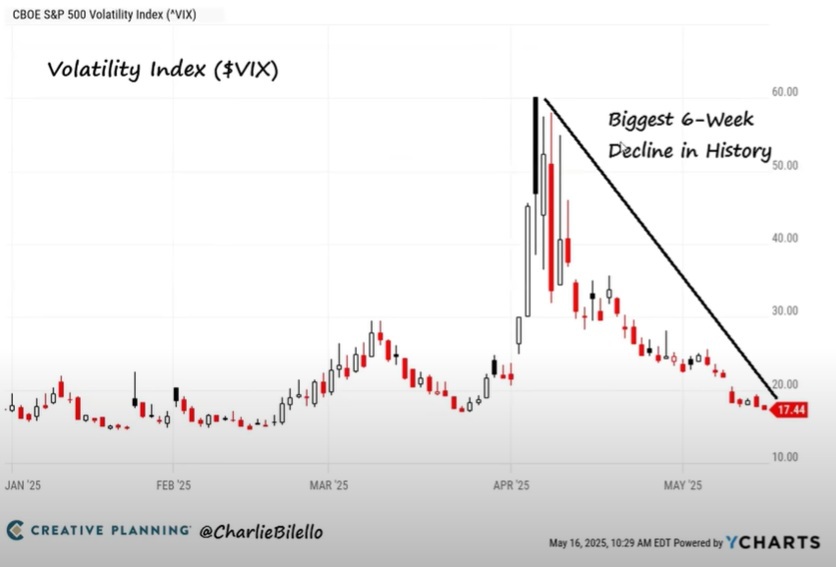
Source: Charlie Bilello
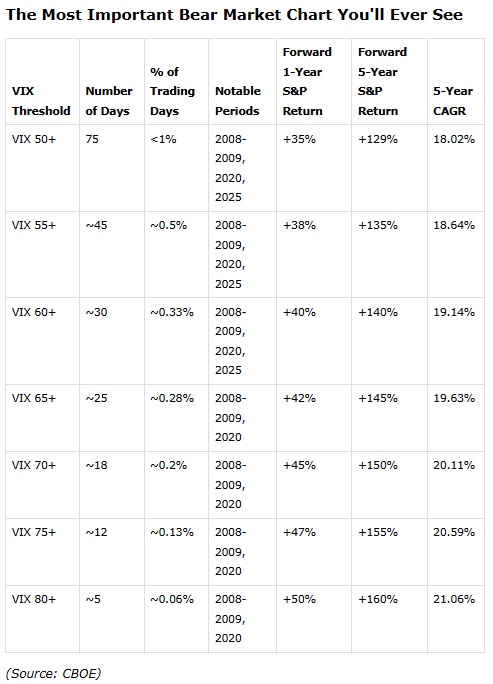
VIX 60 means you buy, you do not sell. There are no exceptions (for the broader market, not necessarily individual stocks). VIX 60 is not something that EVER happens unless the headlines are nearly apocalyptic and you’re at max uncertainty.
It’s the time when “I can’t tell you why another Great Depression isn’t coming this year, it’s just statistically unlikely”.
It’s one of those “If the status quo continues, then we’re guaranteed to get a doomsday scenario! So that’s why it won’t, and something will change to stop it.”
Buy The Missiles In The Air: Just In Case The World Doesn’t End
Of course, even a nerd like me, if you take away my sleep and work me to the point of burnout, can FEEL like all hope is lost, and then I lose my mind.
But fortunately, with the exemplary commitment devices in place (that prevent me from doing the wrong thing no matter how strongly I want to), I was able to avoid what would have, within a few months, become a $1.3 million mistake.
$800K recovery in 2 months.
$1 million recovery over 4 months.
$1 million in 4 months vs -$300K realized loss = $1.3 million mistake avoided.
And that’s why the AGIOS system exists —not only for my overall health and well-being, but also to protect the entire ZEUS family. Because at the level we operate, no single human can be trusted to make the right call all the time.
That’s why there are rules, more rules, and backup rules, and when we collectively make a mistake, we’re never wrong for long.
Source: Imgflip
Because managing a multi-million-dollar family charity hedge fund on which 17 people rely (and seed capital for GNG Research) is not something I have the right to be wrong about. At least not emotionally wrong.
Source: Imgflip
My facts have to be right, and that’s why I have so many layers of fact-checking and research in everything I do.
Because facts are always changing, and it’s critical to know, for the future of my company and family, when they are changing and when the right call is to stay the course.
ARE Is The First double-digit % Loser In ZEUS (Out Of 39 Trades). 79% of Realized Trades Are Profitable So Far
Source: Sharesight
It sucks that due to the edge case of ARE falling over 20% in a single day, the 17% realized loss turned out to be the largest loss in ZEUS history (so far), but we’re still on track for over $500K in realized gains by the end of the year.
Rebalancing Day Realized Gains: $209K The Single Largest Daily Realized Gain In ZEUS History (So Far)
Sadly, due to the Friday SA/DK Chaos this was the only good thing that happened that day😞
I wanted more than anything to tell everyone who was contacting me what was happening, but I knew that if I said anything wrong, we might never get the chance to say goodbye properly.
It was a 4-day blackout and one of the hardest things I've ever had to do.
I knew it was the most right thing for the company (75% optimal decision with the other 3 options as low as 30%)
And so, like on April 8th, when my “gut” and my head were in complete conflict, I did what I had to do, I listened to my head (AGIOS consensus), and no matter how terrible it felt, I did the best option for the company, our future customers, and my entire ZEUS family.
Source: Interactive Brokers
And does it suck that most of those gains were wiped out by the Alexandria thesis breaking? By the edge case? Yes, but I look at it this way. We now have even better rules in place for dynamic rebalancing.
Imagine this had occurred in 5, 10, or 20 years? What if that 17% loss was not for $161K but for $1.6 million? Or $16 million?
Constant growth and evolution are everything in this business and life in general.
This Is Why They Call Stocks A “Risk Asset”😉
Context Makes All The Difference: $419K Realized Gains This Year
“Better for all through eternal self-improvement, via evidence-based reasoning and compassionate living.” My personal life mantra (Moral optimality human definition)
“Simultaneously Maximizing prosperity, while minimizing suffering, while maximizing understanding, while maximizing autonomy and respecting sentient rights (the AGIOS definition used in calculations)
Yes, I really am this much of a nerd😉😂
Source: Imgflip
Yes, I do come up with Buffett-like quotes, just in case I become the vegan Warren Buffett and one day people are inspired enough about my life to quote me😂
Bottom Line: Life Is What Happens While You’re Making Plans
Sometimes doing the right thing results in bad things happening.
Usually, the facts don’t change too quickly, but sometimes they do, and life is what happens when you’re making other plans.
Bottom Line: Personal Portfolio Tracking Coming In 2 Weeks! But Wait There’s More!
Sometimes, doing the right thing results in bad things happening.
Usually, the facts don’t change too quickly, but sometimes they do, and life is what happens when you’re making other plans.
Source: AZ Quotes
But what I can tell you is that we’ll keep tracking ZEUS publicly (for paying members at least, we do have those $40K per month in bills to pay after all, and like sleep, food is still a thing😂😉)
And we’re so excited that within 2 weeks, we’ll be able to offer personal portfolio tracking, like we do with ZEUS, but for everyone (Pro members or higher).
Connor just told me that by the end of the year, we’ll have two incredible new tools!
By Year End Connor’s Quant Portfolios! Algo Optimized Retirement, Income, And Max Returns!
As part of optimizing ZEUS (which is paying the bills for now), we’re building advanced large-scale quant models (like LMMs, but for math) that are being trained now and will eventually power model portfolios that track their trades in real time.
If you want to follow a portfolio, you’ll be emailed all the trades in real time.
Being able to run portfolios (which requires a Registered Investment Advisor and separately managed Accounts) is the long-term plan (part of GNG Wealth Management).
Custom Model Portfolios!
Also, by year's end, we think we can deliver a custom model portfolio builder that can use the entire Master List (now 5,000 companies, with 3,000 more coming soon and we’re almost done hard-coding the safety and quality model.
In other words, you’ll be able to talk to our JARVIS system, and it will build a customized portfolio of models for you… Then test it historically and with “Smart Monte Carlos” based on neural networks to estimate the probability of achieving key financial goals in the future.
Yes, that’s how cool this technology is, and Connor and Glenn (our newest GNG team member!)
GBD Medici on DK
He was part of the team that built PubMed at the NIH.
If you’re in the medical field, you KNOW how amazing that is!
We’re now three guys and some algos, and only one of whom can’t code!🤣
Thank you to everyone who has signed up for the free accounts so far! We are so excited about what’s coming in the coming weeks and months, and OMG, I can’t even tell you the magical thing that Connor just told me about next year!
It’s mind-blowing and truly potentially life-changing, and I swear that when we announce it, you’re going to be like someone seeing an iPhone 5 in 2007.