If you've ever watched two smart people stare at the same ticker and walk away with opposite convictions, you've already felt the problem GNG Quant was built to solve. One investor sees a bargain. The other sees a trap. Same data, same company, same moment in time. The difference isn't intelligence. It's process, or rather the lack of one.
GNG Quant is our rules-based investing engine, and it exists for a simple reason: consistency beats brilliance over time. Its job isn't to predict the future with some magic formula. Its job is to make sure we ask the same hard questions, in the same order, every single time, and then translate those answers into something actionable: a ranked list of stocks, plus clear sizing and risk guardrails that don't bend to emotion.
Here's what that actually means in practice.
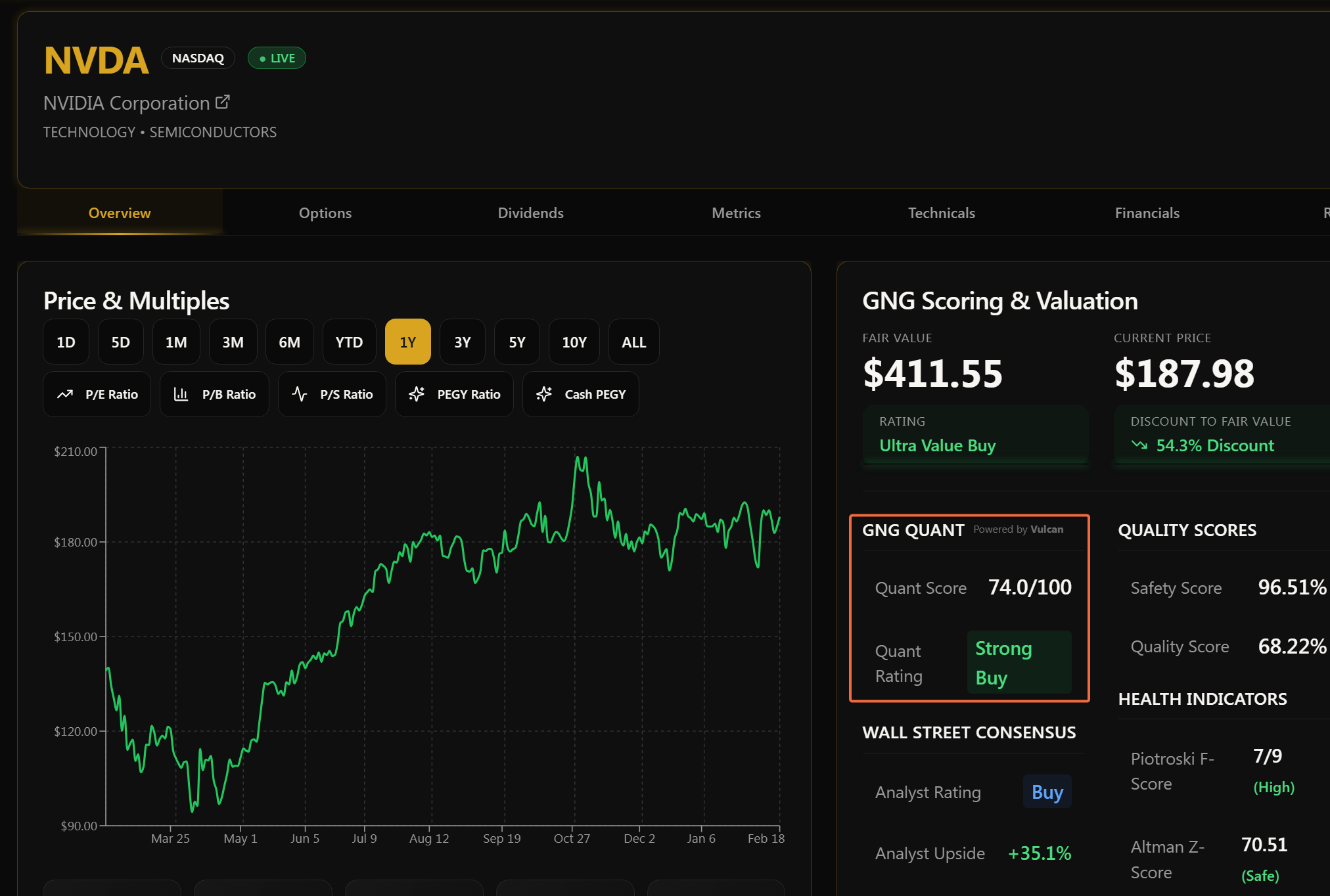
🟠 GNG Quant Is Now Live in the Research Terminal and Stock Details page. Example of our stock details page is NVDA.
GNG Quant isn't a concept we're still building toward. It's running right now inside the GNG Research platform.
Every stock in our database has a live Quant Score out of 100 and a Quant Rating — from Watch to Strong Buy — updated automatically and visible directly on each Stock Details page. Pull up any ticker and you'll see the GNG Quant box front and center, alongside Fair Value, Wall Street consensus, and our full suite of Quality and Health indicators.
The Problem With How Most People Invest
Most investors run on vibes and headlines. Even smart, disciplined investors can drift. One week you care about valuation. The next week momentum is all that matters. The week after that, some balance sheet concern hijacks the whole thesis. That's human. Markets are loud, news is constant, and it's easy to get pulled around by whatever story is moving right now.
GNG Quant is the opposite of that. It's a repeatable process that takes a large universe of stocks and scores each one across a handful of dimensions that actually matter for returns over time. Think of it like a disciplined screening and ranking machine that forces consistency regardless of what the market is doing on any given Tuesday. It doesn't replace judgment. It gives judgment a stable foundation to stand on.
How GNG Quant Actually Works: Three Steps
The system runs in three distinct steps, each one building on the last.
Step 1 starts with the candidate list. We begin with a broad universe of stocks that meet basic quality and tradability requirements. This matters more than it sounds. A system can look spectacular on paper if it's quietly loading up on tiny, illiquid names you'd never actually want to own. So the first gate is a quality check: does this stock belong in a serious, investable universe at all?
Step 2 is where the system earns its keep. GNG Quant doesn't rely on any single factor, because single-factor approaches always have a flaw. A stock that's cheap for a reason isn't the same as a stock that's cheap and getting cheaper for no good reason. So the system evaluates each stock through five lenses simultaneously.
Momentum asks whether the market is actually rewarding this stock right now, or whether it's fighting the tape. Revisions and growth signals track whether earnings expectations and underlying business trends are improving or quietly eroding. Valuation asks whether we're paying a reasonable price for what we're getting, or whether perfection is already baked into the multiple. Quality examines whether this is a business that consistently converts revenue into real profit and free cash flow. Safety reviews the balance sheet and risk profile to determine whether the company can absorb an unexpected hit.
Each lens produces a score, and those scores combine into one overall ranking. The key insight is simple: we want stocks that score well across multiple dimensions simultaneously, not just one. A stock that's screaming higher but is financially fragile is a completely different animal than a stock that's rising because its fundamentals are genuinely improving. The scoring system forces us to see that difference clearly.
Step 3 turns a ranked list into an actual portfolio plan. A list of great scores is not a portfolio. Portfolios need constraints. GNG Quant applies explicit sector caps and position-size ranges to prevent the obvious mistakes, like accidentally building a portfolio that's 60% concentrated in one sector because that sector happened to dominate the scoring in a hot month. It also prevents the emotional trap of oversizing a single name just because the story is compelling.
The Sentiment Layer: The "Pressure Gauge" Most Systems Skip
Now we get to the piece that separates GNG Quant from most quantitative approaches. Every stock in the universe receives a sentiment score, but not in the way most people think about sentiment.
When investors hear "sentiment," they usually picture mood surveys or social media buzz. That's not what this is. In GNG Quant, sentiment is treated as measurable positioning and market pressure, a quantifiable signal about how real money is actually being deployed, not how investors say they feel. This is what makes it genuinely useful, especially around turning points and crowded trades where conventional metrics can look perfectly fine right up until they don't.
The sentiment score draws from two inputs. The first is network sentiment, which is our crowd behavior lens. Instead of asking whether a stock is popular, we ask whether attention is rising or fading, whether the conversation around the stock is constructive or fearful, and whether interest is accelerating faster than the price itself. This matters because flows and attention can move faster than fundamentals. Network sentiment helps explain why a stock rips despite no apparent news, or why it keeps selling off even while the business looks perfectly healthy on paper.
The second input is options sentiment, which reveals what traders are actually betting on with real money. We're not reading tea leaves here. We're looking for signals of crowding, fear, and convex positioning that can push prices around in predictable ways. When options positioning gets one-sided, a stock becomes tightly coiled and jumpy. Small catalysts create outsized moves because so many participants are leaning in the same direction. Conversely, when fear reaches an extreme, it creates the conditions for powerful, fast reversals.
The combined sentiment score functions as a pressure gauge that gets blended into the total ranking alongside all five core dimensions.
Why Sentiment Isn't Used the Way You'd Expect
This is where the approach gets genuinely counterintuitive. High sentiment is not automatically good, and low sentiment is not automatically bad. The score means different things depending on context.
When a high-quality stock shows improving sentiment, it acts as confirmation, a tailwind reinforcing the fundamental thesis. When sentiment is euphoric on a stock where valuation is already stretched, the system treats it as a crowding risk and raises the bar to own it, or shrinks the suggested position size. And when sentiment is deeply negative on a company with a clean balance sheet and solid fundamentals, it can flag a potential pain trade setup, one where even mildly positive news triggers a sharp, fast snapback.
That's the real value of the approach. It doesn't worship sentiment or ignore it. It uses sentiment as a risk and timing overlay that helps avoid obvious traps and surface asymmetric opportunities that pure fundamental screening would miss entirely.
A Process, Not a Promise
GNG Quant is not a black box asking you to trust the output. We track performance over time and run forward checks that answer a basic question: if we had followed these signals in the past, did the approach add value, and under what market conditions did it struggle? That's how trust gets built responsibly, not from one great month, but from documented results combined with honest acknowledgment of when the system works best and when it calls for extra caution.
At its core, GNG Quant is a disciplined, repeatable way to turn messy market data into a clear, risk-aware ranking and portfolio plan, with a measurable sentiment layer that captures both options positioning and crowd pressure.
What it isn't is equally important. It's not day trading. It's not a promise of wins. It's not a substitute for thinking. It's a process that keeps decision-making consistent, forces diversification and sizing discipline, and gives us a measurable framework to improve over time. In markets that reward patience and penalize emotional drift, that process is the edge.