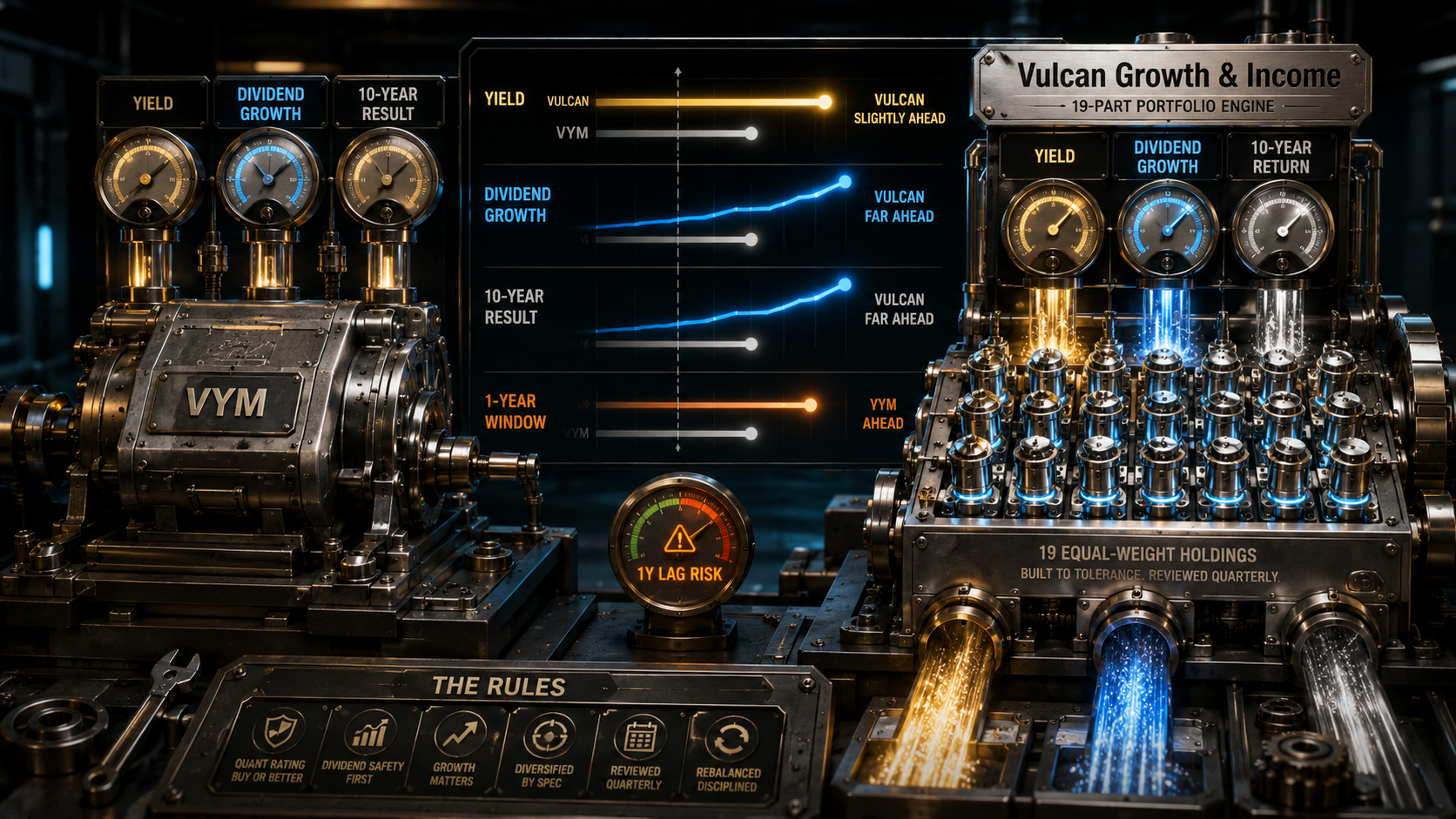

Walk a precision machine shop and the first thing you notice is that nobody argues. Every part on the line earned its place by passing a gauge, not a vote. A spec sheet defines the tolerance, a gauge measures against it, and a part that drifts outside the band comes off the line whether anyone likes it or not. The Vulcan Growth and Income model portfolio, live on GNG Research as of June 10, 2026, was built to run on that same principle: nineteen dividend payers, each one passed through a hard inspection gate, sized by rule, and re-gauged on a fixed schedule.
The thesis: out-grow the income, do not out-yield it
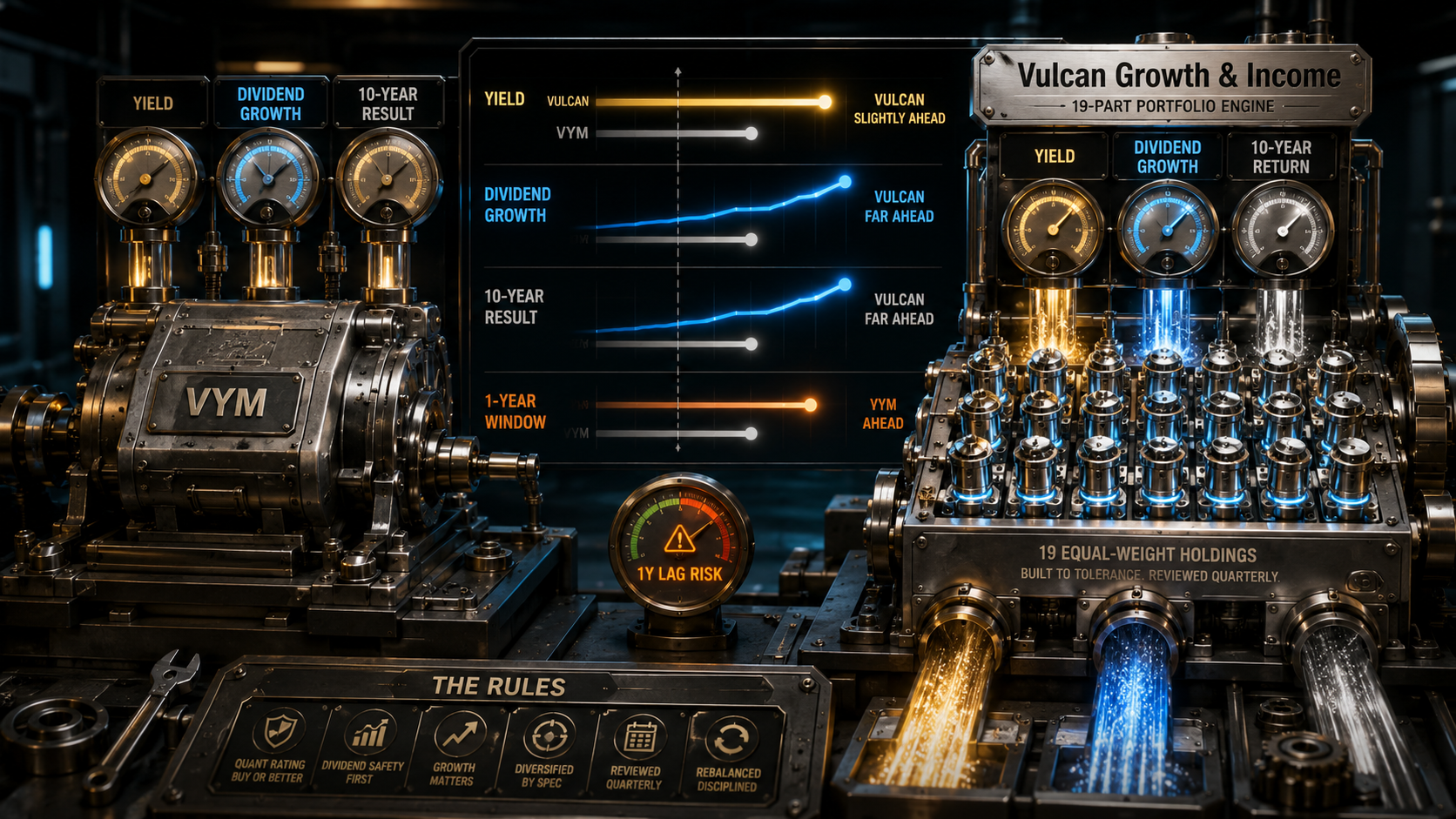
The mandate is to beat the Vanguard High Dividend Yield ETF (VYM) on four measures at once: total return, portfolio yield, dividend growth, and risk-adjusted return. That is a harder brief than it sounds, because the obvious path defeats itself. Loading the book with the highest yielders on the board is precisely how income investors end up holding eroding payouts in shrinking businesses, and the construction rules were written to forbid it.
The design choice that makes the rest work is this: no single holding is required to out-yield the benchmark. Yield is gauged at the portfolio level only. Taiwan Semiconductor (TSM) and Broadcom (AVGO) yield well under 1% and earn their place on total return. Altria (MO) and Regions Financial (RF) carry the income that funds them. Blended, the book clears (VYM)'s roughly 2.45% with a starting yield near 2.66%, a cushion of about 0.2 percentage points.
That thin cushion is intentional, because the real tolerance band is on the second measurement. Weighted dividend growth across the portfolio runs near 10% to 12% a year against (VYM)'s five-year dividend growth of roughly 3.8% and a three-year pace closer to 2.0% to 2.5%. Income compounding at nearly triple the benchmark rate turns a narrow year-one lead into a widening one, and it widens every year the parts stay in spec.
GNG Vulcan Quant Rating - The inspection gate
Every candidate, in either sleeve, had to clear the same gauge before anything else was measured: a GNG Research Quant rating of Buy or better, with no exception for size, popularity, or index membership. Several household mega-cap names with large retail followings failed that gate and were left out, which is the gauge doing its job rather than failing it.
Sign in to leave a comment and join the discussion.
Sign Up Free