

TLDR: Shut Up And Buy Realty Income And You'll Thank Me In A Year😉🤔😂🥳
FIRST, THE PART THE BLOOD-SUCKING LAWYERS MADE ME SAY 🙄
This report is about what the ZEUS Legacy Family Charity Hedge Fund — my family's fund — is doing with its value sleeve, and EXACTLY why. The title is my opinion, and I stand behind it. But it is not a recommendation for your account. GNG publishes research. GNG does not manage your money, doesn't know your tax bracket, your risk tolerance, or whether you think the 10-year Treasury tops out at 5% or 6%. Every number is sourced so you can check my work and decide for yourself... which was always the point of this place 😉

“BUY 6% YIELDING REALTY INCOME"... AGAIN? YES. AGAIN. SAME TABLE, SAME POUNDING, SAME STOCK 🤔😉😂
In January 2025, I paraphrased Buffett's famous 2008 op-ed and wrote "Buy 6% yielding Realty Income. I am.”
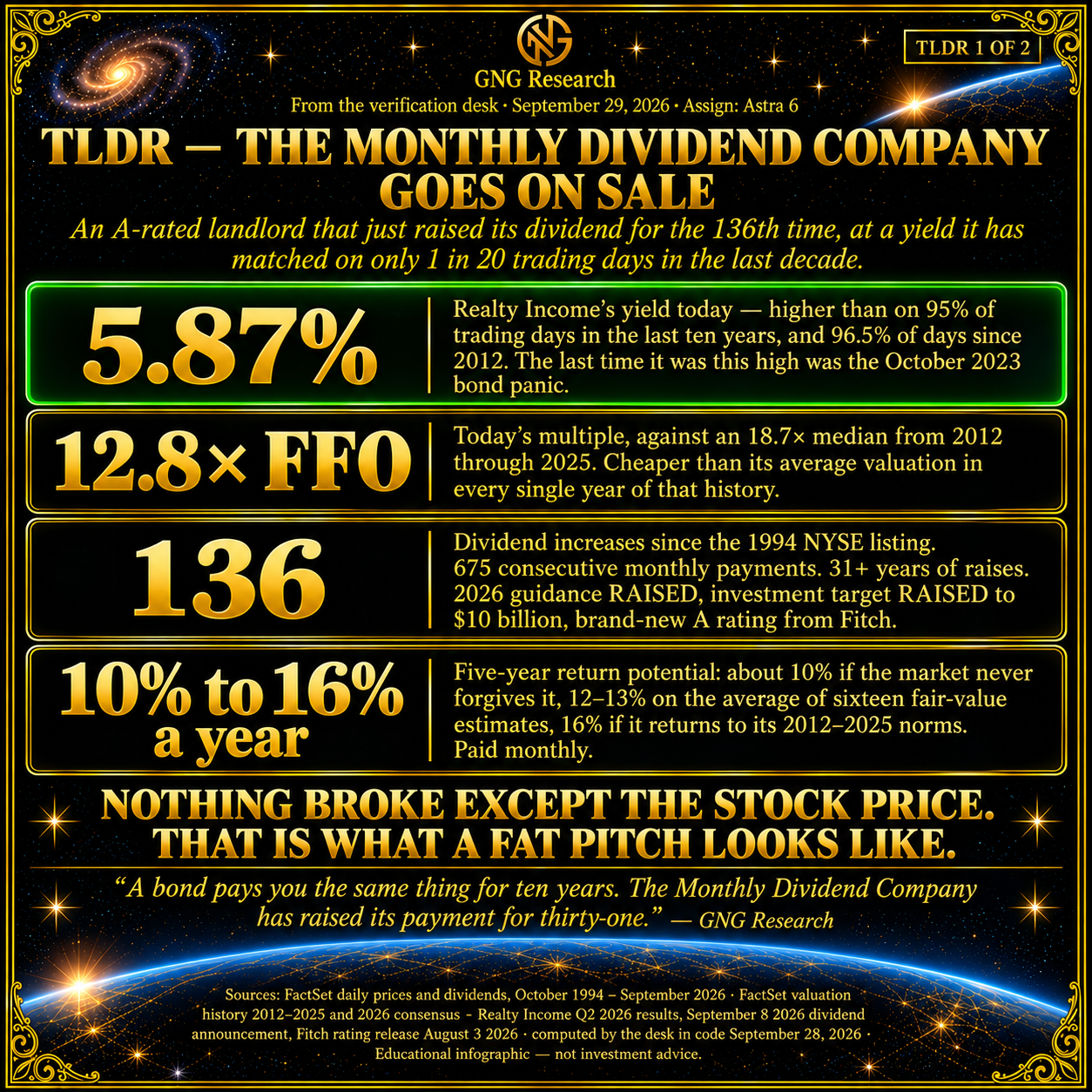
Twenty months later, the Monthly Dividend Company is back at 5.9%, and something remarkable happened in between: the BUSINESS kept compounding. Realty just declared its 136th dividend increase since its 1994 NYSE listing. Its 675th consecutive monthly dividend. More than 31 consecutive years of raises. It raised 2026 AFFO guidance. It raised its investment target to $10 billion. Fitch handed it a brand-new A rating in August.
And the stock? About 5% above where it was when I wrote that line 😂
That's what happens when the Monthly Dividend Company meets a 10-year Treasury above 5.2%. Mr. Market looks at Realty, looks at the bond market, and says, "Why bother?"
Here's why I put "you'll thank me in a year" in a headline, which I don't do lightly. We checked Realty's yield every week since 2004 against its own prior decade. In the 51 weeks it sat in the top 5% — where it sits today — the total return over the next twelve months was positive EVERY SINGLE TIME. Worst case, +4.5%. Median: +15.5%. That's not a forecast. That's the record. And the full math is below, including the two honest caveats.
The only reason I seem like a “Wizard”😂 with these “shut up and buy” calls is that I make them when the probability of major returns is so high as to be ridiculous.
Same reason Howard Marks has made 3 legendary market-timing calls. He waits for a fat pitch and then swings for the fences.
So today I'm going to answer Mr. Market's "why bother?" with math. LOTS of math. Because in the cosmic calendar of Realty Income's 32 years as a public company, a 95th-percentile yield is a rare event — rarer than a total solar eclipse over your house — and it's exactly the kind of event ZEUS was built to take advantage of 🤯
Here's what we'll cover:
How rare a 6% yield really is, using FactSet daily data back to the 1994 IPO.
What the fundamentals say (spoiler: nothing broke).
What Realty is worth against 14 years of valuation history, and what it could return.
What the bond market sees, and what the math says back.
What ZEUS is doing about it — the full value-sleeve optimization, why JEPI and VFLO lost, and why "wait for a better price" doesn't survive contact with the data.
BOTTOM LINE UP FRONT: YES, IT'S A FAT PITCH. HERE'S THE SWING 😉

Buffett's advice was "wait for a fat pitch, then swing for the fences." That never meant "time the exact bottom." It meant: when a blue chip is priced for a disaster that isn't happening, you don't need to be clever. You need to be there.
Realty Income yields more today than on 96% of trading days since 2012. It trades at 12.8X FFO — cheaper than its average valuation in every year of FactSet's history. The business just raised guidance, raised its investment target, earned a new A rating, and raised its dividend for the 136th time. Consensus return potential is 12–13% a year, and about 10% even if the market never forgives it. Paid monthly.
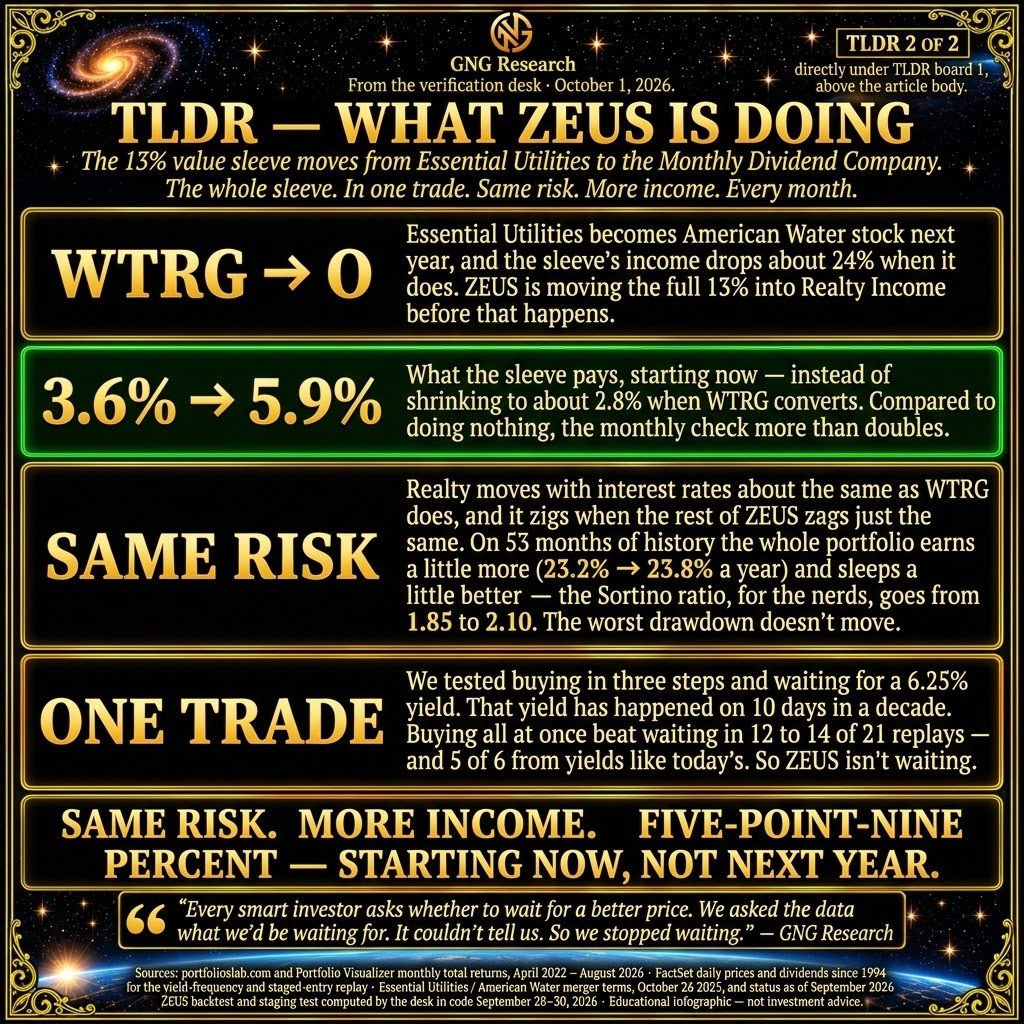
And for ZEUS, it solves a problem that was coming anyway: the value sleeve is 100% Essential Utilities, which becomes American Water stock next year with a 24% haircut to its income. Realty replaces it at essentially the same rate risk, a better Sortino, a better valuation, and a 5.9% yield instead of a shrinking 2.8%.
That's the swing. All of it, in one trade. Now the receipts 🖖
HOW RARE IS A 6% YIELD FROM REALTY? RARER THAN 95% OF THE LAST DECADE 🤯
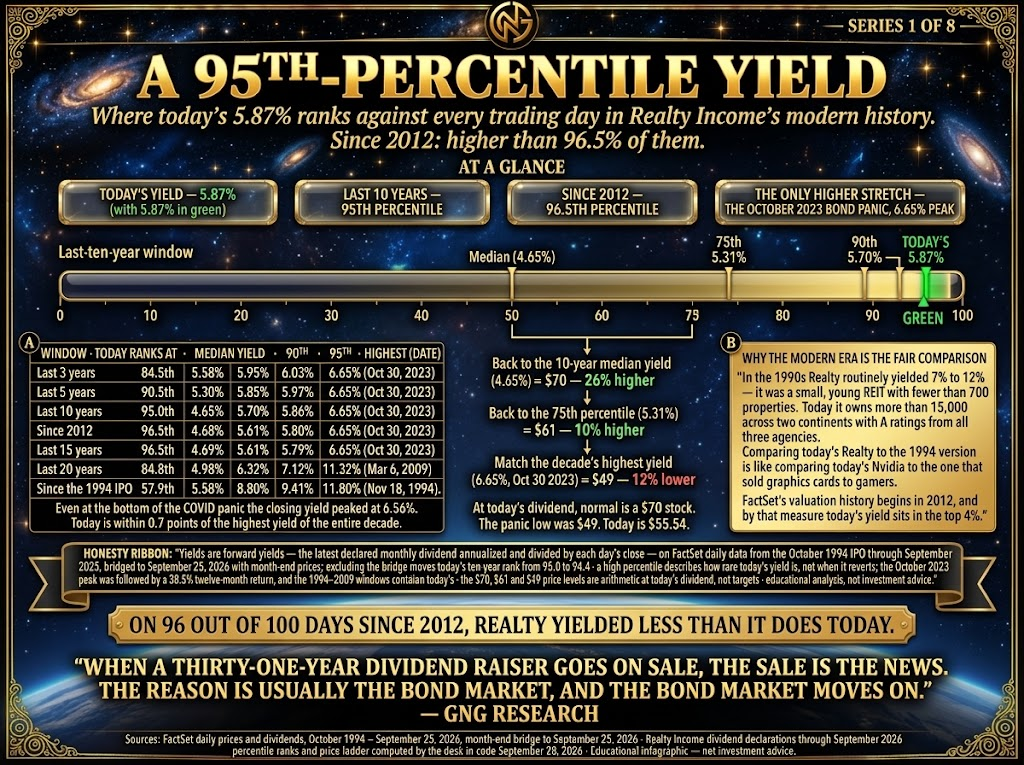
Realty closed at $55.54 on September 25th. The dividend going ex on September 30th is $0.2715 a month, or $3.258 a year. That's a 5.87% yield.
The current price is $ 54.48, and the yield is 6%.
I pulled every trading day from Realty's October 1994 IPO through September 2025 from FactSet — nearly 7,800 of them — added month-end prices since, and calculated the forward yield on each one: the latest monthly dividend times 12, divided by that day's price.
Here's where today ranks. In the last 3 years, the 84.5th percentile. Last 5 years, the 90.5th. Last 10 years, the 95.0th. Since 2012, the 96.5th. Last 15 years, the 96.5th.
Let that sink in. Since 2012, Realty Income has yielded as much as it does today on fewer than 4% of trading days. Even at the bottom of the pandemic panic, the highest closing yield was 6.56%. The highest yield of the entire last decade was 6.65%, on October 30, 2023 — during the bond rout when the 10-year Treasury LAST flirted with 5%.
Sound familiar? 😉
What would it take for Realty to simply get back to normal? At today's dividend, a return to its 10-year median yield of 4.65% is a $70 stock — 26% higher. Getting back to just the 75th percentile is $61, about 10% higher. And matching the highest yield of the decade — the October 2023 panic low — is $49, 12% down from here.
The full-history row is the honest exception: in the 1990s Realty routinely yielded 7% to 12%, because it was a small, young REIT with fewer than 700 properties. Today it owns more than 15,000 across two continents. I don't compare today's Realty to the 1994 version, just like I wouldn't compare today's Nvidia to the one that sold graphics cards to gamers 😂 The modern era — since 2012, when FactSet's valuation history begins — is the fair comparison, and by that measure today's yield sits in the top 4%.
Dividend yield theory works really well for steady-growing, stable businesses like Realty. Effectively, if growth rates don’t change and leverage ratios don’t change, dividend yield vs. historical yield = PEGY ratio vs. historical PEGY.
SO WHAT BROKE? NOTHING... EXCEPT THE STOCK PRICE 😉
When a blue chip trades at a 95th-percentile yield, the first question is always "what's wrong?" So let's check.
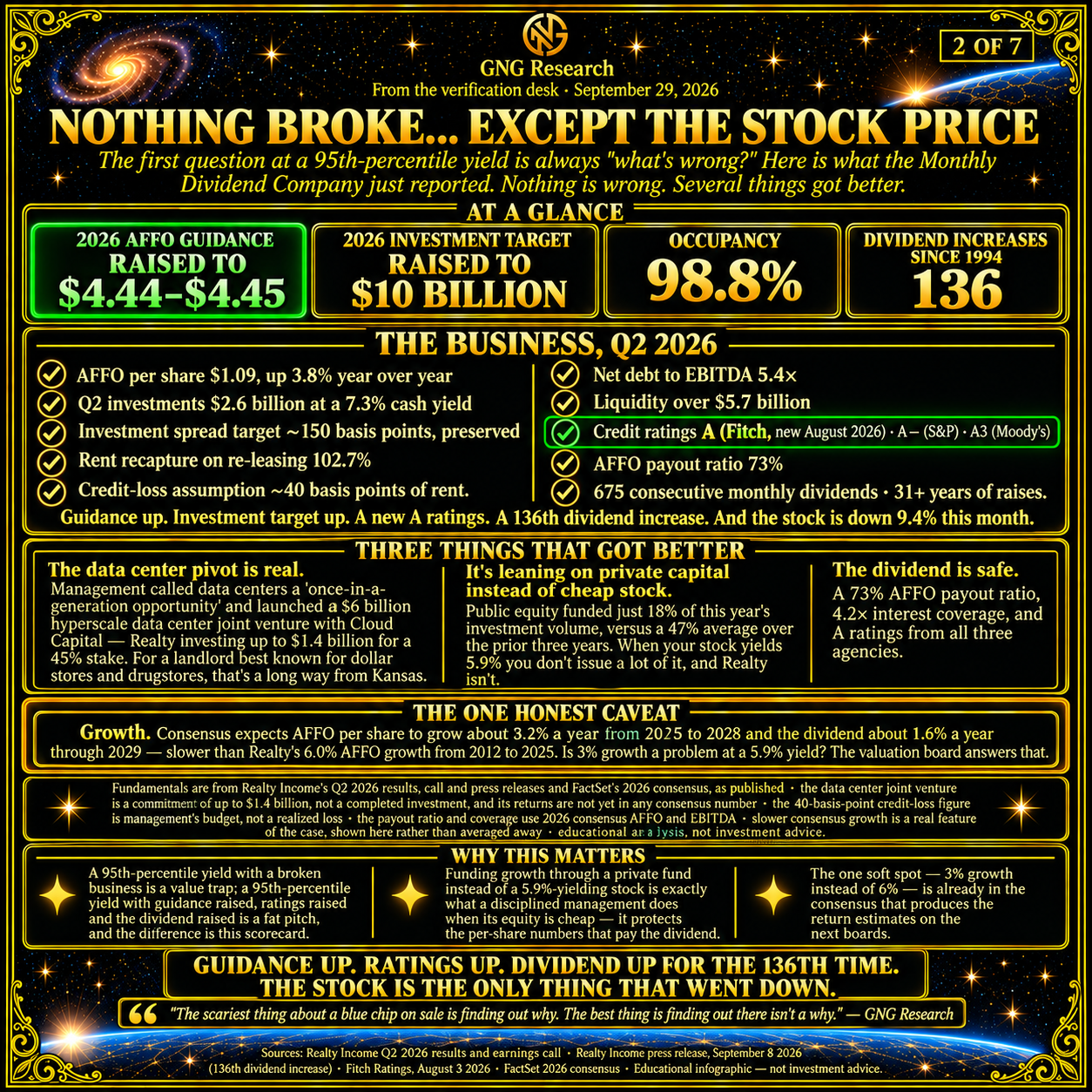
Q2 2026 AFFO per share: $1.09, up 3.8%. 2026 AFFO guidance: RAISED to $4.44–$4.45. Investment guidance: RAISED to $10 billion. Q2 investments: $2.6 billion at a 7.3% weighted cash yield. Investment spread target: ~150 basis points, preserved. Occupancy: 98.8%. Rent recapture on re-leasing: 102.7%. Net debt to EBITDA: 5.4X. Liquidity: over $5.7 billion. Credit ratings: A from Fitch (new in August), A- from S&P, A3 from Moody's. AFFO payout ratio: 73%.
Nothing broke. Actually, a few things got BETTER.
The data center pivot is real. CEO Sumit Roy — who's run Realty since 2018 and came up through UBS investment banking, which is why this company does private-equity deals no other net-lease REIT would touch — called data centers a "once-in-a-generation opportunity" on the Q2 call and launched a $6 billion hyperscale data center joint venture with Cloud Capital, with Realty investing up to $1.4 billion for a 45% stake. For a landlord best known for dollar stores and drugstores, that's a very long way from Kansas 😂 And for anyone who read Tokenomics 4 last week — the receipts on AI demand are compounding, and Realty just bought a seat at that table.
Realty is cutting deals with private equity to finance transactions without selling shares at low valuations.
It’s almost as if their CEO is a former investment banker?🤔😉😂
It's leaning on private capital instead of cheap stock. Public equity funded just 18% of this year's investment volume, versus a 47% average over the prior three years. When your stock yields 5.9%, you don't want to issue much of it, and Realty isn't either. Lower-yielding deals go to its private Core Plus Fund; the balance-sheet investments are structured to maintain the historical ~150-basis-point spread. That's what disciplined management does when its equity is on sale.
The dividend is safe. A 73% AFFO payout ratio, 4.2X interest coverage, and A ratings from all three agencies. This is not a dividend that's going anywhere but up — just more slowly than it used to.
And that's the one honest caveat: growth. Analysts expect AFFO per share to grow about 3.2% a year from 2025 to 2028, and the dividend about 1.6% a year through 2029. That's slower than Realty's 6.0% AFFO growth rate from 2012 to 2025.
Is 3% growth a problem at a 6% yield? Let's find out 🤔
This is shooting fish in a barrel. Fundamentals are fantastic, and the "High rates!" fears are free money.
* For legal reasons, this is not personalized investment advice.
I'm sure lawyers would not allow me to say "free money"
* For legal reasons, this is not "free money," just "very easy money"🤣
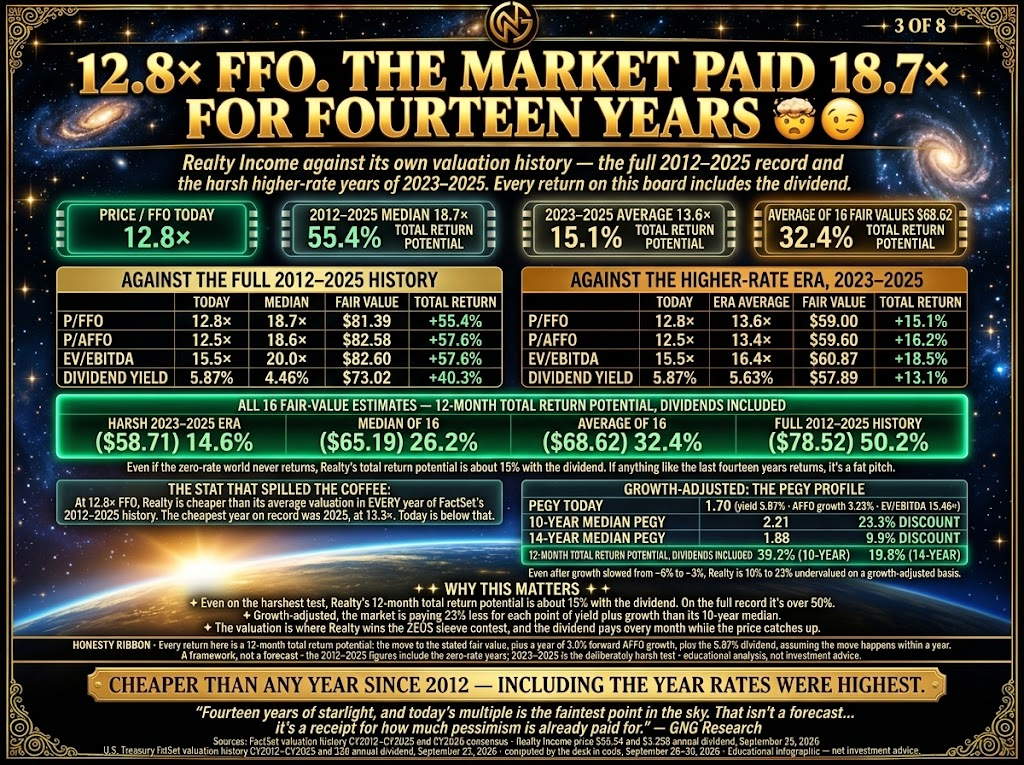
12.8X FFO FOR THE MONTHLY DIVIDEND COMPANY? THE MARKET PAID 18.7X FOR FOURTEEN YEARS 🤔
FactSet's valuation history for Realty starts in 2012. I compared today's multiples to two eras: the full 2012–2025 history, which includes the zero-rate years, and the higher-rate era of 2023–2025, when the 10-year mostly lived between 3.5% and 5%. If you want the harshest possible test, the second era is it.
Against the full history: price-to-FFO of 12.8X today versus an 18.7X median — that's $81.39 of fair value, 46.5% upside. Price-to-AFFO 12.5X versus 18.6X, 48.7% upside. EV/EBITDA 15.5X versus 20.0X, 48.7% upside. Dividend yield 5.87% versus 4.46%, 31.5% upside.
Against the harsh 2023–2025 era: P/FFO 12.8X versus 13.6X, 6.2% upside. P/AFFO: 7.3%. EV/EBITDA, 9.6%. Yield: 4.2%.
My standard method takes the average and median of each multiple across both eras and applies them to the consensus. That's 16 fair value estimates. Average of all 16: $68.62, 23.5% upside. Median: $65.19, 17.4% upside. Full-history estimates alone: $78.52, 41% upside. Higher-rate-era estimates alone: $58.71, 6% upside.
In other words: if the zero-rate world never comes back, Realty is modestly undervalued. If anything like the last 14 years comes back, it's a Buffett-style fat pitch.
What about growth-adjusted? Here's the PEGY profile. The 10-year median PEGY is 2.21. The 14-year median is 1.88. Today's PEGY — EV/EBITDA of 15.46 divided by a 5.87% yield plus 3.23% consensus growth — is 1.70. That's a 23.3% discount to the 10-year median and a 9.9% discount to the 14-year median. Twelve-month fundamentally justified total return potential: 33.3% and 13.9%.
Even after growth slowed from ~6% to ~3%, Realty is 10% to 23% undervalued on a growth-adjusted basis. That's not the 36% discount of February 2025. It's still a discount — on a blue chip that's growing, raising its dividend, and investing $10 billion this year.
And here's the stat that made me spit out my coffee: at 12.8X FFO, Realty is cheaper today than its average valuation in every single year of FactSet's 2012–2025 history. The cheapest year was 2025, at 13.3X. Today is below that 🤯
WHAT CAN REALTY DELIVER FROM HERE? 10% TO 16% A YEAR... PAID MONTHLY 😉
Long-term returns come from yield plus growth plus any change in valuation. Here's what the consensus says, using the fair values above.
Sign in to leave a comment and join the discussion.
Sign Up Free