
Written by Albert Marko & Leo Nelissen
Introduction
Where does inflation come from?
Ask 100 investors, and we bet 90 of them give the same answer: "too much money chasing too few goods."
We heard it in 2021. We heard it in 2022. And we're hearing it again now, with gasoline up more than 27% over the past year and the Federal Reserve hiking rates for the first time since 2023.
There's just one problem. In a modern economy, that phrase mostly gets the order of events backward. The general price level does move with the money supply. But correlation isn't causation, and in a system where most money is created by banks making loans, the money supply mostly reacts to prices instead of driving these prices.
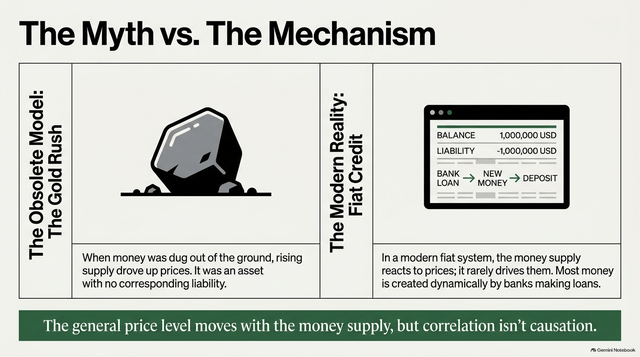
That sounds extremely complex. However, it isn't.
The last two years of U.S. policy are close to a live experiment testing that claim, and the answer matters for your portfolio, for the Fed's next move, and for the midterm elections on November 3.
That's why, in this article, we'll explain how money is actually created (in a way a 16-year-old could follow), which kinds of borrowing move prices and which don't, why the Fed is hiking into an oil shock, why the most comforting inflation number in five years comes with a footnote, and what the proposed $5,000 "Trump Dividend" would really do.
Then we'll turn to portfolios: which businesses win when inflation comes from costs, which ones we'd avoid, and what all of this means for the three dates that matter this fall.
And as we have a lot on our plate today, let's not waste any time and dive in!
Sign in to leave a comment and join the discussion.
Sign Up Free