Energy SectorChina Foreign PolicyGeopolitical RiskNatural Gas
China’s Eurasian Oil & Gas Pipelines: Expansionism and Existential Risk
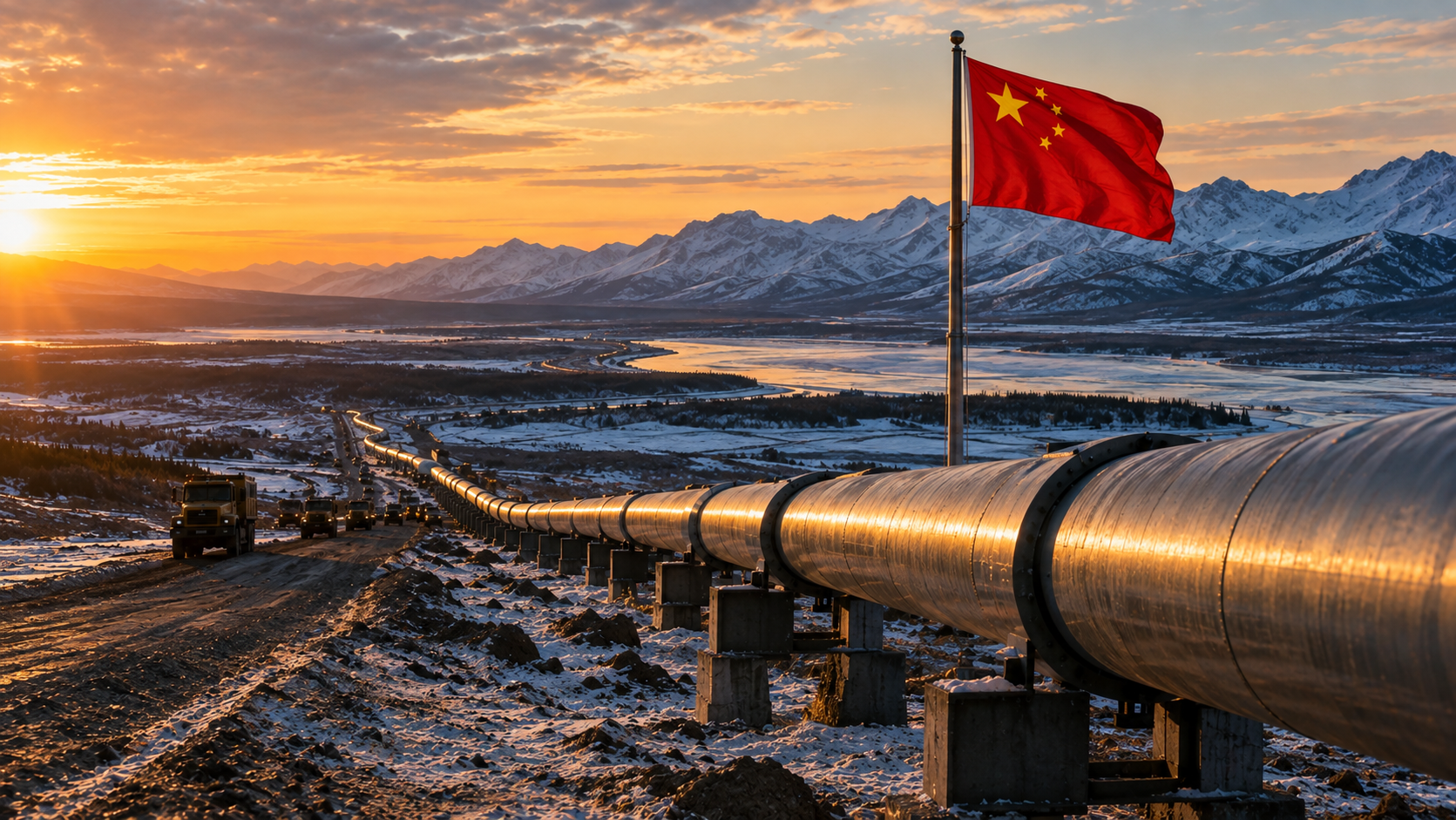
- Eurasian pipelines are a targeted energy insurance policy, not a pathway to territorial expansion
- Pipelines supply ~19% of China’s gas burn; Central Asia flows 36-40 bcm (<10% of demand), Power of Siberia I ~38 bcm (~9%)
- Overland crude covers <10% of imports - Kazakhstan-China 400k bpd (<4%), Sino-Myanmar 440k bpd (~4%); both face throughput constraints and maritime dependence
 Tony Nash
Sep 22, 202612:00 PM130
China’s energy supply chain is its most acute geopolitical vulnerability. The world’s primary manufacturing power remains fundamentally dependent on energy that travels across open oceans, moving from the Persian Gulf and Africa through narrow maritime chokepoints like the Strait of Malacca. A coordinated naval interdiction in these sea lanes would cut off the bulk of China’s raw energy inputs, threatening industrial collapse within months. To hedge against this vulnerability, Beijing has spent two decades executing a massive engineering program across the Eurasian heartland, laying thousands of miles of steel pipelines through the steppes of Central Asia and the forests of Siberia. [Inline image] In Western capitals, this landward expansion is widely interpreted as the construction of an aggressive continental fortress. Strategic analysts frequently observe the flow of Chinese capital into Central Asian infrastructure and conclude that Beijing is building an expansionist sphere of influence to insulate itself from Pacific naval pressure. This narrative collapses when stress-tested against the physical mechanics of global commodity markets. Grounded in actual consumption data, the entire Eurasian pipeline network supplies roughly 19% of China’s total natural gas burn and accounts for less than one tenth of its crude oil imports. While these land corridors successfully bypass vulnerable sea freight routes, their modest scale proves that Beijing is pursuing a targeted energy insurance policy rather than a broad campaign for continental autarky or territorial dominance. [Inline image] Chinese policymakers have understood the fragility of their maritime supply chains since the early 2000s, when leadership explicitly highlighted the strategic danger of relying on routes controlled by foreign navies. Upwards of 80% of China’s seaborne crude imports must pass through the Strait of Malacca before reaching domestic refineries. In any scenario involving a militarized crisis in the Pacific, this maritime traffic represents an immediate vulnerability. Western defense planners are correct to recognize that a state capable of keeping its power grid online and its heavy industry functioning during a blockade possesses a far wider array of strategic options. The urge to build terrestrial trade routes is a direct response to this geographic dilemma. The analytical error in conventional Western coverage lies in treating energy as a single uniform commodity, assuming that land pipes can replace sea lanes across the board. Petroleum and natural gas operate under vastly different transport economics, and Beijing has secured a partial continental buffer for gas while remaining overwhelmingly exposed on oil. Evaluating the actual hardware of China’s Eurasian energy corridors demonstrates the sharp limit between strategic ambition and physical throughput. The Central Asia-China Gas Pipeline system serves as the main terrestrial artery for imported gas, connecting Chinese industrial centers to the vast fields of Turkmenistan. Lines A, B, and C feature a combined design capacity of 55 billion cubic meters per year. Against China's annual gas consumption of roughly 430 billion cubic meters, this theoretical maximum represents about 13% of national demand. The operational reality is even tighter. Actual throughput from Turkmenistan has hovered between 36 and 40 billion cubic meters in recent years, meaning the core Central Asian pipeline network currently supplies less than 10% of the gas burned in China today. The stalled Line D project further illustrates the commercial and political friction inherent in continental infrastructure. Engineered to route an additional 30 billion cubic meters of gas from Turkmenistan through Uzbekistan, Tajikistan, and Kyrgyzstan into Xinjiang, Line D would cover approximately 7% of current national demand. Though construction on the Tajik segment began over ten years ago, the pipeline remains without a firm comple
Sign in to leave a comment and join the discussion.
Sign Up Free