

Five trading days after SpaceX listed in June at a valuation approaching $1.77 trillion, the company entered the CRSP US Total Market Index. That index forms the backbone of the Vanguard Total Stock Market Index Fund, which sits inside millions of American defined-contribution plans. Within weeks, the Russell 1000 and the Nasdaq-100 followed. Retail investors never placed an order, weighed the multiple, or assessed whether launch cadence could support the capitalization. The plumbing of passive asset management bought the stock on their behalf. After an initial post-listing pop, the shares shed between 20% and 30% from their peak, transferring that paper loss directly into the collective balance sheet of retirement savers.
The same pipeline is being laid for the leading artificial intelligence labs. Anthropic is preparing to file its public prospectus, targeting a listing this year (!) that private backers hope will clear at or above $2 trillion. OpenAI remains the delayed twin, holding back its filing until 2027 as management resists taking a discount on a targeted $1 trillion valuation.
The underlying dynamic is identical across both offerings. Years of private funding rounds have pushed paper marks to levels that assume permanent, high-margin pricing power across the entire computing stack. The coming wave of initial public offerings establishes a liquidity exit for early venture funds, sovereign vehicles, and corporate strategics, offloading unseasoned operational risk directly into passive index funds and retirement defaults.
The Tale of the Tape
The two dominant foundational model developers are approaching the public markets from starkly different tactical positions. Anthropic is moving aggressively to seize a receptive window. OpenAI is attempting to defend an ambitious valuation floor while absorbing heavy cash burn.
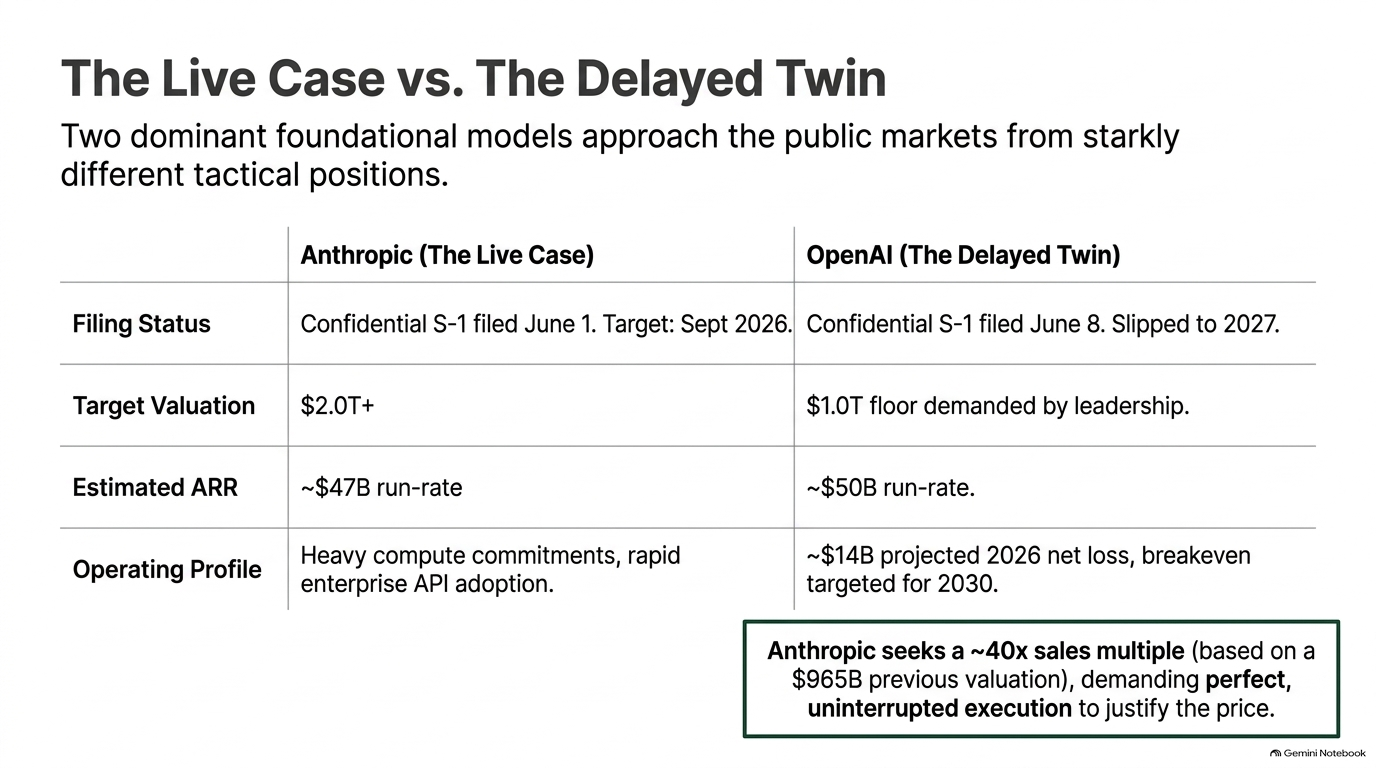
Anthropic’s push into the public market represents an unprecedented capitalization attempt. At its last private valuation of $965 billion, the company traded at roughly 20 times annualized run-rate revenue. Securing a $2 trillion valuation at listing stretches that multiple toward 40 times sales, demanding an aggressive, uninterrupted trajectory of revenue expansion and margin preservation through the end of the decade. While earlier leaks suggested annual run-rates might approach $100 billion to $120 billion by the end of this year, mid-year figures tracked closer to $47 billion. That is exceptional top-line growth, yet it leaves the equity priced for operational perfection relative to its last venture round.
OpenAI presents the inverse problem. Chief Financial Officer Sarah Friar has signaled to staff that a public offering will wait for 2027 unless operational results inflect higher ahead of schedule. While advisers suggested exploring a 2026 listing at a more modest valuation print, Sam Altman rejected any outcome below the $1 trillion mark. With private secondary markets trading shares near an $890 billion valuation, and projected 2026 losses hovering around $14 billion, OpenAI faces the choice of either accepting a down-round or convincing institutional allocators to underwrite years of deep deficits.
Deconstructing the Exit Transfer
To describe this process as dumping risk is to state a structural reality of late-stage venture finance. Today, the residual risk of these businesses remains concentrated in a small circle of balance sheets: venture partnerships, sovereign wealth authorities, corporate strategics such as Microsoft, Amazon, and Nvidia, and early employees holding illiquid options. Their capital sits locked in private shares, marked on quarterly private ledgers, and exposed to steep discounts whenever secondary tender offers clear.
A public listing alters that equation across four fronts:
Primary Capital Formation: The operating company raises fresh cash to finance enormous forward commitments for compute, power, and data centers.
Secondary Clock: The establishment of a public float starts the countdown on insider lockup agreements, creating an orderly off-ramp for early backers.
Valuation Validation: A successful public print validates paper returns, allowing general partners to report realized gains and return capital to limited partners.
Risk Dispersion: The institutional discipline of bearing unhedged, concentrated enterprise risk shifts from venture portfolios to public index holders.
The public listing leaves the fundamental uncertainties of the underlying business unresolved. Unit economics remain unproven at scale, competitive moats against rival, open weight foundation models remain narrow, and valuations of 20 to 40 times sales face immense hurdles to deliver attractive long-term returns on invested capital.
When institutional finance brings a mega-cap transaction to the market at these multiples, the mechanical priority centers on clearing private ledger risk across the listing threshold, anchoring the price before capital expenditures and margin pressures erode the mark. Once that threshold is crossed, the residual downside belongs to public markets.
The Passive Transmission Belt
The path connecting an institutional exit to the average retail investor is the passive index fund. Historically, an initial public offering had to undergo an extended seasoning period before entering mainstream benchmark indexes. Standard & Poor's still maintains a cautious methodology: the S&P 500 requires seasoned public trading, positive aggregate earnings across the most recent four quarters, and approval by an index committee. Investors whose retirement savings sit entirely within vanilla S&P 500 funds gain a temporary structural buffer against early listing turbulence.
The rest of the indexing universe operates under fundamentally different rules. Index providers modified their inclusion methodologies because keeping multi-hundred-billion-dollar market debuts out of benchmarks caused tracking metrics to drift from the broader market. Those changes created an automated fast-track transmission system:
CRSP US Total Market Index: Fast-track rules allow qualifying large-cap listings to enter within roughly five trading days.
FTSE Russell 1000: Initial inclusion for eligible mega-cap offerings occurs within approximately five days of the opening.
MSCI USA Index: Large-cap additions are typically executed within roughly ten trading days.
Nasdaq-100: Eligible non-financial listings can enter in roughly fifteen trading days, with relaxed float thresholds and weight multipliers applied to low-float issues that force outsized passive dollar flows into thin trading books.
This mechanical inclusion feeds directly into the modern defined-contribution retirement system.
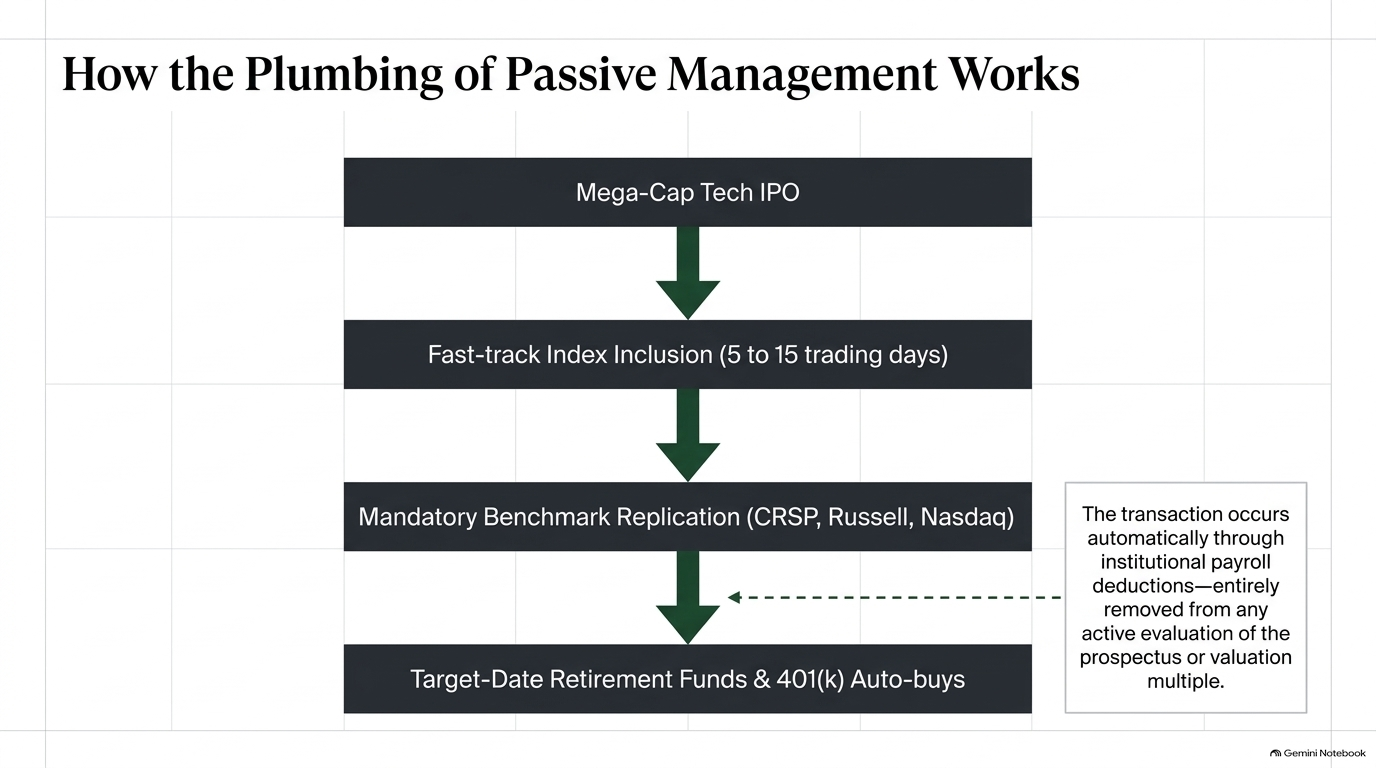
Most workplace retirement plans route employee contributions directly into default target-date funds. These target-date products allocate capital mechanically across total-market, large-cap growth, and international equity indexes. When an index provider adds a newly listed company to its benchmark, every tracking portfolio purchases the stock to minimize tracking error. The transaction occurs automatically through institutional payroll deductions, entirely removed from any active evaluation of the prospectus or valuation multiple.
The structure of modern mega-cap listings accelerates this buying pressure. With Anthropic expected to float only 5% to 8% of its equity initially, the volume of passive capital tracking total-market and growth benchmarks will heavily outweigh the available supply of tradeable shares. This dynamic, visible in the rapid pop and subsequent compression of SpaceX, creates an artificial bid driven by passive mandate rules rather than fundamental investor appetite. The scale of this shift requires measured framing. A $2 trillion listing with an initial free float of 5% creates an investable slice of $100 billion. Within a total US equity market capitalized at tens of trillions of dollars, an individual holding represents a modest fraction of a total-market portfolio. The primary hazard lies in the involuntary accumulation of unseasoned, high-multiple assets across millions of conservative portfolios, effectively serving as the exit liquidity for private capital.
Why the Public Book Is the Weaker Holder
Private investors financed the frontier AI race under assumptions of rapid enterprise adoption, expanding margins, and durable technological moats. The public markets will inherit these businesses under conditions defined by heavy commodity pressure.
First, the capital intensity of frontier models continues to climb. Unlike traditional enterprise software platforms that scale with minimal marginal computing costs, modern frontier model developers face massive capital expenditure cycles with every hardware and algorithmic transition. Compute budgets, cluster maintenance, and power procurement reset higher with each model generation.
Second, proprietary pricing power faces relentless pressure from open-weight architectures and low-cost overseas alternatives. When efficient open-source models deliver performance within striking distance of proprietary closed systems, corporate buyers diversify their workloads to lower-cost providers. Pure-play artificial intelligence labs operate without the broad digital ecosystems that shield the major hyperscalers, lacking captive search franchises, dominant operating systems, consumer device ecosystems, or commercial cloud hosting networks. Every dollar of revenue depends directly on competitive, price-sensitive API calls and enterprise subscriptions.
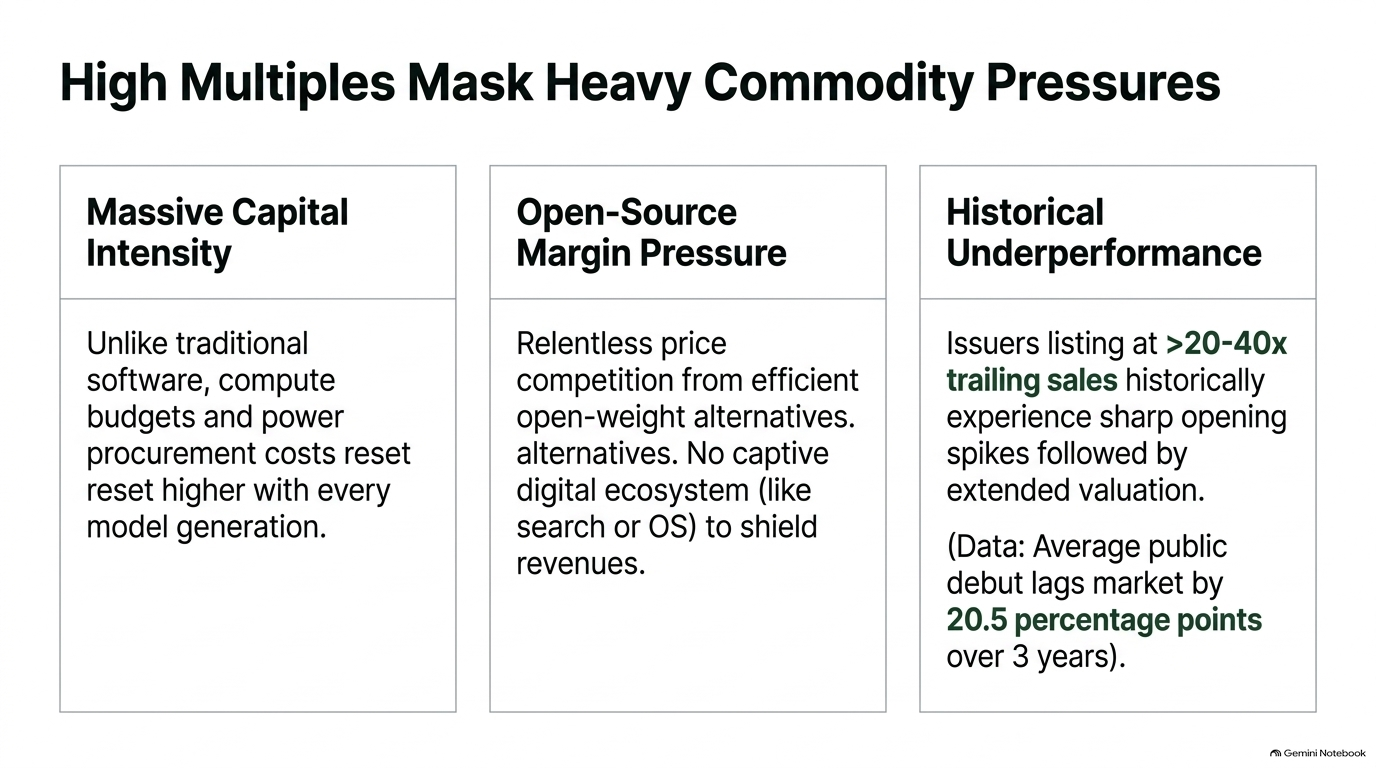
Third, the empirical history of initial public offerings points to a demanding baseline. Research by Jay Ritter tracking decades of domestic listings through 2024 demonstrates that the average public debut underperforms the broader market by approximately 20.5 percentage points over its first three years of public trading. This structural underperformance concentrates heavily in specific market cohorts:
High Revenue Multiples: Issuers that list at valuations exceeding 20 to 40 times trailing sales historically experience sharp opening spikes followed by extended valuation contractions.
Persistent Losses: Companies that enter the public arena without sustained GAAP operating profitability consistently trail seasoned public peers.
Concentrated Control: Modern multi-tier share structures insulate corporate founders and boards from public oversight, removing the governance mechanisms public investors traditionally used to enforce capital discipline.
Anthropic operates with undeniable technical sophistication and a rapidly expanding revenue base. Even so, standing above the historical bottom tier of public listings still leaves an equity priced at 40 times sales exceptionally exposed to multiple compression.
Aligning Institutional Incentives
The momentum driving these companies toward public exchanges is maintained by an interlocking system of institutional incentives:
Investment Banking Syndicates: Underwriting syndicates led by Morgan Stanley, Goldman Sachs, and JPMorgan stand to capture record transaction fees. Structuring and floating a trillion-dollar frontier technology listing represents the pinnacle of institutional league tables and capital-markets revenue.
Venture Capital Funds: Investment partnerships raised between 2021 and 2024 face mounting limited-partner pressure to demonstrate distributed-to-paid-in capital rather than paper performance metrics. Even with lockup agreements temporarily restricting volume, a public float establishes the definitive pipeline to cash distributions.
Employees and Insiders: While internal share buybacks and tender offers have provided periodic liquidity to early technical talent, a broad public listing creates an open market for personal equity diversification.
Index Benchmark Providers: Index architects compete to provide market proxies that capture large shifts in corporate enterprise value. Capturing dominant technology players requires lowering seasoning barriers and accelerating fast-track inclusion windows.
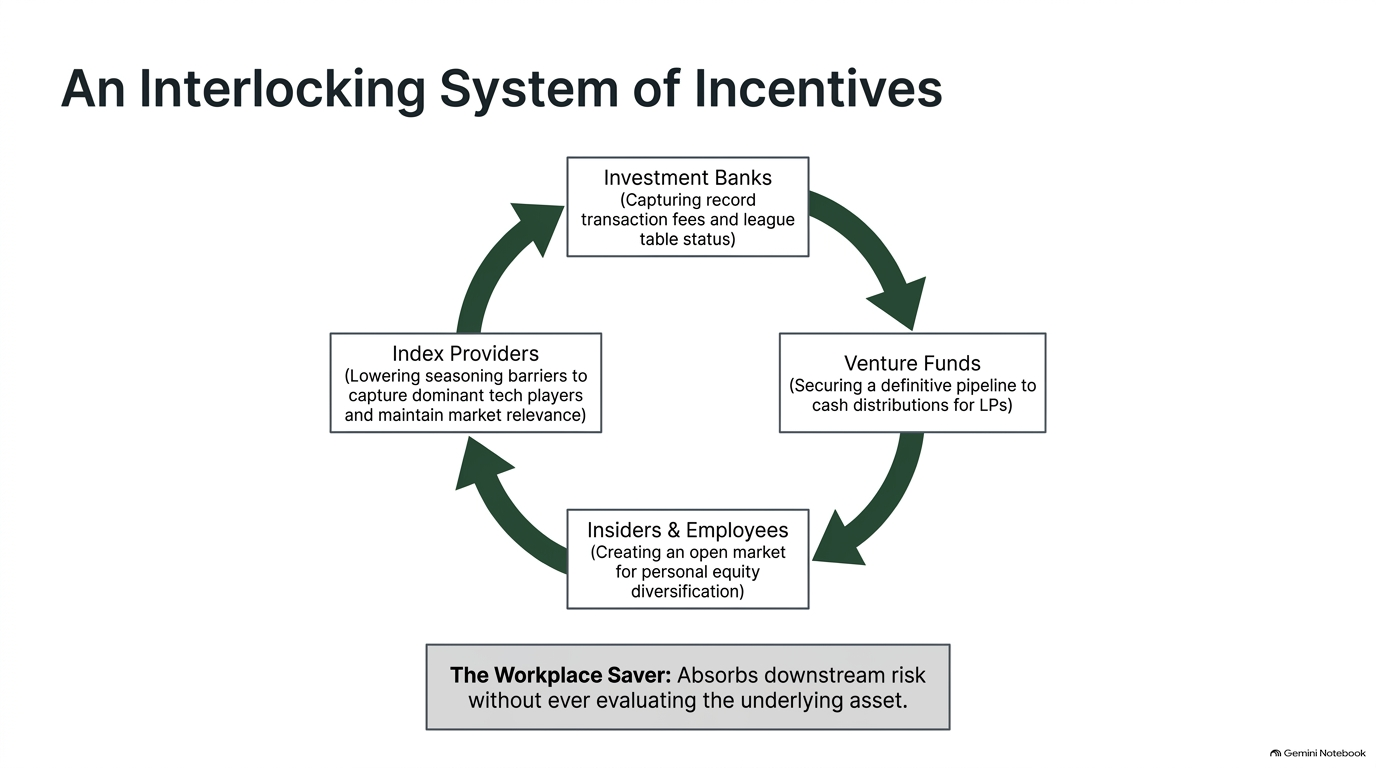
The workplace retirement saver remains completely isolated from this process. The plan sponsor selects a default target-date vehicle, the fund manager replicates a market benchmark, and the employee absorbs the downstream risk without ever having evaluated the underlying asset.
Navigating the Shift
Critiques of these listing mechanics address specific structural risks rather than the fundamental viability of artificial intelligence. Large language models, automated coding environments, and enterprise reasoning systems represent genuinely transformative developments with evident commercial utility. The immediate challenges center instead on aggressive valuation multiples, compressed listing timelines, and the automated routing of late-stage venture risk into conservative portfolios.
Investors and retirement plan participants can manage this transition through several practical measures:
Examine Plan Construction: Review the underlying fact sheet for your retirement plan default options. Determine whether the domestic equity allocation tracks a total-market index like CRSP or Russell, or whether it concentrates strictly within the S&P 500. Plans anchored to the S&P 500 maintain a natural lag, deferring exposure until issuers satisfy explicit profitability and seasoning criteria.
Audit Existing Exposure: Avoid redundant exposure to the computing stack. Investors holding core shares in the major cloud providers already possess substantial exposure to artificial intelligence infrastructure and compute investments. Adding unseasoned pure-play listings at peak multiples amplifies concentration across identical operational dependencies.
Monitor Three Post-Listing Signals: If your capital is exposed through passive broad-market funds, evaluate three market signals as the initial float matures: the expiration calendar for venture and employee lockup agreements, subsequent index rebalancing adjustments as floating share counts expand, and the rate at which reported operating cash flow catches up to headline enterprise multiples.
Decouple the Risk: Treat the listings as independent market events. Anthropic’s calendar points directly to an active autumn process. OpenAI’s timeline remains tied to 2027 performance milestones. Analyzing them separately clarifies the distinct operational risks and capital requirements governing each lab.
When SpaceX listed, the passive market absorbed the shares through index mandates, and everyday account balances bore the subsequent price decline. Anthropic will soon put that same indexing engine to the test at an unprecedented scale, while OpenAI prepares to follow whenever private marks can no longer be maintained away from the public tape. The technological achievements of the AI sector remain undeniable, and the mechanical transfer of late-stage private risk into passive retirement assets remains equally certain. Understanding the plumbing of modern indexing provides the necessary defense against becoming its final buyer.
Sign in to leave a comment and join the discussion.
Sign Up Free