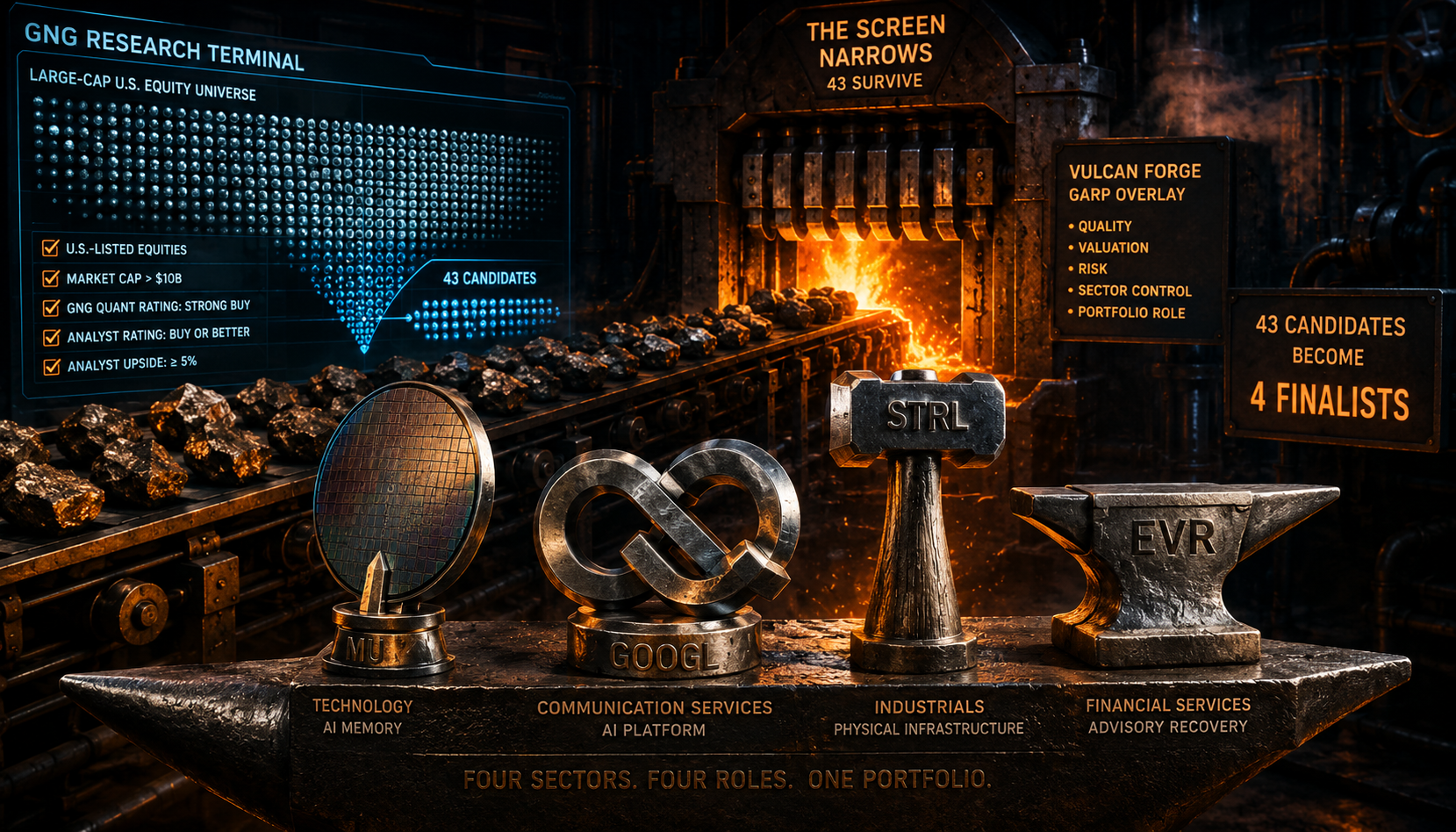

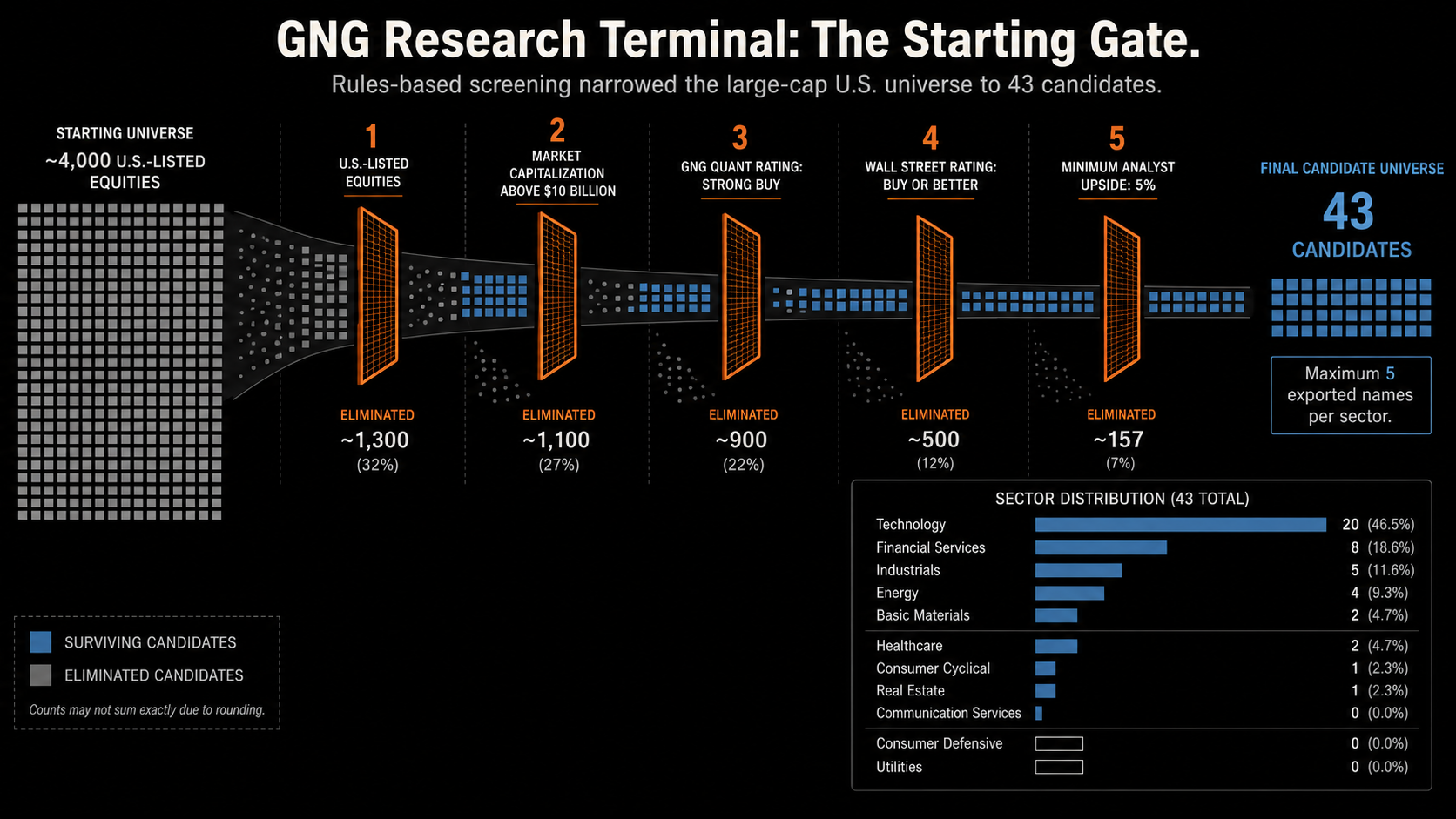
The first cut was mechanical, and that is how it should be. Before the thesis, before anyone gets attached to a favorite ticker, the GNG Research Terminal did the cold work. It took the large-cap U.S. equity universe and forced every candidate through one narrow opening: equity only, U.S. listed, market cap above $10 billion, a GNG Quant rating of Strong Buy, an analyst rating of Buy or better, and at least 5% analyst upside.
What the gate produced was ore. It marked where quality rock might sit and left the harder question, which of it to actually own, for the next stage.
A screen is a quarry, and that is the distinction that carries the whole piece. It shows you where the rock is and separates obvious waste from material worth inspecting. It cannot tell you which metal holds its edge after heat, pressure, and stress. That was the next job, and it belonged to Vulcan.
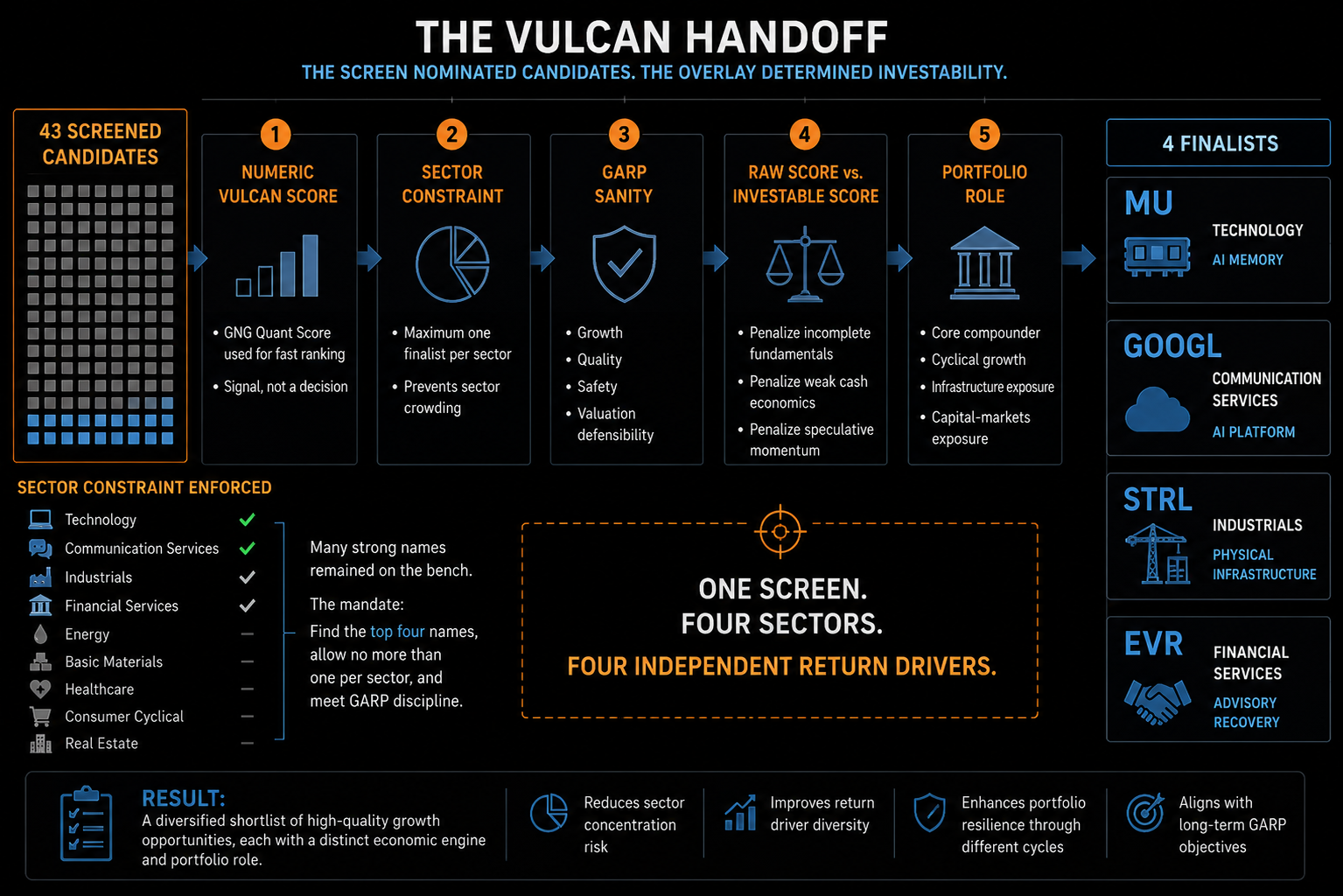
The screen exported 43 candidates. The qualifying pool skewed hard toward Technology, which held the deepest bench, with meaningful benches in Financial Services, Industrials, Energy, and Basic Materials, plus smaller showings in Healthcare, Consumer Cyclical, Real Estate, and Communication Services. Consumer Defensive and Utilities produced nothing that cleared the gate. That absence already says something useful about this market. The strongest large-cap quant pockets right now are not hiding in sleepy defensive names. They cluster around AI infrastructure, capital markets, industrial construction, cyclicals, energy, and metals.
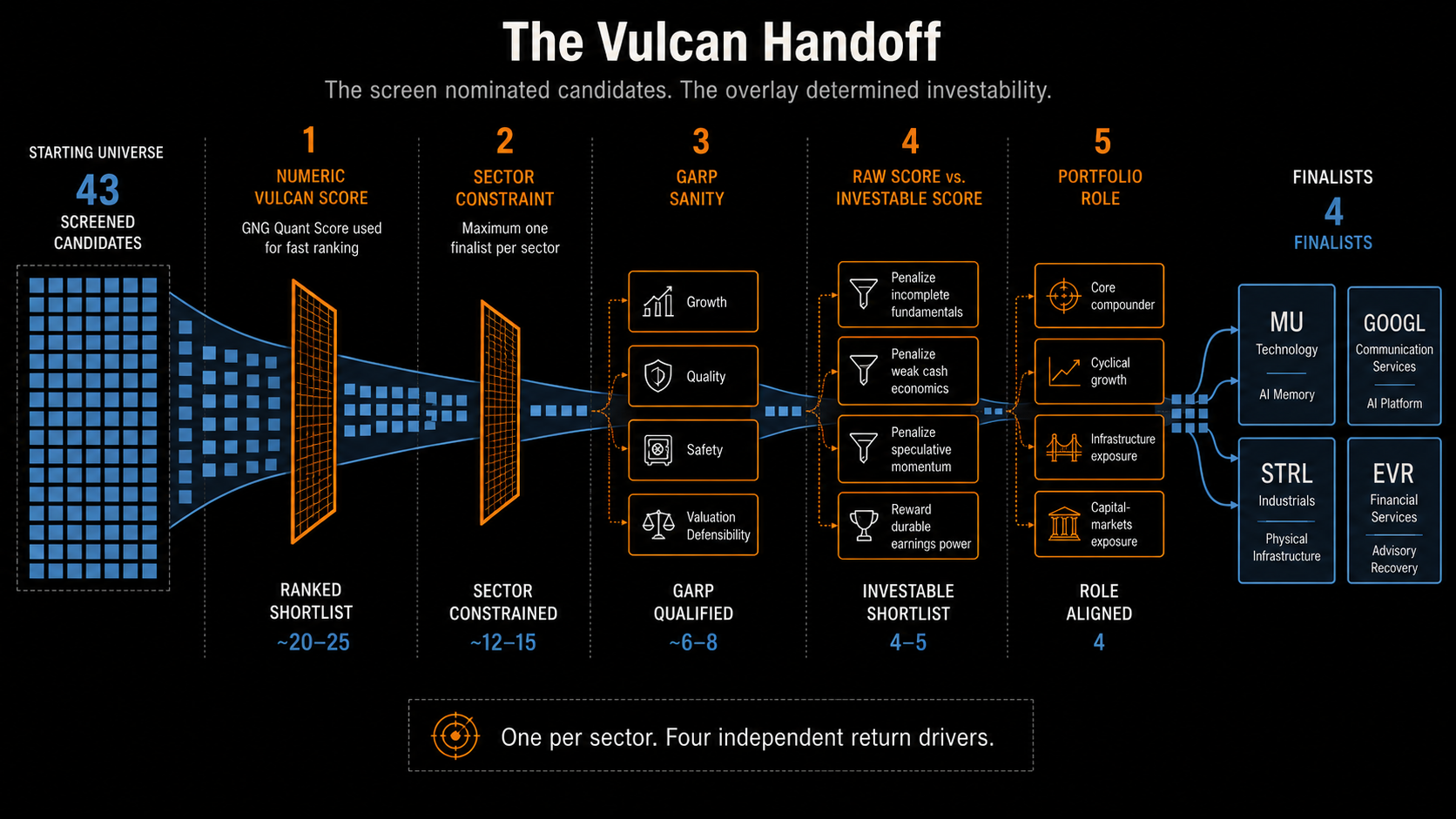
The mandate for the second stage was stricter. Find the top four names, allow no more than one per sector, and use a growth-at-a-reasonable-price lens so the answer does not collapse into a pile of semiconductors and high-beta cyclicals. The finalists had to preserve factor strength while cutting sector concentration.
That is how four names emerged from forty-three: (MU), (GOOGL), (STRL), and (EVR).
They did not earn the shortlist by being the only attractive names in the screen, or the cheapest, or the ones a screen can somehow ride twelve months into the future. Several of them are not cheap, and no screen sees that far. Each earned its place by surviving a different part of the furnace and coming out shaped for a different job.
Micron carries the hottest flame. Alphabet is the load-bearing alloy that keeps the whole structure from turning brittle. Sterling swings the hammer that builds the physical layer. Evercore is the anvil underneath, holding steady while the cycle turns around it. Put together, they form a four-sector basket drawn from one rules-based screen and then refined through Vulcan score, sector control, quality, risk, and valuation sanity.
The Starting Gate: What the GNG Screen Actually Did
The screen began with a premise most investors invert. Do not start with the whole market, and do not start with names you already like and then hunt for evidence. Start with a broad rules-based gate and let the data nominate the candidates.
The Research Terminal filters I required were listed in the USA, above $10 billion in market cap, carrying a Vulcan/GNG Quant rating of Strong Buy and a Wall Street rating of Buy or better, with at least 5% analyst upside, ranked by highest upside first, capped at five names per sector. That produced 43 exported candidates grouped by sector. The grouping matters. A raw top-ten list sorted purely on upside would have leaned heavily into Technology and AI-adjacent names, which looks exciting and answers the wrong question.
The question was never which four names look flashiest. It was which four pieces of quality growth at a fair price come from four different economic engines.
This is where my Vulcan analysis engine takes over. The playbook treats the screen as the backbone and then layers in field mapping, valuation, risk, scenario modeling, and ranking discipline, cross-checked against live prices rather than a stale database export. That last point drives everything downstream, because the screen was sorted by analyst upside, and analyst upside is a blunt instrument. It can overweight volatile names, commodity rebounds, distressed turnarounds, and stale target prices. The GARP question is harder. Can the candidate justify its upside with growth, quality, a sound balance sheet, real cash economics, and a valuation that is not divorced from the business?
That harder question is why the final list changed after the handoff.
The Furnace Rules: What Vulcan Added
Once the 43 names landed, the overlay went to work in five ways, none of them decorative.
The GNG Quant Score became the numeric Vulcan score for this fast-rank exercise, which is a signal and not yet a decision. A Quant Strong Buy earns a candidate a place at the bench and nothing more.
Next came the one-per-sector rule, the single constraint that keeps the output from filling up with Technology and AI infrastructure. That kind of crowding might suit a thematic AI portfolio, while a cross-sector GARP shortlist needs the opposite.
Then GARP sanity, which asks that growth be backed by quality and a defensible price. Speed alone does not qualify a name, because there has to be a reason to believe the engine holds together at the multiple being paid.
A further step split raw score from investable score, which is why the Communication Services slot skipped the highest-momentum name in the sector. That is the most instructive call in the run, and it gets its own section below.
Finally, the overlay asked whether each finalist has a real role to play. Ranking highly is not the same as knowing whether a stock belongs as a core compounder, a cyclical satellite, or a watchlist idea. These four are deliberately different metals doing different work.
Micron: The Heat Source
Micron is the hottest piece of metal on the bench, and that is both the attraction and the hazard.
The screen placed (MU) in Technology near a recent close around $980, with a market capitalization above $1 trillion, a GNG Quant Score of 76.3, and analyst upside near 52%. That made Micron the highest-scoring finalist. The reason is a change in what memory means to an AI system. High-bandwidth memory has moved from a supporting part to a bottleneck, because a processor does the math only as fast as the memory can feed it.
For most of the last decade memory was priced as a cyclical commodity. Investors liked the stocks near troughs, feared them near peaks, and rarely granted them a durable premium. That old muscle memory has not vanished, but it no longer captures the whole picture. That is why (MU) screens the way it does now, with a forward P/E near 6x, a PEG ratio near 0.14, strong safety, and an extraordinary twelve-month total return above 700%.
The outside evidence supports the demand story. Micron is accelerating a roughly $250 billion U.S. fab buildout aimed at AI memory, and it has locked a meaningful share of future output under long-term customer agreements. Those agreements include a floor price designed to secure profitability, and the company has said the deals already cover roughly 20% of DRAM and about 30% of NAND volume, with that share expected to keep climbing. This is a demand-visibility signal rather than a normal commodity-cycle bounce.
The furnace can still overheat, and that is the honest counterweight. (MU) has already run hard, carries a beta above 2, and has posted large drawdowns in its history. The GNG fair value sits close to the recent price rather than well below it, so the quant score is describing the best growth-and-momentum setup in the screen while the valuation signal warns against treating this as a deep-value entry. Both things are true at once, and a disciplined buyer holds them together.
So (MU) leads the ranking without becoming a blind chase. A staged approach makes more sense than a market-order lunge. Initial exposure reads more rational on a 5% to 8% pullback toward roughly $900 to $930, with a stronger add zone closer to $825 to $875. The thesis stays intact while the stock holds its rising long-term trend and HBM demand stays tight. It comes under review if HBM pricing weakens, customer commitments soften, or gross margin rolls over. Handle this one with tongs.
Alphabet: The Platform Alloy
Alphabet is the finalist where investable quality overruled a raw-score tie, and the mechanics of that call are worth slowing down for.
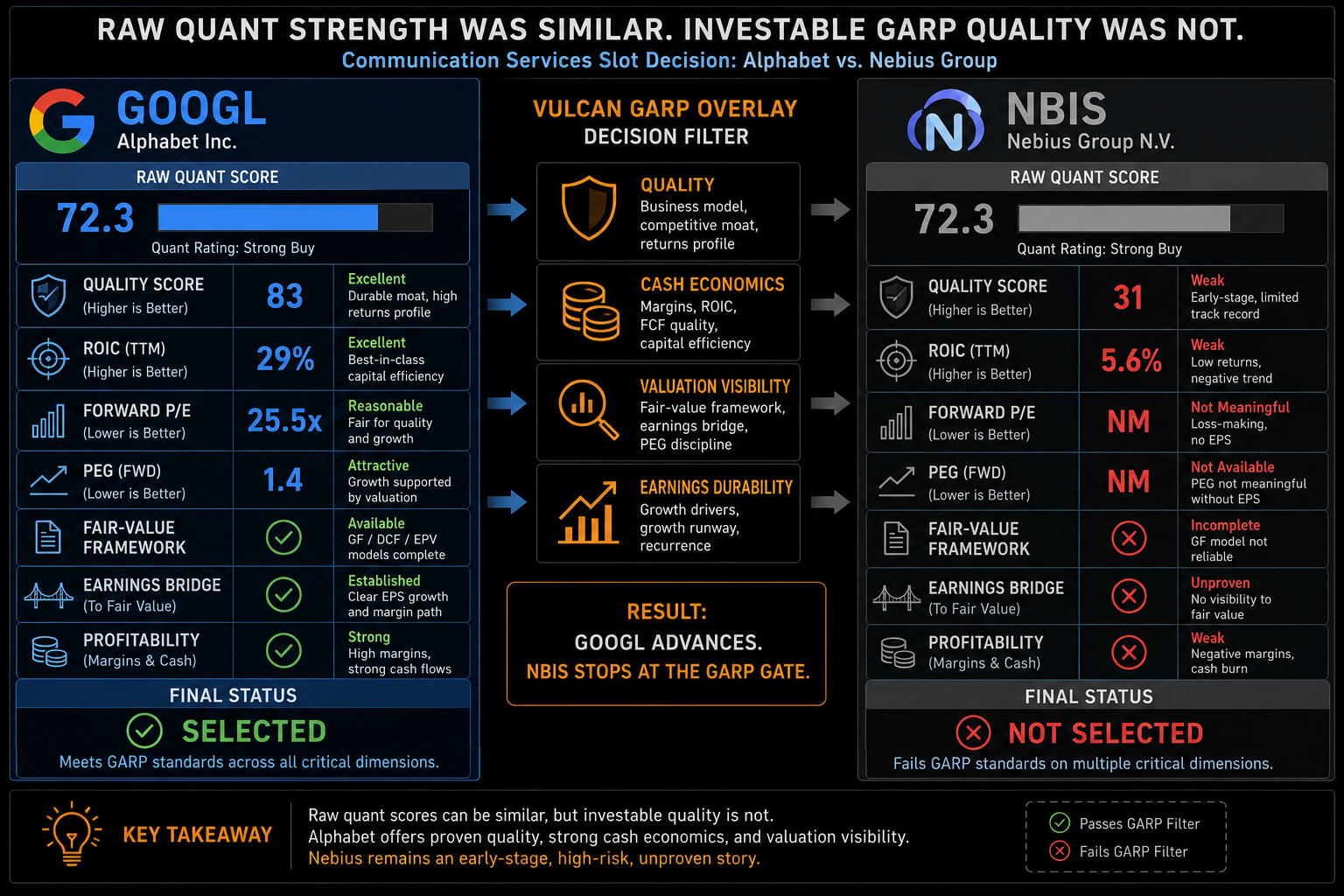
On the raw GNG Quant Score, the two Communication Services contenders finished level. Alphabet and the high-momentum AI-infrastructure name Nebius both scored 72.3. A pure score-only output would have flipped a coin. The GARP lens did not need one, because the two businesses are not remotely comparable underneath the score. Alphabet carries a GNG Quality Score around 83, while the challenger sits near 31, with no usable fair value, deeply negative operating margins, and weak sentiment. Alphabet is already an enormous profit engine, while its rival is still asking investors to fund a build that has no earnings bridge yet.
So the slot went to (GOOGL), and its profile is what a large-cap GARP investor wants to see. Near $359, the screen showed roughly 21% analyst upside, a forward P/E around 25x, a PEG near 1.4, return on invested capital close to 29%, strong quality and safety, and a GNG fair value of about $466, which places the stock well below the model's intrinsic estimate. Reasonable people will weigh that gap differently, since other valuation frameworks see the shares closer to full, but on the house source the discount is real and the quality is not in question.
The operating evidence has turned the old bear case on its head. In its most recent quarter Alphabet reported net income up 81% and EPS up 82% to $5.11, and raised its dividend 5%. The engine underneath was Cloud. Google Cloud generated $20.0 billion in revenue, a 63% year-over-year surge, with Cloud operating income reaching $6.6 billion at a 32.9% margin, nearly doubling from 17.8% a year earlier. Cloud backlog nearly doubled sequentially to $462 billion, with AI Solutions the largest contributor to Cloud growth. Search held up too, with revenue growing 19% as AI experiences drove usage and queries hit an all-time high.
The bear thesis for two years was that generative AI would erode Search. That risk has not disappeared, but the newer evidence is more textured. AI is also a demand driver for Cloud, custom silicon, Gemini, Workspace, cybersecurity, and analytics. Google is now expanding sales of its own AI accelerators to external cloud providers as a lower-cost alternative to merchant graphics chips, which turns the company into both the defender of its core and a supplier at the infrastructure layer. That combination is rare, and it is why (GOOGL) reads as the most core-like name in this basket, the one you can hold through noise.
The risks are real and specific. Search monetization could compress if AI answers cut click-through economics. Regulatory pressure is constant, including active antitrust scrutiny. And the capital bill is enormous, with management raising 2026 AI capex guidance to a range of $180 billion to $190 billion, while a fresh state-level data-center moratorium is one reminder that the buildout carries execution and political friction. A first tranche looks reasonable near current levels for durable platform exposure, with better adds on pullbacks toward $335 to $345 and a stronger zone closer to $315 to $325. What would break the thesis will not show up first on the price chart. Watch for Search growth stalling, Cloud backlog failing to convert, or capex climbing without revenue following behind it.
Sterling Infrastructure: The Hammer
Sterling does not sell accelerators, search ads, or merger advice. It builds the physical layer underneath the AI and reshoring economy, and that is precisely why it belongs here.
Sorted by analyst upside, the Industrials export placed (STRL) behind Dycom, which carried the higher headline upside near 50%. Once Vulcan score and GARP quality entered the picture, Sterling moved ahead, with a GNG Quant Score of 71.9 against Dycom near 66.7 and a cleaner growth-and-quality fit for the specific AI-infrastructure thesis. Sterling's metrics read well: high quality and safety, return on invested capital in the mid-20s, strong interest coverage, and a PEG near 1.1 that still looks reasonable against the growth rate. The forward P/E near 35x is not cheap, and this is where GARP requires judgment rather than a rule. A rich multiple can be earned when earnings growth, backlog, and margin expansion supply the bridge.
Sterling's most recent quarter supplied that bridge in steel. First quarter 2026 revenue surged 92% to $825.7 million, net income rose 143% to $96 million, and adjusted EBITDA jumped 107% to $166.6 million. The E-Infrastructure Solutions segment grew 174% to $597.7 million and now accounts for over 90% of signed backlog, driven by AI data centers, semiconductor fabs, and advanced manufacturing. Signed backlog reached $3.80 billion, up 78%, and combined backlog reached $5.15 billion, up 131%. Management raised full-year 2026 guidance to $3.7 billion to $3.8 billion in revenue, roughly a 51% increase over 2025 at the midpoint, alongside adjusted EPS guidance of $18.40 to $19.05. This is the company grading the site and pouring the foundations before the servers ever arrive.
The risks are equally clear. The stock has already rerated hard and remains volatile, recently pulling back into the high-$600s after touching a 52-week high above $1,000. Execution risk rises after acquisitions, and backlog has to convert into high-margin revenue rather than sit as a headline. If data-center project timing slips or hyperscaler capex pauses, this growth story compresses quickly. A starter position at current levels should stay small, with better GARP entries on pullbacks toward $610 to $635 and a more attractive accumulation zone around $550 to $575, provided backlog and guidance hold. The tripwires are backlog direction, adjusted EBITDA margin holding above 20%, organic growth above 25%, and the durability of full-year guidance.
Evercore: The Anvil
Evercore is the quietest name in the group, and it earns its place by doing something the other three cannot.
After a memory maker, a platform, and a builder, the basket needed a different return driver. (EVR) supplies advisory revenue, capital markets, private capital, and wealth, with a GNG Quant Score of 71.6, the highest among the exported Financial Services names. When deal activity returns, companies need advice, sponsors need exits, balance sheets need restructuring, and cross-border transactions need trusted intermediaries. Evercore sits at that intersection as an advisory pure-play, and its Q1 delivered. First quarter 2026 adjusted net revenues reached $1.4 billion, up 100% year-over-year, with advisory fees up 123% to $1.24 billion and adjusted diluted EPS of $7.53 versus $3.49 a year earlier. The firm raised its quarterly dividend 6% to $0.89 and returned $673.3 million to shareholders through dividends and buybacks in the quarter.
Here is the honest tension the raw screen hides, and it is the single most important caveat in this piece. On the house fair-value model, (EVR) does not trade at a discount. GNG places fair value near $239 against a price in the mid-$300s, roughly a 40% premium, and the GNG letter rating on the name is a Hold even while the quant rating is Strong Buy. An independent model at Morningstar likewise flags the shares as trading at a premium. Advisory revenue is also lumpy by nature. The record quarter leaned on large deal closings, and forward consensus steps down sharply for the following quarter, which is exactly what a cyclical advisory model does between peaks. That reframes the name. This is a high-quality franchise bought at a full price on the strength of an M&A recovery, and the word value does not really belong in the description.
The remaining risks follow from that. A recession, higher rates, a closed IPO window, or heightened deal scrutiny can slow activity fast, and a compensation ratio that absorbs too much of the upside can blunt operating leverage even when revenue grows. (EVR) also carries real market beta and will not behave like ballast in a risk-off stretch. Given the premium to intrinsic value, entries look more sensible on pullbacks toward $310 to $320, with a stronger zone around $285 to $300, while acknowledging that even those levels sit above the model's fair value. Size it below (GOOGL) and treat the tripwires as advisory revenue momentum, operating margin, the compensation ratio, and capital-return discipline.
Why the Other Sector Leaders Fell Short
The exclusions carry as much information as the selections.
Basic Materials produced attractive precious-metals names, and Pan American Silver in particular carried a Strong Buy quant rating and very high analyst upside. Metals exposure introduces commodity-price dependence and macro sensitivity that dilute clean GARP durability, so it belongs on a watchlist rather than ahead of the four finalists.
Energy offered high-upside names led by Petrobras, whose risk package includes political interference, commodity exposure, and dividend variability. That is a harder fit for a growth-at-a-reasonable-price shortlist. Healthcare produced Teva, whose stretched fair-value signal and leverage profile made it a weaker GARP candidate, while higher-quality names like United Therapeutics and Neurocrine deserve their own deeper work rather than a slot here. Real Estate's best business was Prologis, a genuinely strong company whose rate sensitivity and modest screen upside kept it out of the top four under this mandate.
Technology was the hardest cut. Nvidia is arguably the superior business, with a GNG Quant Score near 69 against Micron's 76, but the one-per-sector rule forced a single Technology pick, and this run handed (MU) the higher Vulcan score and the more direct HBM asymmetry. That is a ranking outcome for this specific screen and settles nothing about the two businesses head to head.
Portfolio Construction: Rank Is Not Weight
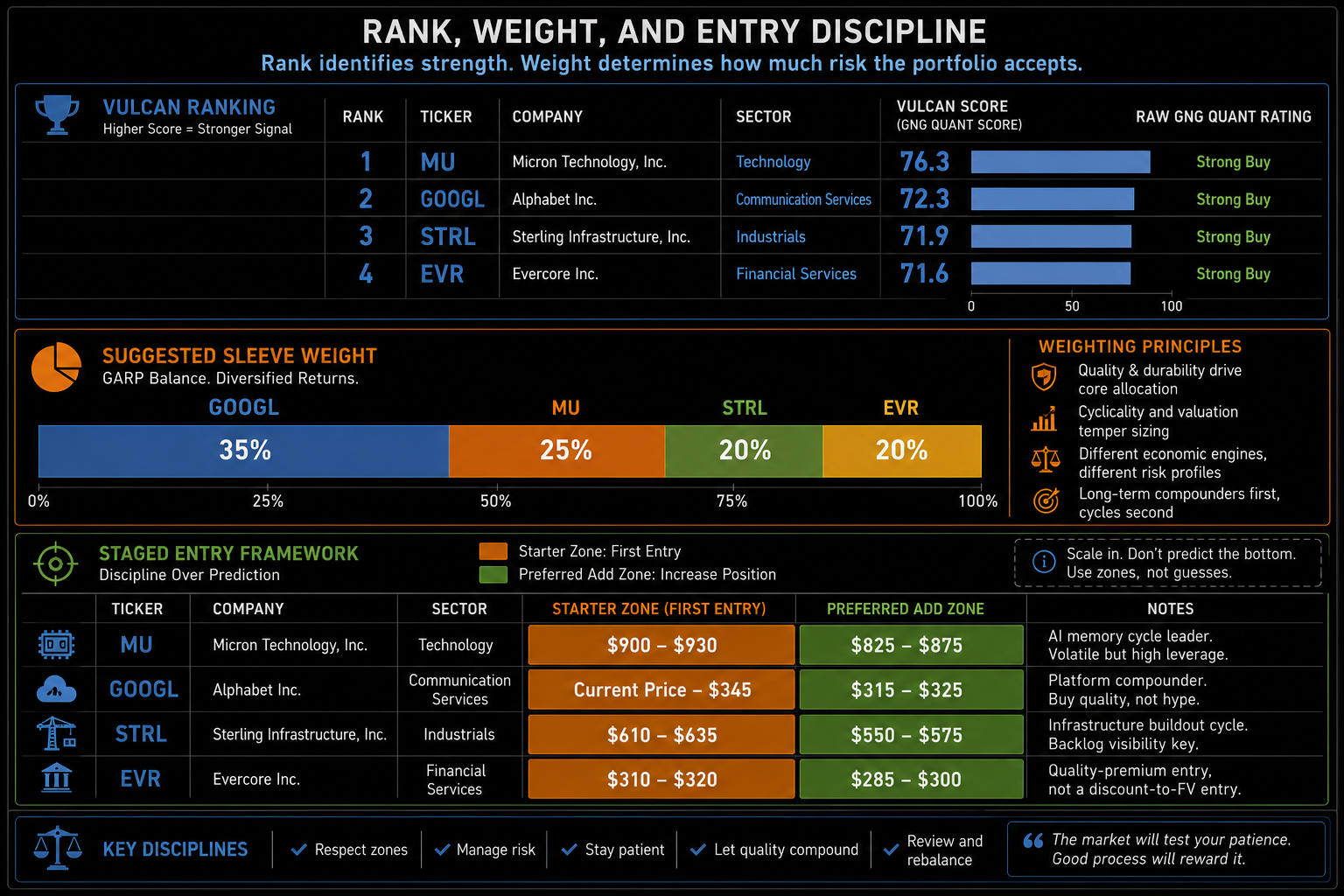
This is a four-name candidate sleeve, not a finished portfolio, and the most common mistake would be to size the names by rank.
Equal weight is the cleanest way to track them for research, at 25% each. Inside a real allocation the weighting would tilt toward durability rather than raw score. A balanced Vulcan weighting would give roughly 35% to (GOOGL) as the cleanest platform compounder, 25% to (MU) with the memory-cycle risk respected, 20% to (STRL) so construction beta matters without dominating, and 20% to (EVR) as the capital-market recovery engine.
Aggressive investors could lift (MU) and (STRL). Conservative investors should let (GOOGL) anchor the sleeve with (EVR) second. Micron ranks first because it posted the best score in the screen, and that fact alone does not entitle it to the largest position. The furnace tells you which pieces are strong. How much stress to put on each one is a separate decision, and it belongs to portfolio construction.
Buy-Zone Framework
These are execution zones for a screened GARP shortlist rather than formal full-deep valuation ranges. Full Vulcan buy ranges would require complete valuation triangulation, external fair-value anchors, and scenario modeling.
Ticker | Recent Price | Starter Zone | Preferred Add Zone | Thesis Review Trigger |
|---|---|---|---|---|
(MU) | ~$985 | $900 to $930 | $825 to $875 | HBM pricing weakness, memory overbuild, gross-margin rollover |
(GOOGL) | ~$359 | Current to $345 | $315 to $325 | Search slowdown, Cloud backlog not converting, capex outrunning AI revenue |
(STRL) | ~$660 | $610 to $635 | $550 to $575 | Backlog deterioration, EBITDA margin below 20%, guidance cut |
(EVR) | ~$345 | $310 to $320 | $285 to $300 | Advisory slowdown, comp-ratio pressure, weak capital return |
For (EVR), even the add zone sits above the GNG fair-value estimate near $239, so these are quality-premium entries rather than discount entries.
Five Risks That Can Break the Basket
AI spending fatigue is the clearest threat. Micron, Alphabet, and Sterling all lean on AI infrastructure demand, so a material slowdown in hyperscaler capex would pull one of the basket's strongest cross-name drivers at once.
Valuation compression is the second. Micron and Sterling have already moved sharply, and if rates rise or growth multiples contract, strong fundamentals will not fully shield the names from drawdowns.
Cycle timing is the third. Micron rides memory cycles, Evercore rides capital-market cycles, and Sterling rides project execution and backlog conversion. None of these is a bond substitute, and each can turn on its own clock.
False precision in analyst targets is the fourth. The screen used analyst upside as a filter, and targets lag fast-moving stocks, which is the reason the process did not stop at upside and layered valuation and quality on top.
Sector opportunity cost is the fifth. The one-per-sector rule improves diversification and, in the same motion, excludes strong names like Nvidia, Prologis, Pan American Silver, and United Therapeutics, each of which may still merit separate work.
Final Decision
The GNG Research Terminal handed over a disciplined starting universe of large-cap U.S. equities with strong quant ratings, supportive analyst ratings, and minimum upside. That was the quarry. Vulcan then applied the furnace, reranking by numeric strength, capping sector duplication, separating speculative momentum from durable GARP, and asking each finalist to justify a place in a four-name shortlist.
The output is (MU) for AI memory, (GOOGL) for AI platform durability, (STRL) for AI and reshoring infrastructure, and (EVR) for capital-market recovery. The counter-intuitive result is that neither the highest-upside slice of the export nor the most obvious all-AI basket won. What survived the furnace was a small toolset built for four different jobs: heat, alloy, hammer, and anvil.
A screen only ever hands you raw metal. Turning it into something worth owning is the work of the furnace, which is the entire reason for a second stage after the export.
Master Metrics Table
Metric | MU | GOOGL | STRL | EVR |
|---|---|---|---|---|
Sector | Technology | Communication Services | Industrials | Financial Services |
GNG Quant Score | 76.3 | 72.3 | 71.9 | 71.6 |
GNG Quant Rating | Strong Buy | Strong Buy | Strong Buy | Strong Buy |
Wall Street Rating | Buy | Buy | Buy | Buy |
Analyst Upside | 51.7% | 21.0% | 37.9% | 14.1% |
Forward P/E | 6.1x | 25.5x | 35.1x | 19.1x |
PEG Ratio | 0.14 | 1.42 | 1.13 | 1.52 |
ROIC (GNG) | 47% | 29% | 25% | 34% |
Quality Score (GNG) | 64.9 | 83.0 | 82.9 | 83.9 |
Safety Score | 89.5 | 84.1 | 82.4 | 99.1 |
Altman Z-Score | 23.4 | 14.1 | 10.1 | 7.1 |
Piotroski F-Score | 7 | 6 | 6 | 5 |
12M Total Return | ~702% | ~103% | ~192% | ~16% |
GNG Discount to FV | +4.5% (near FV) | -23.3% (below FV) | N/A | +39.9% (premium) |
Primary Role | AI memory bottleneck | AI platform compounder | Physical AI infrastructure | Advisory cycle recovery |
References
GNG Research Terminal screen output and Vulcan-mk5 field mapping, scoring, and ranking workflow. Data cross-validated against gngresearch.csv and vulcan_chunk files, July 2026.
Alphabet Q1 2026 results and earnings call: Google Cloud revenue and operating income, backlog, Search growth, and 2026 capex guidance (company filings and earnings coverage, April 2026).
Sterling Infrastructure Q1 2026 results and raised 2026 guidance (company release and earnings coverage, May 2026).
Evercore Q1 2026 results, dividend increase, and capital return (company release and earnings coverage, April to May 2026).
Micron U.S. investment expansion and long-term customer supply agreements (news coverage, July 2026). Independent valuation reference for the Evercore premium (Morningstar, 2026).
Live quote references for MU, GOOGL, STRL, and EVR as of the week of July 13 to 15, 2026.
Confidential, Vulcan Project. Not investment advice.
Sign in to leave a comment and join the discussion.
Sign Up Free