

Introduction
I get some version of the same message about twenty times a week. "Leo, what do you think of X?"
I love these messages. I answer as many as I can. But if I had a dollar for every time I've typed out a careful three-paragraph reply and then realized I had answered a completely different question than the one being asked, I could fund a decent starter position in something.

Which brings me to the picture above.
What Is That?
It's a chicken.
Every single one of you got that right. We all know it's a chicken.
Now let me ask a different one. Is Lowe's (LOW) a buy?
Some of you say yes, because it's half of a duopoly trading 29% below its high, while I am typing this. Some say no, because comparable transactions fell 2.1% and the CFO just gave bad guidance. Some say it depends on mortgage rates, which would be a really good answer (but that's not the point today).
All three of you are right.
Here's why. "Is Lowe's a buy" is a fragment.
A chicken is a chicken because "what is this" contains everything it needs. "Is this a buy" contains almost nothing. Buy at what price? Over what horizon? Funded by selling what? Instead of what alternative? And wrong under what circumstances?
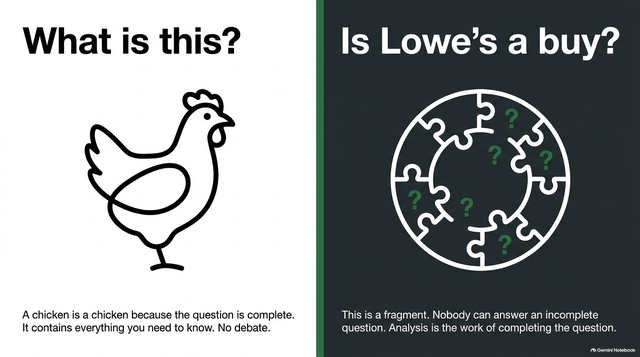
I have to say that in college when we discussed SMART questions, I never really paid attention, nor did I care. However, there's a lot to be learned from asking questions, as nobody can answer an incomplete question. This means that everybody answers a slightly different one and then argues about it.
That never leads to anything. It also applies to politics sometimes.
So here is the thing I want from this piece. If you stop reading now, you've still gotten your money's worth:
Analysis is the work of completing the question.
Everything below fills in one more variable. By the end, you should be able to write this about any company on earth (for most of them, anyway):
I think [company] compounds free cash flow per share at [rate] for [years], because [durability reason]. At [price] the market implies [different rate]. My horizon is [X]. I am wrong if [specific, checkable thing] happens.
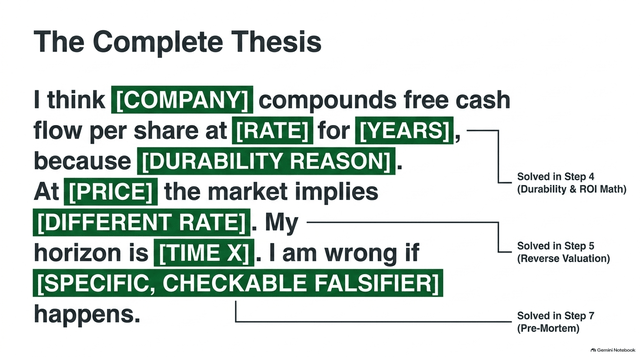
Can't fill it in? Then you don't have a thesis. That sounds harsh, but if you know me, you know that I believe in simple rules and techniques. And if I had applied this when I started investing, I would have been way richer now, as I couldn't apply this to most of my investments (I'm talking about a period 14-ish years ago).
One more thing before we start, and it's uncomfortable. "I don't know" is a valid output. Usually it's the correct one. Hendrik Bessembinder (who I often bring up) studied nearly 26,000 U.S. stocks going back to 1926 and found the best four percent of listed companies explain the entire net wealth gain of the U.S. market. Everything else, collectively, matched Treasury bills. Only 42.6% of stocks beat one-month T-bills over their own lifetimes.
In other words, most stocks are not worth owning.
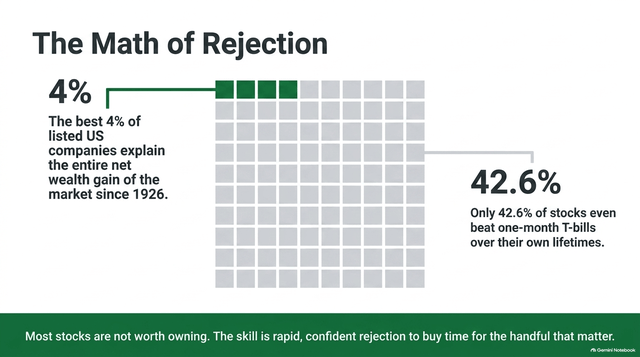
That's why I often say that knowing what company to avoid is often a better skill than knowing what company to buy, especially for retail investors who tend to buy everything they like (been there, done that).
This entire article is based on that, as I want to help people understand my method and get a framework that helps them do the homework themselves. And even if you're a pro (many people reading this have been investors before I was born), I think there might be some helpful stuff in here.
Sign in to leave a comment and join the discussion.
Sign Up Free