Hedging a Portfolio with Options - Options Series Part 1
Hedging secures realized gains by converting open-ended losses into a known, survivable worst-case, preserving compound returns - insurance with an explicit, quantifiable cost and strong regime dependence
Options suit hedging due to asymmetry - limited premium downside with open-ended protective payoff, precision of strike and expiry selection, and capital efficiency where small premiums hedge large positions
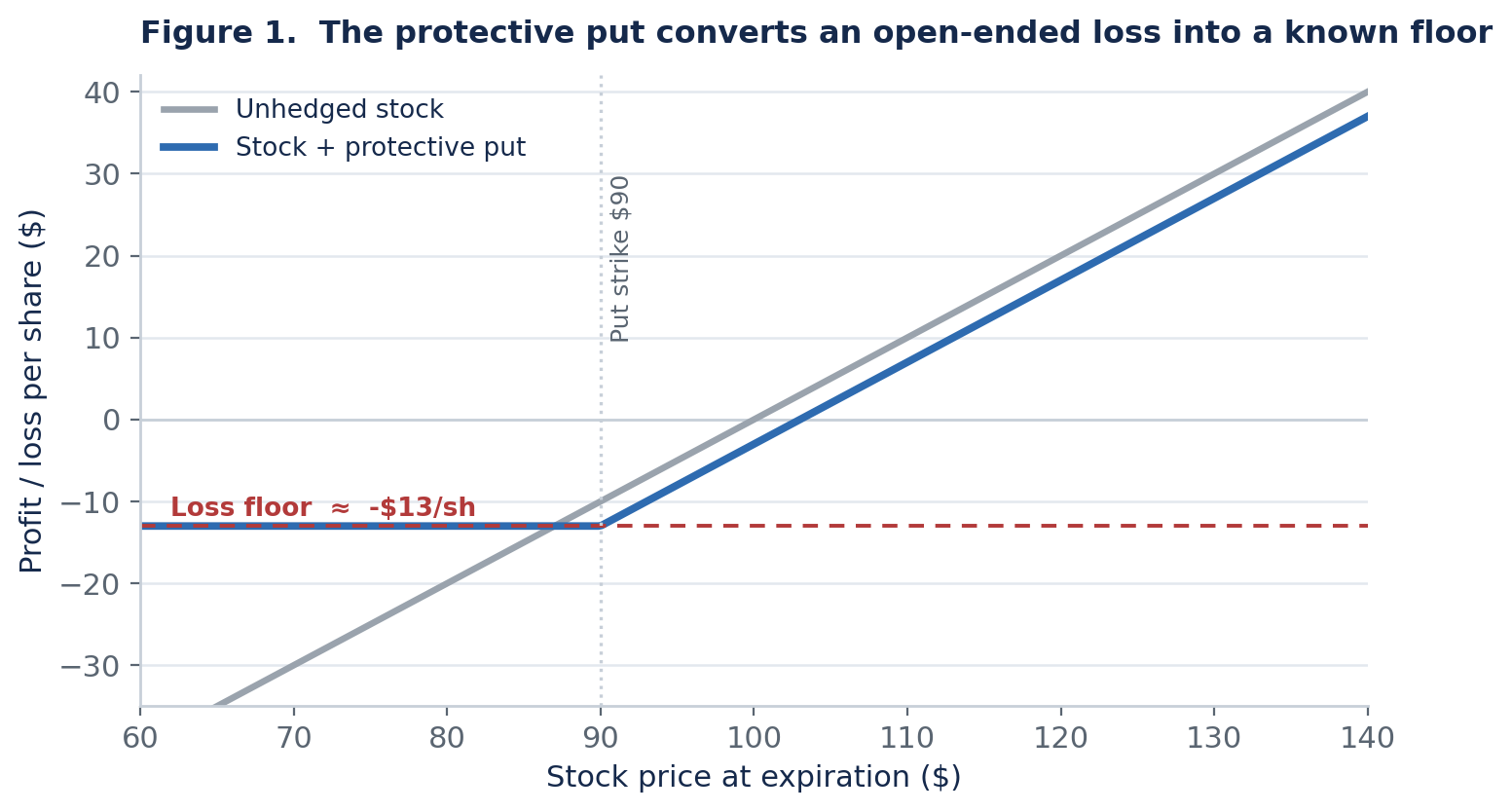
Protective put example: buy one 90-strike put on a $100 position for $3.00, capping worst-case loss to roughly $13 per share while retaining full upside less the premium - use for concentrated or taxable positions
Collar example: buy 90 put for $3.00 and sell 112 call for $2.80, net cost ~$0.20 per share - materially lowers carry but surrenders upside above $112, appropriate if willing to forfeit shares on a rally
Implementation framework - treat hedges as position-sizing decisions not market calls, use selectively around events, monitor theta and IV, plan premium budget or collars to manage recurring carry and roll costs
CConnor Graham
May 26, 2026·7:05 PM·340·0
Most long-term investors struggle at least once with which assets to own and for how long. Hedging addresses the opposite question.. how to secure the gains you have already earned when the market turns against you.
This article introduces options as a tool suited for the task. It frames hedging as a form of insurance with an explicit, quantifiable cost, then walks through the two foundational structures every member should understand before anything more advanced (protective put and the collar).
We model their payoff profiles, examine the cost of carrying protection through a calm market (premium) and compare drawdowns under a crash scenario.
The conclusion is deliberately unglamorous.. hedging is never free and is rarely always-on. We will address Zeus's non-traditional approach later in the series. and its value is conditional on regime.
Used with discipline, however, it converts an open-ended loss into a known, survivable one, preserving the ability to compound.
The full analysis continues with our complete valuation breakdown, downside risks, and position sizing.
Subscribers see specific entry and exit targets plus our forward-looking commentary.

Sign in to leave a comment and join the discussion.
Sign Up Free