

I have to admit that going with "masterclass" in the title made me cringe a little bit, even though I did it myself. After all, it implies that I believe I'm a highly accomplished expert, or anything along those lines. I would never call myself that.
However, in light of recent in-depth articles where I put a lot of emphasis on the educational side, I think it would reflect the content of this article quite well.
And to get started right away, I want to show you two numbers from the same fund.
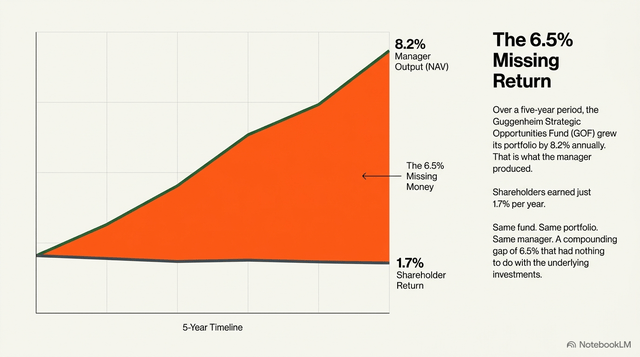
Over the past five years, the Guggenheim Strategic Opportunities Fund (GOF) grew its portfolio at 8.2% per year. That is the NAV (net asset value) return. It is what the manager actually produced with the assets.
Over that same five years, shareholders earned 1.7% per year.
It's the same fund with the same portfolio and the same manager, and a gap of roughly 6.5 percentage points annually, compounded, and not a single cent of it had anything to do with the investments inside the fund.
That gap is the entire subject of this article.
I have written a lot about the gap between a fund's distribution rate and what the fund actually earns. That is one gap. Closed-end funds ("CEFs") stack three of them on top of each other, and if you only know about the first one, the other two will eventually take money from you without you ever understanding why.
So today I want to walk through all three properly.
And, as I already briefly mentioned, this is a teaching piece, not a ranking. By the end, you should be able to open any CEF page and know within about five minutes whether it deserves your money.
Now, let's dive in!
First, What You Are Actually Buying
A closed-end fund raises money once, at IPO, and then closes. The share count is fixed. From that day forward, you are not buying shares from the fund, and you are not selling shares back to it. You are trading with other investors on an exchange, exactly like a stock.
This one structural detail creates everything else.
So, bear with me.
An ETF has authorized participants who create and redeem shares all day, which is the arbitrage mechanism that pins the price to the value of the holdings. A CEF doesn't have that. So, the price does whatever supply and demand tell it to do, and the value of the underlying portfolio does whatever the assets do, and those two numbers are free to drift apart for years.
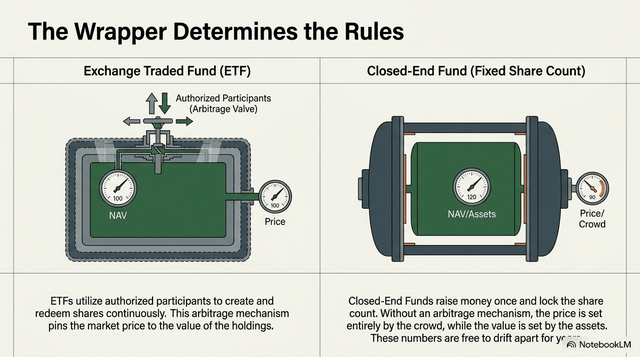
The closed structure buys you something real in exchange. Because the manager never faces redemptions, they can own things that would be dangerous inside a daily-liquidity wrapper. Think about municipal bonds, senior loans, private credit, preferred stock, infrastructure equity. They can also borrow, and the 1940 Act allows it up to 300% asset coverage for debt and 200% for preferred shares. That's the leverage part.
That last part matters more than most people realize. The leverage lives inside the fund. You cannot get a margin call on a CEF you bought with cash. The fund can be forced to deleverage, which is bad, but the liability is never yours personally. This is very important to mention. After all, if you, personally, buy stocks with leverage, the risks are different. Now, you can get a margin call or watch your assets implode.
In other words, you get access to better assets and structural leverage. In exchange, you accept that the price you pay is set by a crowd, not by arithmetic.
Now the three gaps.
Gap One: Price Versus NAV
The discount or premium is just the price divided by NAV, minus one.
A fund at $19 with a $20 NAV trades at a 5% discount. At $12 with a $10 NAV, it trades at a 20% premium.
Simple, right?
In the first case, you're buying $20 for $19. In the other, you're getting $10 worth of assets for $12.
Here is where almost everyone goes wrong. They see a wide discount and think it's a bargain.
A discount is not a bargain. I think many investors in areas like Business Development Companies will agree with me here, as I have often explained that I happily pay a premium if I can get quality in return. A discount relative to that fund's own history might be. Those are completely different statements, and the difference is where the money is.
Take the Adams Diversified Equity Fund (ADX). This thing has been running since 1929. It is a plain large-cap equity portfolio, no leverage, expense ratio around 0.59%, which is cheap enough to embarrass most active managers. Over the past decade, its discount has averaged 14.5%. That is just how ADX trades, and it has traded that way for longer than any of us have been investing.
If you bought ADX at a 14% discount thinking you had found free money, you did not. You found the normal price.
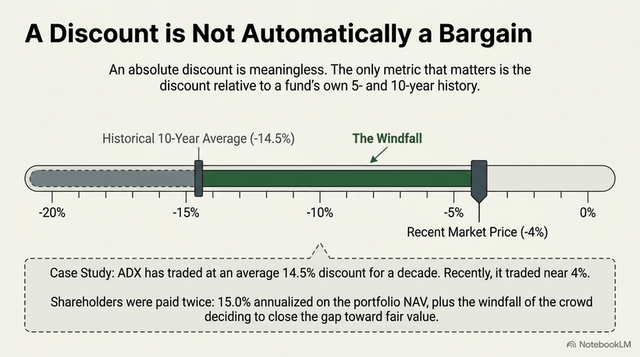
But look at what happened recently. ADX has been trading near a 4% discount this year. Its five-year annualized NAV return through the end of 2025 was 15.0%, and 2025 alone was 18.9% on NAV. So the portfolio did well, and on top of that the discount compressed from its long-run 14.5% toward 4%. Shareholders got paid twice. Once by the assets, once by the crowd deciding to pay closer to fair value.
That second payment is the part people miss. It also runs in reverse.
Which brings us back to GOF. Over the past five years, GOF has traded at an average premium of roughly 23%. Think about that for a second. That's 23% above the value of what it owns. In late 2025, that premium had compressed to around 6%, and this year the fund has been trading well below where it was.
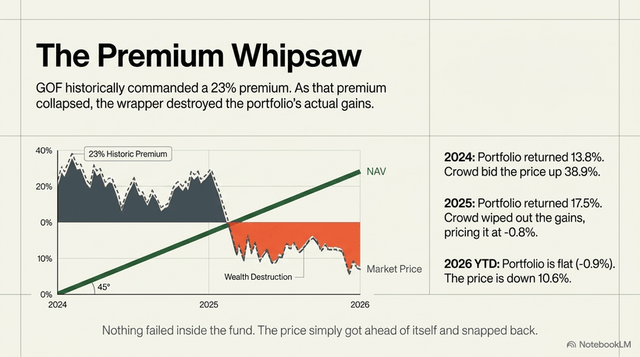
Now, watch the whipsaw. In 2024, GOF returned 38.9% on market price against 13.8% on NAV. The portfolio made you 14%, the crowd made you the other 25%. In 2025, market price returned negative 0.8% while NAV returned 17.5%. The portfolio made you 17.5%, the crowd took back 18%. Year to date in 2026, market price is down 10.6% while NAV is down 0.9%.
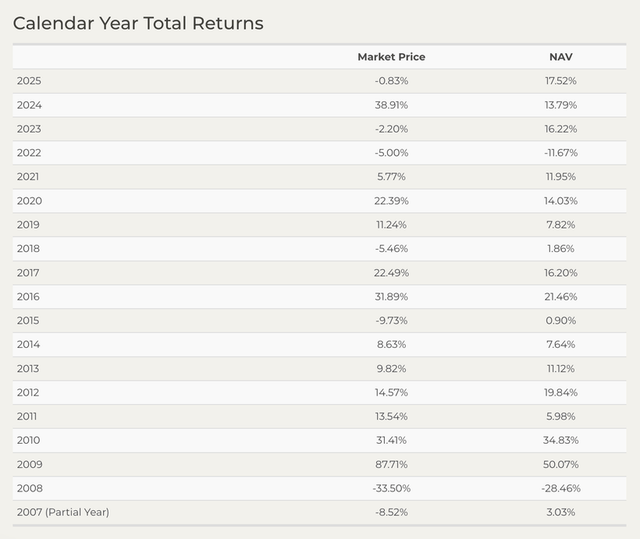
All of this tells us that this is a fund whose price got ahead of itself and then came down.
So the rule I use is simple. I never look at an absolute discount without looking at the fund's own five- and ten-year average alongside it. A fund at a 5% discount that normally trades at 15% is expensive. A fund at a 5% premium that normally trades at 20% might be cheap. The headline number tells you nothing on its own. In general, that applies to many data sets.
And one more thing, because this is the part that gets sold to people. Nothing forces a discount to close. There is no mechanism, no deadline, no arbitrageur whose job it is to fix it. Funds can trade cheap for decades because they deserve to.
This can be because of weak performance, unstable distributions, a bad asset class, or a manager nobody trusts.
If you buy a CEF that deserves a discount, nothing will change.
Gap Two: Leverage
Most income CEFs borrow, as they use leverage. This is the second thing you are buying without realizing it.
The Cohen & Steers Infrastructure Fund (UTF) is a good one to learn on, because the disclosure is unusually clean. UTF runs leverage at about 30% of managed assets, as we can see below. On $4.4 billion in managed assets, that is a lot of borrowed money working alongside your equity.
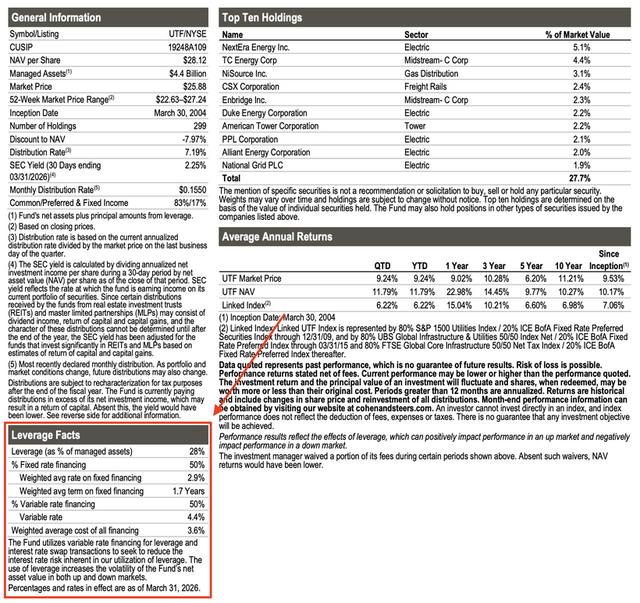
Leverage does exactly what you would expect. It magnifies the good years and the bad ones, and it turns the fund's cost of borrowing into a permanent line item that has to be paid before you see a cent.
Now here is the number that actually matters and that nobody checks (at least, not enough people). UTF's weighted average cost of financing is slightly above 3.0%, with 67% of it fixed and 33% variable, and management has locked portions of that financing through 2028 using interest rate swaps.
Read that again. In a world where the front end of the curve is nowhere near 3%, this fund is borrowing at 3.2% because somebody had the discipline to term it out and hedge it. That is a genuine competitive advantage, and it is invisible unless you go looking in the annual report.
Compare that to a fund running mostly floating-rate leverage in the same environment. It's the same asset class, same market, with wildly different economics. Under a Fed that is still leaning higher for longer, the fund with unhedged floating borrowings watches its net investment income get eaten from the inside while the hedged one carries on.
This is the single most underrated line of research in the entire CEF universe. Two funds can look identical on the screener and have completely different cost structures underneath. I truly cannot repeat this enough.
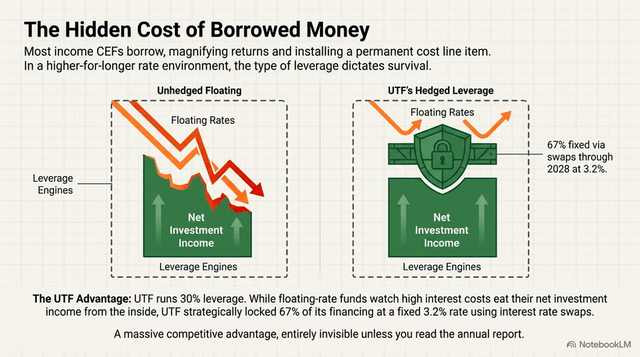
The questions are always the same three. How much leverage, what does it cost, and how much of that cost is fixed versus floating. If a fund makes those hard to find, you should already ignore it. It's like a gas station that tries to hide its prices.
One caveat on UTF, and I want to be fair about it. Roughly half of its leverage has been variable-rate, and if rates keep pushing higher, the interest expense rises with them. The swaps cover a portion, not everything. In other words, even hedges roll over at some point. It is a well-run fund, but not a bulletproof one.
Gap Three: What The Distribution Is Actually Made Of
Every CEF that pays a big distribution has to fund it from somewhere, as obvious as that may sound.
There are only four places where it can get funding.
Net investment income,
Short-term realized gains,
Long-term realized gains, and
Return of capital.
Technically, three groups, as I put capital gains into two groups.
Return of capital is the one everybody panics about, and mostly for the wrong reason.
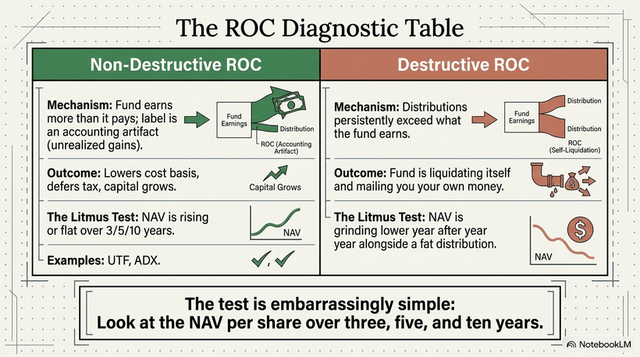
Here is UTF's January distribution. Of $0.1550 per share, about 21% came from net investment income and about 79% was classified as return of capital.
That looks terrible. Now put it next to the fact that UTF returned 15.65% on NAV in 2025.
Both are true at once, and understanding why is the whole lesson. UTF holds infrastructure equities. Those go up in value, but unrealized appreciation is not income and does not count as investment income for distribution accounting. So the fund pays out a distribution that gets labeled return of capital even though the portfolio grew far faster than the payout. The NAV did not shrink at all. In fact, as I just showed, it went up.
That is non-destructive return of capital. Your cost basis goes down, which defers tax rather than eliminating it, but no capital was actually destroyed.
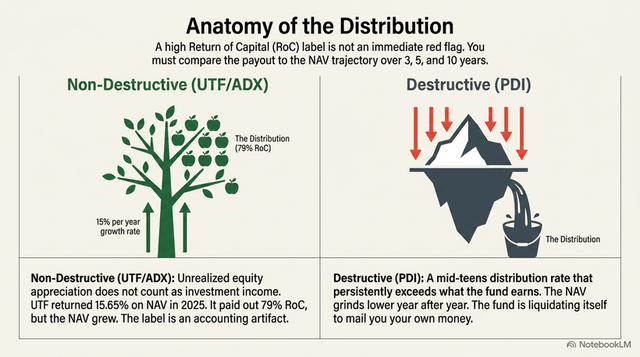
ADX does the same thing. Its February distribution was 13% net investment income, 9% long-term gains, and 78% return of capital, against a five-year NAV return of 15.0% and a distribution rate around 7.6%. The fund is earning far more than it pays.
Destructive return of capital is the other animal entirely, and the test is embarrassingly simple. Look at NAV per share over three, five, and ten years. If the fund is paying a big distribution and NAV is grinding lower year after year, the fund is liquidating itself and giving you the proceeds.
Which brings me to the fund I get asked about constantly.
The One I Would Not Own At Just Any Price
The PIMCO Dynamic Income Fund (PDI) is one of the most widely held CEFs in retail portfolios, and I understand why. PIMCO is a genuinely excellent credit shop. The fund runs about $7 billion, and the track record since its 2012 inception is around 10.6% annualized on NAV, and the distribution rate has run in the mid-teens.
I am not going to tell you PIMCO cannot manage credit. They obviously can. Heck, PIMCO is a credit giant.
Here is my problem. PDI's distributions have persistently exceeded what the fund earns, which pressures NAV. It runs leverage around 32%. Its expense ratio is 1.67%, which on a leveraged fund is a serious drag. And it has historically traded at a premium averaging somewhere in the 12% to 18% range, with roughly 5% to 7% premiums looking cheap by that standard.
Now look at what shareholders actually received. Over five years, PDI returned 3.8% annualized on market price against 6.2% on NAV. Over ten years, 8.2% on market against 8.7% on NAV. Since inception, the two are close, 10.7% versus 11.0%.
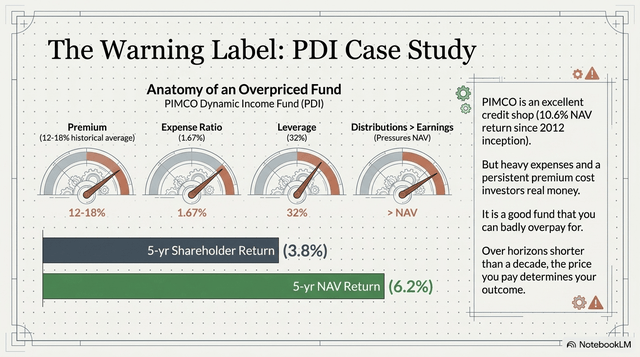
So, over long horizons, the premium roughly washes out. Over five-year holding periods, it cost investors real money. And the shorter your horizon, the more the premium dominates everything else.
That is my honest position on PDI. It is not a bad fund. It is a good fund that you can badly overpay for, and the price you pay determines most of your outcome over any horizon shorter than a decade.
Which is a very different sentence from "avoid this fund." I want to be precise, because I think a lot of CEF commentary is lazy in both directions.
Something Happening Right Now That Most Holders Do Not Know About
BlackRock (BLK) is running discount management programs across certain of its closed-end funds. If a fund's shares trade at an average daily discount wider than 10% during the measurement period, the fund intends to conduct a tender offer for at least 5% of outstanding shares at 98% of NAV.
The measurement period started on January 1, 2026, and runs through September 30, 2026. As of the June 30 update, most funds in the programs were trading below the 10% trigger.
I bring this up for a reason that has nothing to do with trading it.
The sponsor is telling you, in writing, that a persistent double-digit discount is a problem serious enough to spend shareholder money on fixing it. That is the industry validating the entire premise of gap one. Discounts are not cosmetic. If anything, they are a real transfer of value away from shareholders, and the people running these funds know it.
It is also worth understanding what a tender at 98% of NAV does. It hands a small slice of holders a near-NAV exit, which is a genuine floor of sorts, but 5% of shares does not permanently repair a structural discount. Treat it as a signal about sponsor behavior, not as a catalyst you can underwrite.
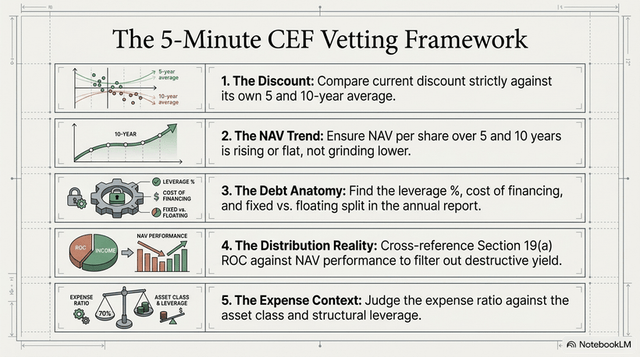
How I Would Vet Any CEF In Five Minutes
This is the part I would actually save.
One. Current discount versus its own five- and ten-year average. Not the absolute number. The relative one. If you only do one thing, do this.
Two. NAV per share over five and ten years. Rising or flat is fine. A steady decline alongside a fat distribution means you are being paid with your own money.
Three. Leverage percentage, cost of financing, and the fixed versus floating split. It is in the annual report. Two funds in the same asset class can have opposite economics here.
Four. Distribution composition from the Section 19(a) notice, read against NAV performance. High return of capital plus a growing NAV is fine. High return of capital plus a shrinking NAV is not.
Five. Expense ratio, and check whether it includes interest expense. A 1.7% fee on a leveraged credit fund is a very different burden than 0.6% on an unlevered equity fund.
If a fund passes all five, you still have to like the underlying assets. The wrapper alone being sound does not make the portfolio good. But it's a big part of the homework.
And obviously, I have to include the next part as well.
Where I Might Be Wrong
Two things are important here.
First, I am structurally biased toward the unlevered, cheap, boring end of this market, and that bias has a cost. Leverage works more often than it fails. A fund borrowing at 3.2% against assets yielding meaningfully more is doing something economically sensible, and my instinct to flinch at leverage has probably kept me out of good outcomes.
Second, everything I have said about relative discounts assumes mean reversion in investor sentiment. That is an assumption, not a law. ADX has traded at a wide discount for decades without correcting. GOF held a 23% premium for years, which means anyone who shorted the premium on valuation logic got run over for a long time before being proven right. Being early on a discount argument is indistinguishable from being wrong.
So, please keep that in mind.
Takeaway
Closed-end funds are the only income wrapper where the price you pay is a separate decision from the asset you buy. That is the whole thing.
GOF's portfolio compounded at 8.2% over five years while its shareholders got 1.7%. Nothing went wrong inside that fund. Everything went wrong at the point of purchase.
So do not start with the yield. Start with what the fund holds, then what it borrows and at what cost, then what its distribution is actually made of, and only then what the market is charging you for it relative to what the market usually charges.
Get those four right and the yield takes care of itself. Get them wrong, and the yield is just the bait.
Let me know what you think!