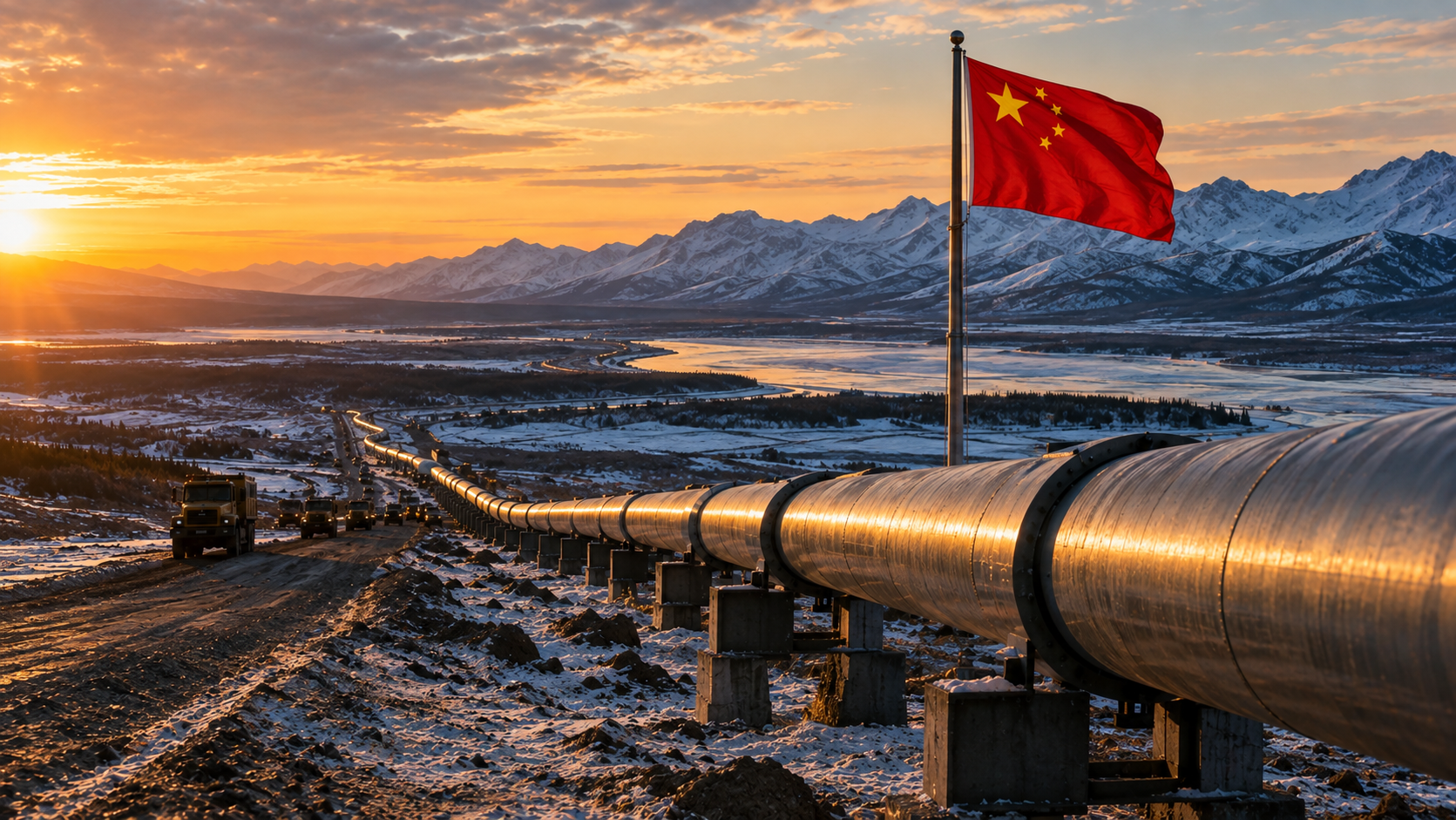

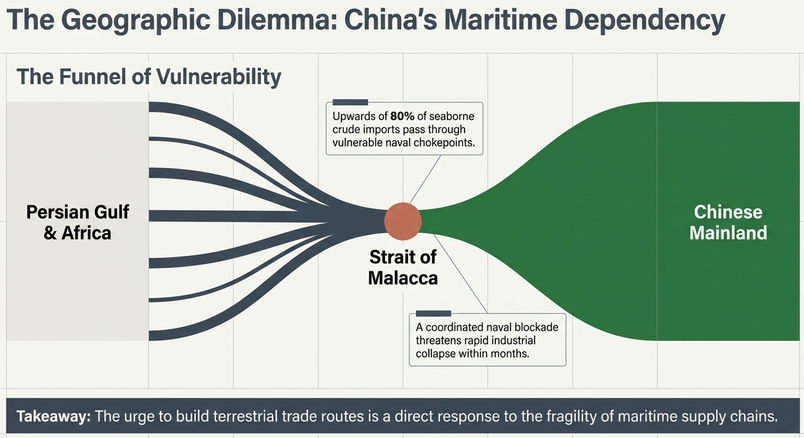
China’s energy supply chain is its most acute geopolitical vulnerability. The world’s primary manufacturing power remains fundamentally dependent on energy that travels across open oceans, moving from the Persian Gulf and Africa through narrow maritime chokepoints like the Strait of Malacca. A coordinated naval interdiction in these sea lanes would cut off the bulk of China’s raw energy inputs, threatening industrial collapse within months. To hedge against this vulnerability, Beijing has spent two decades executing a massive engineering program across the Eurasian heartland, laying thousands of miles of steel pipelines through the steppes of Central Asia and the forests of Siberia.
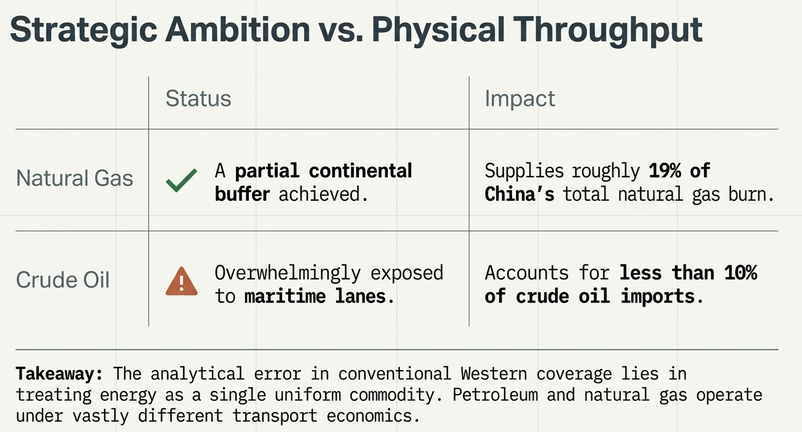
In Western capitals, this landward expansion is widely interpreted as the construction of an aggressive continental fortress. Strategic analysts frequently observe the flow of Chinese capital into Central Asian infrastructure and conclude that Beijing is building an expansionist sphere of influence to insulate itself from Pacific naval pressure. This narrative collapses when stress-tested against the physical mechanics of global commodity markets. Grounded in actual consumption data, the entire Eurasian pipeline network supplies roughly 19% of China’s total natural gas burn and accounts for less than one tenth of its crude oil imports. While these land corridors successfully bypass vulnerable sea freight routes, their modest scale proves that Beijing is pursuing a targeted energy insurance policy rather than a broad campaign for continental autarky or territorial dominance.
Chinese policymakers have understood the fragility of their maritime supply chains since the early 2000s, when leadership explicitly highlighted the strategic danger of relying on routes controlled by foreign navies. Upwards of 80% of China’s seaborne crude imports must pass through the Strait of Malacca before reaching domestic refineries. In any scenario involving a militarized crisis in the Pacific, this maritime traffic represents an immediate vulnerability. Western defense planners are correct to recognize that a state capable of keeping its power grid online and its heavy industry functioning during a blockade possesses a far wider array of strategic options. The urge to build terrestrial trade routes is a direct response to this geographic dilemma.
The analytical error in conventional Western coverage lies in treating energy as a single uniform commodity, assuming that land pipes can replace sea lanes across the board. Petroleum and natural gas operate under vastly different transport economics, and Beijing has secured a partial continental buffer for gas while remaining overwhelmingly exposed on oil. Evaluating the actual hardware of China’s Eurasian energy corridors demonstrates the sharp limit between strategic ambition and physical throughput.
The Central Asia-China Gas Pipeline system serves as the main terrestrial artery for imported gas, connecting Chinese industrial centers to the vast fields of Turkmenistan. Lines A, B, and C feature a combined design capacity of 55 billion cubic meters per year. Against China's annual gas consumption of roughly 430 billion cubic meters, this theoretical maximum represents about 13% of national demand. The operational reality is even tighter. Actual throughput from Turkmenistan has hovered between 36 and 40 billion cubic meters in recent years, meaning the core Central Asian pipeline network currently supplies less than 10% of the gas burned in China today.
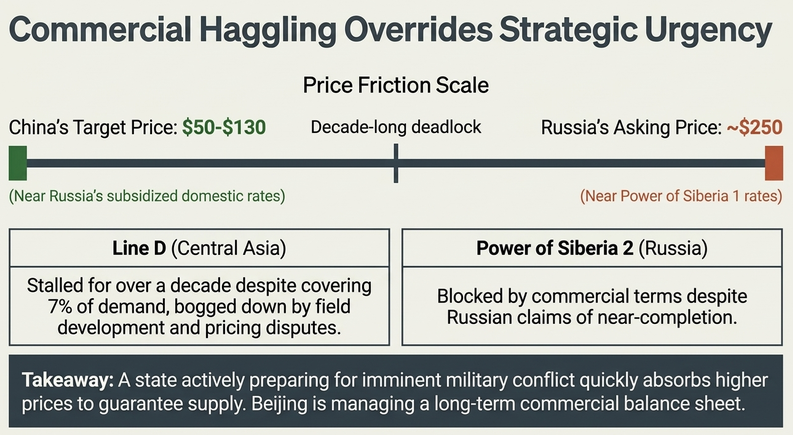
The stalled Line D project further illustrates the commercial and political friction inherent in continental infrastructure. Engineered to route an additional 30 billion cubic meters of gas from Turkmenistan through Uzbekistan, Tajikistan, and Kyrgyzstan into Xinjiang, Line D would cover approximately 7% of current national demand. Though construction on the Tajik segment began over ten years ago, the pipeline remains without a firm completion date. The delay is not driven by physical engineering hurdles, but by prolonged disputes over gas field development rights and import pricing. If Beijing were treating this infrastructure as an urgent wartime priority, state planners would not allow commercial haggling to delay completion by over half a decade.
The Russian vector of China’s gas strategy tells a similar story of commercial caution. The Power of Siberia 1 pipeline stands as a functional success, delivering approximately 38 billion cubic meters of gas annually from Eastern Siberia. Operating near its full design capacity, this route accounts for roughly 9% of China’s national gas consumption. However, negotiations over the proposed Power of Siberia 2 pipeline, designed to transport 50 billion cubic meters of gas from Western Siberia through Mongolia, have exposed deep structural tensions between Beijing and Moscow.
While Russian officials routinely announce that construction plans are approaching their final stages, the project remains blocked by commercial terms. Moscow wants to sell the gas at rates near the Power of Siberia 1 contract price of roughly $250 per thousand cubic meters. Beijing is leveraging its market dominance to demand prices near Russia’s heavily subsidized domestic industrial rates, targeting a range between $50 and $130. A state actively preparing for an imminent military conflict would quickly absorb a higher gas price to guarantee supply. Beijing's willingness to engage in a decade-long war of attrition over import costs demonstrates that state planners are managing a long-term commercial balance sheet rather than building a crash wartime economy.
Official Chinese targets project total overland gas pipeline capacity to reach 114 billion cubic meters by the end of the decade. Measuring this target against long-term demand growth puts the strategic outcome in focus. By 2030, Chinese natural gas consumption is expected to reach 550 billion cubic meters per year. Even if state-owned energy companies hit their import capacity ceiling, overland pipelines will supply barely 20% of national demand. Domestic production remains the primary baseline for Chinese energy security, currently generating about 60% of all gas consumed. Under the most optimistic pipeline construction timelines, terrestrial imports will serve as a supplemental baseload rather than a total replacement for imported liquefied natural gas.
The disparity between continental supply and national demand is far more stark in the crude oil sector. China consumes roughly 11.5 million barrels of imported crude oil per day during standard operating periods. The Kazakhstan-China oil pipeline, which runs from the Caspian coast to Xinjiang, features a design capacity of 20 million tonnes per year, or roughly 400,000 barrels per day. This maximum capacity covers less than 4% of China's daily crude import requirements. Furthermore, actual flows of native Kazakh crude through the system remain minimal, with the line operating primarily as a transit pipe for Russian oil. Planned expansions slated through 2030 will yield only minor capacity gains that fail to alter China’s systemic reliance on maritime tankers.
The Sino-Myanmar crude oil pipeline provides another example of strategic intent constrained by physical realities. Engineered to bypass the Strait of Malacca by receiving tankers on the Bay of Bengal and piping crude into southwestern China, the system has a design capacity of 440,000 barrels per day, covering roughly 4% of daily import demand. Domestic instability within Myanmar and operational bottlenecks have consistently kept the pipeline running below its rated throughput. More importantly, this pipeline does not remove maritime risk, it merely shifts the offloading point. Crude oil must still travel via vulnerable ocean-going tankers across the Indian Ocean to reach the terminal at Kyaukphyu.
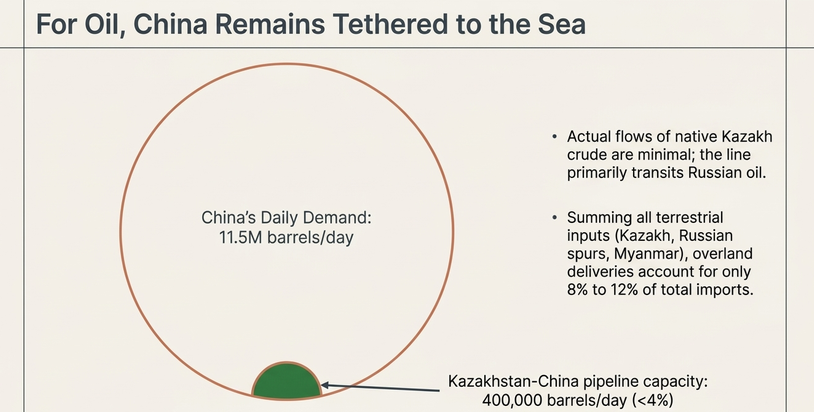
Summing all overland crude inputs, including pipeline spurs from Russia, the Kazakh system, and the Myanmar route, true terrestrial oil deliveries account for only 8 to 12% of China’s total imports. Over 90% of the crude required to power Chinese transport, manufacturing, and military logistics must move over sea lanes. When market shocks or regional crises interrupt seaborne trade, as occurred this year when Chinese crude imports temporarily dropped to 8.1 million barrels per day, Beijing must rely on strategic stock draws and domestic demand suppression. The Chinese state possesses no land-based oil project capable of replacing maritime trade.
The political environment in Central Asia further disproves the notion that China is securing an absolute sphere of control through infrastructure spending. Sovereigns like Kazakhstan, Uzbekistan, and Turkmenistan are not passive subjects in a regional game. They manage complex multi-vector foreign policies designed to preserve their own independence. Central Asian governments routinely prioritize domestic heating and industrial demand during severe winters, unilaterally reducing natural gas exports to China to avoid domestic unrest. These states actively cultivate trade ties with Europe, Turkey, and the Middle East to balance Chinese influence.
Kazakhstan offers clear evidence that host nations retain complete sovereign independence despite heavy Chinese infrastructure investment. Even with deep trade ties to Beijing and security agreements with Moscow, the government in Astana publicly refused to endorse Russia's territorial claims in Ukraine. Central Asian leadership views Chinese energy investments as a tool to monetize national resources and break historical dependencies on Russian transit grids. In return, Beijing gains reliable access to raw commodities and establishes regional engineering standards without taking on the burden of military garrisons or territorial defense guarantees.
Similarly, non-energy infrastructure projects across the Eurasian corridor reflect commercial trade mechanics rather than military expansionism. The China-Kyrgyzstan-Uzbekistan railway, currently undergoing heavy tunnel construction through mountain passes, is designed to reduce overland freight times to Europe and the Middle East by roughly a week. The route will handle containerized cargo, accelerating the transit of manufactured goods. Conflating a commercial rail corridor built for freight velocity with a strategic energy pipeline confuses two distinct operational goals. High-speed rail connections generate trade revenue, but only bulk molecules can power heavy industry.
Assessing Western strategic anxiety against actual trade data requires evaluating what these pipelines can and cannot achieve in a crisis. The prevailing fear that Beijing has engineered an invulnerable continental economy is contradicted by basic import ratios. A sustained naval blockade during a major military confrontation would immediately sever nine-tenths of China's imported crude oil, triggering severe industrial contractions and forcing emergency rationing regardless of how much gas flows out of Central Asia or Russia. Furthermore, replacing maritime dependence on open sea lanes with a total reliance on Russian state energy companies merely exchanges one vulnerability for another.
The true strategic function of China’s Eurasian infrastructure is to raise the baseline threshold of national resilience. The pipeline gas that flows overland, representing roughly a fifth of national consumption, guarantees that key industrial nodes, fertilizer production, and urban utilities remain operational during a maritime blockade. This overland supply prevents an immediate economic collapse under international sanctions, giving Chinese leadership additional endurance during a prolonged crisis. The pipelines do not grant immunity from economic pressure, but they reduce the immediate downside risks associated with a major maritime confrontation.
The pace of pipeline development offers a clear indicator of Beijing’s strategic planning. If Chinese state entities begin signing un-economic gas contracts at above-market prices to accelerate construction schedules, it would signal a transition toward emergency war planning. Conversely, as long as state planners continue to haggle over import pricing, insist on commercial terms, and accept long construction delays, Beijing is acting as a disciplined commercial buyer. The current data shows a steady, price-sensitive effort to secure secondary energy supply chains without committing the vast capital required to execute a total, crash-program pivot away from the sea.
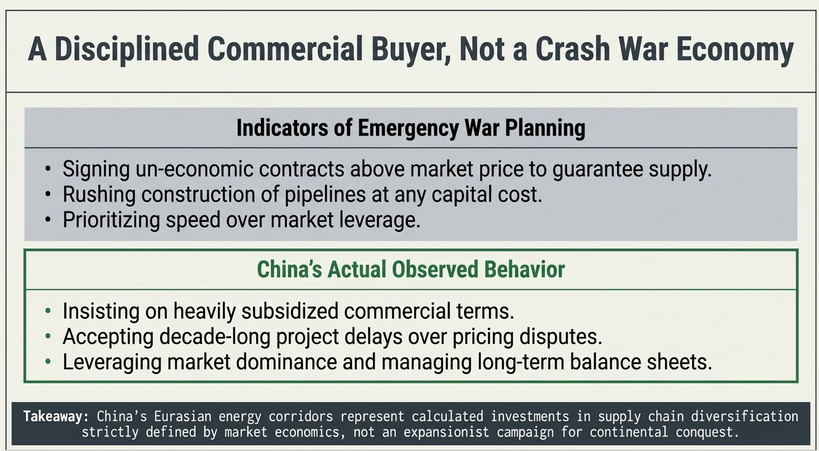
China’s Eurasian energy corridors are best understood as calculated investments in supply chain diversification. By securing roughly 20% of its gas requirements and a fraction of its oil demand via overland routes, Beijing has bought a measure of strategic optionality. These pipelines alter the defensive calculations of the state by protecting core utility networks from total maritime interdiction. However, they do not represent an expansionist campaign for continental conquest or a total retreat from the global ocean economy. They are practical tools of energy security, strictly defined by market economics and the physical limits of landward transport.
Sign in to leave a comment and join the discussion.
Sign Up Free