

RRKLB
    IIRDM
    PPL
    AASTS
    LLMT
    Defense and AerospaceSpace StocksBarbell Strategy

    Orbital Infrastructure: Six Public-Market Windows Into the Space Economy's Real Growth Phase

    Orbital Infrastructure: Six Public-Market Windows Into the Space Economy's Real Growth Phase
    • The most valuable company in the global launch economy executed roughly half of all orbital launches in 2025. It's not publicly traded. The six names that are may be the next best allocation.
    • One name in this basket carries an 8.36% free cash flow yield, a Piotroski score of 8 out of 9, and a 26% operating margin. Nobody calls it a space stock. The data disagrees.
    • A satellite data company just reported remaining performance obligations up 106% year-over-year, crossed into positive free cash flow, and is moving to 30 cm-class resolution. The upgrade cycle is the next catalyst.
    • Two major U.S. carriers have signed definitive commercial agreements for direct-to-device satellite broadband on unmodified smartphones. The regulatory and technical milestones that separate "signed" from "scaled" are th
    • The space economy's picks-and-shovels play carries a 5.2% gross margin and a Wall Street consensus that sees 46.7% upside. The gap between analyst price targets and financial fundamentals tells you exactly which risks th
    • The defense and space ballast name in this basket has a Safety Score of 90.59, 21.7% ROIC, and revenue exposure to the spacecraft designed to carry humans back to deep space. Beta of 0.19 makes it the portfolio shock abs
    • All six names logged 12-month returns between 20% and 1,000%. All six also logged peak-to-trough drawdowns of 40% to 92% in the same period. Position sizing is not optional in orbital infrastructure.
    Glenn Ford
    Apr 15, 20261:23 PM3740

    The real space trade isn't rockets. It's recurring data, contracted backlogs, and the utilities that carry every signal leaving Earth.

    Somewhere above your head right now, roughly 11,000 active satellites are transmitting the signals that route financial transactions, coordinate precision agriculture, and feed military reconnaissance networks. Most investors are aware that space is "big." Fewer have noticed that the business model has fundamentally changed, and that change is now showing up in audited financials.

    The launch cadence metric says it plainly: 2025 saw approximately 325 orbital launches, a record, with SpaceX executing 165 of those flights and representing roughly half of all global orbital launches for the year. Here is the counterintuitive wrinkle Wall Street tends to miss. SpaceX's dominance is not a threat to every public space name; for several of them, it's a distribution channel. Rocket Lab flies missions that require dedicated rideshare economics SpaceX doesn't prioritize. Planet Labs' daily Earth-imaging coverage operates independent of any single launch provider. Iridium's 66-satellite L-band constellation was launched years ago and generates revenue whether SpaceX flies 165 or 265 missions next year.

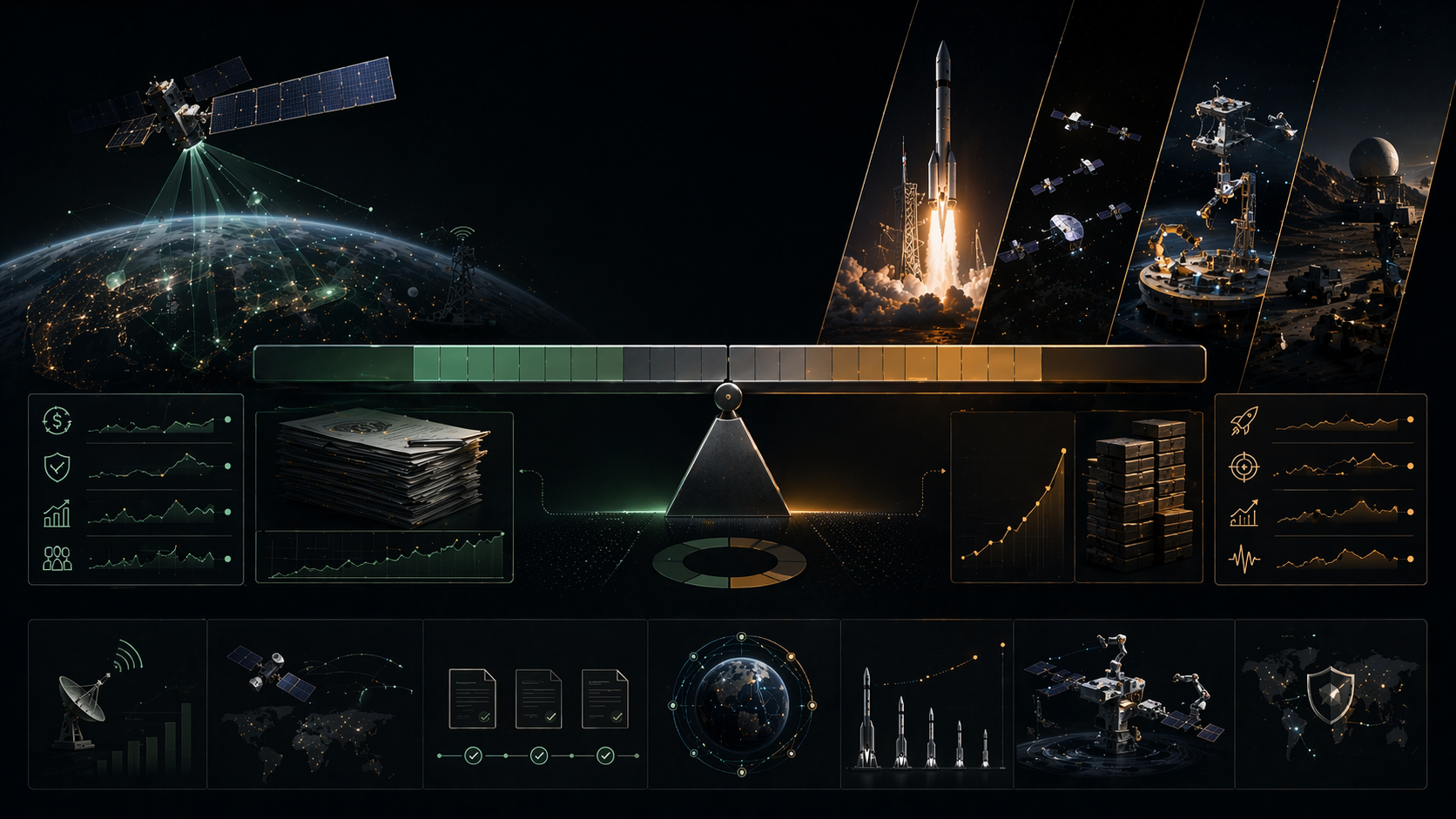
    The actual space trade in 2026 is a barbell. On one end: high-growth infrastructure builders with real contracted backlogs and expanding unit economics. On the other: a utility-grade recurring-revenue anchor that behaves like a telecom dressed in a space costume. In between: a pair of option-like names that are genuinely compelling if you size them to match the binary risk. The six names below represent every meaningful sub-sector in the investable public market.
    Keep Reading

    Create a free account to access more content.

    Sign in to leave a comment and join the discussion.

    Sign Up Free