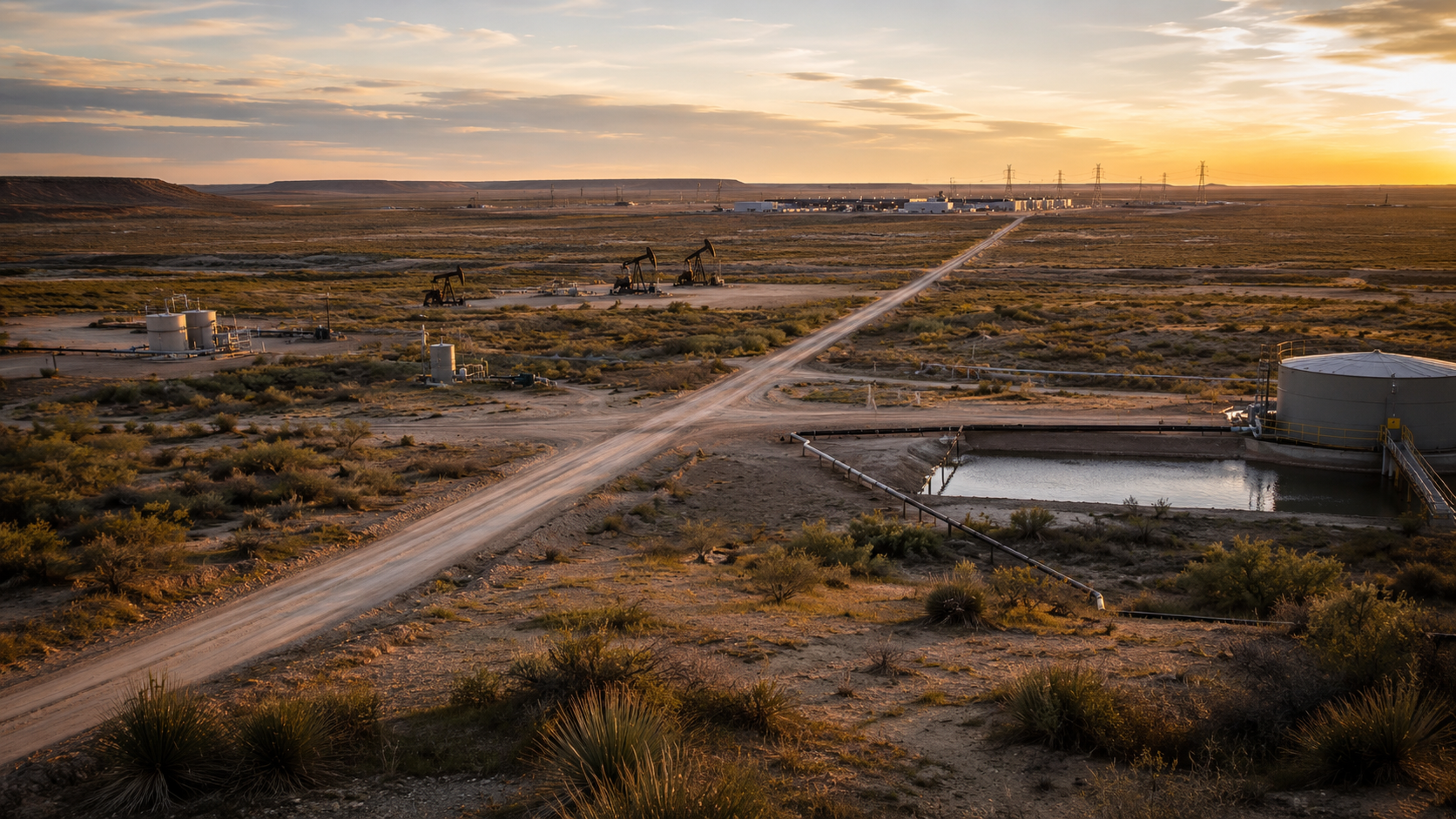

Texas Pacific Land Corporation (TPL) and LandBridge Company (LB) are the two largest positions in my portfolio.
Not by a little. LandBridge is roughly 15% of my book, and TPL is roughly 11%. Together they are more than a quarter of everything I own (excluding real estate), which is a level of concentration that would make most advisors give me a lecture on diversification (I have given many as well and admitted that what I was doing wasn't "normal").
I have also written about both of these companies more than any others. I have made the case for owning Permian land in front of audiences. I have argued, repeatedly and at length, that the most durable way to own the physical economy is to own the ground it happens on and to collect a fee from everyone who needs to use it.
So, when both companies reported second quarter results on Wednesday afternoon and held earnings calls within ninety minutes of each other on Thursday morning, I paid close attention.
Both delivered record quarters.
By Thursday afternoon, when I started writing this article in Saranda, Albania, TPL was down 8.4% at $350.01, and LB was up 6.9% at $80.81.
That's interesting because these are two companies with the same thesis, to a large extent, anyway. A spread this big on a single day is quite something.
And, as you may be used to from me, I have no interest in being cute about this, given how much of my net worth sits in these two names. So let me walk through what each company reported, what the calls actually said, where I got things wrong, and what I think the market was really reacting to.
Because I do not think it was the earnings.
The Scorecard
Let me start this part with the "boring" hard numbers before I tell you the actual story behind them.
Texas Pacific Land, 2Q26:
Revenue of $246.1 million, up 4% sequentially and 31% year over year
Adjusted EBITDA of $215.6 million, up 19% sequentially and 30% year over year, an 88% margin
Free cash flow of $155.5 million, up 14% sequentially and 20% year over year
Net income of $153.9 million, or $2.23 per diluted share
Record oil and gas royalty production of 39.7 MBoe/d and record produced water royalty volumes of 4.87 million barrels per day
No debt, $248.6 million of cash, dividend held at $0.60
LandBridge, 2Q26:
Revenue of $66.8 million, up 31% sequentially and 41% year over year
Adjusted EBITDA of $59.8 million, up 33% sequentially and 41% year over year, an 89% margin
Free cash flow of $40.2 million, a 60% margin
Net leverage of 2.5x, down from 2.7x, no maturities until 2030
Full-year guidance reaffirmed at $210 million to $230 million of adjusted EBITDA
Dividend held at $0.12
On paper, both are excellent. There's just one problem. One of these quarters is a lot cleaner than the other, and it is not the one that got rewarded.
TPL: Strip Out The Oil Price
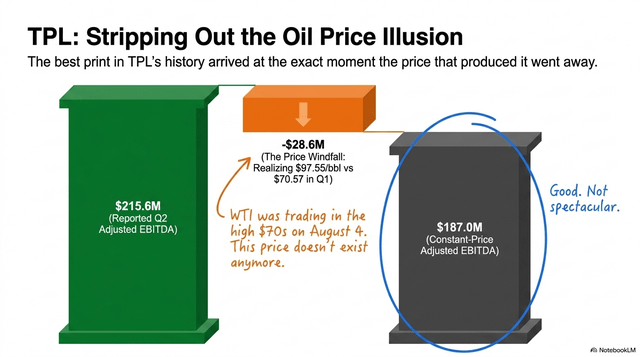
TPL's realized oil price was $97.55 per barrel against $70.57 in the first quarter. That's a 38% sequential move in the single most important input to the business. After all, TPL is much more dependent on oil royalties than LandBridge, which has just 5% direct oil and gas exposure (through royalties).
Ty Glover (TPL's CEO) said the unhedged royalty position allowed TPL to benefit fully from the strong price environment. That's true, and it is a feature. But I want to be honest about how much of this quarter was price rather than performance.
TPL produced 1,280 thousand barrels of oil. Hold the first quarter's realized price constant, and oil royalties would have been roughly $90 million instead of $119 million. That is about $29 million pre-tax, roughly $23 million after tax, and about $0.33 of the $2.23 in earnings per share. Adjusted EBITDA on that basis would have been about $187 million rather than $215.6 million.
Don't get me wrong. That's still good. But it's not spectacular.
And WTI was trading in the high seventies on August 4, against a 52-week intraday high of $119.47 set on March 9. Think about that for a second. The best print in TPL's history arrived at almost exactly the moment the price that produced it went away.
Now, the composition. Record production of 39.7 MBoe/d sounds very good. But oil volumes went from 14.9 to 14.1 MBoe/d (thousand barrels of oil equivalent per day), which is a 5.4% sequential decline. Natural gas went from 10.7 to 13.1, and NGLs (natural gas liquids) from 11.4 to 12.5.
Gas realized $0.40 per Mcf. Forty cents. That is Waha basis doing what Waha basis does when the Permian produces more gas than the pipes can carry. Note that Waha is the local natural gas benchmark. Because the Permian produces so much natural gas, regional prices tend to be the lowest in the country.
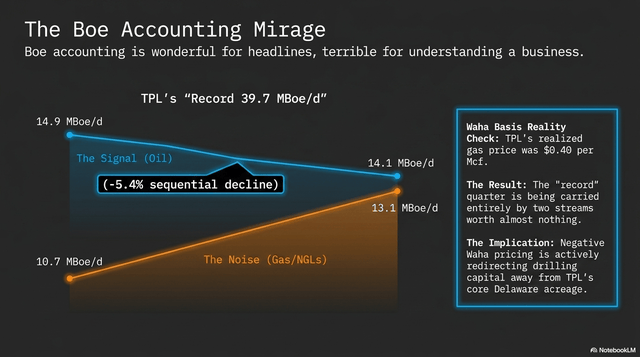
So, the record barrel of oil equivalent number is being carried entirely by the two streams worth almost nothing. Boe accounting is wonderful when you want a headline and terrible when you want to understand a business.
Tim Rezvan at KeyBanc asked exactly this during the earnings call, and Chris Steddum gave a reasonable answer: accounting noise as new acquisitions came online, plus heavy 2025 development in gas-rich areas including high-interest Culberson County wells with three- and four-mile laterals drilled over a short window. He expects the oil cut back above 40% over time.
I believe him. I also note it is unfalsifiable for two quarters, and I am putting down a marker to check in November.
Moreover, there is a related item being underweighted. Water sales volumes fell 19% sequentially. Glover's explanation was direct, which is that weak in-basin gas prices (think of Waha) have caused operators to shift some development away from the Delaware Basin.
Read that again. Negative Waha pricing is not just a revenue line problem. It is redirecting drilling capital away from TPL's core acreage. Management expects the mix to shift back as new pipeline capacity enters service over the next few quarters, and I think that is right (it's an easy call if you ask me). But it means the "cheap stranded Permian gas will power the data centers" story and the "Delaware activity is strong" story are in direct tension right now.
Finally, the item nobody discussed. TPL's line of sight inventory:
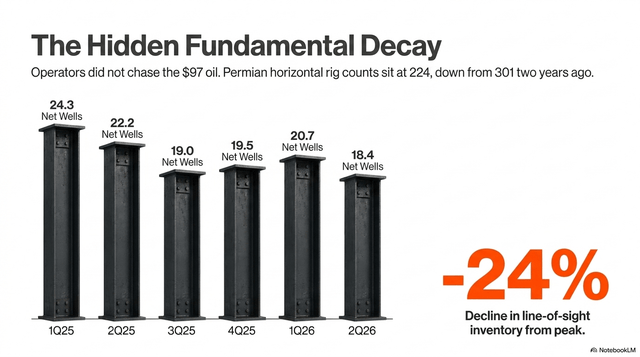
As you can see in my overview above, we're dealing with a 24% decline from peak, and it happened through a quarter of $97 oil. Permian horizontal rig counts sat at 224 against 301 two years ago. In other words, operators clearly did not chase the price.
Also, every question on the call but one was about data centers. That tells you how this stock is now being underwritten.
What The TPL Call Added
Glover said TPL is in advanced conversations with multiple hyperscalers, AI labs, and power generators on 25 gigawatts of projects, and that he would be disappointed if the company does not announce at least one or more major definitive agreements in the near term.
That is a big number and an unusually specific commitment for a CEO to make publicly.
Second, Shackelford and Jones County is a template instead of a one-off. TPL bought more than 10,000 acres for roughly $100 million. That's roughly $10,000 an acre, which is located well outside the Permian near Abilene. Over a year of diligence, bought for a customer they had already been working with, and Glover said plainly that they think they can replicate it (makes a lot of sense). His criteria were contiguous land, water, natural gas access, grid infrastructure, established fiber, and proximity to a midsized city. That is a very clear checklist, which also means we should expect more.
He also named the partner. That partner is Bolt, which is a company I have brought up a few times in the past. That connects to the strategic agreement TPL announced in December 2025 with Bolt Data & Energy, which is co-founded and chaired by Eric Schmidt. Bolt raised $150 million, of which TPL invested $50 million, receiving an equity interest, warrants, and a right of first refusal to supply water to Bolt-affiliated projects.
I want to be careful here, because this is a genuine change in what TPL is. A royalty owner collects a percentage of someone else's revenue and spends nothing. TPL now owns equity and warrants in a development-stage data center company, has bought $100 million of land at market prices, is negotiating tax abatements with local communities, and is building a desalination plant. Glover said TPL wants to be as involved in each project as it can while staying "really capital light."
Those two objectives are in tension. I think the trade is correct, because the returns available in West Texas power and compute are almost certainly better than incremental Permian royalty. But it is a trade.
Third, and most interesting, the desalination plant got repositioned. TPL has completed construction and begun commissioning its Orla facility, roughly 10,000 barrels per day, using a patented freeze process with equipment exclusivity for oil and gas applications.
Here is what changes the analysis. Steddum explained that the process chills produced water below fifteen degrees Fahrenheit to drop the salts out, and that the heat transfer required for direct chip cooling in a data center is a fraction of that. The same equipment that makes desalination work also produces ice and chilled water at exactly the spec hyperscalers need.
Stack the angles: water that sits outside the hydrologic cycle, which is a water-neutrality selling point; waste heat recovery; lithium potentially extractable from the concentrated brine; high-spec freshwater for irrigation and industrial cooling. Orla as a standalone produced water treatment business was always hard to underwrite. Orla as colocated cooling infrastructure for a hyperscale campus is a different asset entirely.
And one thing management said that I think is the most honest valuation signal of the week. Oliver Huang at Tudor, Pickering asked why there had been no meaningful buyback for several quarters. Steddum said the opportunity set is rich, cited Shackelford, and said the company wants to be in cash build mode.
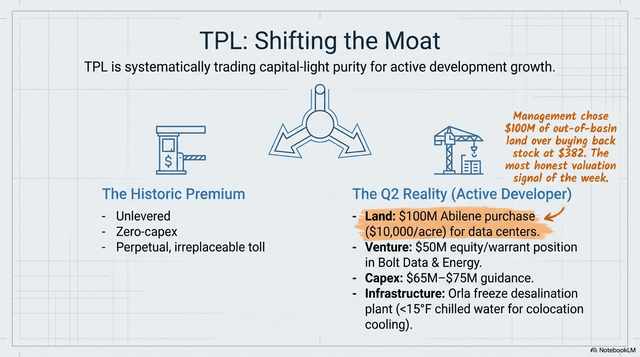
What does that mean? With $249 million of cash and a record free cash flow quarter, the people with the best information about this business would rather buy land near Abilene at $10,000 an acre than buy TPL stock at $382.
Interesting, to say the least.
LandBridge: The Lumpy Line And The Pull-Forward
LB's headline was 31% sequential revenue growth, and the composition matters a lot.
I visualized it below:
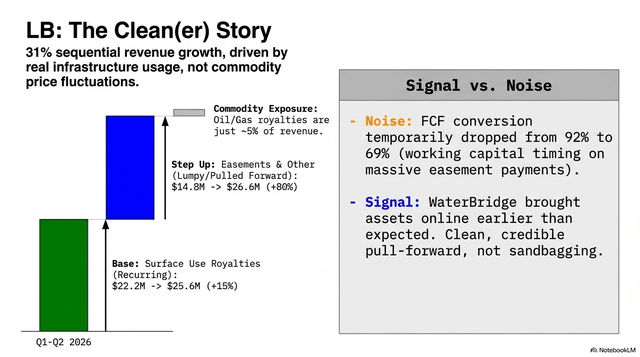
As we can see above, of roughly $15.8 million of total sequential growth, about $11.8 million came from the easements line, where option payments, access fees, and lease bonuses land.
Resource sales rose 1%. Oil and gas royalties rose 20% on price but are only about 5% of revenue, which is precisely the point of owning LB rather than a mineral company.
On guidance: first half adjusted EBITDA was $104.6 million against a $210 to $230 million full-year range. That implies $53 to $63 million per quarter in the second half against 2Q's $59.8 million. 2Q annualized is $239 million, above the top of the range.
I read that on Wednesday night as management quietly telling you that the second quarter was above trend. The call gave a better answer. Charles Meade at Johnson Rice said he had modeled about 5% sequential growth in water and got 15%, and asked whether the third quarter had been pulled forward. Scott McNeely credited the WaterBridge team with bringing assets online earlier than expected, said the ramp continues in the second half, and said plainly it will not be as pronounced, with the Speedway facility ramping as a driver.
That was a terrific explanation. Also, I believe LB has really stepped up its game. They are suddenly good at holding earnings calls. That was something I often criticized in past years, when I blamed some big stock declines on poor calls. They fixed that.
But here is what nobody asked.
Adjusted EBITDA rose by $14.9 million. Operating cash flow rose by $0.3 million. Interest expense was essentially identical, so this is working capital. Free cash flow actually declined sequentially in the quarter management is calling a record, and the margin fell from 80% to 60%.
Related party receivables are up $4.9 million in the first half. My best guess is collection timing on the big easement payments and that it reverses. But "record revenue, flat cash" is a pattern you want to catch early, and four analysts got on that call, and not one asked about it.
Again, I'm not worried, but we need to keep an eye on this.
The Number That Reframes Both
Ben Lund at Goldman asked about produced water royalty rates, and the answer was the most valuable disclosure across either call.
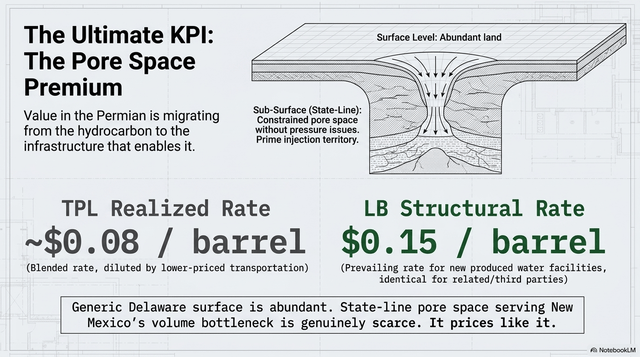
The prevailing rate for new produced water facilities on LandBridge acreage is $0.15 per barrel. WaterBridge (WBI) pays it. Third parties pay it. It's the same rate.
McNeely added that legacy WaterBridge sites carry lower rates and drag the blended average down, that rates have risen for several years, and that he expects them to keep rising as pore space scarcity plays out, particularly as New Mexico volumes look for an outlet along the state line.
Now compare. TPL generated $37.1 million of produced water royalties on 443.3 million barrels, which works out to about $0.0836 per barrel. Glover said the blended rate should stay steady to increasing, with the caveat that transportation royalties price below actual pore space injection royalties.
LandBridge's prevailing new-contract rate is roughly 80% above TPL's blended realized rate.
I do not want to oversell this, because it is not clean. TPL's number is a blend across a mix including lower-priced transportation royalties. LB's $0.15 is a new-contract rate, and LB does not disclose volumes, so you cannot compute its own blended average. The true gap is narrower.
But the direction is unambiguous and structural. LB's pore space sits along the Texas-New Mexico state line, without the pore pressure constraints that have made disposal difficult across much of the basin, and it serves New Mexico volumes running out of places to go. That is a scarcer asset than generic Delaware surface, and it prices like one.
TPL's produced water royalty is a very good additional stream attached to an oil royalty. LB's produced water royalty is the core business. It has a premium rate, and management believes the rate is going up.
The Thing Nobody Is Talking About
Here is what I think actually happened on Thursday, and it has almost nothing to do with either release.
On August 3, three days before these calls, Governor Abbott directed the Public Utility Commission of Texas and ERCOT to conduct a comprehensive verification and audit of every data center project advancing through the ERCOT interconnection process, to be completed before any project moves forward. Some readers brought it up to me and asked me to give my opinion. Today, I'm doing that.
The scale is worth absorbing. ERCOT is tracking more than 1,800 projects that represent more than 474 gigawatts of requested interconnection. That's more than five times the grid's record peak demand. ERCOT has already postponed its Batch Zero transmission planning study. Projects that fail get denied connection.
The audit asks five things of each project: how much public money it takes in tax incentives and abatements, whether it brings its own power or leans on the grid, whether it brings its own water or competes with local communities, what it does to limit neighbor impact, and who actually owns it.
This is not a moratorium. If anything, it is a filter, which is designed almost perfectly around the difference between a real project and a queue position.
Lund asked McNeely about it directly, and his answer was self-serving and, I think, substantively correct. Every project LB contemplates is behind the meter and co-located, often with net export to the grid, so those projects reduce ERCOT demand rather than add to it. All plan to use brackish or eventually treated produced water, so they do not compete for municipal supply. The sites are large contiguous blocks where community work is already done.
If we run LB's pitch against Abbott's five criteria and it clears every one. In a world where 474 gigawatts of requests get sorted into real and not-real, owning the land where the real ones can actually be built becomes considerably more valuable.
Now the uncomfortable part for TPL. TPL just spent $100 million near Abilene, and Glover's criteria included grid infrastructure and proximity to a midsized city. That is a more grid-connected, more community-adjacent profile than the middle of the Delaware. It is also the part of Texas where the political backlash is loudest. And Glover mentioned TPL is already working with local communities on tax abatements, which is now item one on the state's checklist.
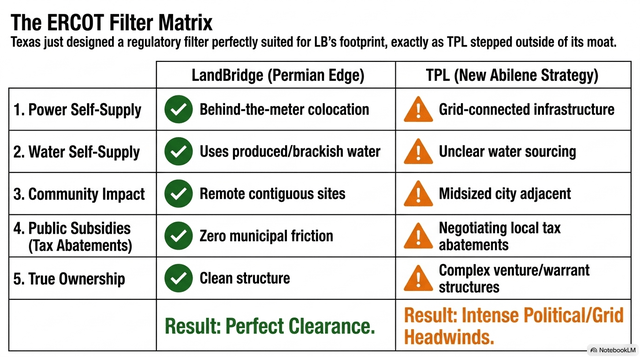
Shackelford is probably a good acquisition, and Bolt is a serious partner. But TPL took a step outside its moat in the same week the state made the moat more valuable.
A Quick And Dirty Valuation That Explains So Much
TPL at $350.01, roughly 69.0 million shares, $24.1 billion market value, $23.9 billion enterprise value net of cash:
Trailing twelve-month adjusted EBITDA of $748.7 million: 31.9x
2Q normalized to first quarter oil pricing and annualized: 32.0x
Trailing free cash flow of $533.7 million: 2.2% yield, roughly 45x
Dividend of $2.40: 0.69%
LB at $80.81, roughly 76.9 million Class A and B units, $6.2 billion equity value, $6.7 billion enterprise value including $505 million net debt:
Guidance midpoint of $220 million: 30.5x
2Q annualized at $239 million: 28.1x
2Q free cash flow annualized: 2.4% yield on enterprise value
Dividend of $0.48: 0.59%, net leverage 2.5x at the top of a 2.0x to 2.5x target
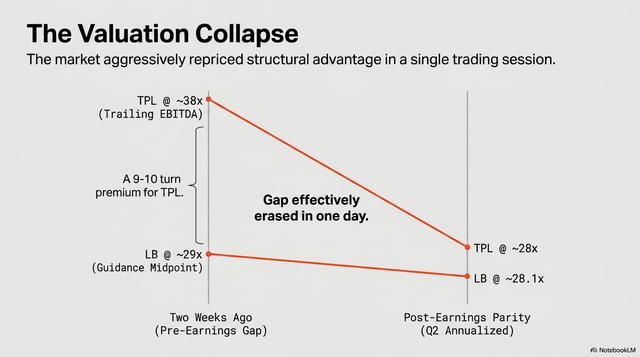
Two weeks ago TPL traded at roughly 38x trailing EBITDA and LB at roughly 29x guidance. A gap of nine or ten turns. After one session, that gap is essentially gone. On 2Q annualized, they are within half a turn of each other.
That is a remarkable amount of relative repricing in a single day, and it is the most important thing that happened this week.
My View
I am bullish on both. I am more bullish on LandBridge.
The core claim has always been that value in the Permian migrates from the hydrocarbon to the physical infrastructure that enables it, and that the water stream in particular is a volumetric toll compounding independently of the oil price. Both prints validated exactly that. TPL's produced water volumes hit a record and grew 15% year over year while oil volumes declined sequentially. LB's recurring surface royalty grew 15% sequentially. Delaware water-to-oil ratios keep climbing as wells age and operators move into deeper, wetter benches.
The second leg, that West Texas becomes the physical host of the compute buildout, moved from narrative toward fact this quarter. TPL has a named Chevron project, a named partner in Bolt, 25 gigawatts of advanced conversations, and a near-term definitive agreement promised. LB has seven counterparties, more than 10 gigawatts on a deliberately risked basis, and a stated expectation of firm leases with revenue by the end of next year.
Why do I like LB more than TPL?
LandBridge is the cleaner expression. Oil and gas royalties are 5% of revenue, as I already briefly mentioned, so you are not underwriting a commodity price. The royalty rate is disclosed at $0.15 per barrel, is rising, and is identical for related and third parties. State-line pore space is genuinely scarce in a way generic surface is not. The digital pipeline is risked conservatively rather than headline-maximized. And the business is structurally advantaged against exactly the filter Texas just imposed.
TPL is the higher-quality asset and the more expensive one, and it is changing character. CapEx guidance of $65 to $75 million. A $100 million out-of-basin purchase. A $50 million venture equity position with warrants. A desalination plant heading toward a 100,000 barrel per day Phase 3. Line of sight inventory down 24% from peak. And an earnings base that just captured $97 oil in a $78 world.
None of that is bad. Most of it is management doing the right thing with an enormous opportunity. But the premium multiple TPL carried was built on being an unlevered, zero-CapEx, perpetual, irreplaceable toll, and each of those four adjectives is a little less true than it was a year ago. Again, still true, just slightly less beneficial than what LB is now bringing to the table.
What am I doing?
This may not come as a surprise, but I'm holding both. Not adding at these levels, and not trimming. Twenty-six percent of a portfolio in two names is a lot, and I want to be clear-eyed that this is not really two positions. It is one position with two tickers, so to speak.
If I were building this position from scratch today, I would weight it more toward LB than I currently do.
What would change my mind on TPL: two more quarters of sub-40% oil cut without a credible explanation, line of sight inventory below 16 net wells, or a second out-of-basin purchase without a signed anchor tenant.
What would change my mind on LB: the operating cash flow gap persisting into the third quarter, or an Up-C collapse in the Texas conversion that takes the effective tax rate from 11% to the low twenties without corresponding index inclusion.
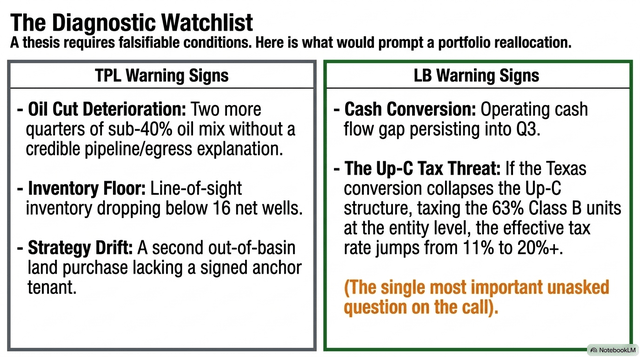
On that last point, McNeely gave the index rationale clearly, noting certain S&P, Russell, and CRSP benchmarks are limited to corporations and that inclusion would expand the investor base and improve liquidity. All of that is true. But LB paid $3.9 million of tax on $35.0 million of pre-tax income, an 11% effective rate, because the 48.7 million Class B units holding roughly 63% of the economics are not taxed at the entity level. If the conversion collapses that structure, the tax rate roughly doubles. I'm not a tax genius, but that's something to keep an eye on as well.
Takeaway
Both companies delivered record quarters, and the market split them fifteen points apart while I am writing this, which tells you the reaction was not about the quarters.
TPL's print was flattered by $97 oil that no longer exists. Its record production was carried by gas at forty cents. Its forward inventory has fallen 24% from peak, and it is steadily trading capital-light purity for growth. Management chose $100 million of Abilene acreage over buying back its own stock, which is the most honest statement about valuation anyone made this week. The 25 gigawatt pipeline and the repositioning of freeze desalination as data center cooling are genuinely exciting, and I think the strategy is right. But TPL stepped outside its moat in the same week Texas made the moat more valuable.
LB's print was lumpier than the headline suggested, and its cash conversion fell 23 points with nobody asking why. But the call delivered the best disclosure of the week: $0.15 per barrel on new produced water contracts, identical for WaterBridge and third parties, with rates management expects to keep rising. That answers the transfer pricing question I had been raising and establishes that scarce state-line pore space commands a premium.
And what actually moved these stocks was probably neither release. It was Abbott's August 3 directive, which turns 474 gigawatts of interconnection requests into an audit sorting real projects from queue positions on power self-supply, water self-supply, public subsidy and community impact. That filter is a gift to behind-the-meter, self-watered, contiguous Permian sites. It is a problem for everyone else.
I own both, and I am bullish on both. The thesis is working.
But if you asked me to put one more dollar to work today, it goes into LandBridge.
Easy choice.
Sign in to leave a comment and join the discussion.
Sign Up Free