

India’s headline numbers suggest an economy running on all cylinders. In the first quarter of fiscal year 2027, real gross domestic product expanded by 7.8 percent year on year, while gross value added rose 8.2 percent. The tertiary sector set the pace, led by a 12.1 percent surge in financial, real estate, and professional services, alongside a 9.2 percent expansion in manufacturing and an 11.9 percent rise in gross fixed capital formation. By official measures, India remains the fastest-growing major economy in Asia.
Corporate reality tells a far more hesitant story. Benchmark equity earnings continue to lag nominal economic growth. Large-cap technology services firms and consumer staples providers face margin compression and subdued volume growth. The divergence exposes an uncomfortable structural shift. If the white-collar labor engine that established India's modern role in the global division of labor is being automated by algorithmic models, the character of Indian growth must change. The question is not whether a nation of 1.4 billion people simply fades from relevance, but whether the specific economic model that built its urban middle class and funded its external accounts can survive in an era of automated labor.
The Quarter-Century Offshoring Machine
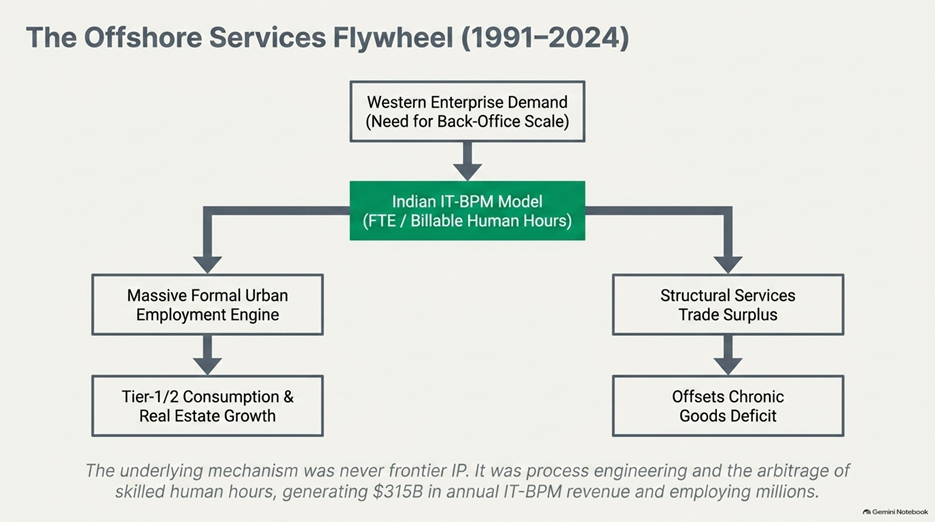
The modern Indian economic narrative began in earnest with the 1991 balance-of-payments crisis and the structural reforms that followed. The initial catalyst was the Y2K software transition, which matched Western corporate demand for low-cost legacy code remediation with a massive cohort of English-speaking technical graduates. Over the subsequent twenty-five years, this transformed from opportunistic contracting into the primary pillar of India's balance of payments.
By fiscal year 2026, the information technology and business process management (IT-BPM) sector had scaled to roughly $315 billion in annual revenue, according to industry estimates from Nasscom. Total commercial services exports reached a record $421 billion, dominated by software, data processing, and global business operations. Historically accounting for between 7 and 10 percent of gross domestic product, the offshore services sector provided several million high-productivity, formal jobs. Crucially, the persistent services surplus functioned as the primary macroeconomic shock absorber, neutralizing chronic merchandise trade deficits driven by crude oil and electronics imports.
The underlying economic mechanism was never the export of frontier intellectual property. It was process engineering, organizational scale, and the arbitrage of skilled human hours. Indian service providers perfected the offshore development center, institutionalizing time-zone differences to operate round-the-clock enterprise support factories. This provided a reliable escalator into the formal consumer economy for millions of households, powering domestic aviation, urban residential real estate, and consumer discretionary spending.
Deconstructing the Current Growth Engine
The current macroeconomic aggregates mask considerable internal variance across production and expenditure categories. While tertiary industries grew by 10 percent overall in the latest quarter, this expansion was heavily concentrated in financial intermediation, professional consulting, and real estate transactions. Manufacturing grew at an impressive 9.2 percent, but its overall footprint remains modest at roughly 14 to 17 percent of gross domestic product, depending on the accounting standard applied. Agriculture continues to employ nearly 45 percent of the national workforce while contributing less than a fifth of total economic output.
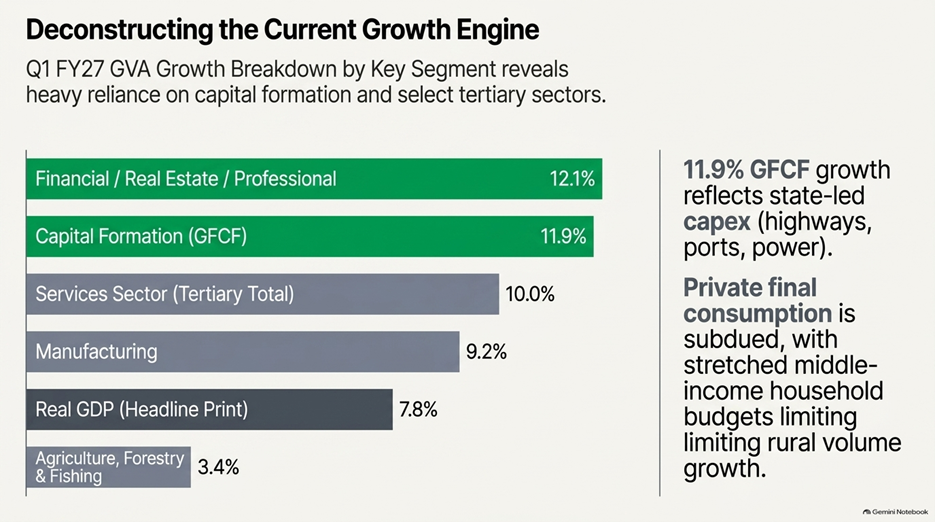
On the expenditure ledger, capital formation is doing the heavy lifting. The 11.9 percent growth in gross fixed capital formation reflects state-led capital expenditure in national highway corridors, port capacity, freight rail, and power transmission. Private final consumption expenditure presents a more subdued picture. Corporate filings across mass consumer goods, packaged foods, and entry-level two-wheelers reveal sluggish rural volume growth and stretched middle-income household budgets, pointing toward an uneven economic expansion.
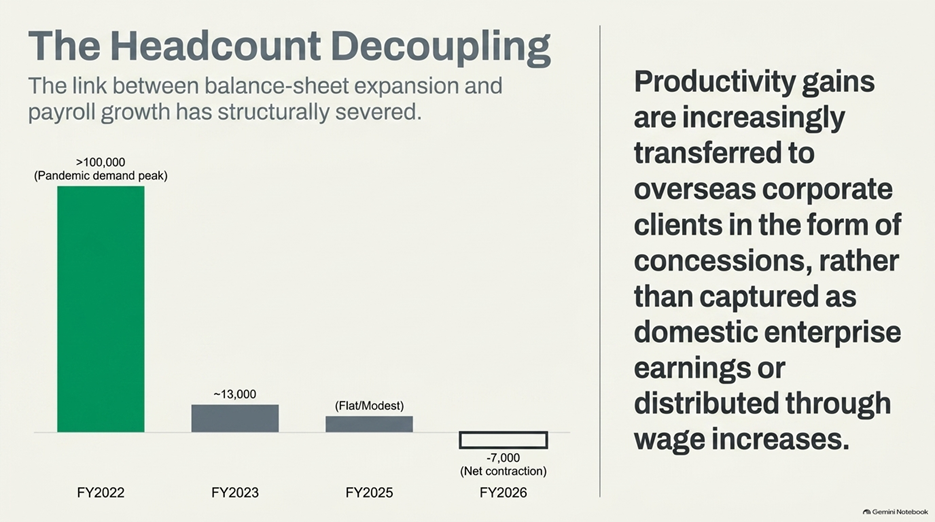
Within the major IT conglomerates, the link between balance-sheet expansion and payroll growth has begun to fray. While aggregate gross revenues expanded modestly in fiscal year 2026, overall employment headcount across the top five firms contracted by roughly 7,000 personnel. This followed an addition of only 13,000 roles the year prior, compared to annual net additions that frequently exceeded 100,000 during the pandemic demand cycle. Productivity gains are increasingly transferred to overseas corporate clients in the form of price concessions rather than being captured as domestic enterprise earnings or distributed through wage increases.
The Automation of the Offshore Factory
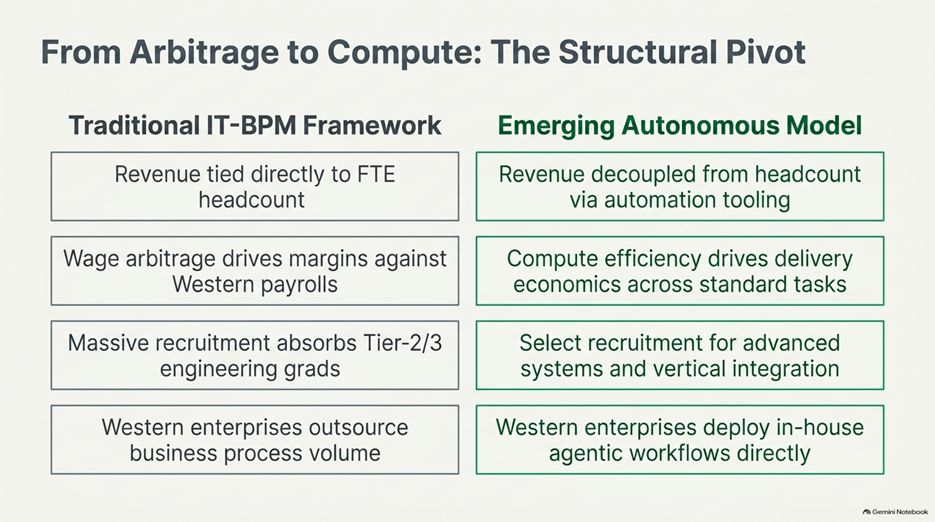
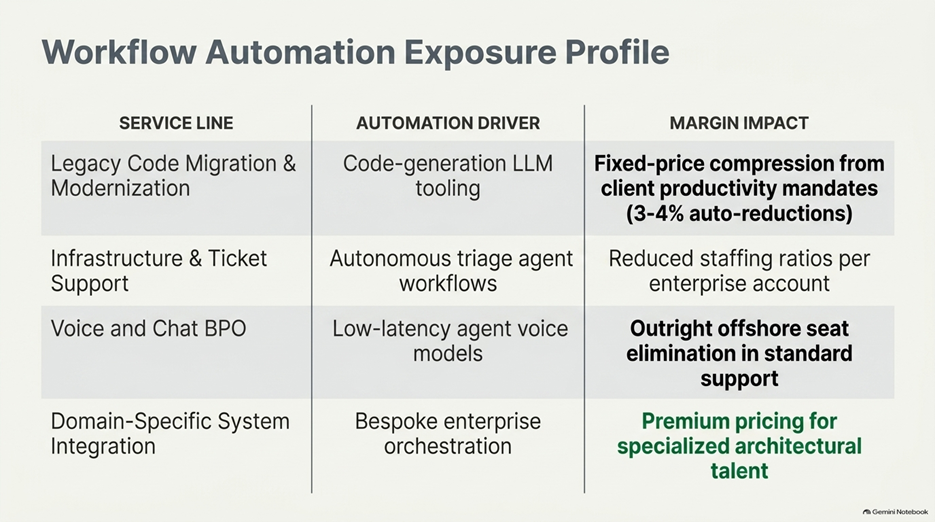
Large language models and autonomous software systems intersect directly with the core services historically exported from India. Code modernization, test-suite automation, legacy documentation, database migration, and Tier-1 infrastructure maintenance are the specific workflows most susceptible to algorithmic automation. The standard hourly billing model, which generated stable double-digit margins by staffing large enterprise accounts with junior developers, is eroding under client demands for fixed-cost, outcome-based contracts.
The pressures are visible across three distinct operational segments:
Enterprise Application Maintenance: Routine software patching and functional testing that previously required dedicated offshore engineering teams are shifting to automated diagnostic tools. Western enterprise clients are incorporating contractual clauses that demand automatic 3 to 4 percent annual price reductions to capture these workflow efficiencies.
Customer Support and Business Process Outsourcing: Voice generation models and agentic chat frameworks operate with unit costs that sit well below the fully loaded expense of an offshore seat in Manila or Pune. Enterprise clients with mature automation programs have begun reducing total outsourced vendor allocations across transactional call-center workflows.
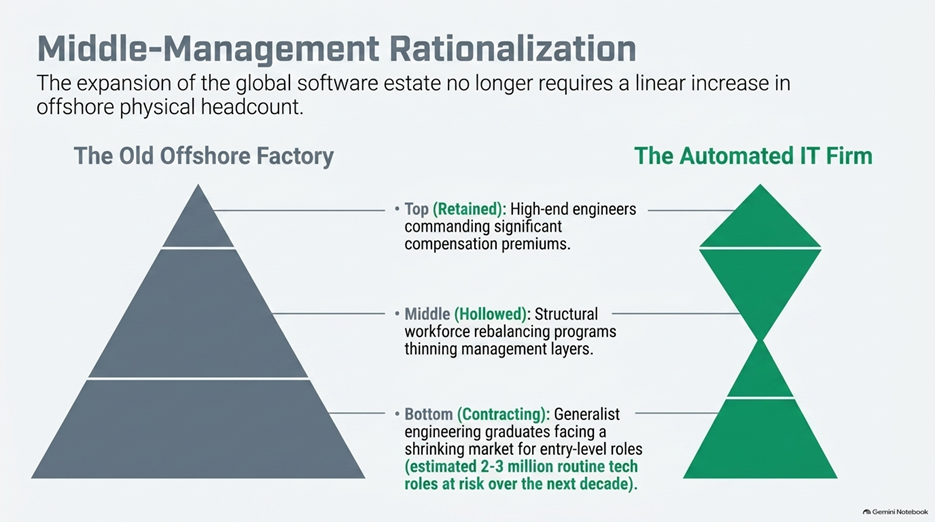
Middle-Management Rationalization: Tier-1 IT vendors have initiated structural workforce rebalancing programs, thinning middle management layers while accelerating internal retraining initiatives across foundational model application programming interfaces.
Services export volumes have not fallen off a cliff; monthly figures remain relatively resilient, reflecting ongoing enterprise digital transformations and multi-year contractual commitments. Yet the forward-looking indicators are clear. The expansion of the global software estate no longer requires a linear increase in offshore physical headcount.
The Mechanics of the Data-Center Tenant
The central economic paradox of modern computing is that value accrues primarily to owners of scarce physical capital and proprietary model architectures, rather than general integrators. The critical elements of the technology stack reside upstream in high-bandwidth memory design, advanced lithography tooling, and hyperscale compute clusters located in North America and East Asia.
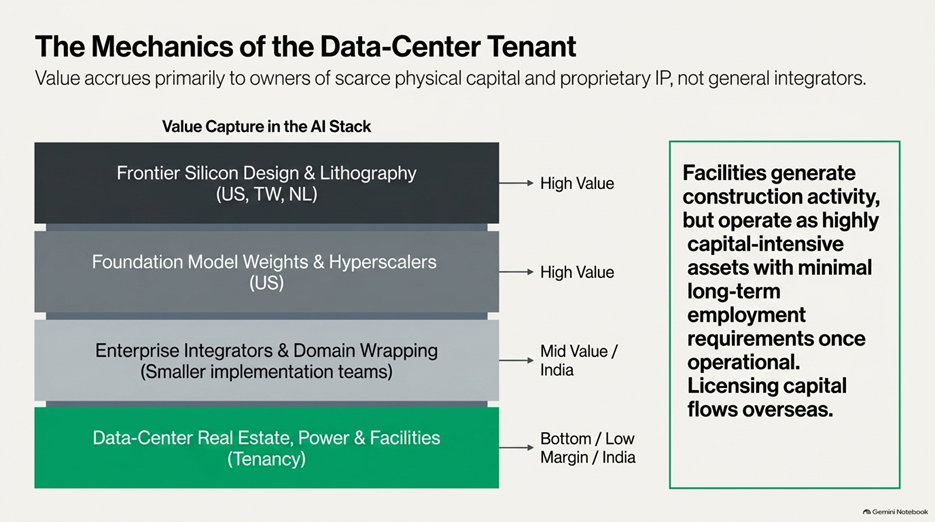
When computational execution shifts from human teams to distributed servers, Indian enterprise engagement divides into three structural layers:
Inference and Infrastructure Ownership: Advanced foundation models execute on hardware architectures developed by Western semiconductor designers and fabricated in East Asian foundries. Indian entities participate primarily as capital expenditure purchasers or cloud capacity consumers, sending licensing capital overseas.
Domestic Facility Tenancy: Real estate operators and domestic conglomerates are committing billions to physical server facilities across Mumbai, Chennai, and Noida. These facilities generate construction activity and long-term utility demand, but they operate as highly capital-intensive assets with minimal long-term employment requirements once operational.
Application Layer Integration: The intermediate layer involves wrapping generalized foundation models into functional enterprise software tailored for banking, logistics, and healthcare clients. This domain requires deep architectural knowledge and data compliance engineering, but it requires significantly smaller implementation teams than historical enterprise resource planning deployments.
The consequence for the broader economy is a narrowing of the formal labor channel. High-end engineers command significant compensation premiums, but the broader pyramid of generalist engineering graduates faces a contracting market for entry-level white-collar employment. An estimated two to three million routine technology and support roles face structural transition pressures over the coming decade, dampening the primary wage engine of urban consumption.
Alternative Growth Vectors
If the traditional software export engine cannot sustain its historical rate of labor absorption, alternative sectors must expand their contribution to net value added and employment.
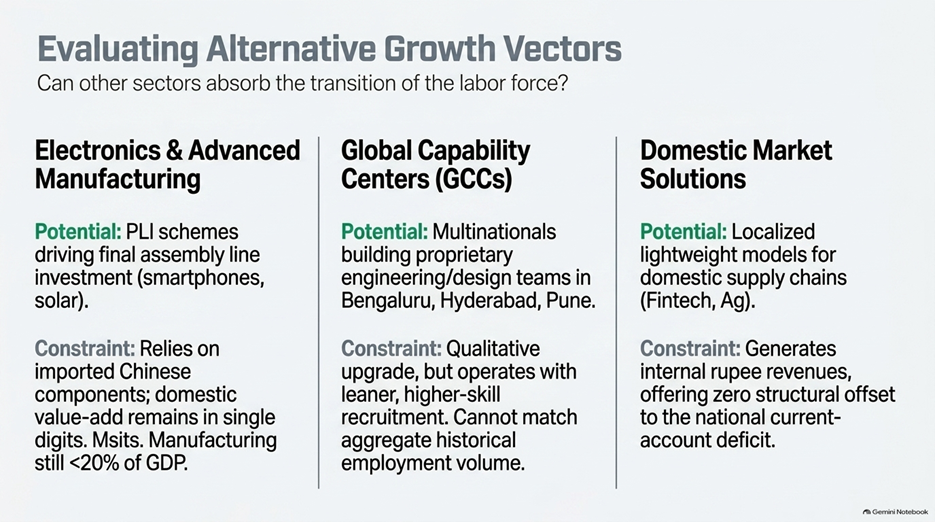
The administration’s Production-Linked Incentive (PLI) schemes have delivered visible operational results in smartphone final assembly, generic active pharmaceutical ingredients, and solar component manufacturing. Global consumer electronics brands have materially shifted final assembly lines to southern Indian manufacturing hubs to diversify geopolitical exposure. Yet electronics assembly operations frequently rely on imported components from mainland China, limiting domestic value addition to single-digit percentages while maintaining elevated merchandise import requirements. Manufacturing's aggregate contribution to gross domestic product remains well below the thirty percent threshold that characterized the developmental trajectories of South Korea, Taiwan, or China.
Multinational corporations are also expanding Global Capability Centers (GCCs) across Bengaluru, Hyderabad, and Pune. Rather than contracting third-party service vendors, international banks and industrial firms are setting up wholly owned engineering subsidiaries to oversee data engineering, risk modeling, and product design. GCCs represent a natural qualitative upgrade in the complexity of work performed domestically, but they operate with leaner, more selective recruitment standards than the legacy third-party service providers.
On the domestic front, software engineering focus has turned toward local application deployment. Enterprise developers are deploying lightweight language models to address agricultural logistics, regional language financial inclusion, and public administrative interfaces. This strengthens domestic institutional capability, but domestic software applications generate internal rupee revenues rather than external hard currency, offering no structural offset to the national current account.
Strategic Relevance Across Three Horizons
Evaluating India's global weight requires distinguishing between corporate utility, portfolio construction, and domestic social cohesion.
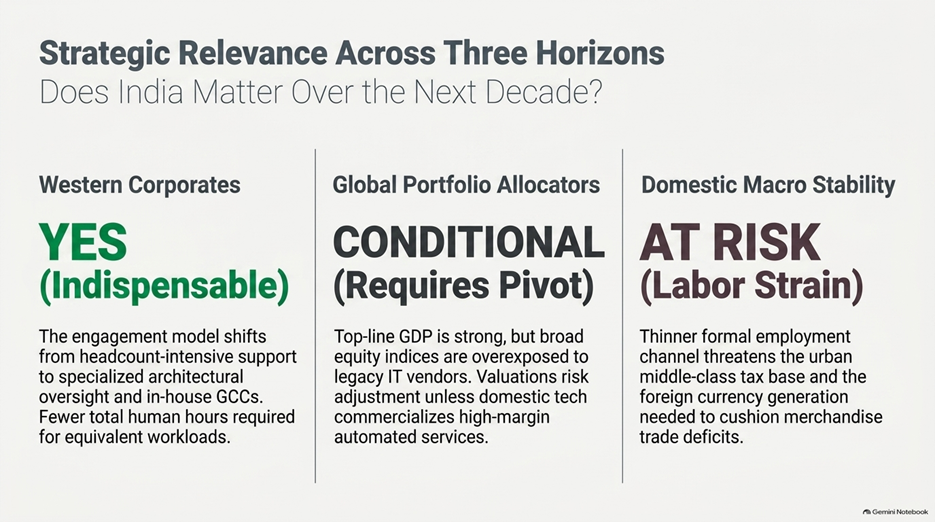
For Western multinational enterprises, India remains an indispensable base of engineering talent and an expanding consumer market. The engagement model, however, is shifting from headcount-intensive support contracts to specialized architectural oversight, compliance monitoring, and in-house capability centers. Multinationals require fewer total human hours to manage equivalent corporate workloads.
For emerging-market portfolio allocators, India’s top-line macroeconomic expansion remains one of the few large-scale investment venues capable of absorbing institutional capital. The broader equity indices carry heavy exposure to legacy technology service exporters and high-multiple consumer franchises. As global investment capital flows toward physical hardware manufacturers and specialized component suppliers across Northeast Asia, Indian equity multiples face valuation adjustments unless domestic technology firms successfully commercialize high-margin automated services.
For domestic policymakers, the fundamental challenge is managing the transition of the labor force. The services boom created the urban middle class that underpinned modern Indian tax revenues and domestic consumer spending, while generating the foreign currency necessary to balance national merchandise trade. If capital-intensive server deployments replace headcount-driven services contracts, macroeconomic growth metrics may diverge from median household prosperity.
The Operational Horizon
India will continue to matter as a major geopolitical power, an expansive market for consumer goods, and a deep reservoir of technical talent. The narrower premise that powered the previous twenty-five years (that an economy can skip industrialization by scaling low-cost, human-delivered white-collar services) faces an unprecedented technological test.
The trajectory of this transition will be determined by three measurable variables:
Services Export Composition: Whether gross services receipts can maintain their historical growth trajectory as contractual pricing models shift from billable hours to fixed automated deliverables.
Labor-Market Absorption: Whether expanding domestic manufacturing hubs, electronics assembly corridors, and infrastructure projects can absorb millions of graduates who can no longer rely on campus recruitment from legacy IT vendors.
Intellectual Property Generation: Whether domestic technology leaders can capture vertical application-layer software value, or whether they will function primarily as local real estate and utility providers to foreign-owned computing platforms.
If domestic enterprise converts this moment into proprietary software development and expanded advanced manufacturing, India's macroeconomic expansion will stabilize on a sturdier foundation. If not, top-line gross domestic product may continue to print impressive headline rates, while the primary engine of modern Indian middle-class prosperity struggles for traction.
Sign in to leave a comment and join the discussion.
Sign Up Free