

PPFE
    Dividend Investinghigh-yield investing

    Pfizer: The 6.5% Yield Everyone Is Afraid To Trust

    Pfizer: The 6.5% Yield Everyone Is Afraid To Trust
    • Last raise was Dec 12, 2024 to $0.43, Dec 2025 declared $0.43 - quarterly rate at $0.43 for six quarters, calendar 2026 pays $1.72 vs 2025, next governance test is the Dec 2026 declaration
    • Dividend costs about $9.8bn annually, based on 5.7bn shares and $1.72 per share - evaluate coverage using free cash flow, not GAAP EPS, given recurring non‑cash impairments
    • FCF has not covered the dividend recently - 2023 FCF $4.8bn vs dividends $9.3bn (193% payout), 2024 FCF $9.8bn vs $9.5bn (97%), 2025 FCF $9.1bn vs $9.8bn (108%); 2026 FCF range $11.9bn-30.1bn
    • Patent cliff is material - products losing protection across 2026-27 represented $21.4bn of 2024 sales; Pfizer expects $17-18bn revenue erosion 2026-28, roughly one‑third of 2025 revenue ($62.6bn)
    • Durable protections can change the trough - Vyndamax (tafamidis) settlement limits U.S. generic entry to June 1, 2031, preserving ~ $6.3bn of 2025 sales and suggesting the consensus 2029 earnings trough may be overstated
    Leo Nelissen
    Aug 17, 20262:40 PM770

    I have a rule about high yields.

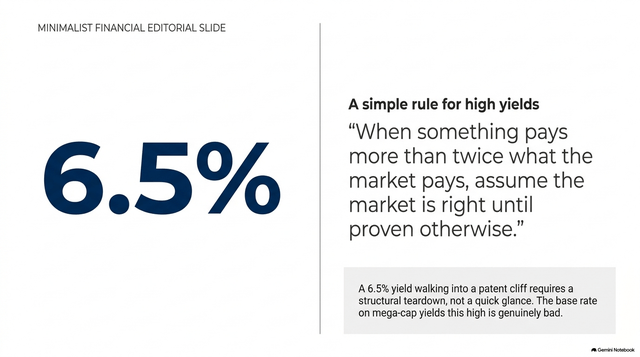
    When something pays me more than twice what the market pays, I assume the market is right until I can prove otherwise. Not because the market is clever. It often isn't. But the base rate on 6%-plus yields in mega-cap equities is genuinely bad, and I would rather be slow than sorry.

    Pfizer (PFE) yields roughly 6.5%.

    I brought it up recently as a high-yield turnaround with attractive risk/reward, and I still think that. But I gave it a few hundred words, and a yield like that on a company walking into a patent cliff deserves a lot more than a few hundred words.
    Image

    I also got a fair amount of pushback, and the pushback was consistent. Not about the science. Not about the cliff. It was about management. The word "poorly run" came up more than once, usually attached to the debt load and the acquisition record.

    That is the right objection, and I'm going to spend real time on it rather than waving at it.

    But first, a fact buried in the payout record that almost nobody is writing about.

    So, let's dive in!

    Keep Reading

    Create a free account to access more content.

    Sign in to leave a comment and join the discussion.

    Sign Up Free