

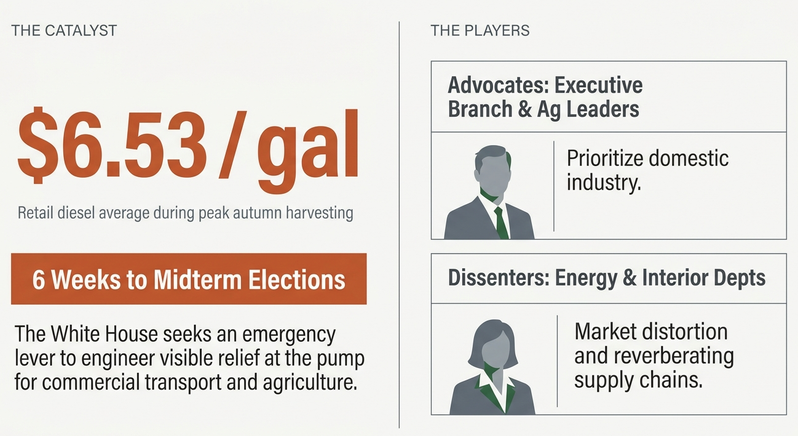
Political pressure surrounding commercial transport and agricultural fuel reached a flashpoint on Tuesday when President Donald Trump announced his support for a domestic diesel export embargo, arguing that American refining output should prioritize domestic industry ahead of foreign buyers. The intervention follows intense lobbying from agricultural leaders, notably Senator Chuck Grassley of Iowa, who cited record retail diesel averages of $6.53 per gallon coinciding with peak autumn harvesting. Treasury Secretary Scott Bessent confirmed alongside Trump that the administration is actively studying whether a full or partial export restriction is feasible within current refining capacity, aiming to render a swift determination. With midterm elections six weeks away, the White House is seeking an emergency lever to engineer visible relief at the pump, setting off open dissent from Energy Secretary Chris Wright and Interior Secretary Doug Burgum, who have cautioned that halting outbound fuel flows will reverberate across markets and distort domestic fuel supplies.
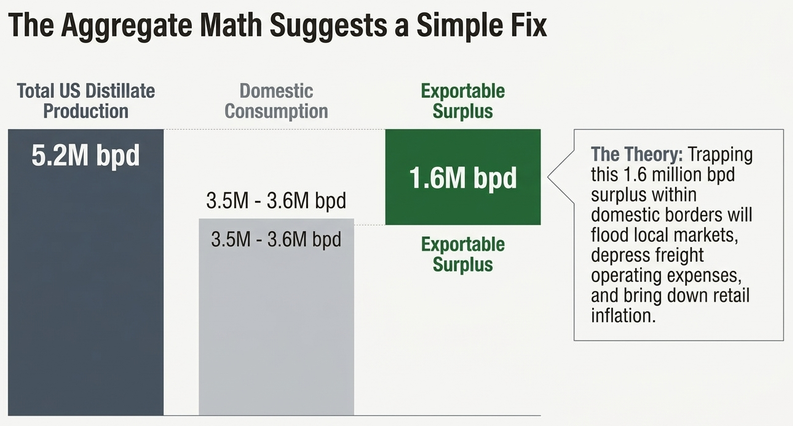
Market proponents of an export ban build their case on aggregate supply balances: the United States produces roughly 5.2 million barrels per day of distillate while domestic demand consumes between 3.5 and 3.6 million barrels per day. The resulting exportable surplus of 1.6 million barrels per day departs predominantly from the Gulf Coast, and populist policymakers contend that trapping these volumes within domestic borders will flood domestic markets, depress freight operating expenses, and bring down retail inflation.
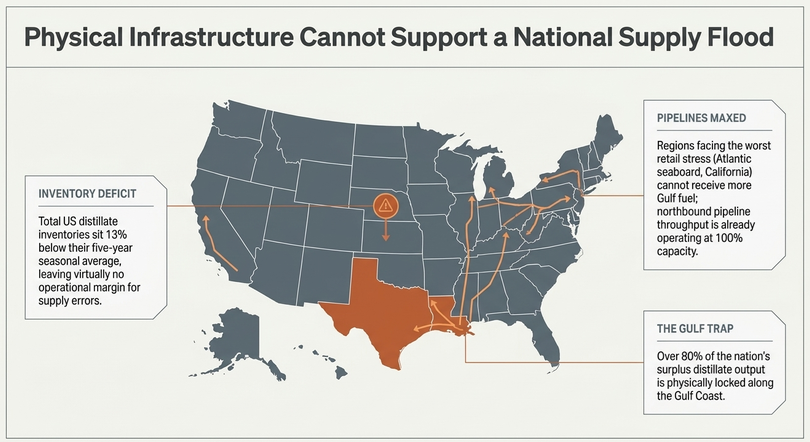
That expectation ignores the physical pricing mechanisms and transport bottlenecks governing refined products. While gross production exceeds domestic consumption, total US distillate inventories sit roughly 13% below their five-year seasonal average, leaving little operational margin for supply errors. Crucially, over 80% of surplus distillate output sits along the Gulf Coast. The regions facing severe retail stress, particularly the Atlantic seaboard and California, run with depleted inventories because pipeline throughput running north from Texas is operating at capacity. Redirecting waterborne Gulf barrels to New York Harbor requires Jones Act tankers, an expensive, finite domestic fleet incapable of scaling up to move hundreds of thousands of additional barrels per day. Rather than engineering a uniform national price drop, an export ban would trigger immediate price fragmentation across regional hubs. Gulf wholesale diesel would drop by 20 to 50 cents per gallon as local tanks fill toward capacity, while Atlantic Coast pricing would remain tethered to tight global waterborne import benchmarks.
Institutional analysts and refining trade groups point out that merchant refineries cannot act as open-ended storage facilities. Distillate, gasoline, and jet fuel are co-produced in continuous chemical processes. If Gulf Coast storage terminals reach operational limits within two to three weeks of an embargo, refiners face an unavoidable ceiling where they must either dump product into an oversupplied Gulf spot market at steep losses or throttle back crude runs. Reducing crude runs to curb distillate accumulation automatically slashes gasoline output. An intervention designed to ease agricultural and trucking fuel costs before an election risks triggering a secondary supply squeeze on domestic gasoline at some point, potentially driving gasoline futures upward – coincidentally – right after voters head to the polls.
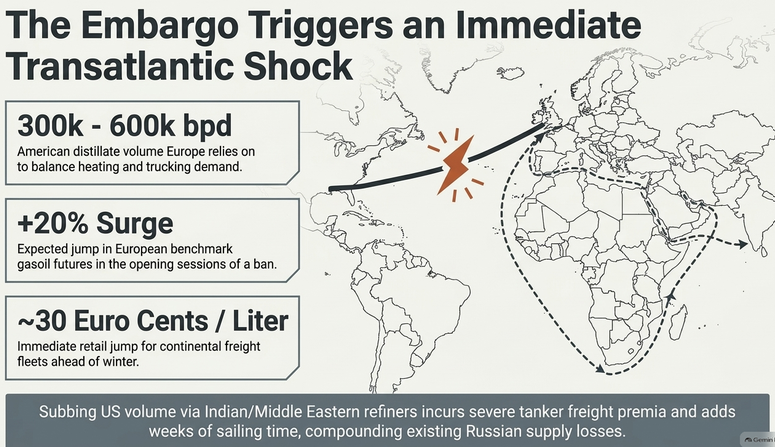
In overseas markets, what we presume could be an abrupt six-week embargo of uncertain duration would deliver an immediate supply shock to a continent already coping with the loss of Russian supplies and protracted maritime disruptions around the Middle East. European buyers import between 300,000 and 600,000 barrels per day of American distillate to balance regional heating and trucking demand. That volume cannot be substituted overnight by refiners in India or the Persian Gulf without incurring severe tanker freight premia and adding weeks of sailing time around southern Africa. European benchmark gasoil futures would surge around 20% (maybe more) in the opening sessions of a ban, translating to an immediate retail jump of ~30 euro cents per liter for continental freight fleets and industrial operators ahead of winter.
The financial and operational shock could hit Gulf Coast merchant refiners immediately. Pure-play coastal processors like Valero Energy and Marathon Petroleum, whose shares sold off sharply following the administration's comments, face collapsing distillate crack spreads and forced utilization cuts. Phillips 66 could absorb margin erosion at its coastal complexes, while integrated majors ExxonMobil and Chevron could see downstream profitability fall across their Beaumont and Pascagoula refineries. Inland processors like HF Sinclair could remain somewhat shielded by captive mid-continent demand, but the primary export engines of the American refining complex would catch record processing margins evaporate into flat or negative netbacks.
Recognizing these market risks, the eventual policy outcome will likely fall short of an outright export embargo. Rather than imposing a total halt that triggers legal challenges under the International Emergency Economic Powers Act and inflames European allies, the administration is more likely to pursue a negotiated settlement. A compromise framework could take the form of targeted export quotas, volume carve-outs tied to domestic inventory minimums, or temporary waivers paired with a broader relaxation of the Jones Act for coastal product shipments. Such an arrangement would allow the White House to demonstrate decisive political action on harvest-season diesel prices while avoiding the severe market disruptions, refinery run cuts, and secondary gasoline spikes that a blanket export ban would inevitably produce.
Sign in to leave a comment and join the discussion.
Sign Up Free