By Tony Nash
Introduction
For the past six months, global attention has been held by the Persian Gulf. A grinding air campaign against Iranian military targets, the death of supreme leader Ali Khamenei, naval blockades choking the Strait of Hormuz, and volatile flare-ups have dominated news and geopolitical analysis worldwide. When a shooting war threatens 20% of the world's daily petroleum supply, peripheral geopolitical developments naturally get pushed off the front page.
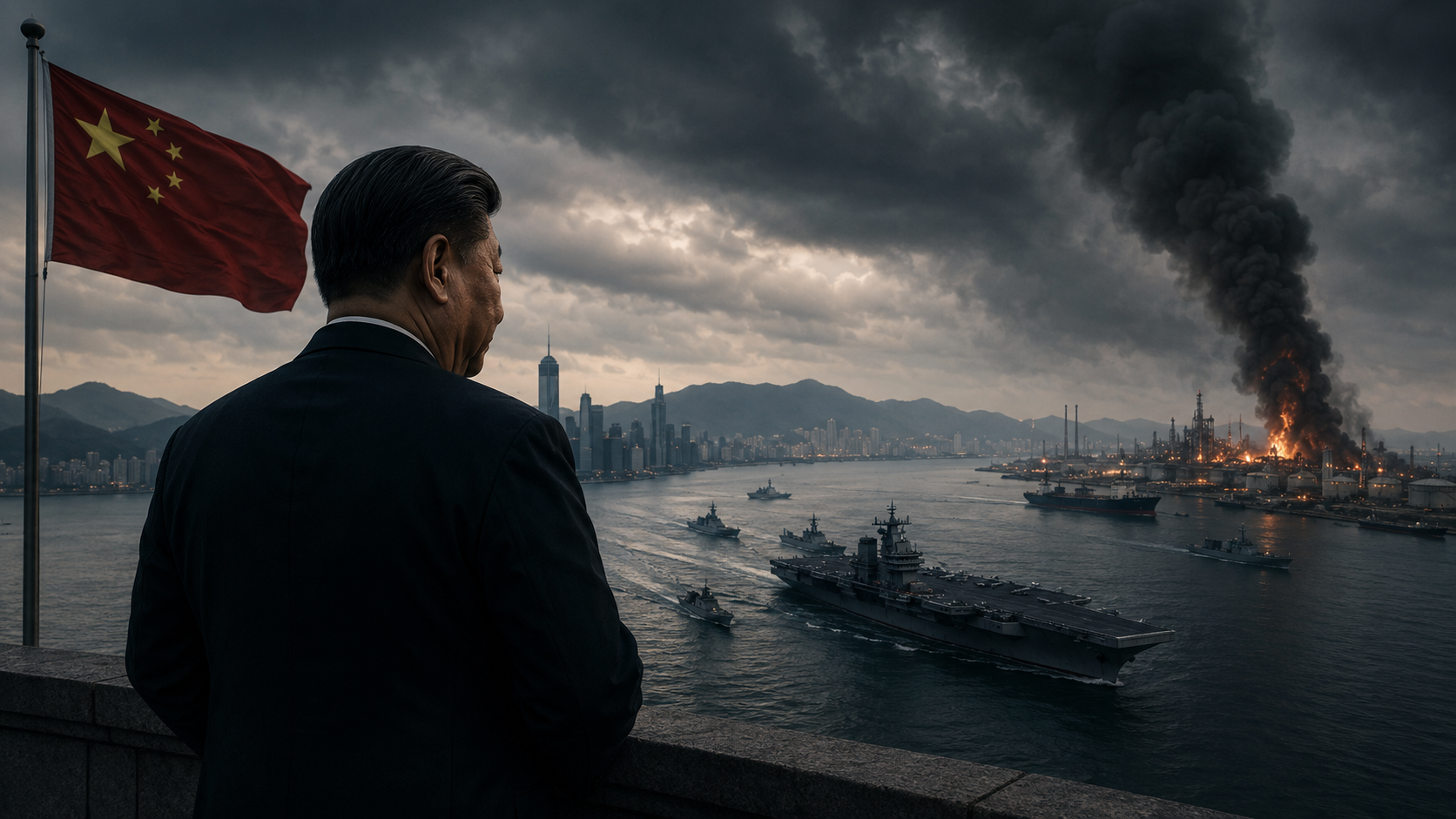
For anyone who took their eyes off Beijing during this window, the conventional assumption is straightforward. The popular narrative suggests that while Washington burned through precision munitions, carrier strike groups, and diplomatic bandwidth in the Middle East, China calmly seized the moment. The working theory holds that Beijing stepped into the vacuum, stitched together an anti-Western Eurasian coalition, and outmaneuvered a distracted adversary. Strip away the theater of recent summit communiqués and state-media broadcasts, however, and China’s maneuvering looks less like a strategic masterstroke and more like aggressive management of an unraveling periphery.
The physical facts on the ground tell a fundamentally different story. China has indeed been busy, but it is operating along the fringes not from an apex of strategic confidence, but out of necessity. Its primary Middle Eastern partner is reeling, its own military high command is paralyzed by internal purges, and its domestic economy is locked in an outright capital strike.
The Proxy Liability
Tehran was cultivated for years as Beijing’s anti-Western security anchor and primary source of deeply discounted hydrocarbons. That investment has yielded severe operational failure. American and allied strikes systematically dismantled Iranian integrated air defense networks, command nodes, and naval infrastructure. The resulting naval blockade has effectively choked crude loadings at Kharg Island. Iran is trapped in hyperinflation, its domestic economy is cratering, and state revenues have evaporated.
China delivered rhetorical cover at the Shanghai Cooperation Organisation summit in Bishkek, signing off on declarations opposing unilateral sanctions and defending Iranian sovereignty. Yet Beijing has not deployed a single naval asset to escort tankers, nor has it challenged the American naval perimeter.
This directly impairs the physical economy inside China. Independent teapot refiners in Shandong built their margin profile on off-radar Iranian crude settled in renminbi outside the Western financial system. With loadings blocked at the source, these refiners are drawing down rapidly exhausting floating inventories parked across Southeast Asia. Beijing cannot replace those missing barrels without paying full freight on the open market, directly squeezing downstream industrial margins in a domestic economy already struggling with deflation.
The Command Freeze
Aggressive posturing around the first island chain masks deep institutional dysfunction inside the People's Liberation Army. Sweeping anti-corruption purges have hollowed out the Central Military Commission. The operational governing body of the armed forces has effectively narrowed to Xi Jinping and his top discipline enforcer, Zhang Shengmin. When an apex military council is reduced to the political leader and an internal investigator, operational initiative dies. Theater commanders will not propose or execute high-risk, combined-arms operations when an operational failure or frank risk assessment invites a corruption charge.
Beijing’s recent military maneuvers reflect this paralysis. Stepped-up coast guard patrols east of Taiwan, renewed island-building at Antelope Reef in the Paracels, and a passing exercise with an Indonesian warship are low-risk political theater. They project presence for domestic state media without testing the PLA in a live combat environment.
Taipei has capitalized on this hesitation. Taiwan’s newly proposed defense budget exceeds 3% of gross domestic product, while its Han Kuang exercises tested decentralized command and drone integration designed specifically to exploit a rigid, politically terrified adversary.
Simultaneously, Beijing’s decision to squeeze heavy rare-earth exports to Japan down to near-zero levels after detaining two Japanese nationals has backfired strategically. While it inflicts short-term pain on Tokyo, it has accelerated Japanese deep-sea mineral recovery, domestic refining investments, and G7 alternative procurement chains, placing an explicit expiration date on China’s processing monopoly.
The Domestic Capital Strike
Beijing’s foreign policy performance is primarily designed to project momentum outward while the domestic balance sheet contracts. Second-quarter gross domestic product slowed to 4.3%, with the manufacturing purchasing managers' index contracting at 49.8. The July Politburo meeting doubled down on state-directed output, pouring credit into the "six networks," including upgraded power grids and computing infrastructure.
The real economy is refusing to follow. Non-governmental fixed-asset investment dropped 8.5% in the first half of the year, while property investment plunged over 19%. Private enterprises and households are not borrowing, investing, or spending. Beijing is manufacturing vast industrial surpluses into a domestic market that cannot absorb them, while foreign markets are rapidly erecting defensive tariff walls.
The Peripheral Reality
Xi’s travel schedule confirms this defensive calibration. Flying to Bishkek and Cairo allows Beijing to posture as a global security architect without assuming the physical or financial burdens of underwriting regional stability. Egypt signed twenty memorandums of understanding, yet Cairo remains anchored by $1.3 billion in annual American military assistance and International Monetary Fund debt conditionalities. A state visit marking seven decades of diplomatic ties does not displace the American Fifth Fleet or secure Red Sea transit.
Most telling is Beijing’s caution toward Washington. Despite blistering public attacks on American sanctions, Xi has carefully preserved his scheduled September 24 meeting with Donald Trump in Washington. Beijing cannot stomach secondary sanctions on its major state lenders or an expanded tariff schedule while its domestic capital formation is frozen.
Beijing has exploited Western distraction to pick up marginal, low-cost tactical chips, but treating diplomatic communiqués and gray-zone patrols as strategic dominance ignores reality. China is managing a ruined Iranian ally, an exhausted shadow oil trade, a purged military high command, and a private sector on strike.
Sign in to leave a comment and join the discussion.
Sign Up Free