

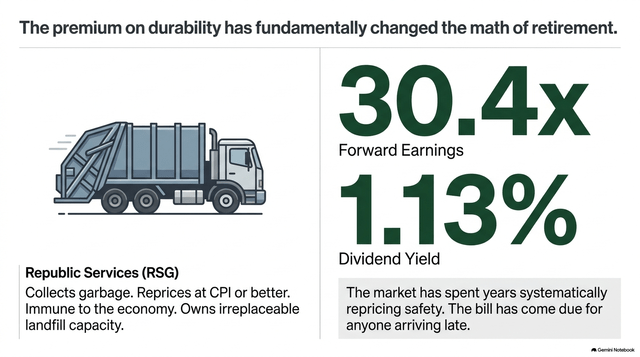
Republic Services (RSG) trades at roughly 30x forward earnings.
It collects garbage.
I want to be clear that I mean this as a compliment. Republic owns landfill capacity that essentially cannot be permitted into existence anymore. It reprices at CPI or better, and the volume shows up whether the economy is booming or falling apart. It is one of the finest businesses in the U.S. market, and I understand exactly why it trades where it does.
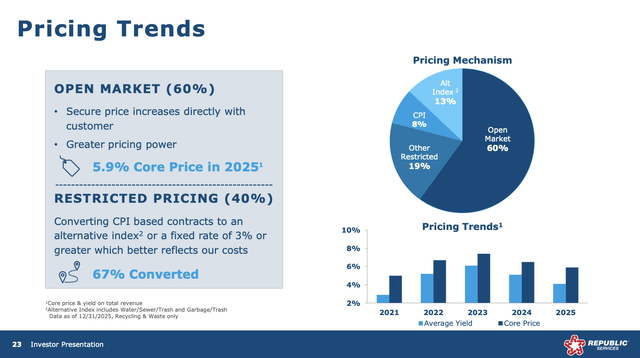
But thirty times forward earnings for waste collection tells you something important about where we are. And what it tells you is that the market has spent the last several years systematically repricing "safety," and the bill has come due for anyone who arrived late.
So here is my question for you.
If you are ten years from retirement and you go shopping today for the thing every financial advisor tells you to buy, meaning a diversified basket of high-quality dividend growers, what yield do you actually get?
The answer is going to annoy you (it sure annoyed me).
Now, this article started with a reader comment. It is one of the best I have received in a while, because it is specific and it comes from someone doing real work:
WHK is probably too risky for me as am nearing retirement age. An idea for an article, or even another 'portfolio' could be a diversified selection of companies for people nearing retirement. So compounders / dividend growth companies as opposed to high yields such as WHK or very low yields and higher risk such as TPL or LB.
Examples could be CSL, CME, UNP, ZTS, BMI etc.
There's just one problem.
Carlisle (CSL) yields 1.25%. Badger Meter (BMI) yields 1.17%. Both are lower yields than Texas Pacific Land (TPL) and LandBridge (LB), the two names being ruled out in that comment for being "very low yields." So low yield is not really the objection.
And that is not a criticism of the reader (not at all). It is a symptom of the market I just described. The mid-yield, high-quality, steadily-growing dividend payer that everybody wants for their fifties has been bid so hard that when you go looking for real examples, you keep landing on companies yielding barely 1%.
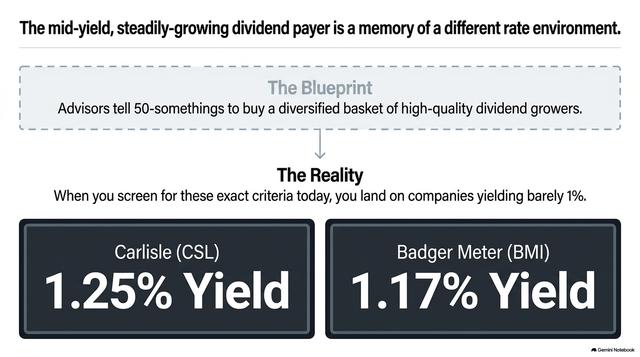
The category is a memory of a different rate environment.
So let's run the numbers and see what is actually left.
Sign in to leave a comment and join the discussion.
Sign Up Free