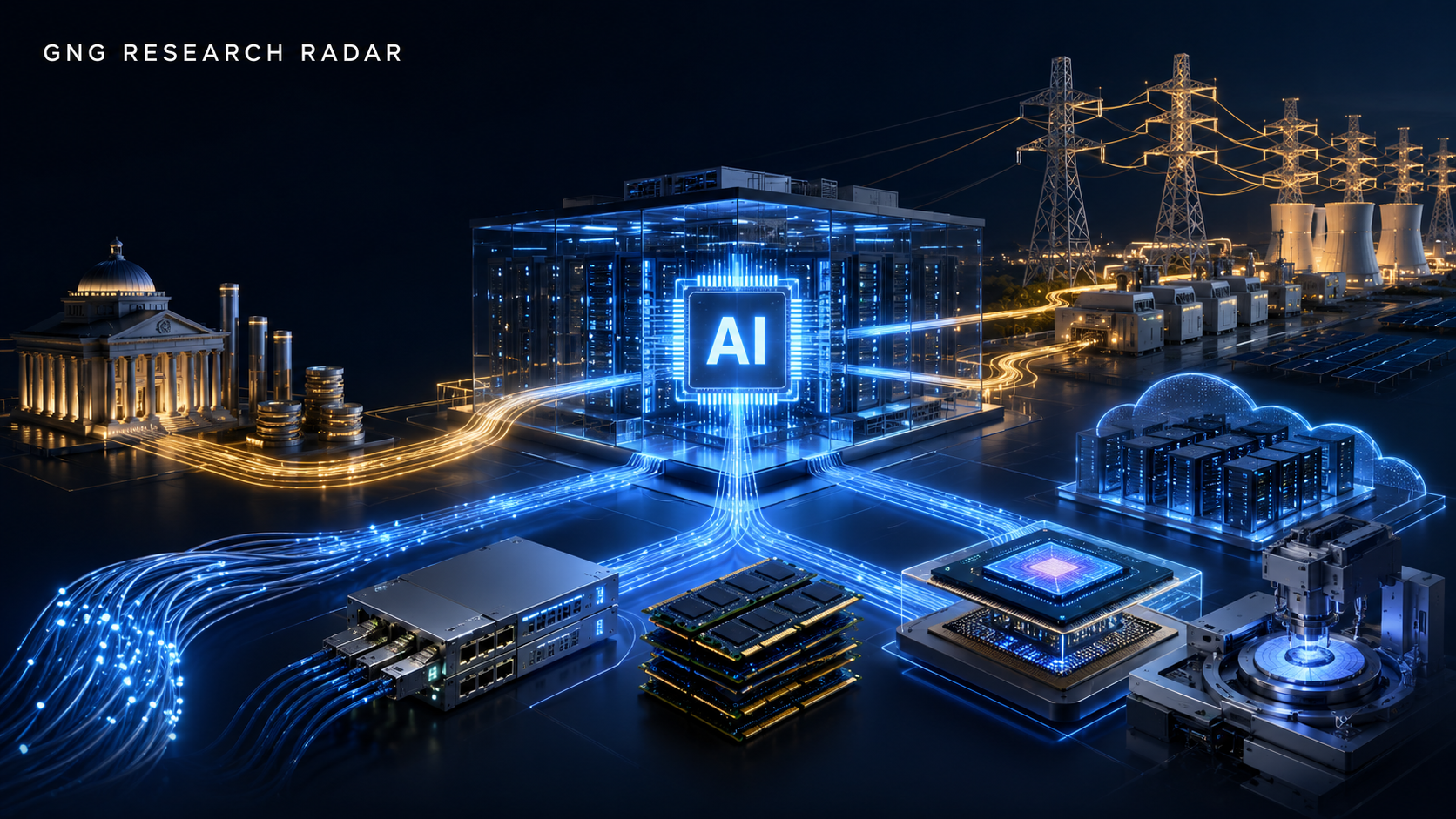

This week’s best research came from company disclosures and infrastructure-policy developments. AI demand remains strong, but financing quality, power availability and cash conversion are becoming more important.
1. NVIDIA opens a major AI-financing channel
NVIDIA signed agreements with Apollo, BlackRock, Blackstone, Brookfield, Goldman Sachs and KKR to develop platforms capable of supporting more than $500 billion of AI infrastructure over time.
This could ease financing constraints for neoclouds and data-center developers while supporting demand for GPUs, networking, cooling and power equipment. But $500 billion is potential financing capacity, not committed spending. Investors still need to distinguish funded projects and contracted customers from speculative capacity.
Stocks to watch: (NVDA), (CRWV), (NBIS), (IREN) and (ORCL).
2. Power is becoming a formal gate for data centers
PJM attributes roughly 30 GW of its projected 32 GW load growth through 2030 to data centers. Its proposed framework would require certain new large loads to bring equivalent generation or accept possible emergency curtailment.
If approved by FERC, power access can no longer be treated as a routine assumption. Companies with secured generation, interconnection rights, backup power or behind-the-meter solutions could gain an advantage. Developers advertising large pipelines without firm power deserve a meaningful probability discount.
Stocks to watch: (BE), (ETN), (VRT), (GEV), (CEG), (VST), (AEP), (PPL) and (EXC).
3. Palantir could expand into defense manufacturing
A reported draft Pentagon memo directs up to $244 million toward Palantir services through March 2027 and asks the services to identify potential funding through December 2028.
The work reportedly targets munitions-production and maintenance bottlenecks, potentially using Palantir’s Warp Speed platform. This could expand (PLTR) beyond battlefield intelligence into defense-industrial production and supply chains.
However, a planning directive is not booked revenue. Actual funding, task orders and contract awards remain the next confirmation.
4. Cisco and Supermicro confirm broader infrastructure demand
Cisco recorded $9.3 billion of FY2026 hyperscaler AI-infrastructure orders and expects related revenue to rise from roughly $4 billion to $7.5 billion in FY2027.
Supermicro reported FY2026 sales of $39.1 billion and guided toward $65–72 billion for FY2027. Its growth outlook is exceptional, but its results remain preliminary and the board is reviewing transactions involving export-control issues.
The reports confirm that spending is expanding beyond GPUs into networking and complete rack systems. Cisco offers higher margins and recurring exposure. Server integrators can grow faster but carry greater concentration, working-capital and compliance risks.
Stocks to compare: (CSCO), (ANET) and (SMCI). Read-throughs include (AVGO), (LITE) and (COHR).
5. Memory, storage and packaging remain AI bottlenecks
Sandisk expects enterprise data-center flash demand to reach 1.2 zettabytes by 2030 and targets mid-to-high-teens annual growth from FY2028 through FY2030.
Applied Materials reported record quarterly revenue of $9.12 billion, up 25%. Management emphasized memory architecture, advanced packaging and energy efficiency as increasingly important AI-system constraints.
This supports the broader picks-and-shovels thesis, although cyclicality, valuation and bullish long-term forecasts still require discipline.
Stocks to compare: (SNDK), (MU), (AMAT) and (LRCX).
6. Mag7 concentration creates shared capex risk
Schwab estimates that technology represents roughly 30% of the MSCI ACWI but is expected to generate 47.6% of its 2026 earnings growth.
That does not prove AI is a bubble. It shows how even a moderate hyperscaler capex slowdown could affect Mag7 earnings, infrastructure suppliers and index valuations at the same time.
(GOOGL), (AMZN) and (META) should be compared on AI monetization and free cash flow after capex. (NVDA) should be monitored for the quality and financing of end demand. (AAPL) and (TSLA) require separate, non-infrastructure theses.
Three main takeaways
NVIDIA’s initiative could strengthen the AI buildout, but financing capacity is not the same as funded customer demand.
Firm power, interconnection rights and curtailment exposure now belong in every data-center investment analysis.
The most useful next comparisons are (CSCO)/(ANET)/(SMCI) and (SNDK)/(MU)/(AMAT)/(LRCX).
Sign in to leave a comment and join the discussion.
Sign Up Free