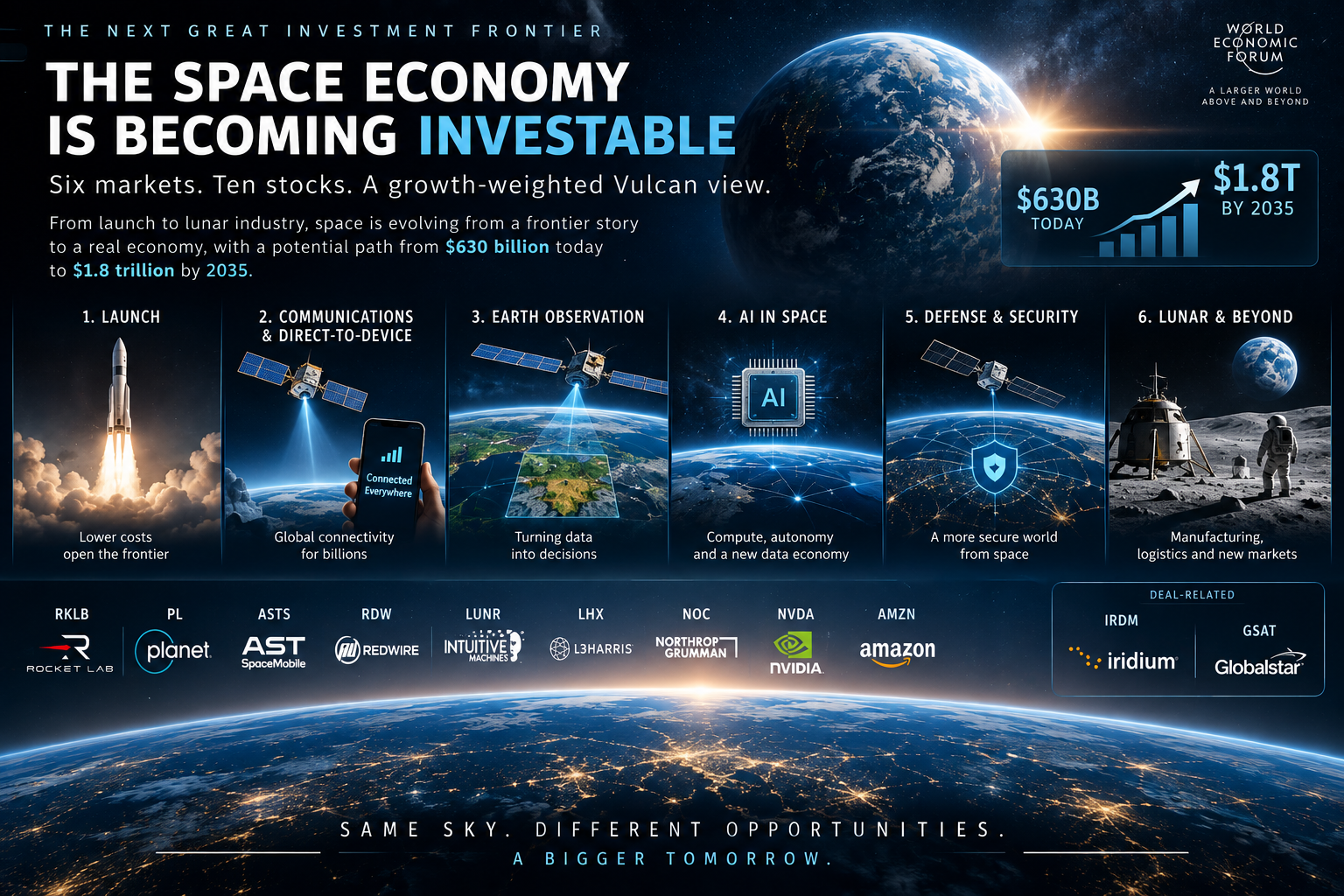

The World Economic Forum puts today's space economy at roughly $630 billion and projects about $1.8 trillion by 2035. The United States launched close to 3,500 objects into orbit in 2025. The Defense Department has proposed lifting the Space Force budget 123%, to roughly $71 billion.
Yet the ten tickers most often called space stocks carry consensus revenue growth estimates ranging from 5% a year to 322% a year.
Buying "space" as one trade is lazy, and that spread is the proof. So let me ask a better question.
How much of each company's thesis has already turned into reported revenue, and how much is still a forecast?
Capital Group's recent piece is the right place to start, because it avoids the single biggest mistake investors make with this theme. Space is not one industry. Launch, satellite communications, direct-to-device connectivity, Earth observation, defense sensing, orbital computing, lunar infrastructure and microgravity manufacturing have very different economics, maturity levels and competitive structures.
Before we go further, I owe you an admission about the model.
I don't think ordinary Vulcan weighting is quite right for this particular exercise. Standard Vulcan deliberately gives Value, Growth, Quality, Momentum and Safety equal 20% weights, which is sensible for a mature equity universe. It can systematically underweight an emerging industry where several potentially important companies are still spending ahead of revenue and where the next three years matter far more than the previous five.
So for this article I am keeping Standard Vulcan intact as the parallel discipline, and running a one-time Space Growth Vulcan overlay for candidate selection. I am weighting forward growth and demand at 55%, strategic position at 15%, execution and backlog conversion at 10%, financeability and dilution at 10%, valuation at 5%, and current risk and tape at 5%. The forward block leans heavily on 1-, 2- and 3-year revenue consensus estimates, revisions, contracted demand, backlog and forward cash-flow improvement where available. Those are already legitimate Vulcan growth inputs, and I am simply giving them substantially more influence for one emerging-market exercise.
Treat that weighting as my judgment call, not a stone-cold fact.
Higher risk tolerance does not mean ignoring financing. A company can lose money today and still qualify. It cannot endlessly issue stock, miss milestones and call the result growth, and that distinction becomes important by the end of this piece.
My resulting hierarchy is fairly clear, so you know where this is going. Rocket Lab (RKLB) and Planet Labs (PL) are the two names I would build the research around first. AST SpaceMobile (ASTS) has greater raw upside but materially more deployment risk, and Redwire (RDW) is becoming much more interesting as its revenue, backlog and margins mature.
Intuitive Machines (LUNR) has the fastest forward growth in the group and still belongs in the venture-sized bucket. L3Harris (LHX) and Northrop Grumman (NOC) are the steadier defense beneficiaries. NVIDIA (NVDA) and Amazon (AMZN) offer high-quality indirect exposure, while Iridium (IRDM) and Globalstar (GSAT) now carry merger mechanics that make them less useful as clean standalone long-term ideas.
These are thematic research conclusions, not official Vulcan BUY or STRONG BUY ratings. I am deliberately not manufacturing exact buy zones for ten securities out of stale database prices, because official Vulcan current-price valuation and zones require live quotes reconciled across at least two independent sources.
Let's take the six markets in order.
1. Space is not one market: Planet Labs and Iridium
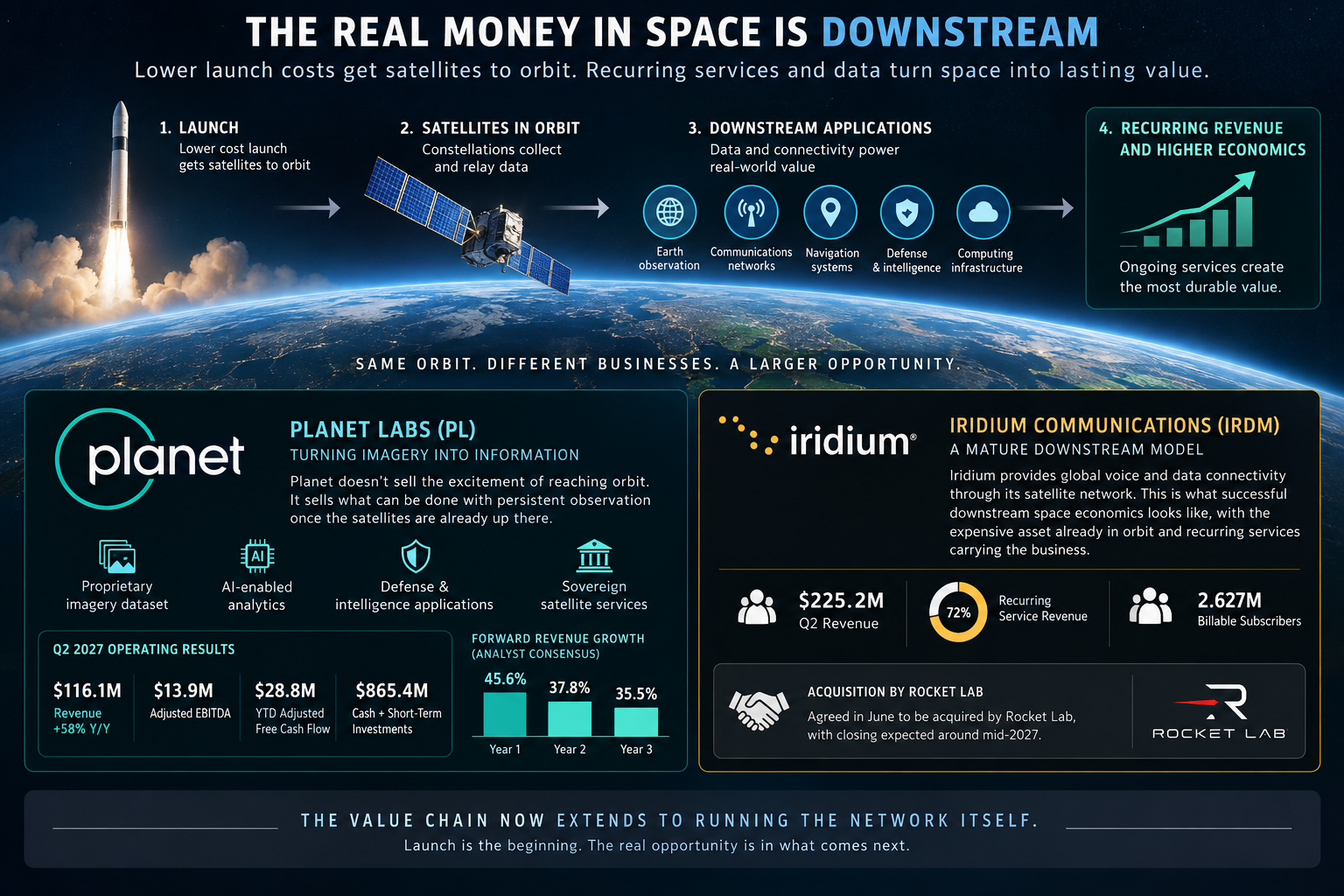
Capital Group makes an important observation almost immediately: much of the eventual money in space may be earned downstream, not by whoever launches the rocket. Satellites create communications networks, Earth-observation datasets, navigation systems, defense intelligence and eventually computing infrastructure. Lower launch cost is the enabling technology, while recurring services are where the best economics can develop.
That is why Planet Labs (PL) is one of the more interesting names in the entire exercise. Planet does not sell the excitement of reaching orbit. It sells what can be done with persistent observation once the satellites are already up there.
Its business increasingly combines a proprietary imagery dataset, AI-enabled analytics, defense and intelligence applications, and sovereign satellite services. That starts to look less like a traditional aerospace manufacturer and more like a vertically integrated information business with satellites as the data-acquisition layer.
Planet's operating evidence improved sharply this year, starting with fiscal Q2 2027 revenue of $116.1 million, up 58% year over year, with adjusted EBITDA of $13.9 million. Year-to-date adjusted free cash flow reached $28.8 million, and cash plus short-term investments stood at $865.4 million. I read that as a materially different setup from a pre-revenue space story.
GNG's forward snapshot strengthens the case. Current analyst consensus estimates revenue growth of roughly 45.6% in year one, 37.8% in year two and 35.5% in year three. For a company already producing more than $100 million of quarterly revenue and running positive adjusted EBITDA, that profile carries far more analytical weight than a triple-digit forecast starting from almost nothing.
You are probably wondering where the catch is, and there is one.
Planet raised about $120 million through its ATM during the quarter, so dilution has not disappeared, and the stock's volatility remains severe with a three-year maximum drawdown of 68%. In this higher-risk version of Vulcan I will accept moderate dilution when it arrives alongside accelerating revenue, improving cash generation and a large cash balance. I will not accept dilution that exists only to finance recurring operating losses with no evidence of scale.
The second name here is Iridium Communications (IRDM), and it sits at the opposite end of the maturity curve. Q2 revenue was $225.2 million, recurring service revenue represented 72% of the total, and the network supported 2.627 million billable subscribers. This is what successful downstream space economics eventually looks like, with the expensive asset already in orbit and recurring services carrying the business. (Iridium Investor Relations)
There is one large complication. Iridium agreed in June to be acquired by Rocket Lab, with closing expected around mid-2027, so I would no longer treat IRDM as a clean multi-year standalone selection. The thesis has become partly merger consideration and closing risk.
Strategically, though, that transaction is one of the most revealing developments in the whole sector. Rocket Lab evidently reached the same conclusion Capital Group did, which is that the economics do not stop when the launch vehicle releases the payload.
In this industry the value chain now extends to running the network itself.
Sign in to leave a comment and join the discussion.
Sign Up Free