Introduction
Last week, a senior safety researcher at the company that makes Claude said something that got my attention. In general, it got a lot of attention.
Evan Hubinger, who leads Anthropic's Alignment Science team, wrote that he personally puts the odds above 10% that AI kills every human being on the planet within the next decade. His exact words were that his team does "really do earnestly believe AI could kill all humans".
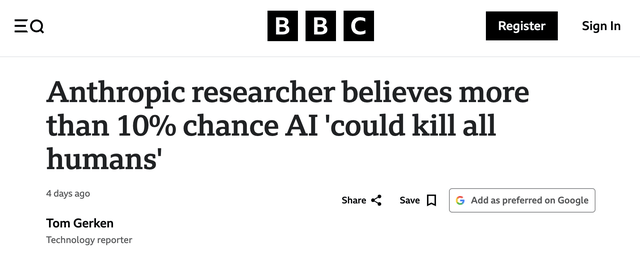
And to add fuel to the fire, he added that the company does not yet have a plan for aligning a superintelligent system.
A day or two later, Geoffrey Hinton went on BBC Newsnight. Hinton won the Nobel Prize in Physics in 2024 and is usually called the "godfather of AI." When he was asked about that 10% number, he said it seemed not an unreasonable estimate to him.
And at the end of August, Bill Gates published a roughly 6,000-word essay saying that AI will either be the greatest equalizer ever invented or the worst source of injustice. The interesting thing is that, for the first time in his life, he wrote that he wishes a technology would move more slowly.
That Bill Gates news was also brought up by some readers. And, as always, whenever people bring up something interesting, I write it down. These reader concerns are a big reason why I am writing this article today.
I also need to be honest about something, as I have no edge whatsoever on whether AI ends the world. Nobody does. I believe many fears are overblown.
However, I do not believe that AI should be underestimated. I spend a lot of money myself on AI capabilities to improve our research, access to data, and so much more.
If the people building this stuff believe it is powerful enough to be a species-level risk, it is certainly powerful enough to destroy the earnings power of a lot of companies currently sitting in your portfolio.
And that's exactly why I am writing this.
That brings me to Jordi Visser. I often care about his opinions, as he has been on top of the AI revolution for a while. And although I don't always agree with him, his argument right now is that traditional macro is dead and that we are at the start of an AI-driven productivity boom. I think he is mostly right.
I also think the bullish half of his argument and the bearish half are the same sentence, and that is the part where it gets really interesting for us.
Hence, in this article, I want to cover what Visser is claiming, where I think he goes too far, what the Gates essay means for how these profits get taxed, why our TOLL+M framework is built for exactly this environment, and five businesses I would own if intelligence becomes free.
So, let's dive in!
Sign in to leave a comment and join the discussion.
Sign Up Free