

Introduction
"Our favorite holding period is forever."
If I had a dollar for every time I have seen that Warren Buffett quote on social media, I would be in a much better financial position.
It's a line I have taken more seriously than most. From the day I started building my dividend growth portfolio, I adopted a never-sell mindset, which was based on buying great companies, keeping adding to them, and letting dividends and time do the heavy lifting.
There's just one problem, which is that "never" is a very long time. And as many of you know, I have broken that rule a few times. More recently, I sold Rexford Industrial Realty (REXR) to build a core Amazon (AMZN) position.
Now, the question has become very practical for me. As some of you know, I have left the Netherlands. I'm currently in Germany, waiting for my move to Albania. That changes my tax situation in a big way.
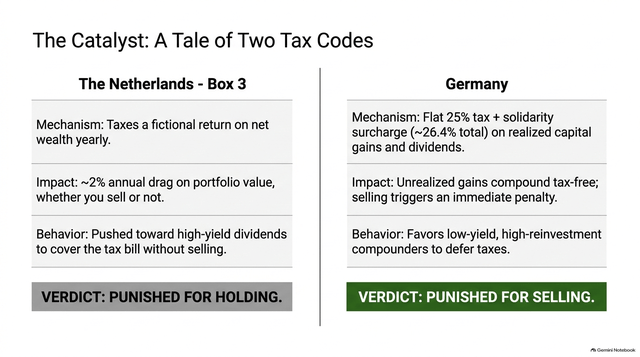
In the Netherlands, I was subject to a wealth tax. The Dutch Box 3 system taxes a fictional return on your net wealth every single year, whether you sell anything or not. On a stock portfolio, that comes down to roughly 2% of its value per year above a tax-free allowance.
That's one of the reasons I initially focused too much on yield. I wanted my dividends to cover that tax in the long term, so I would never be forced to sell shares to pay the government. Makes sense, right?
The problem was that this system cost me too much money. By focusing on yield right from the start, I sacrificed growth. Also, getting taxed on unrealized gains makes compounding much harder. Not paying capital gains taxes is a great thing, but not if it interferes with my personal strategy, as I'm not a trader.
Germany works the other way around. There's no wealth tax. However, realized capital gains are taxed at a flat 25%, plus a solidarity surcharge, which brings the total to roughly 26.4% (more if you pay church tax). Dividends are taxed at the same rate. This, too, adds up.
Essentially, the Dutch system punished me for having wealth, while the German system punishes me for selling (taking actual profits).
That's why I want to use today's article to answer a question I have been thinking about for weeks: how feasible is a never-sell mindset, really? What does it take for a company to deserve a "forever" spot in a portfolio? And when should even a never-sell investor sell?
To answer that, I'll walk you through the math of selling, why age isn't the deciding factor (building on our recent retirement work), and a simple framework that ties TOLL+M and PLOW+M together.
Along the way, I'll discuss a number of stocks, including a few I don't own.
On a side note, Albania also taxes realized gains, although at a lower rate. And while I don't like taxes at all (who does like paying taxes?), I prefer the gains tax, as it makes accumulating wealth easier. It also makes stock picking very important!
And as I'm super excited, I would say we get right to it!
Sign in to leave a comment and join the discussion.
Sign Up Free