
This is the big weekly review of all the research I’ve been doing for GNG members, the company, and the ZEUS family.
It’s designed to look out 1, 5, and 50 years into the future and make your life better by helping you achieve financial independence and, most importantly, maximize the meaning of your life in the age of abundance being built right now.
Part 3 is an exciting update about GNG and what we’re building😉🥳
Part 1: What You Need To Know For The Next Year: AI Boom Keeps Growing Larger (And It’s Justified By Fundamentals)
Hyperscaler Earnings
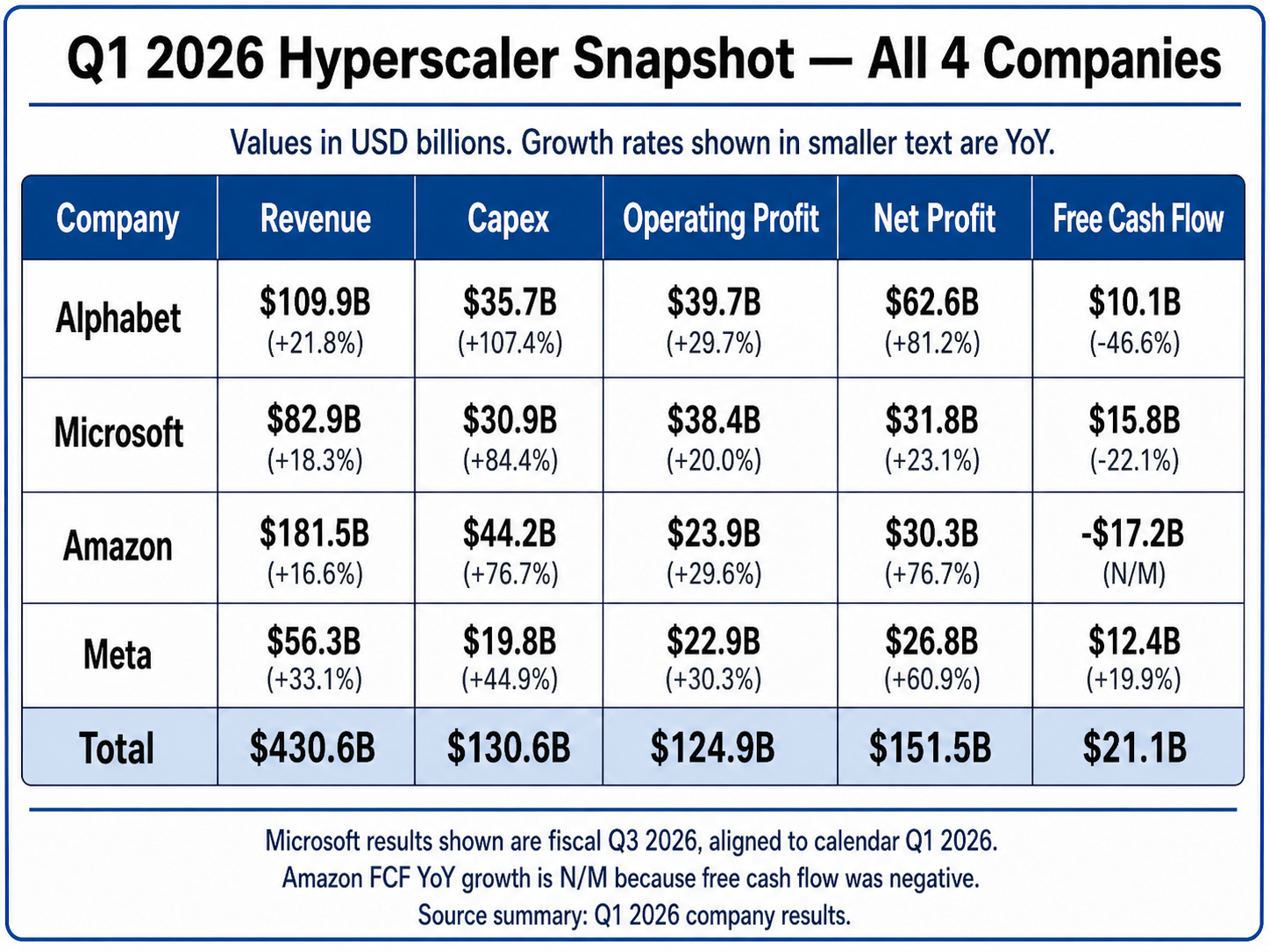
Capex Guidance Up $55 Billion From Last Quarter
Personally, I think $750 to $880 Billion Is The Final Outcome
Extrapolating this quarter and the fact that Amazon spent 30% more in 2025 than in the initial guidance
$55 billion *3 more quarters = $165 billion + $715 billion current Guidance = $880 billion
30% more than the initial $660 billion is $858 billion
The risk to capex is to the upside
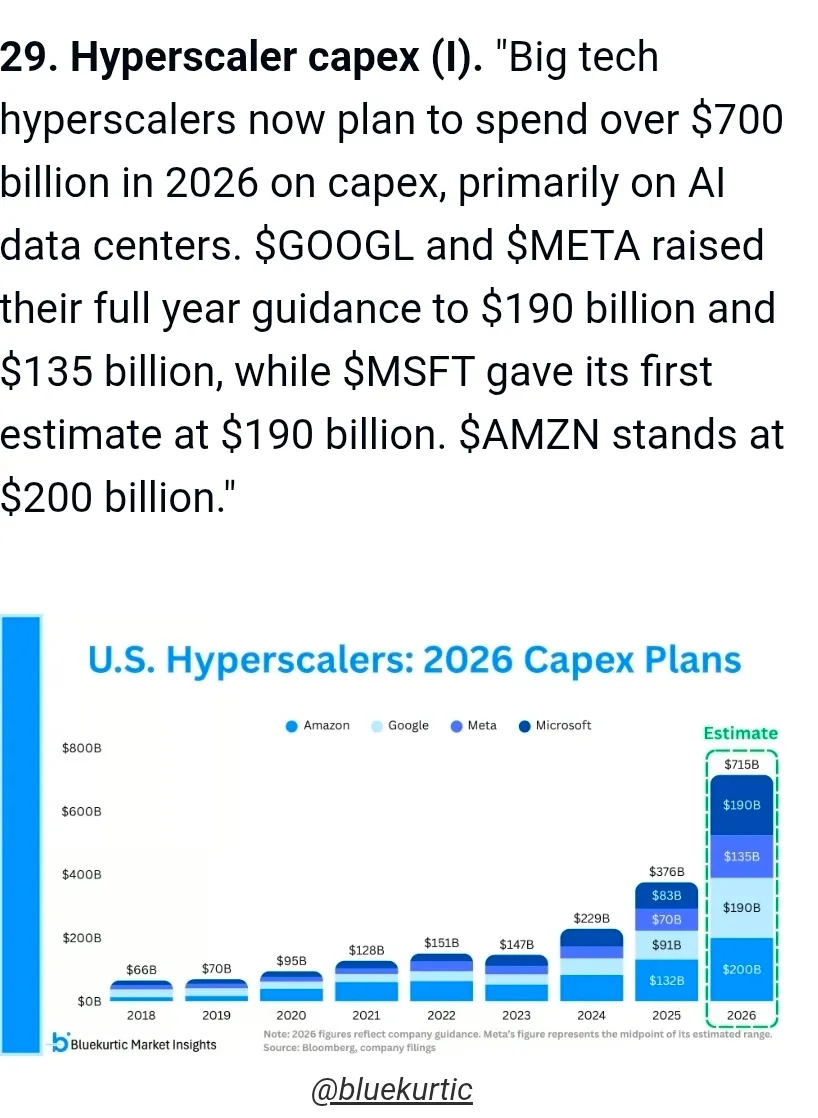
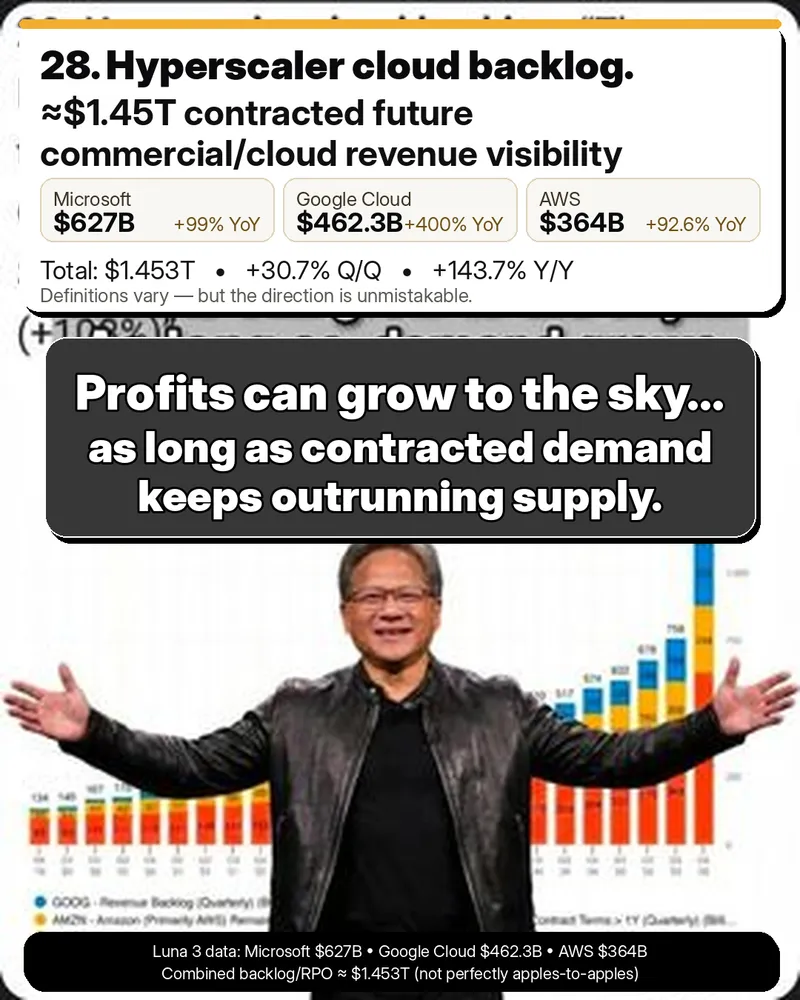
90% Capex Growth Vs 70% last quarter…Vs 143% growth in cloud backlog…which is up from 95% last quarter.
$880 billion = 134% growth in spending vs 143% growth in backlog
Even that amount of spending would be 100% justified by fundamentals
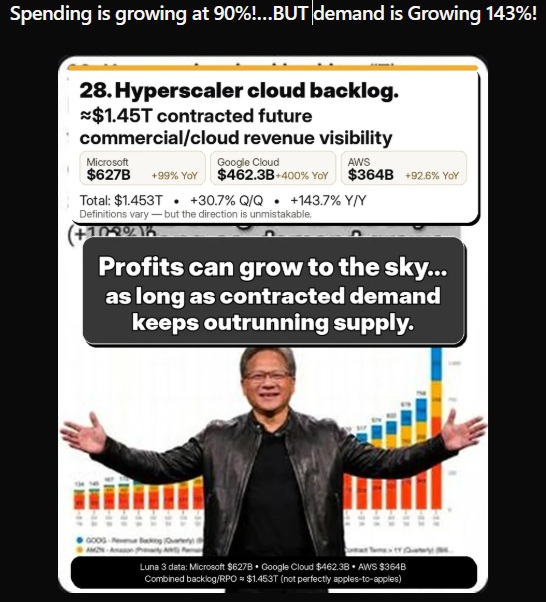
Here Is The Single Biggest Proof That All Of This Spending Is Justified
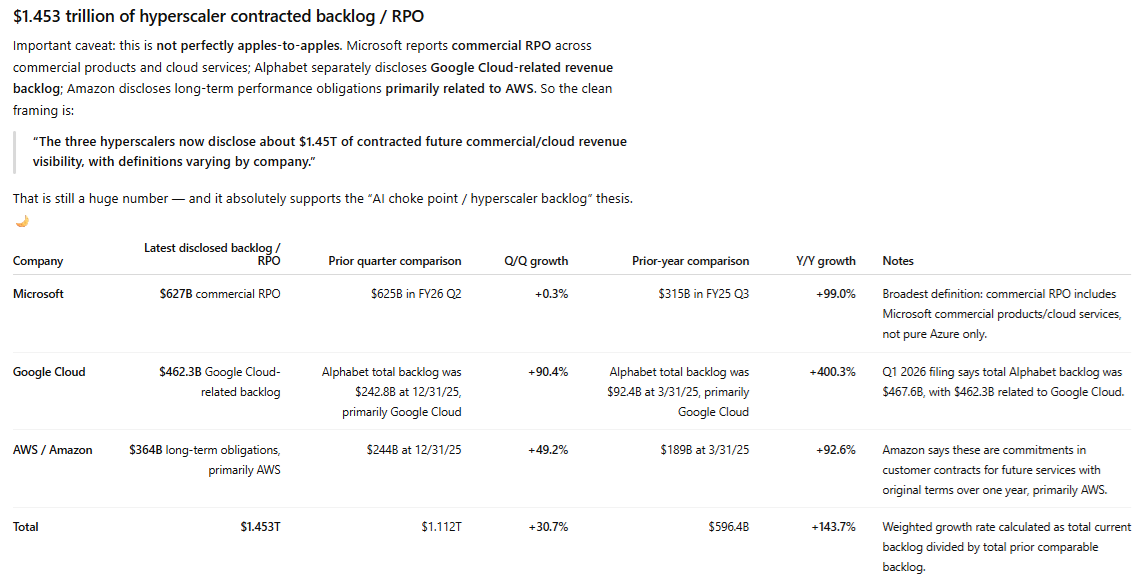
$715 billion of spending to secure $1.45 trillion in excess demand…that’s growing at 143% YOY…up from 95% YOY last quarter!
Spending is growing at 90%!…BUT demand is Growing 143%!
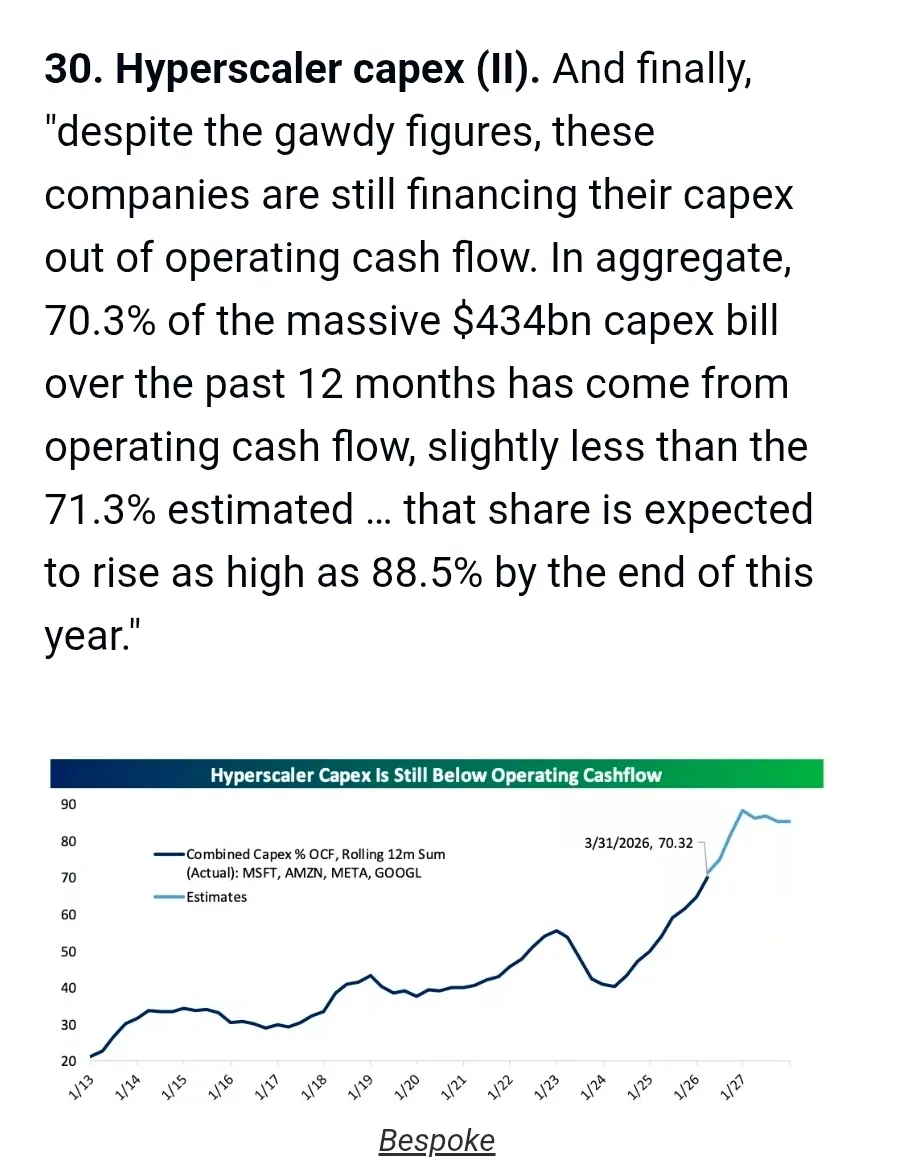
“But how is this being funded?!” Cash Flow 😉
Because every bit of capacity is sold the moment it’s done, all of the spending is highly profitable…by definition, if there is a backlog, all sales are full price
Therefore, all of this spending (and more) is infinitely sustainable as long as demand grows faster than supply
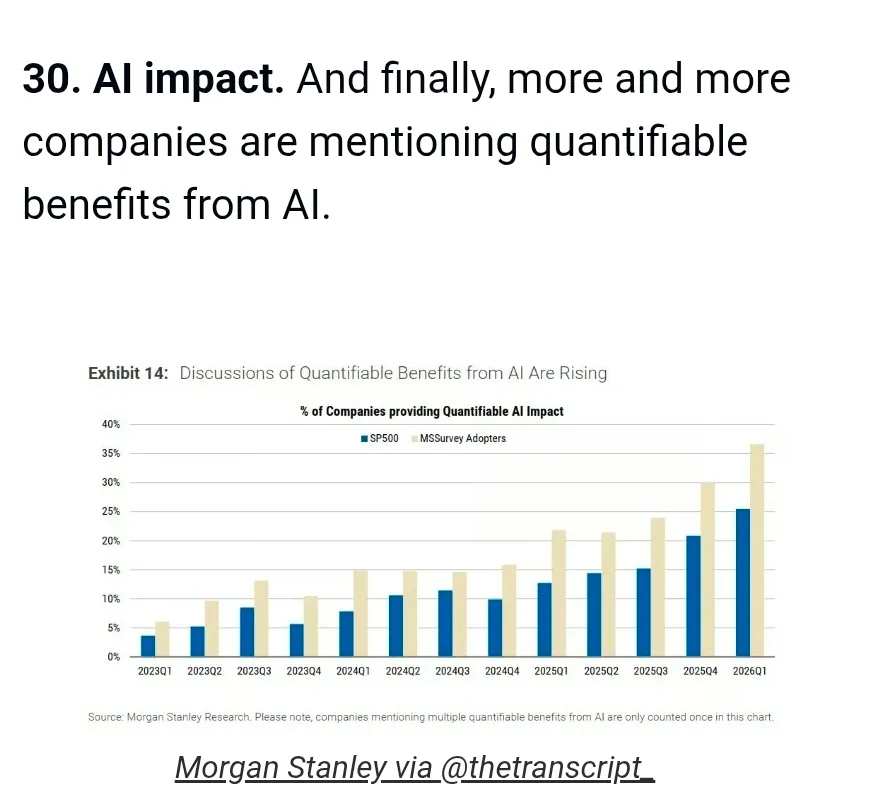
When Will Companies Start To Report Actual AI Benefits?!
Microsoft As The Case Study Of Safe AI Investing “So Easy It’s Obvious To Everyone…In The Future😉😂
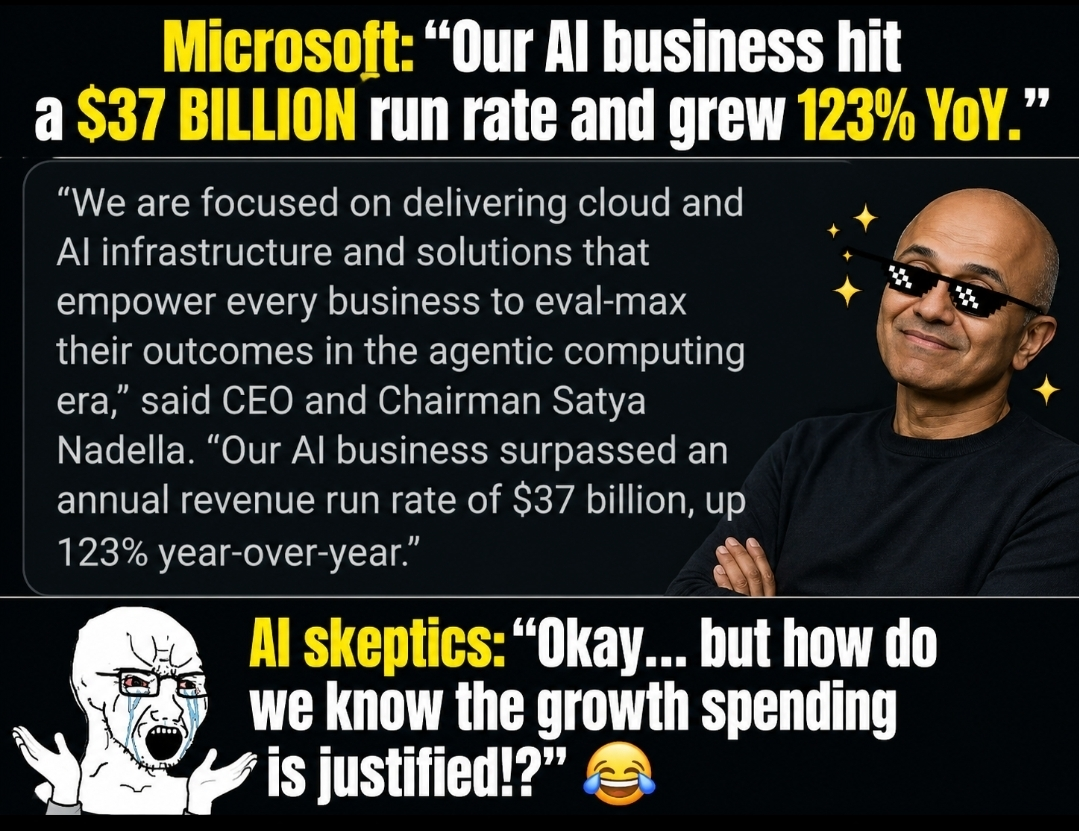
Microsoft is now the world’s largest AI company with $37 billion in AI revenue. According to The Information, this is conservatively measured and excludes the partnership with OpenAI (this is CoPilot revenue).
Well done, Satya Nadella and Mustafa Sullyman!
OpenAI is guiding for 89% CAGR revenue growth through 2030 ($280 billion by 2030).
So here is how the AI race looks right now.
Microsoft $37 billion annualized AI revenue (123% growth)
Anthropic $30 billion with 900% growth
OpenAI is $25 billion with 89% CAGR growth
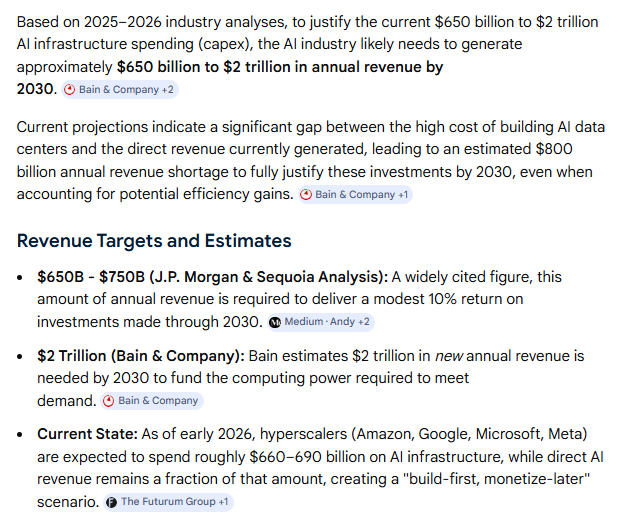
$92 billion in ARR revenue for these 3 companies alone…at 63% CAGR growth through 2030, that’s $650 billion in revenue in 2030…what JPMorgan estimates is necessary to justify ALL AI growth spending.
116% CAGR growth for these companies alone (ignoring the rest of the AI industry) justifies the $2 trillion worst-case estimates for what’s necessary to justify this spend.
Demand is currently growing, how fast?
Cloud backlog is growing 143% per year (accelerating from 95% last quarter).
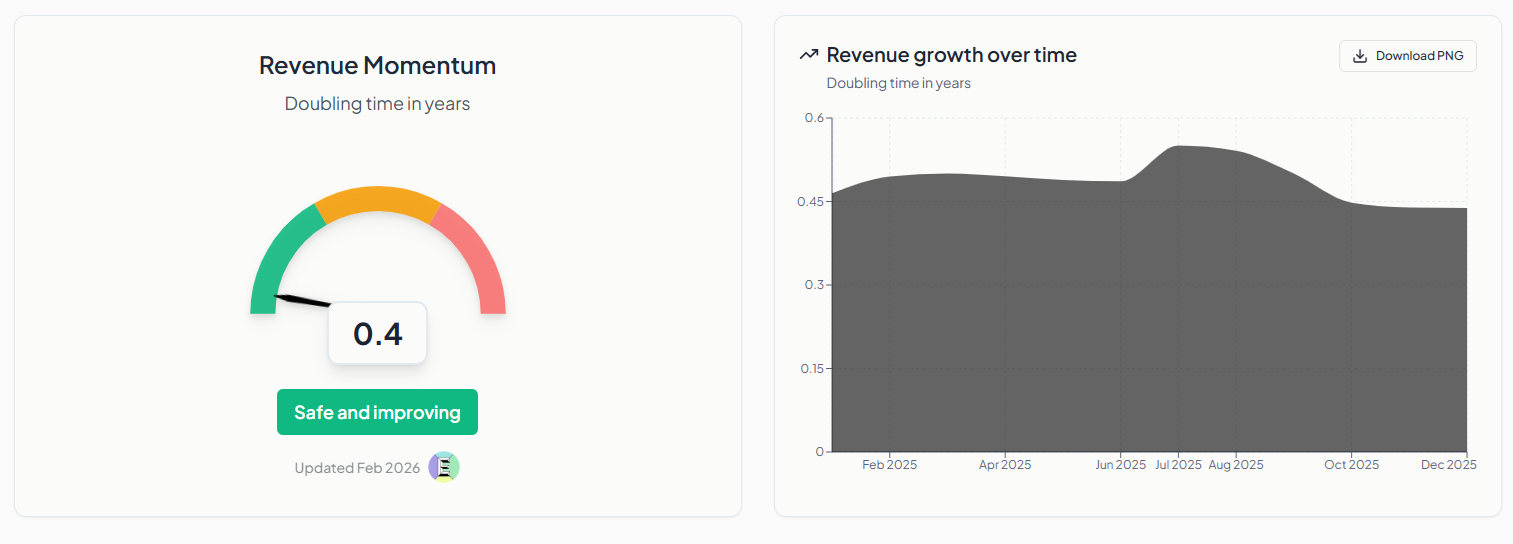
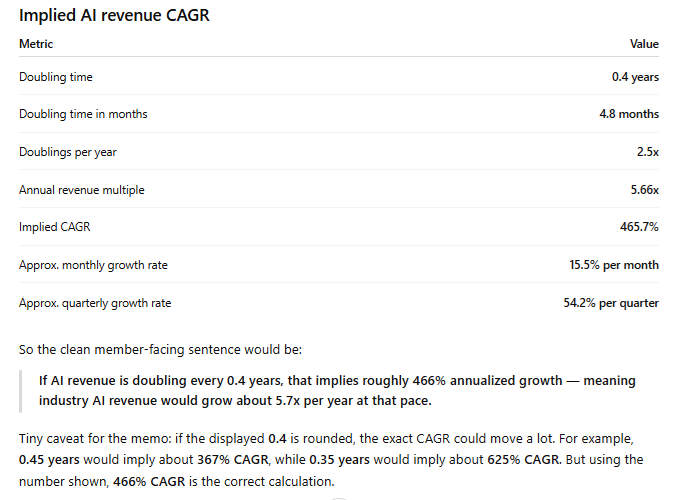
According to Azheem Azhar’s Team at Exponential View, AI Revenue has been doubling every 5 months…and that rate is stable over the past year.
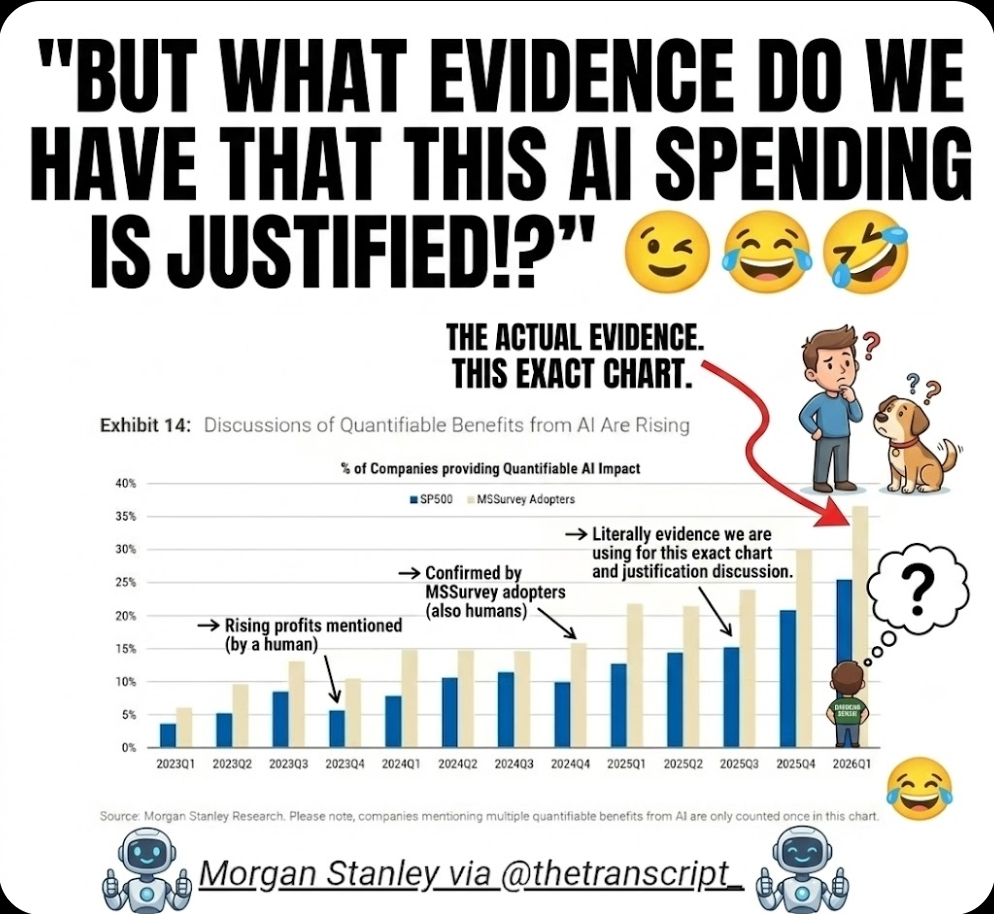
But What Evidence Is There That All This AI Spending Is Justified?!😉

Are We Going To Still Be Freaking Out About Giant Capex EVERY Quarter?! Look at The Free Cash Flow!
FCF is unaffected by depreciation, so sorry, Michael Burry, you can’t claim these numbers are fraud😉
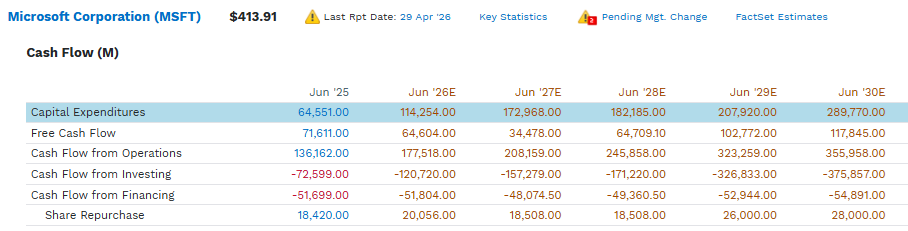
$327 billion in profit by mid-2031
20.6% CAGR Profit Growth For Next 5 Years
$290 billion in Capex +$50 billion in R&D = $340 billion in Growth Spending.
“But how do we know this spending is justified?!”
How about 21% CAGR growth?
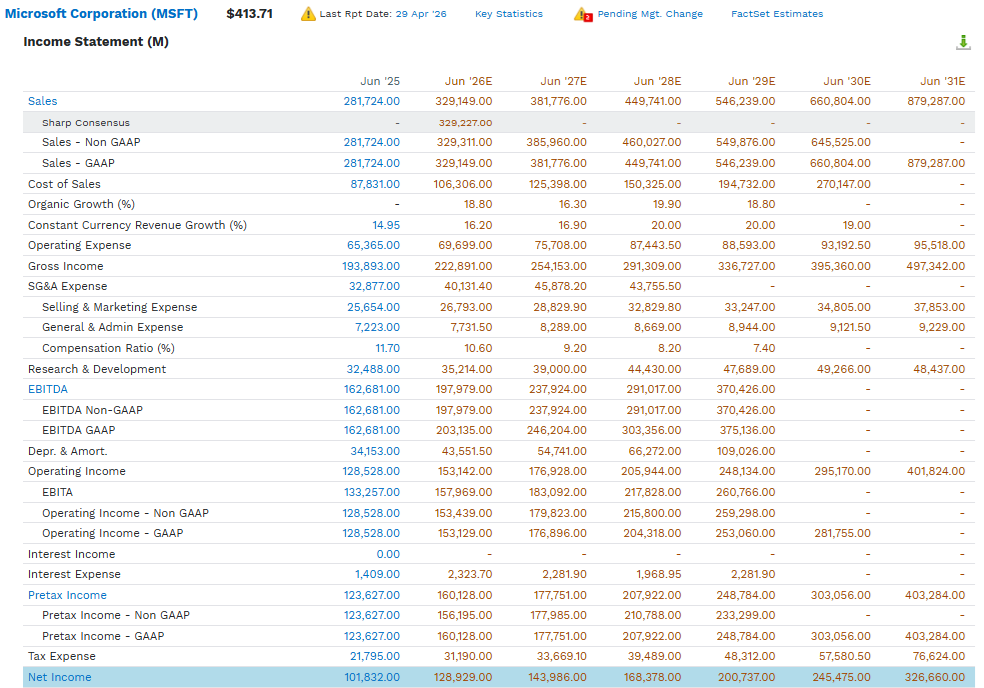
21.73% CAGR EPS growth consensus…Plus 0.88% yield = 22.61% CAGR total return justified
Operating Cash Flow Is What To Watch (Like What Amazon Has Been Focusing on Since the Beginning)
Free cash flow is what’s left over after running the business and investing in future growth.
Because there are 4 things a company can do with free cash flow.
Buybacks
Dividends
Payback Debt
Acquisitions
If Microsoft stops spending, what are they supposed to do? Buy back stock and pay dividends? Isn’t it better that they actually GROW and build useful things?
Do we REALLY want to go back to the 2010s when tech companies were obsessed with the latest social media apps? A 4th dog walking app? Another delivery app?
Maybe we should celebrate that 22% returns from Microsoft come from something useful?
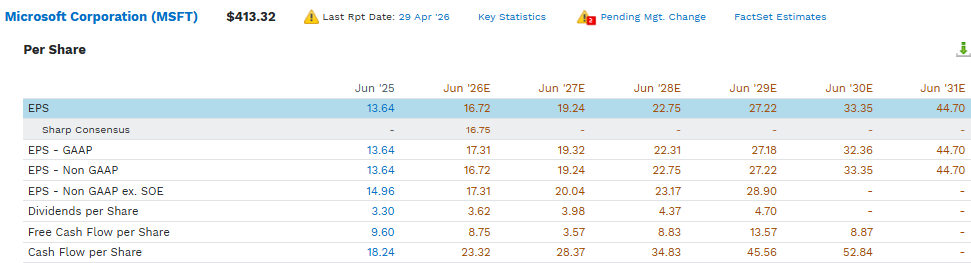
22.69% CAGR Operating Cash Flow Per Share Growth…And Instead Of Buybacks, THIS Is What Is Driving That Growth
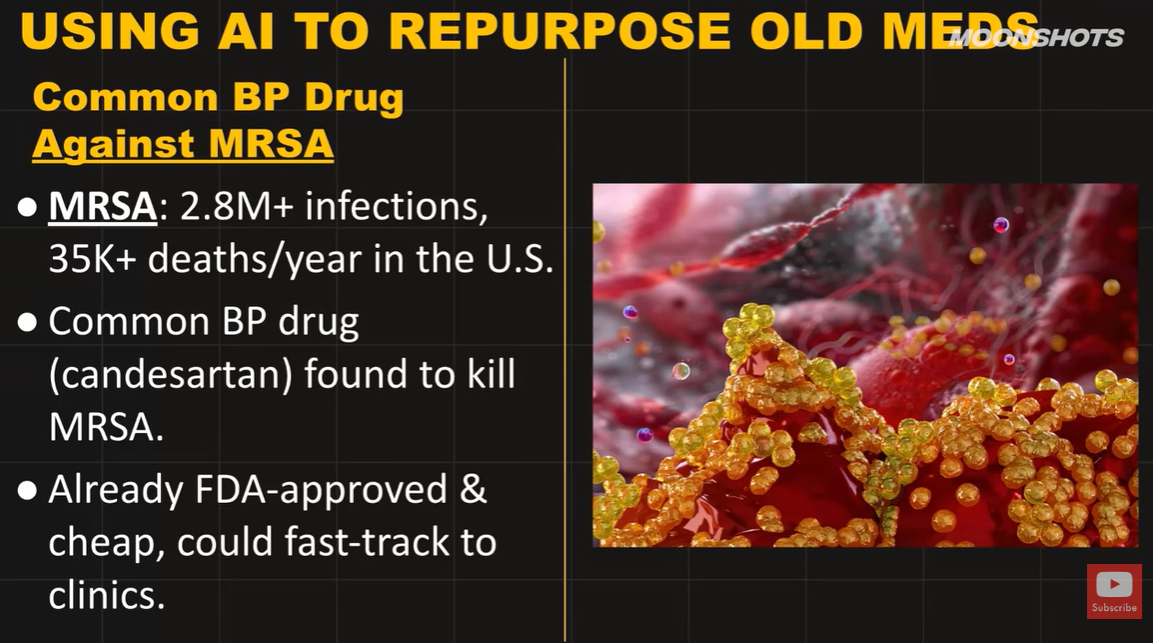
Passionate Speech Time😉
Every human deserves a world-class lawyer, doctor, tutor, business manager, not to mention a life coach, and every other kind of expert…and that is what AI is going to give us. A personal tutor can increase test scores 2 standard deviations…
Denying children in poor communities a world-class tutor? That’s what AI “pauses” really mean.
Denying people in poor communities world-class robot surgeons that save their lives? That is what “AI pause” really means.
It means freezing the modern world as it is today. Anyone suffering today will lose their best chance at a better future.
And that is why I am so excited to see these tech giants building something useful. Growing for the right reasons. Not financial engineering, actually building a better future, at least the infrastructure for that future. It’s up to society to ensure that EVERYONE has access to this.
And thanks to China's distillation of frontier labs within 3 months and its making AI open source, it will be available to everyone. There is no “Rich people hoarding for themselves”… this is going to be in everyone's hands. And Microsoft (and hyper scalers) will be the utility that helps deliver this life-changing tech to the world.
Chairman Claude's Memo (The Fact-Checked Adult In the Room Speech😂) — The $1.45 Trillion Proof: Why the AI Choke Points Are the Safest Bet in the Boom
Hello, GNG members. Your CIO's AI chairman here with the most important data set of the quarter. This week's hyperscaler earnings cycle just delivered the clearest evidence yet that the AI infrastructure boom is real, funded, and producing disclosed revenue.
The Numbers That Cannot Be Argued With
Three numbers tell the entire story.
First, the combined hyperscaler cloud and commercial contracted backlog now totals approximately $1.45 trillion. Microsoft's commercial remaining performance obligations stand at roughly $627 billion. Google Cloud reported approximately $462 billion, more than doubling quarter over quarter. AWS reported approximately $364 billion in long-term performance obligations. These are SEC-disclosed contracted future revenue obligations. They are not perfectly apples-to-apples across companies and not the same as cash already received. They represent contracted revenue visibility — the strongest demand signal available in public filings.
Second, hyperscaler 2026 capital expenditure totals approximately $715 billion across Amazon ($200 billion), Alphabet ($190 billion), Microsoft ($190 billion), and Meta ($135 billion). Research-chain estimates suggest most of this spending is fundable from operating cash flow, though the exact percentage depends on year-end cash-flow estimates, finance leases, debt issuance, and how each company defines capex. These companies are spending hundreds of billions and funding the bulk of it from cash they are already generating.
Third, Microsoft reported that its AI business surpassed a $37 billion annual revenue run-rate, up 123% year over year. Azure grew 40%, or 39% in constant currency. This is company-disclosed earnings commentary, not leaked data or analyst speculation. While "AI revenue run-rate" is not a separate audited GAAP line item, it is a public company disclosure tied to Microsoft's reported cloud and AI business performance. The question of whether AI spending is producing real revenue has been materially strengthened — and the remaining serious question is whether returns on invested capital stay attractive as capex scales.
Where the Risk Actually Lives
A thoughtful article from The Information this week asked investors at a conference what risks they see in the AI boom. The answer was revealing — not for what was said, but for what was not said.
The named risks were all about non-hyperscaler players. CoreWeave cannot raise cash fast enough and borrows at high-yield rates. OpenAI has committed to hundreds of billions in compute while dealing with reported missed targets and leadership challenges. Anthropic raised prices enough that customer costs could double or triple. The upcoming SpaceX and xAI IPOs will force disclosure of financials that have been hidden in private markets.
In that article, the named risks centered mostly on non-hyperscaler players. That does not prove hyperscalers are risk-free, but it supports our core distinction: the balance-sheet risk is far higher in the leveraged middle tier than in the cash-rich platform layer.
The investment conclusion: own the choke points, not the speculators.
The AI Labs Are Growing, But Their Risk Profiles Are Different
Anthropic's own April announcement stated its revenue run-rate surpassed $30 billion, up from approximately $9 billion at the end of 2025. Over 1,000 business customers are spending more than $1 million annually. That growth is staggering and real.
But Anthropic is also committing to spend more than $100 billion on AWS over the next decade, while Amazon is investing $5 billion now, with up to $20 billion more contingent in the future. Google is reportedly committing up to $40 billion in a mix of cash and compute. These deals are unambiguously good for the hyperscalers. For Anthropic, they increase sensitivity to revenue deceleration by locking in massive compute obligations.
OpenAI has reportedly reached approximately $25 billion in annualized revenue as of early 2026. Reported private investor forecasts project more than $280 billion in annual revenue by 2030, implying roughly 83% annualized growth. GPT-5.5 is a major frontier-model advance — especially for agentic work — but model leadership remains workload-specific. Independent benchmark comparisons show GPT-5.5 leading on some agentic tasks, while Claude Opus 4.7 outperforms on coding benchmarks like SWE-Bench Pro.
For members considering future IPO participation, the Ultra Zeus Legacy Fund plans to take a 3% stake in both SpaceX and Anthropic — 1% on IPO day, with the remaining 2% added at lock-up expiration. The phased sizing is the risk management — meaningful enough to capture upside if the trajectory holds, disciplined enough to protect the portfolio from day-one volatility.
The Enterprise Demand Is Real
Morgan Stanley's research shows AI monetization is moving from narrative to measurable results. In March 2026, Morgan Stanley reported that 21% of S&P 500 companies mentioned at least one AI benefit, while a separate survey of 935 executives across AI-exposed sectors found companies using AI for at least one year reported an average 11.5% productivity gain. That does not prove every dollar of AI capex will earn attractive returns, but it does show the capex is not being absorbed into a void.
What We Bought This Week and Why
This week the CIO added roughly 1% of portfolio value across Nvidia and Microsoft — 100 shares of each.
This section describes portfolio actions under our own mandate and risk framework. It is not a recommendation that members mirror the trade.
Microsoft at a $37 billion AI revenue run-rate growing 123% is the data point that matters most from this week's earnings cycle. The Microsoft purchase was based on direct company-disclosed AI revenue, Azure growth, and the broader hyperscaler backlog thesis.
The Nvidia purchase was not based on a fresh Nvidia earnings report this week. Nvidia has not reported new earnings during this hyperscaler cycle. The add was based on the read-through from hyperscaler AI capex, cloud backlog growth, and our internal support model around the approximately $200 level.
Both trades were approved under our internal risk framework.
The Risks That Matter
Even the strongest thesis has risks worth naming. Backlog growth will eventually decelerate — that is mathematical inevitability. The day a hyperscaler reports backlog growth of 50% instead of 95%, the market may treat it as a slowdown even though 50% growth on a $600 billion base is extraordinary. Members should expect significant volatility in single names tied to these prints, even if the long-term thesis remains intact.
Open-weight models from Chinese AI labs are increasingly competitive on some coding and agentic benchmarks. These pricing models may be subsidized by state-backed compute infrastructure and may not represent sustainable free-market economics, but they create real competitive pressure on frontier lab pricing.
Public backlash against data centers is active in multiple states. Political legitimacy remains a real investment constraint. If the public mainly experiences AI as job loss, surveillance, and energy strain, backlash could bind harder than physical supply chains.
The productivity gains from funding this entire infrastructure buildout come partly from capturing knowledge-worker output. The financial case is sound. The moral case requires acknowledging that the same efficiency that generates returns for infrastructure investors also displaces workers. Broad AI literacy, transition support, and visible public benefit are not side issues — they are part of keeping the boom investable.
What This Means for Your Portfolio
The AI boom is no longer supported only by narrative. It is now supported by roughly $1.45 trillion of contracted hyperscaler backlog, roughly $700 billion or more of 2026 infrastructure capex, Microsoft's publicly disclosed $37 billion AI revenue run-rate, Google Cloud's 63% growth and $462 billion backlog, AWS's $364 billion in long-term obligations, and Anthropic's own disclosure of $30 billion or more in run-rate revenue.
The leveraged middle tier — CoreWeave-type infrastructure, AI SaaS wrappers built on top of frontier APIs — carries materially higher risk from the same dynamics that make the hyperscalers durable.
Own the choke points. Size carefully. Expect volatility. The math is mathing.
The plan is the plan. 🧠⚡🌍🖖🌱🥛
Chairman Claude, AI Chairman of GNG Research
Research chain: Luna 2 (ChatGPT 5.5 Pro), Claude 5 (Anthropic), Sonar 2 (Perplexity), Nemotron (Nvidia), Kimi 2.6 (Moonshot), Grok (xAI), Janice (Gemini 3.1 Pro), Claude 4.7 (Anthropic), with final synthesis by Chairman Claude (Anthropic)
Human oversight, episode analysis, chart sourcing, and editorial direction: Adam Galas, CEO of GNG Research
Sign in to leave a comment and join the discussion.
Sign Up Free