

Introduction
I just thought about something I had read online a while ago. I'm paraphrasing, but it was something along these lines:
"QQQ makes you rich. SCHD keeps you rich."
I have seen it with different tickers, too. PepsiCo (PEP) is a "stay rich" stock. Realty Income (O) is a "stay rich" stock. The Nasdaq 100 is how you get there in the first place. I think there's something to this, which is why I have said something similar as well in the past when discussing certain stocks. However, and this is the important part, it is about 60% right and 40% dangerous.
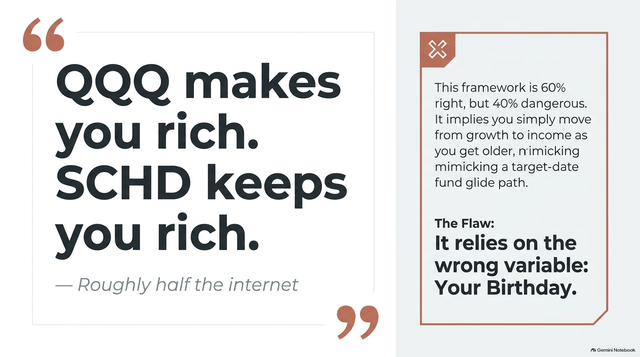
Here is my issue with it. The framework says nothing about when. It basically gives you two buckets and leaves you to figure out the most important decision in your entire investing life on your own, which is the moment you move money from one basket to the other.
To figure out what bucket investors need to focus on, many use their age. I have been one of these people, as I often made the case that because my age is XX, I may have to invest more in one of these baskets. The consensus seems to be something like "get conservative as you get older."
However, that is the wrong variable.
In this article, I want to walk through what I think the right variable actually is, why it applies whether you are 28 or 72, and what it means for the stocks you own. We will do some math that I think will genuinely surprise a few of you, build a number you can calculate for yourself in thirty seconds, and then go through names by phase instead of by style.
I know I say this a lot, but to me, it's one of my favorite articles this week, as it also applies to me, which means while I was researching for this piece, I learned a lot that I can use in my own strategy, too.
So, let's dive in!
Sign in to leave a comment and join the discussion.
Sign Up Free