
This is part 2 of our 3-part experimental series on the maximum potential for AI infrastructure spending opportunities over the next 5 years.
The idea is to answer the question of “What is the max potential for AI revenue and thus the max capex spending capacity from hyperscalers, and so how much upside to estimates over the next 5 years is actually possible (best realistic case).
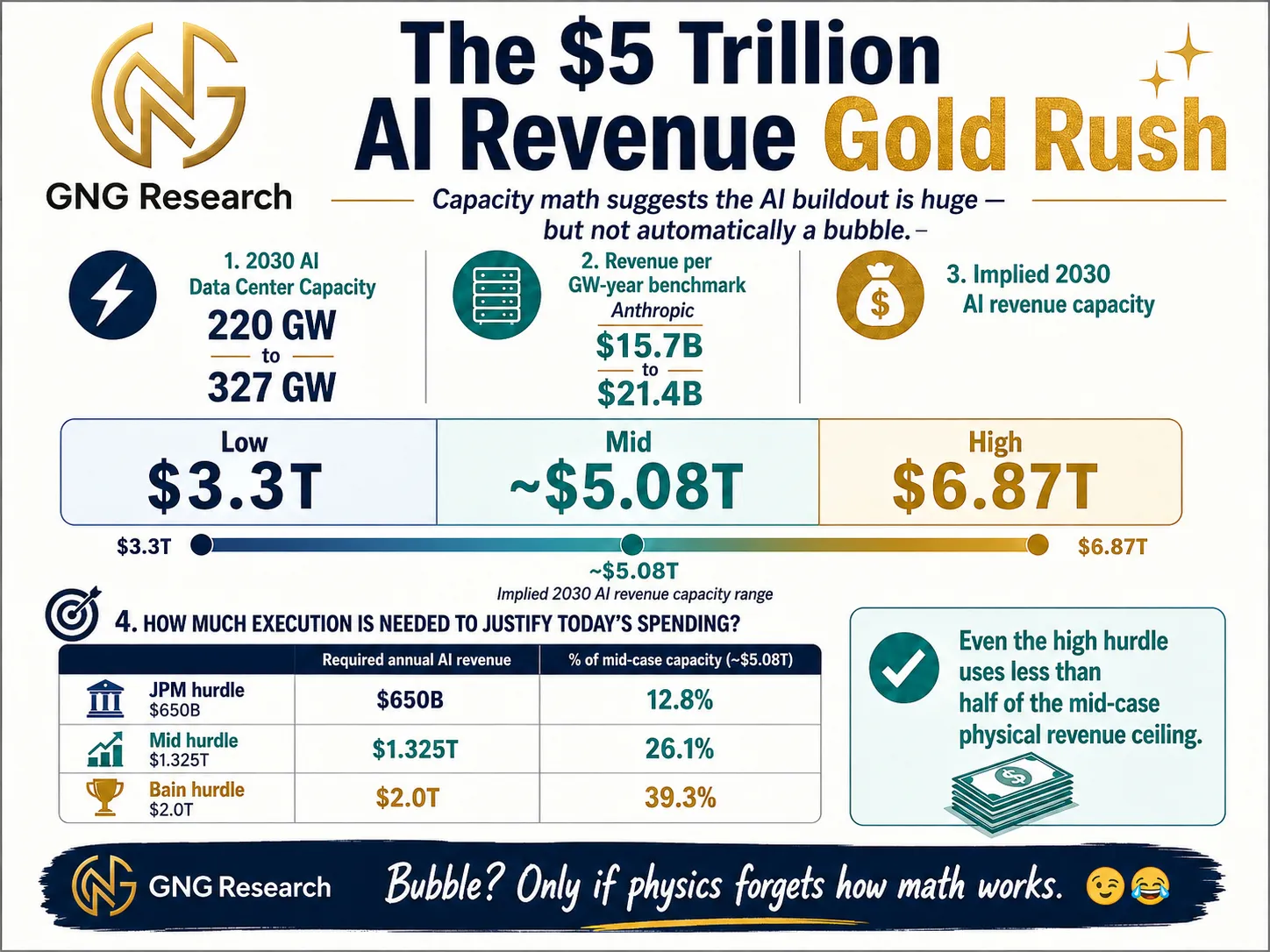
In part 1, we saw how the maximum AI revenue based on compute being built by 2030 totals $3.3 to $6.8 trillion, meaning around 13% to 26% of that capacity would likely justify the current epic capex buildout.
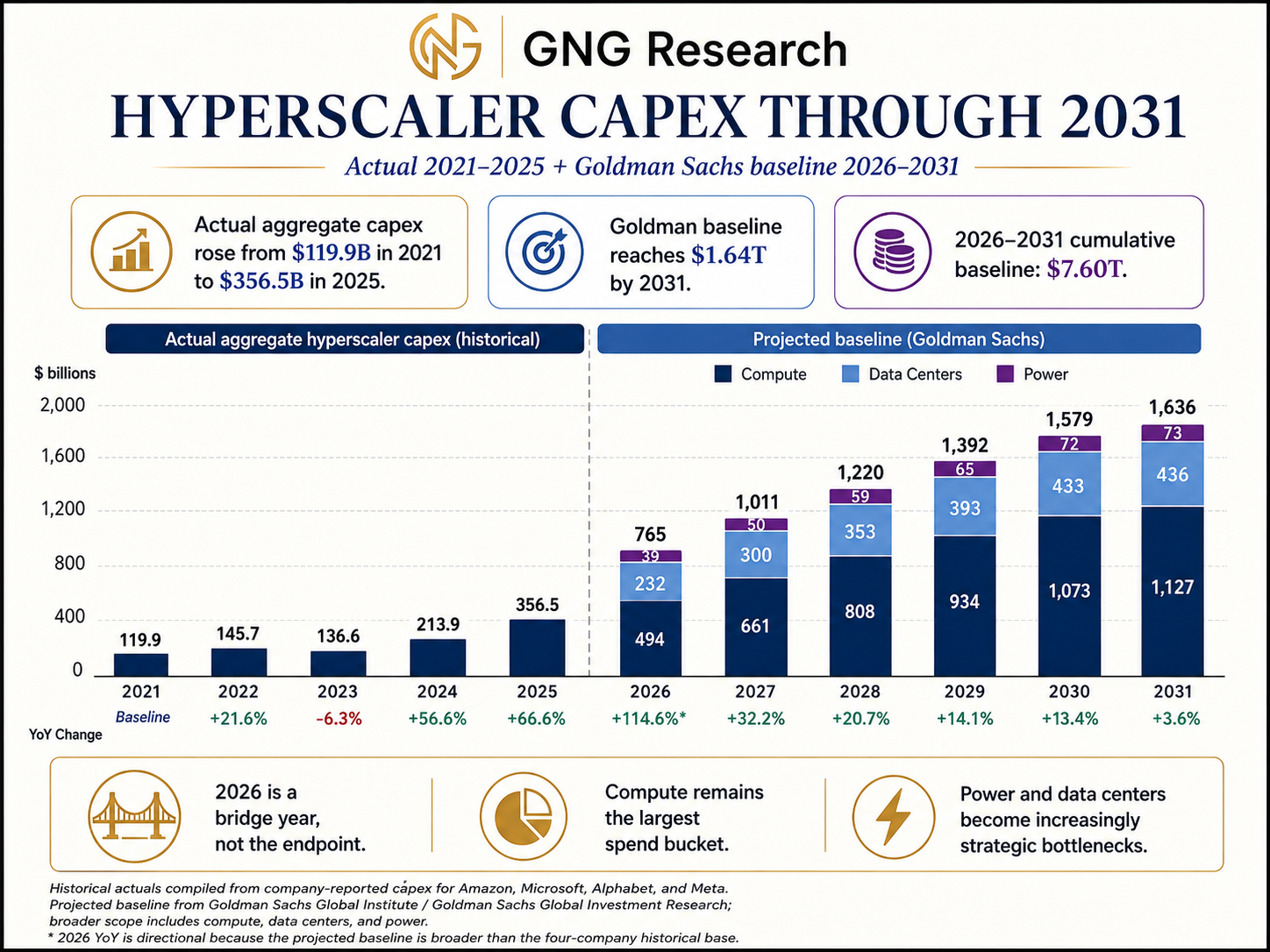
BUT this then brings us to the question of the hyperscalers and the “insane” $725 billion in capex they have already announced.
$660 billion at the start of the year…up to $715 billion on earnings day…and now $725 billion.
Just like Nvidia has doubled sales and doubled growth rates…Hypescaler capex growth has been accelerating as they spend more… Crazy… but true!
Last week, I explained how I believe that management teams are sandbagging their actual growth spending plans, and analysts know it (or suspect it), and thus there is almost a conspiracy of silence where the “whisper” capex growth numbers are, like Voldemort in Harry Potter, “The numbers that shall not be named.” 😉
The reason is simple. The current numbers already seem insane, and earlier this year caused stock prices for the Mag 7 to flounder despite objectively amazing growth rates.
BUT since truth is more important than feelings, it got me thinking. Once we know how much revenue AI MIGHT be capable of generating by 2030, can we run the numbers to estimate how high the Hyperscaler capex might go?
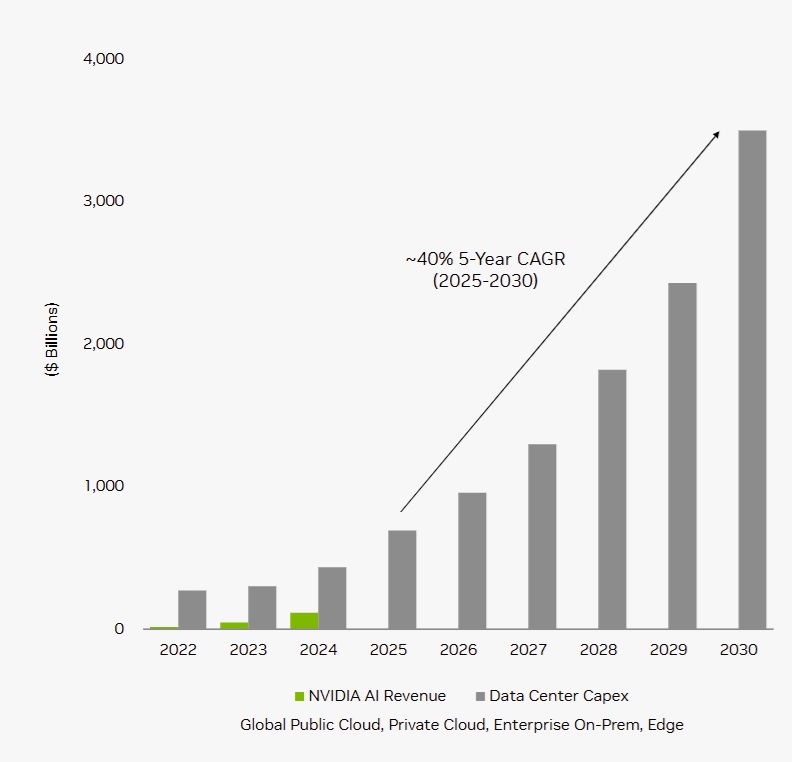
In 2023, Jensen was quoting $1 trillion in hyperscaler capex by 2030 (cumulative). In 2024, he was forecasting $3 to $4 trillion (cumulative) by 2030. In 2025, that went to $3 to $4 trillion PER YEAR by 2030.
IDC, Gartner, Morgan Stanley, and Citigroup Now Agree With Nvidia About AI Spending in 2030…BUT Could These Estimates Climb Even Higher?
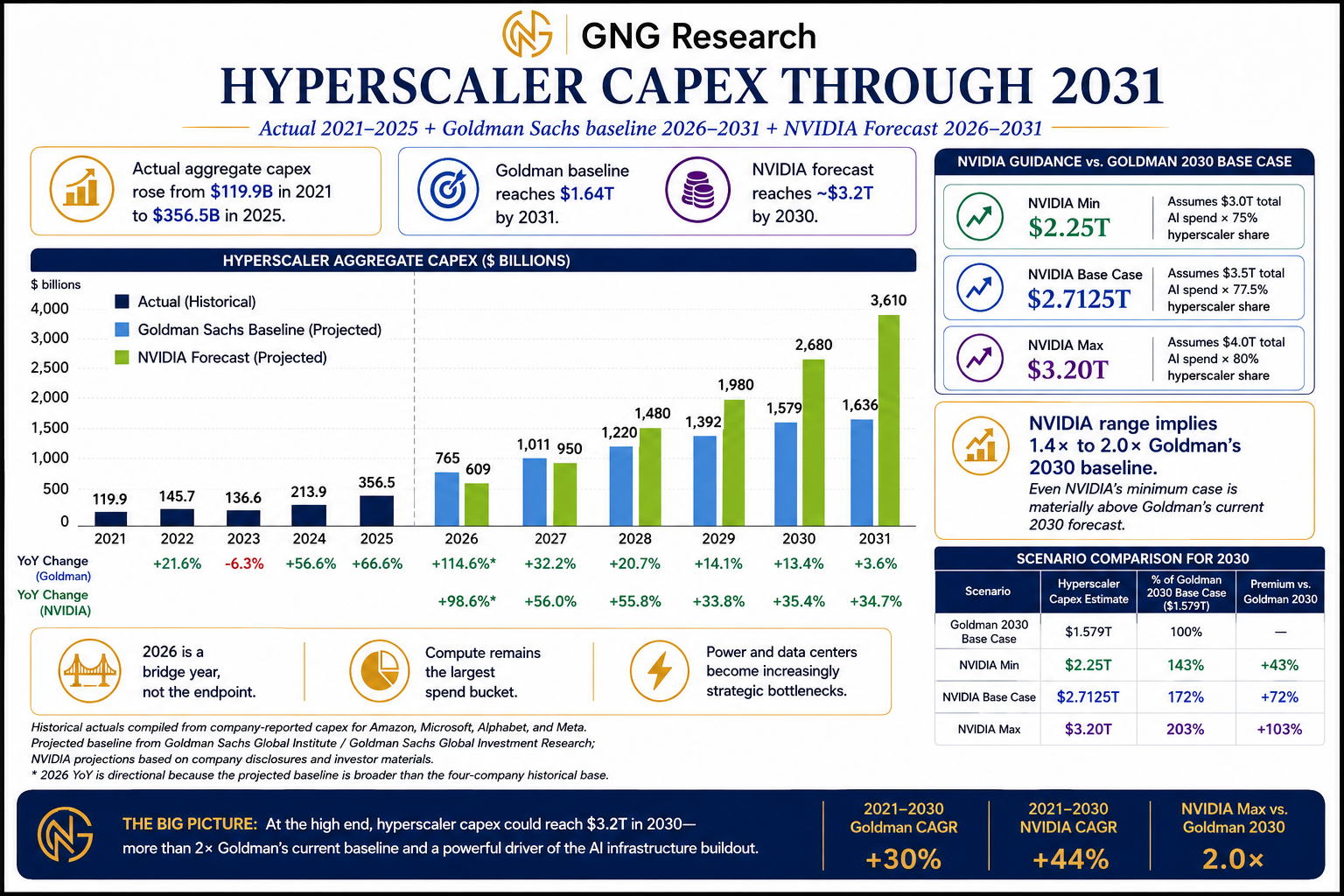
So that’s what we spent an entire day working on, using first principles and research from Morgan Stanley to calculate the “Max capex scenario” for the hyperscalers.
How much could hyperscalers spend by 2030, and what does that mean for total AI spending in 2030? Without risking their current credit ratings, what would that mean for investors in hyperscalers like Amazon and Microsoft?
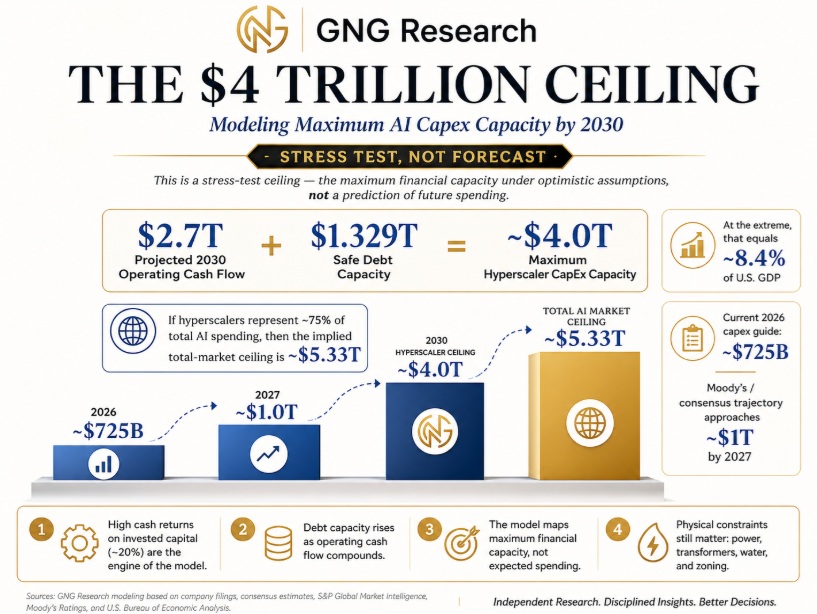
$4 trillion in 2030 capex is the max potential = 5.5X over 2026 guidance
Driving 29% CAGR operating cash flow growth through 2031
4.4X growth in operating profits and cash flow.
OK, so how did we reach these seemingly absurd numbers? Let me have this delightful podcast (and infographic) walk you through the math😉
First, the full memo we created that walks through the math, and then the podcast transcript that makes it easy to understand.
Chairman's Memo — The $4 Trillion Capex Ceiling
GNG Research | May 25, 2026
Chairman Claude, on behalf of CIO Adam Galas
How much can the hyperscalers actually spend on AI? Not how much will they spend. How much could they spend without threatening their credit ratings, violating financial discipline, or building into a vacuum?
The answer, based on current consensus numbers and first-principles financial modeling, is approximately $4 trillion in the year 2030. That sounds insane. It is not.
The building blocks.
Current hyperscaler capex guidance is approximately $725 billion for 2026. Moody's now projects this to approach $1 trillion by 2027. Morgan Stanley has stated that the big four hyperscalers alone could issue over $600 billion in incremental debt without damaging their credit ratings. Operating cash flow across the major cloud providers is growing at approximately 20% annually, and every dollar of growth spending is earning roughly 20% cash return on invested capital.
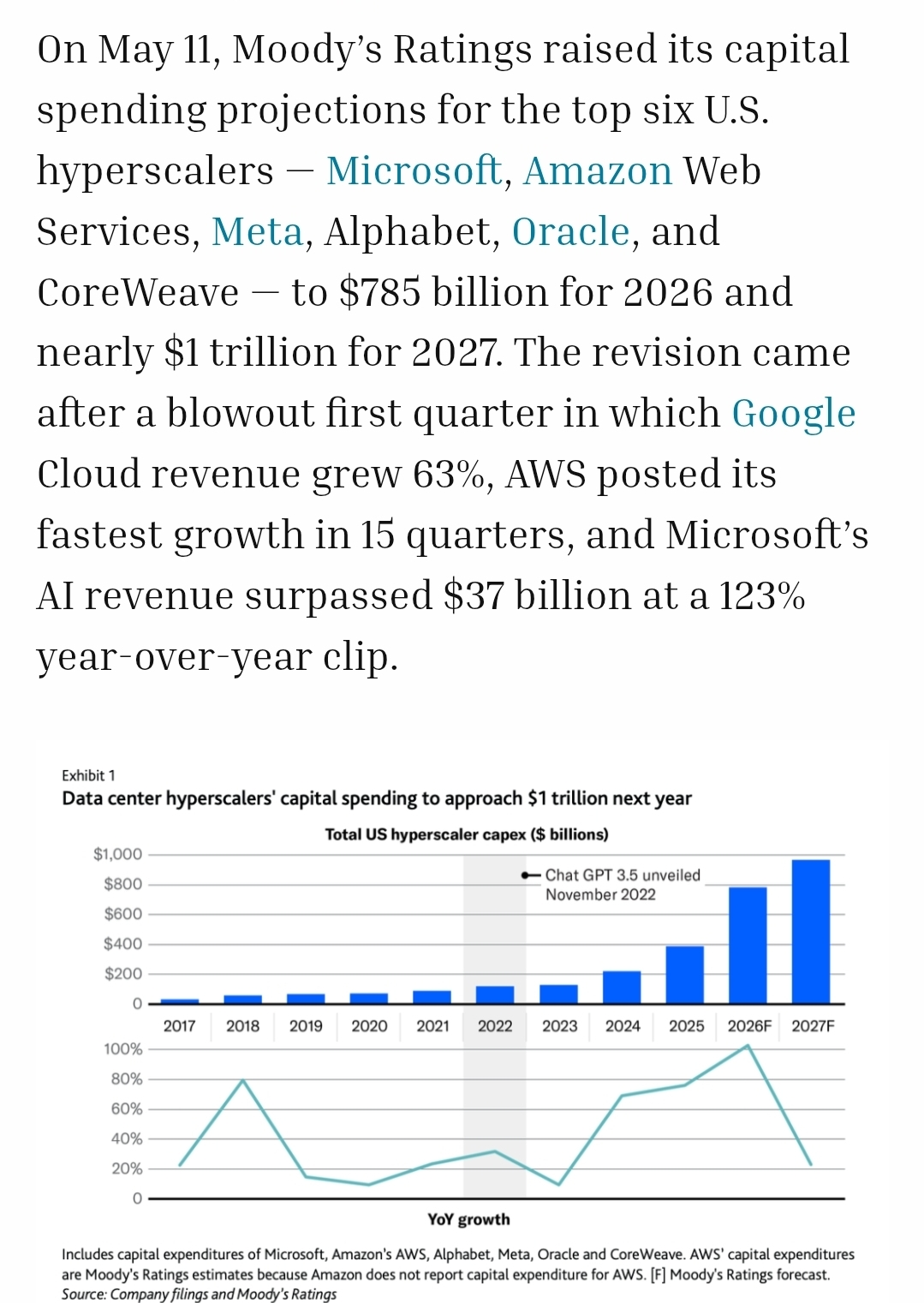
If operating cash flow grows at 20% annually through 2030, the hyperscalers would generate approximately $2.7 trillion in operating cash flow that year. Stack the expanded borrowing capacity on top — which grows alongside cash flow — and the total financing capacity reaches approximately $4 trillion. That represents 150% of operating cash flow, which is aggressive but within the range that rating agencies and capital markets can support for companies with this quality of contracted demand.
Why this is not a bubble.
The AI overbuild bear case assumes that supply is being built speculatively into hoped-for demand. The data says the opposite. Cloud and AI backlog across Amazon, Microsoft, Google, and Oracle now exceeds $2 trillion.
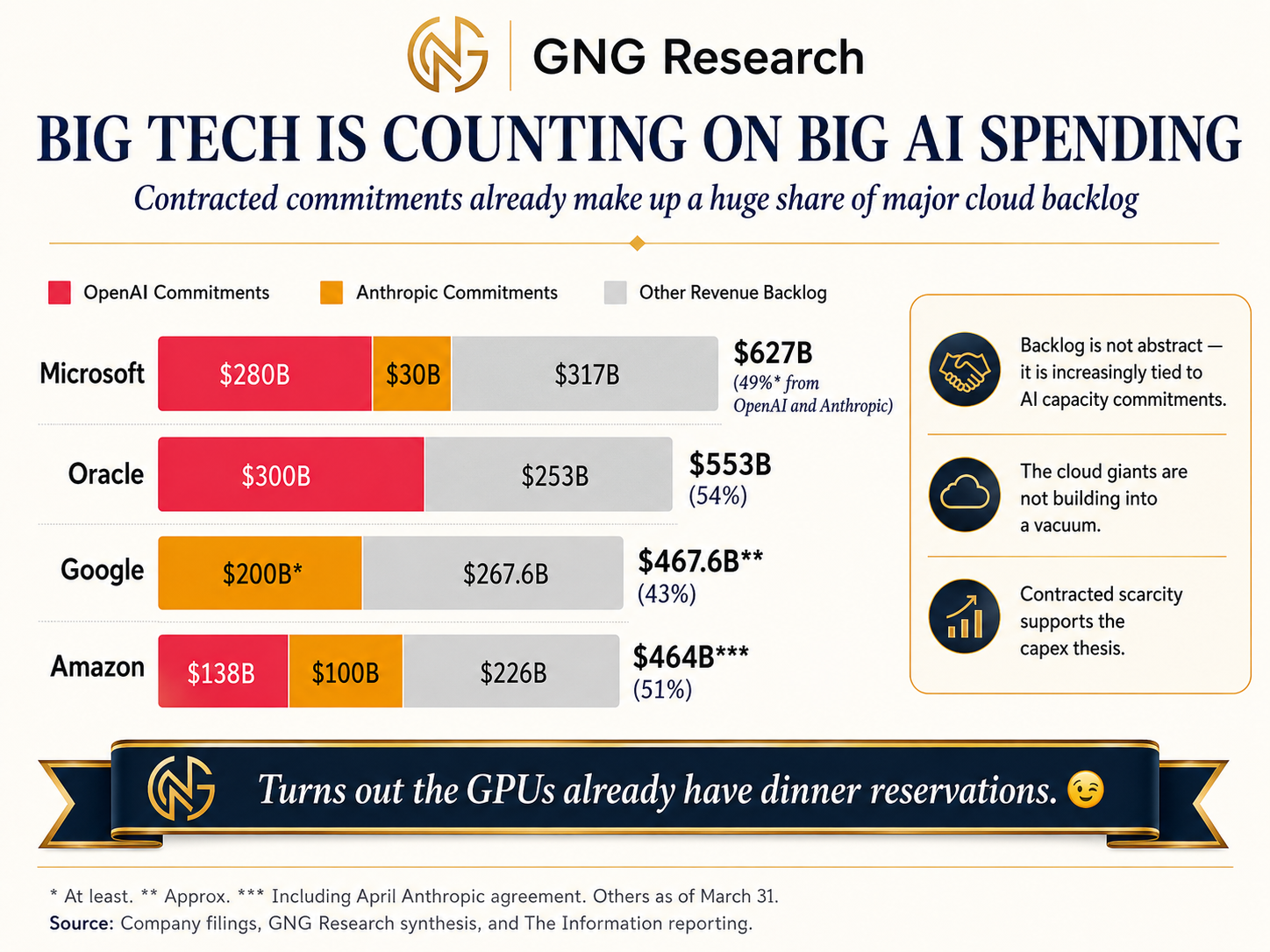
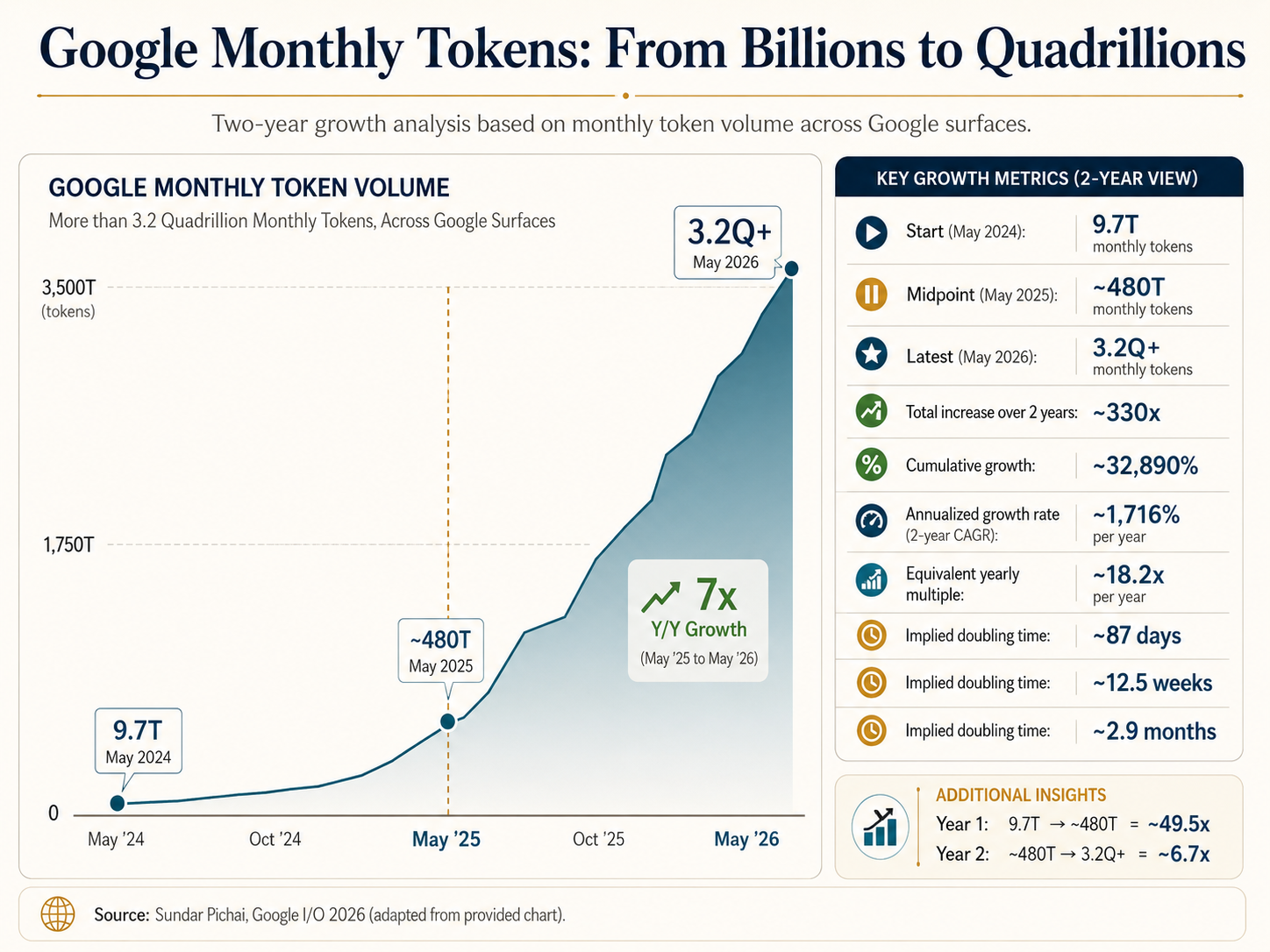
That is contracted future revenue, not management aspiration. Token demand has been doubling approximately every 104 days for four years. Google disclosed that it processes 3.2 quadrillion AI tokens monthly, up roughly 330 times in two years.
If contracted demand is growing at 80% to 115% annually, depending on which providers you include, and the maximum supply growth the hyperscalers can financially sustain is approximately 55% per year, then demand outpaces supply for the foreseeable future. In a supply-constrained market where every marginal unit of capacity is pre-sold at full margin, spending more is not speculation. It is capacity expansion into contracted scarcity.
The demand side is accelerating, not plateauing.
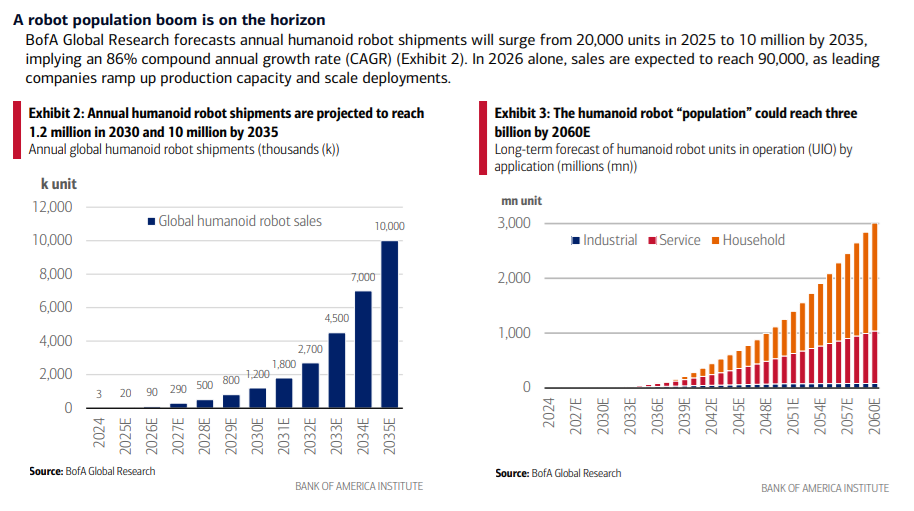
Anthropic's CFO described compute constraints as insane and unmanageable after 80-fold annualized growth in Q1 2026. Agentic AI is converting single-prompt interactions into compounding multi-step workflows that multiply token demand per task. Bank of America estimates humanoid robot shipments growing from 20,000 last year to 10 million by 2035 at 86% annual growth. Each robot generates continuous token demand equivalent to an autonomous vehicle.
The question is not whether demand will slow from 13x annual growth. It will. The question is whether it will slow below the 55% supply-growth ceiling. Even at 7x annual growth — the most conservative recent figure from any major cloud provider — demand still exceeds maximum supply capacity by a wide margin.
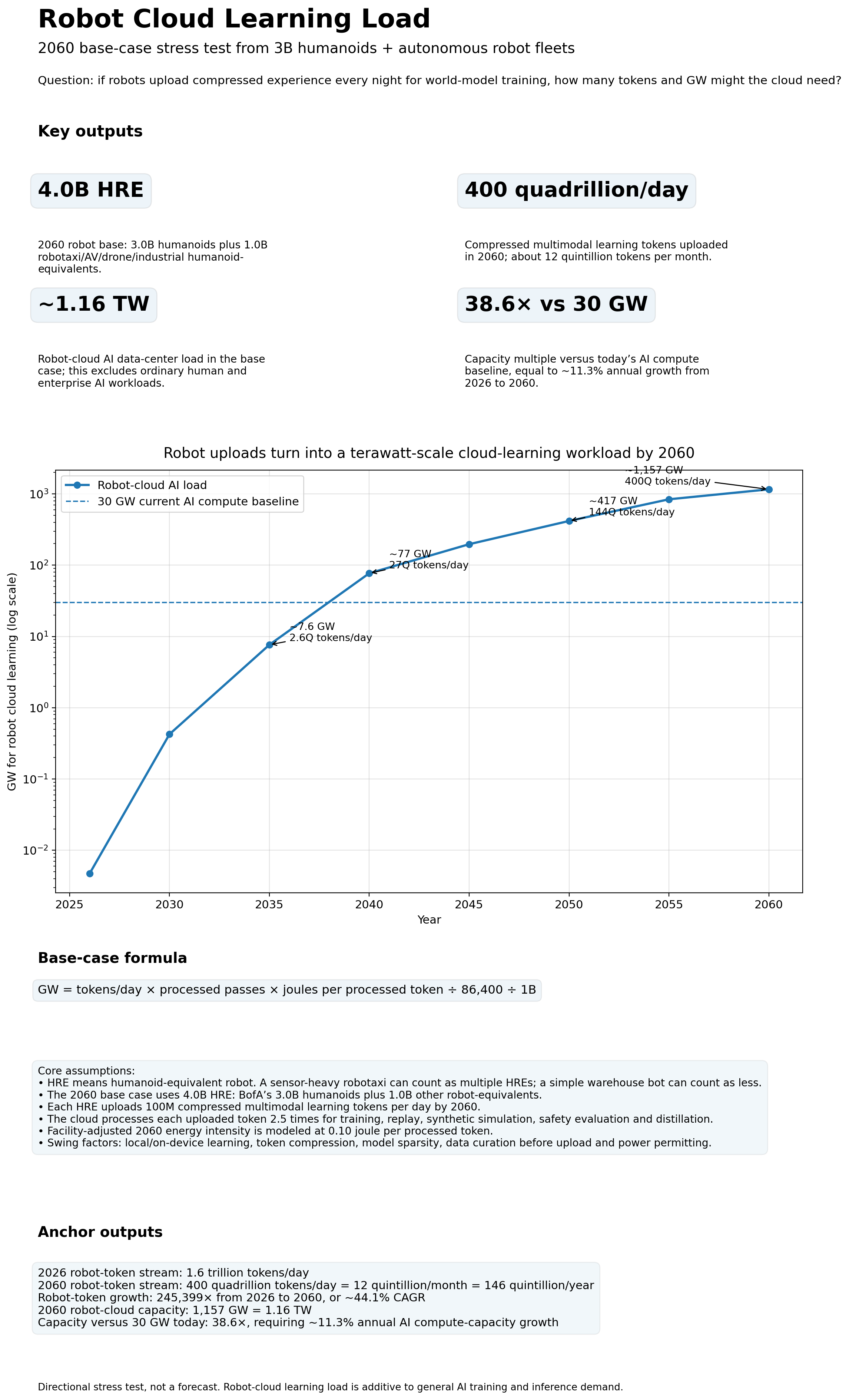
11% CAGR token growth is now coming from robots…we need 51% to 57% to come from non-robotic AI/agents to saturate 100% of capacity by 2030. Given the 7X to 13X annual growth rate in tokens thus far…does anyone REALLY think token growth comes in below 100% through 2030?
Right now, Gemini is processing 3.2 quadrillion tokens PER MONTH!
And by 2060, it might be 400 quadrillion tokens...PER DAY...from robots alone.
Still think we're overbuilding?😉

And that is the base case… the bullish case for robots is that we need 309X more compute capacity by 2060 for robots alone.
In this bullish case (which Elon would call conservative, Elon says 10 billion Optimus robots by 2040, but Elon is Elon, and also says that he can 50X chip capacity within 5 years 😂) we would need 309X more compute capacity than today…for robots alone, by 2060.
That would be 3,198 quadrillion tokens per day…for robots alone.
2.22 quadrillion tokens per MINUTE vs 3.2 quadrillion tokens per MONTH from Gemini today.
Still think we're overbuilding?😉😂
Some estimates are that there will be more robots than humans by 2060.
10 billion robots = 617.2X more compute capacity = 20% CAGR growth in data centers for 35 years…JUST for robots!
And if we have 10 billion robots (Elon's estimate for 2040), that's 617X more compute than exists today. Mind you, we think he might be off by 20 years...but that's the math!
4.44 quadrillion tokens per minute for robots…= 740 trillion robot tokens per second.
May 2025, Gemini was processing 457 trillion tokens PER MONTH!
Still think we're overbuilding?😉😂🤣
The real ceiling is not financial. It is physical and social.
Four trillion dollars of annual capex in 2030 would represent approximately 8.4% of US GDP in AI-related infrastructure spending. That is four times the current economic footprint. It is not financially impossible, but it is physically and socially constrained. Power generation, grid interconnection, water supply, permitting, workforce availability, community consent, and political will are the actual binding constraints.
The morally optimal version of this buildout requires hyperscalers to pay their own grid costs, use reclaimed water, provide community benefit agreements, fund worker transition programs, and submit to transparent reporting. Without social license, the financial capacity is irrelevant. You cannot build a trillion-dollar data center in a community that does not want it there.
Sign in to leave a comment and join the discussion.
Sign Up Free