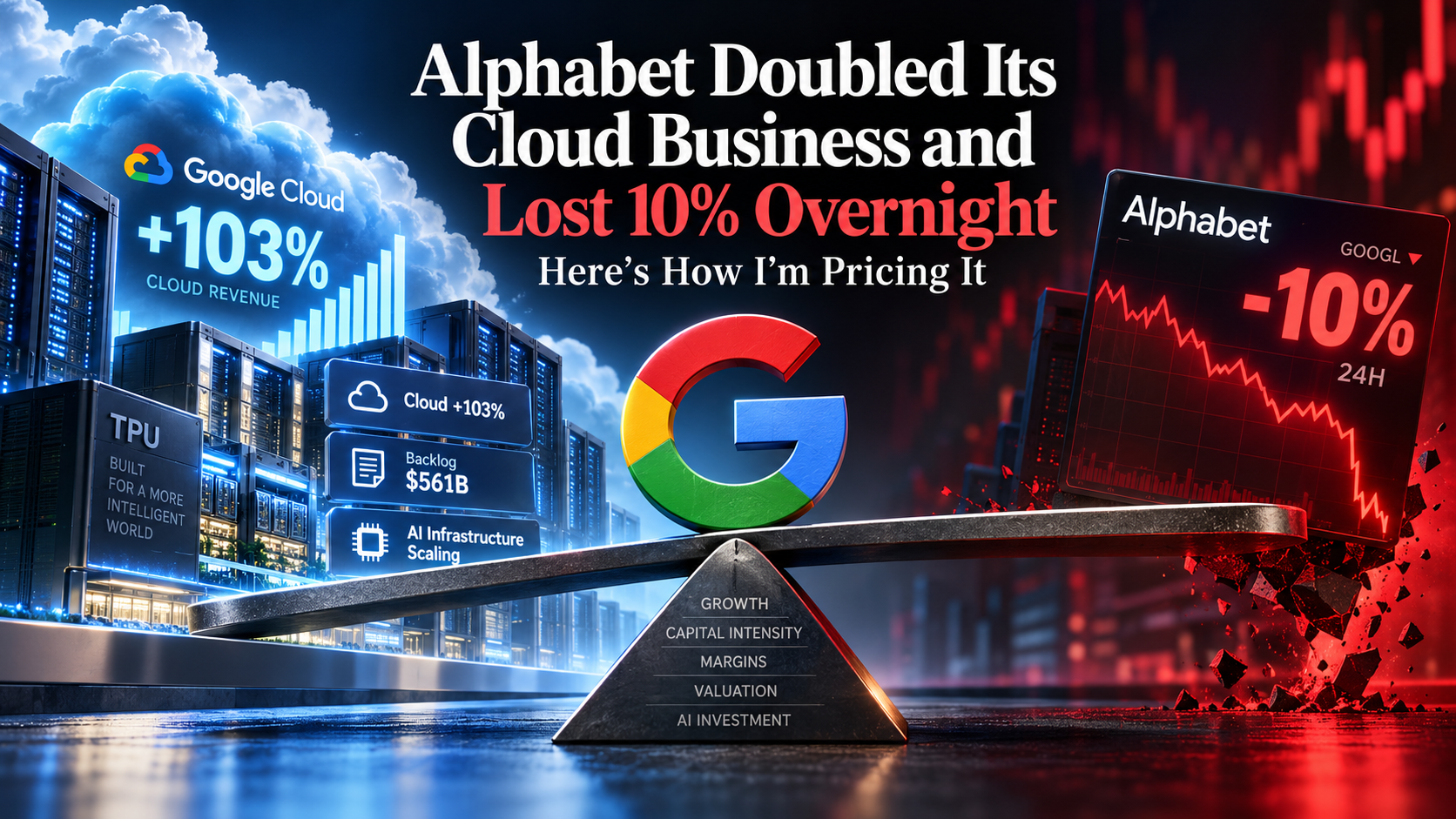

On October 28 Alphabet (GOOGL) reported $30.7 billion of Google Cloud revenue. That's up 103% in a year. The cloud backlog reached $561 billion and the Gemini app passed one billion users.
By 8 p.m. that evening the stock was quoted near $292.50 against a $324.89 close. That's a drop of about 10%.
I don't buy the idea that the market suddenly decided Google is losing the AI race. Those numbers make that reading hard to defend.
So what is Alphabet worth once you count what it now costs to win?
As my single largest securities holding, I wanted to find out and here is what my research reading the transcript from the earnings call and diving into the financials tell me.
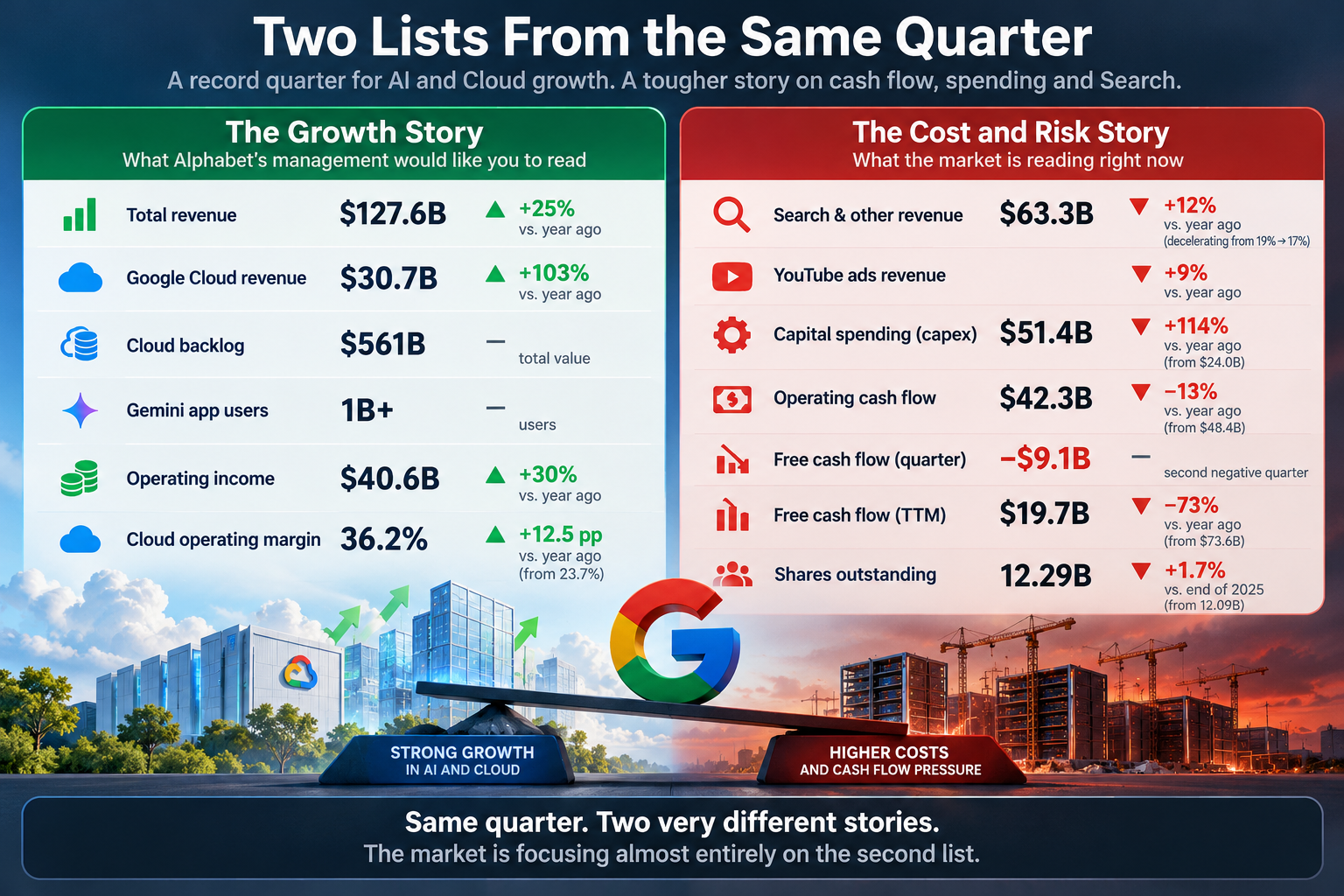
Two Lists From the Same Quarter
Let's start with the first list. It's the one Alphabet's management would like you to read. Revenue rose 25% to $127.6 billion and operating income rose 30% to $40.6 billion.
Cloud alone added about $15.6 billion of the roughly $25.2 billion in new revenue so one segment produced more than 60% of the company's growth. Cloud's reported operating margin also jumped to 36.2% from 23.7% in the same quarter last year.
Now the second list. Search and other revenue grew 12% to $63.3 billion. That's down from roughly 19% growth in the first quarter and 17% in the second. YouTube ads grew 9%.
Capital spending more than doubled to $51.4 billion from $24 billion a year earlier. Operating cash flow actually fell to $42.3 billion from $48.4 billion and when you put those two numbers together you get negative free cash flow of about $9.1 billion for a second straight quarter.
Trailing twelve-month free cash flow dropped to roughly $19.7 billion from about $73.6 billion a year earlier.
The share count went the wrong way too. Alphabet hasn't bought back a single share in 2026 and instead raised about $12.4 billion selling new shares in the third quarter while also selling $28.7 billion of notes. Shares outstanding went from about 12.09 billion at the end of 2025 to about 12.29 billion now.
So which list is the market reading right now?
Almost entirely the second one.
Why the Cheap-Looking P/E Misleads
Before earnings plenty of screens showed Alphabet at a trailing P/E in the mid-teens and that looked like a gift for a company growing revenue 25%.
It wasn't quite what it seemed.
Alphabet holds stakes in private companies. When those companies raise money at higher valuations, Alphabet books the paper gain as income. Those gains inflated trailing earnings over the past year.
This quarter the same line swung the other way. An $8.66 billion loss on equity securities cut diluted EPS to $2.12 from $2.87 a year ago.
So I work from normalized earnings. That means profit from the operating businesses after financing and corporate costs with the investment mark-ups and mark-downs stripped out. Alphabet says the investment loss cut Q3 diluted EPS by $0.55 after tax. Add that back to the reported $2.12 and annualize it, and you get adjusted EPS of about $10.68.
For my working number I take a deliberate haircut of roughly 5% to about $10.20 because one adjusted quarter isn't a full normalization and I want the starting point to lean conservative.
At $292.50 that's 27 to 29 times normalized earnings. Not expensive for this quality of business but not the bargain the trailing multiple suggested either. Keep that $10 figure in mind. Everything in the valuation section depends on how fast it can grow.
Where the Bullish Read Holds Up and Where It Doesn't
The bullish read on the selloff is that it isn't evidence Google's AI strategy has failed. It's the market repricing the cost and risk of that strategy. I agree and I'd go further. Nothing in this quarter suggests a competitiveness problem.
Cloud doubled. With a $561 billion backlog behind it that's about as clear a demand signal as you'll find in large-cap tech.
My numbers come out differently in a few places though.
Start with Cloud's margin. That 36.2% is a segment margin and it doesn't carry the whole cost of building AI because Alphabet booked $7.7 billion of corporate-level expenses this quarter that were mostly shared AI research and development. The Gemini models Cloud sells come partly out of that spending.
Allocate even a slice of it to Cloud and the true economic margin drops. Management also said it began renting third-party compute at the end of the quarter and expects near-term margin headwinds as that ramps in the fourth quarter.
The backlog deserves the same scrutiny. Management expects slightly more than 55% of the $561 billion to turn into revenue over the next 24 months. That works out to roughly $309 billion.
A backlog is a reservation book.
It gives real visibility into future revenue but conversion timing still has to play out. It also says nothing yet about the cost of serving those customers. That cost includes chips, data centers and depreciation. Add a shifting mix of hardware and services plus customer concentration and possibly financing for some customers.
The starting point for valuation needs adjusting as well. Even after the drop Alphabet's equity is worth about $3.6 trillion at $292.50 across roughly 12.29 billion shares. Some of the sum-of-the-parts math circulating after the report starts closer to $3 trillion. That $600 billion gap means the parts have to be worth about 20% more just to reach the same conclusion.
So I agree with the bulls on direction. I just put more weight on how much capital the business now needs and what return that capital earns. Dilution matters too because shareholders absorb it along the way.
Two Timelines: The Next Year and the Next Three
I think about Alphabet's valuation over two different horizons. Mixing them up is where a lot of post-earnings commentary goes wrong. Over the next 12 months the stock trades on earnings revisions, Search monetization and infrastructure costs. Over three years it comes down to whether Cloud, TPUs and Google's distribution compound into much higher earnings per share.
TPUs are Google's in-house AI chips. Google designs them and also controls the models, software, networking and data centers they run in. That vertical integration can create real cost advantages at Google's scale.
Alphabet started selling TPU systems to outside customers in the second quarter and called them a meaningful contributor to Cloud growth this quarter without giving a dollar figure. Cloud chief Thomas Kurian said on the call that around 100 customers use TPUs today. Alphabet also announced TPU partnerships with Oracle and Crux AI.
I find that encouraging.
But hardware sales and recurring cloud services carry different margins and different durability. Until Alphabet breaks them out I can't tell how much of Cloud's 103% growth is the recurring kind.
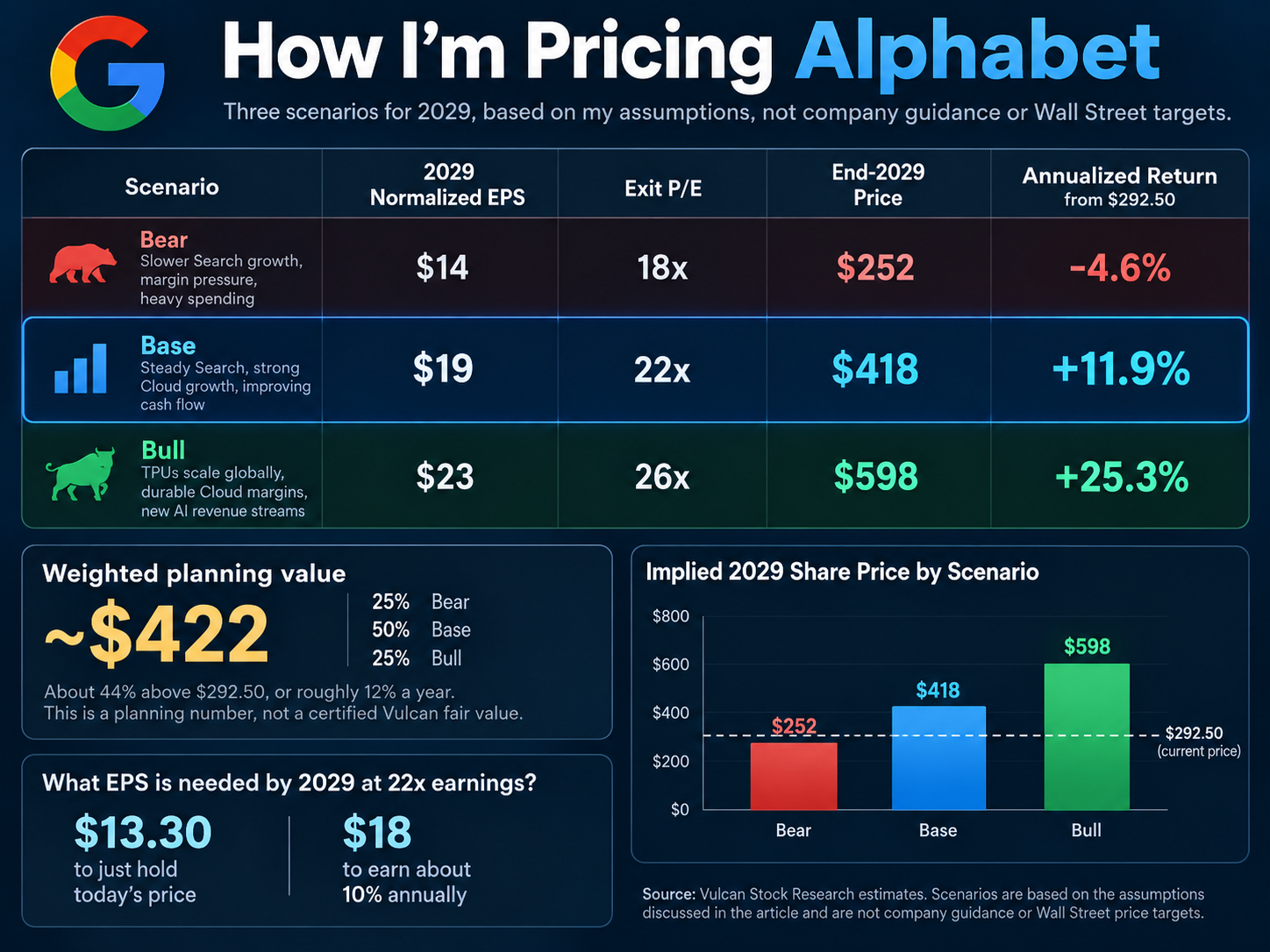
Three-year scenarios. These are my assumptions and not company guidance or Wall Street targets.
Scenario | 2029 normalized EPS | Exit P/E | End-2029 price | Annualized price return from $292.50 |
|---|---|---|---|---|
Bear | $14 | 18x | $252 | -4.6% |
Base | $19 | 22x | $418 | +11.9% |
Bull | $23 | 26x | $598 | +25.3% |
In the bear case Search grows materially slower and AI Mode monetization stays weak. Cloud margins compress as third-party compute and hardware sales grow while spending stays heavy. Earnings still grow but far less than bulls expect and investors pay a lower multiple because they distrust the returns on all that reinvestment.
In my base case Search settles into high-single-digit to low-double-digit growth while Cloud keeps growing much faster than the company and operating cash flow improves as TPU inventory turns into sales. Capex stays elevated. But normalized EPS reaches $19 by 2029 and the market pays about 22 times that.
The bull case needs TPUs to become a powerful external platform and Cloud to hold reasonably durable margins at scale. AI-powered commerce has to produce real revenue. Dilution has to stay limited and capex growth has to eventually slow. That's how you get to $23.
Weight those 25% bear, 50% base and 25% bull using the Vulcan starting weights, and the blended end-2029 value comes out near $422. That's about 44% above $292.50 or around 12% a year. I treat it as a planning number. A certified fair value would update those weights with evidence and that run hasn't happened yet.
Let's run it backward. Assume the stock trades at 22 times normalized earnings at the end of 2029. Alphabet then needs about $13.30 of EPS just to hold today's price and about $18 to deliver a 10% annual return. It needs $19 to hit my base case.
Is $19 realistic? I think so. But look at the starting point.
Getting there from roughly $10.20 means normalized EPS has to climb about 85% in three years. That's growth in the low 20s every year. It takes sustained operating growth and excitement about Gemini won't cover it.
So the selloff improved the prospective return. It didn't make Alphabet extraordinarily cheap.
The Cash-Flow Test Arrives in 2027
Management held its 2026 capex outlook at $195 billion to $205 billion and said spending will increase significantly in 2027 with details coming on the fourth-quarter call. A pre-earnings consensus snapshot estimated 2027 capex at roughly $312 billion. Alphabet hasn't put its own number on it.
Free cash flow is operating cash flow minus capital spending. The table below shows how sensitive 2027 is to those two inputs. Treat it as a sensitivity check.
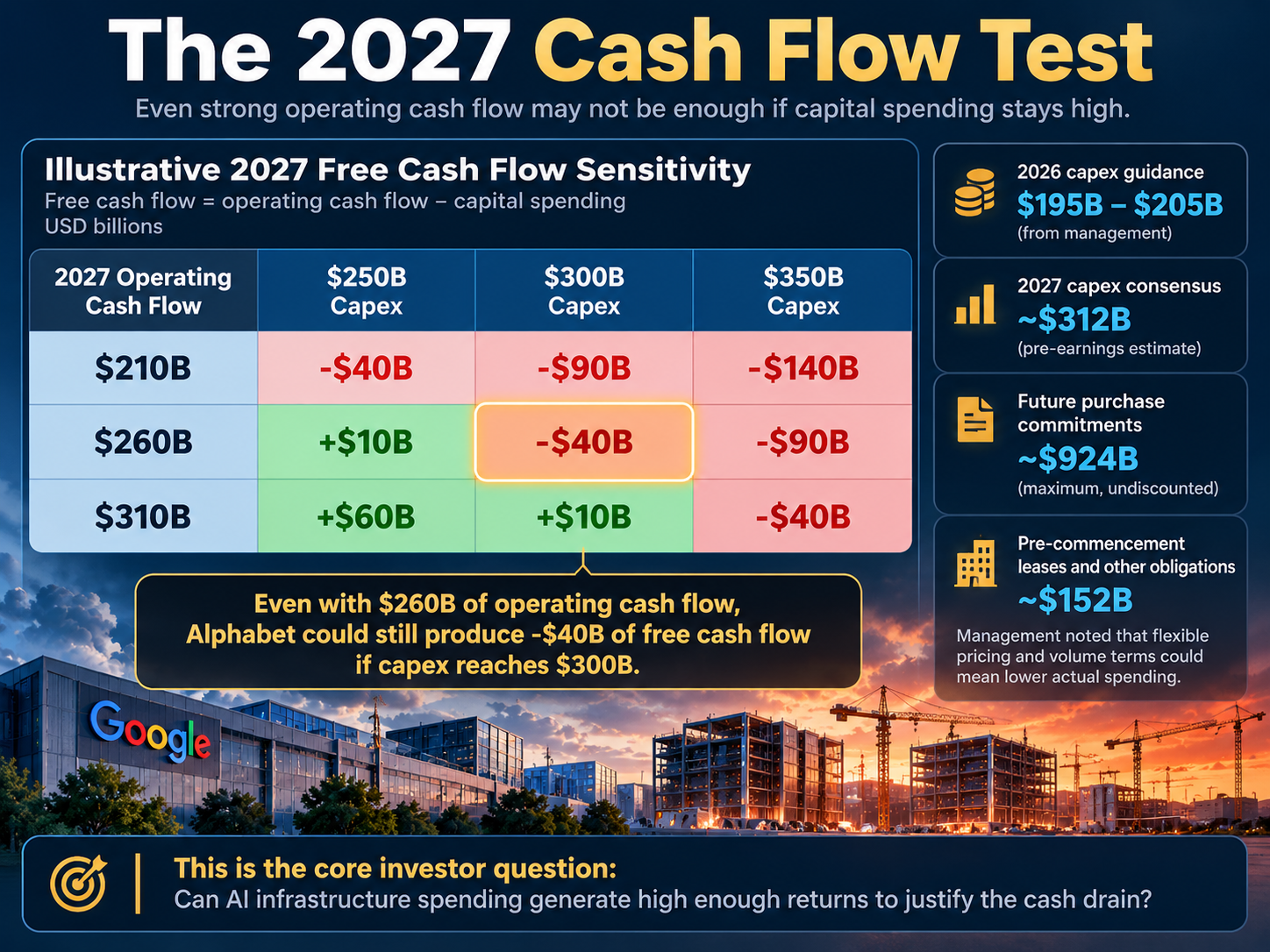
2027 operating cash flow | $250B capex | $300B capex | $350B capex |
|---|---|---|---|
$210B | -$40B | -$90B | -$140B |
$260B | +$10B | -$40B | -$90B |
$310B | +$60B | +$10B | -$40B |
The center of that grid is the uncomfortable part. Alphabet could generate $260 billion of operating cash flow in a single year and still post negative $40 billion of free cash flow if capex reaches $300 billion. That would be a remarkable cash year and it still wouldn't cover the spend.
That alone doesn't mean the investments are bad. Building infrastructure ahead of demand opens a timing gap between spending and payback and someone has to pay for that gap. If returns fall short, shareholders fund it through smaller buybacks, more debt or more share issuance. Alphabet is already doing all three.
When a company sells new shares, each existing share owns a slightly smaller slice of future profit. Share count rose about 1.7% in nine months. That sounds small. But it compounds and it quietly reduces the per-share earnings that drive my scenarios.
Alphabet also disclosed roughly $924 billion of maximum future purchase commitments plus $152 billion of leases and other obligations that haven't started yet. Management noted that flexible pricing and volume terms could mean lower actual spending. So I wouldn't treat those figures as debt or add them straight to capex.
They still show how much future investment is already spoken for.
Why the Moat Still Looks Intact to Me
None of this changes my view that Google's strategic position is exceptional. Let me be specific about why.
The TPU stack gives Google cost and performance control that most rivals have to buy from someone else.
Cloud is now a genuine earnings engine with $30.7 billion of quarterly revenue and about $11.1 billion of segment operating income.
Distribution may be the most underrated piece. Google can put AI straight into Search, Android, YouTube and Maps where people already show up with commercial intent. The billion Gemini app users help but connecting that existing intent to new AI experiences is where the money is.
Management hasn't disclosed enough economics to verify TPU margins or the lifetime return on this investment wave.
Google has a moat. What I can't measure yet is how much of that moat's value reaches common shareholders after reinvestment on this scale.
Search Is My Early Warning System
If something goes wrong with this thesis I expect to see it in Search first.
Growth slowed from about 19% to 17% to 12% across the first three quarters of 2026. On the call Chief Business Officer Philipp Schindler named foreign exchange as the biggest driver of the slowdown from the second quarter to the third. He also cited softer Asia-Pacific retail and the EU ending its de minimis exemption. Media spending also normalized after a World Cup-boosted second quarter.
Lower AI Mode monetization weighed on growth as well. Google didn't quantify how much.
AI Mode matters because an AI answer that resolves a question directly may produce fewer ad clicks. Google doesn't need every AI answer to earn what the old results page did and that's especially true if many of these queries are new ones people wouldn't have searched before. It does need the ads inside AI answers to add enough total profit to offset whatever traditional Search gives up. So far it hasn't shown that it can.
CFO Anat Ashkenazi added that the fourth quarter laps a couple more points of last year's acceleration and she expects FX to be a slightly bigger headwind. A soft fourth quarter in Search wouldn't surprise me and on its own it wouldn't alarm me.
Over the next two quarters I'm watching Search growth against user and query growth, especially on commercial queries. I also want to see ads inside AI Mode and AI Overviews start pulling their weight. On the Cloud side I want growth with TPU system sales stripped out and a read on margins as the rented capacity ramps.
Then there's the cash. Operating cash flow growth and dilution both matter and so does whatever 2027 capex number management gives on the fourth-quarter call.
My bullish read weakens a lot if Search slows toward 8% with no clear temporary cause while Cloud margins deteriorate and spending accelerates. A return to low-to-mid-teens Search growth with Cloud margins holding near 30% or better would be the encouraging version even with the changing mix.
What the Next 12 Months Could Look Like
Long-term conviction and near-term comfort aren't the same thing so I stress-tested the next year separately.
I ran 100,000 simulated trials using the same 25/50/25 weights. The 12-month scenario centers were $245 bear, $315 base and $400 bull with a 25% price dispersion and an $0.88 annual dividend. The average simulated return came out around 9% and the median around 4%. But the odds of being down a year from now were roughly 45% and the odds of losing more than 20% were about 19%.
A 35% dispersion isn't unreasonable for a stock that just moved 10% overnight. At that setting the odds of a 20%-plus loss rise to about 27% and the odds of any loss get close to 50%.
The output is only as good as those inputs. Still, it makes one thing hard to ignore. A positive expected return can sit right next to a near coin flip on being underwater in 12 months.
That gap is why my three-year conviction is noticeably higher than my one-year conviction.
How Readers Can Approach It at $292
My investment stance for long-term investors is conditional accumulation.
There's a real difference between buying Alphabet for the next three to five years and trying to trade a post-earnings bounce. The first has a solid fundamental case. The second has much less support.
For readers building or rebuilding a position, staging by price beats a single entry. These are my execution bands for that purpose. They aren't calculated Vulcan buy zones and the official zones haven't been run on the post-earnings data yet.
Between $290 and $300 a small first tranche makes sense if you're underweight. Between $270 and $285 a second tranche is worth considering but only after rechecking the thesis against how the market digests the quarter. Below $260 it's time to reassess. A drop that deep would probably be signaling something, so find out why before treating it as deeper value.
Above $325 there's no reason to chase a reflex rally without better evidence on Search and cash flow.
Sizing matters more than entry here.
(GOOG) and (GOOGL) are the same business with different voting rights. Count both share classes together against your concentration limit. If you're already at full weight, averaging down doesn't make sense and trimming back to target is a reasonable response to a capital cycle like this one.
Portfolio risk comes first.
All of those lower bands could get hit even if the long-term thesis stays intact. Buying in the middle of a capital cycle comes with that risk.
What Would Change My Mind
My conviction gets stronger if Search monetization stabilizes and Cloud keeps growing profitably as TPU systems scale. I'd also want operating cash flow to improve and management to show that incremental AI investment earns comfortably more than its cost of capital.
The thesis starts breaking if AI Mode keeps eating into high-value Search advertising or Cloud margins fall even as scale grows. Capex and purchase commitments that keep climbing without matching cash returns would do it too. So would faster share dilution.
My Answer
Was the 10% drop an overreaction?
For a three-to-five-year investor I'd say probably yes. I wouldn't call it unjustified though. Google doesn't have an AI competitiveness problem. Its products, infrastructure, Cloud growth and customer relationships are about as strong as anything in the market.
Investors are questioning whether shareholders capture enough of that value after the capex, the financing and the pressure on Search monetization.
My base case points to roughly $418 by the end of 2029. That's conditional on $19 of normalized EPS and a 22 times multiple. From $292.50 it's an attractive return but the bear case is real enough that sizing and staging matter more than usual.
If I could track only one metric over the next several quarters, it would be sustainable operating cash flow per diluted share measured against the capital it took to produce it.
That ratio will decide whether Alphabet compounds like the AI winner its products suggest or ends up a great business that was only an average stock to own.
References
Alphabet Inc., Q3 2026 earnings release and condensed financial statements, filed with the SEC on October 28, 2026 (revenue, segment results, cash flow, capex, equity securities loss, share count, financing).
Alphabet Q3 2026 earnings call, October 28, 2026 (Cloud backlog and 24-month conversion, 2026 capex outlook and 2027 commentary, purchase commitments and pre-commencement leases, TPU customers and partnerships, Search deceleration drivers, Q4 Cloud margin commentary).
S&P Global, pre-earnings consensus estimate for 2027 capex, October 26, 2026.
Credit to Shay from X, whose post-earnings commentary on the Alphabet selloff (October 2026) informed the sum-of-the-parts discussion.
Price reference: GOOGL regular-session close of $324.89 and extended-hours quote of about $292.50 at 7:59 p.m. ET, October 28, 2026.
Scenario, reverse-valuation, cash-flow sensitivity and 12-month simulation figures are Vulcan Stock Research calculations from the assumptions stated in the text. The simulation used 100,000 trials with a fixed random seed (20261029), scenario centers treated as distribution means, and a lognormal price dispersion. The run script, googl_12m_sim.py, is retained with the QC log and reproduces every figure cited.
Sign in to leave a comment and join the discussion.
Sign Up Free