
Introduction
Aerospace might be the most fascinating supply chain on the planet.
I don't say that lightly. My master's degree focused on purchasing and supply management, and whenever my professors needed an example of how complex (and how brutal) a supply chain can get, they went with aerospace (or the automotive industry).
It's also one of the sectors I get the most questions about. Boeing (BA), RTX (RTX), TransDigm (TDG), AAR Corp. (AIR), HEICO (HEI), Airbus (EADSY), and many more. The questions are always slightly different, but they boil down to the same thing: who actually makes the money?
Let me give you two numbers.
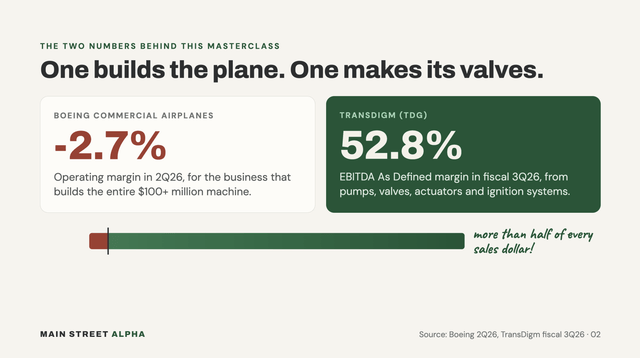
In 2Q26, Boeing's Commercial Airplanes segment, the business that literally builds the plane, reported an operating margin of negative 2.7%.
In its fiscal 3Q26, TransDigm, which is a company most travelers have never heard of, reported an EBITDA As Defined margin of 52.8%. TransDigm makes things like pumps, valves, actuators, and ignition systems.
Think about that for a few seconds.
The company that builds a $100+ million machine loses money on it (at least for the time being). The company that makes some of the small parts inside it keeps more than half of every sales dollar as EBITDA, which is quite something.
That gap is the entire story of this article.
In this article, I'll walk you through the full aerospace supply chain, from raw metal to the maintenance hangar. I'll explain who has pricing power (and why), give you my favorite company at each stage, and share the five questions I ask before buying anything in this industry.
It's a long one, but it isn't time-sensitive. Come back to it whenever an aerospace stock lands on your radar.
So, let's dive in!
Why Aerospace Is The Ultimate Supply Chain
Aerospace combines almost every feature that makes a supply chain tricky. I'll focus on three.
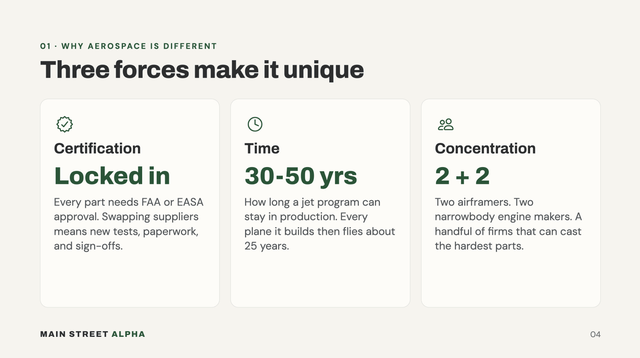
Certification. Every part that flies needs approval from regulators like the FAA in the U.S. and EASA in Europe. Once a part is designed into an aircraft, it's essentially locked in. Switching to another supplier means new testing, new paperwork, and new approvals, which often cost more than the part itself. If you want to understand why some tiny components come with enormous margins, start here.
Time. The Boeing 737 first flew in 1967. It's still being built today. A single aircraft program can stay in production for 30 to 50 years, and every plane it produces then flies for roughly 25 years. A company that wins a spot on a new aircraft today can earn money from that single decision until the 2070s.
Concentration. Large commercial jets are a duopoly (Airbus and Boeing). Narrowbody engines are mostly in the hands of two players: CFM International (a 50/50 joint venture between GE Aerospace (GE) and France's Safran) and Pratt & Whitney (part of RTX). Further down the chain, only a handful of companies can produce the most complex castings and forgings that go into a jet engine.
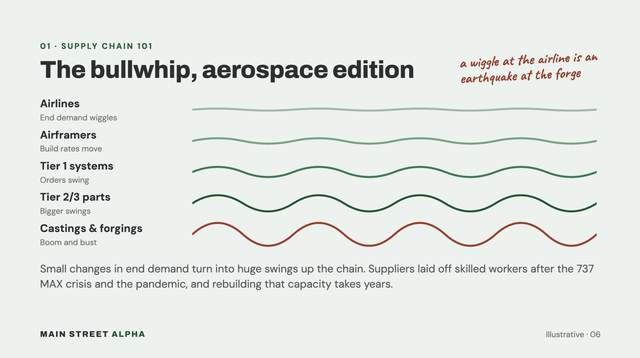
On top of that, aerospace suffers from what supply chain people call the "bullwhip effect" (small changes in end demand turn into huge swings further up the chain).
When Boeing cut production after the 737 MAX crisis and the pandemic, suppliers laid off skilled workers. When demand came roaring back, many of those workers were gone. Rebuilding that capacity takes years, which is why Airbus has missed its production targets in each of the last four years and why Boeing needs FAA approval for every step up in 737 production.
Boeing got approval to go from 38 to 42 737s per month in October 2025. In May 2026, it passed the FAA review for 47 per month. CEO Kelly Ortberg wants to reach 52 and, someday, 63.
Airbus aims for 70 to 75 A320 family jets per month by the end of 2027. And here's the kicker: Airbus itself named Pratt & Whitney as the key pacer of that ramp. It's funny because it means that an engine supplier sets the speed limit for the world's largest aircraft maker.
Meanwhile, the two airframers are sitting on a combined backlog of more than 15,000 commercial aircraft: 9,222 at Airbus at the end of June, plus more than 6,200 at Boeing. At roughly 870 deliveries per year, Airbus's backlog alone covers about a decade of production.
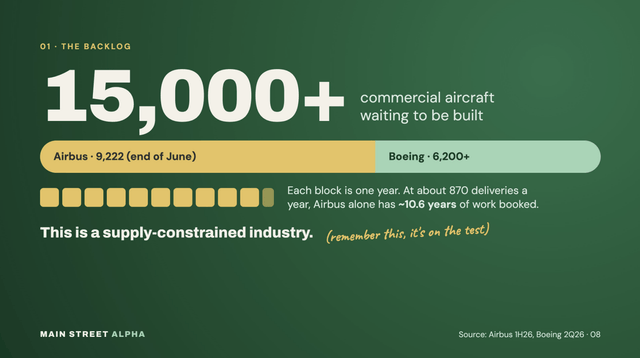
This means it is a supply-constrained industry. Keep that in mind, as it's the foundation of everything that follows.
Sign in to leave a comment and join the discussion.
Sign Up Free