Japan's 2026 Defense White Paper: What It Can Achieve and What It Can't
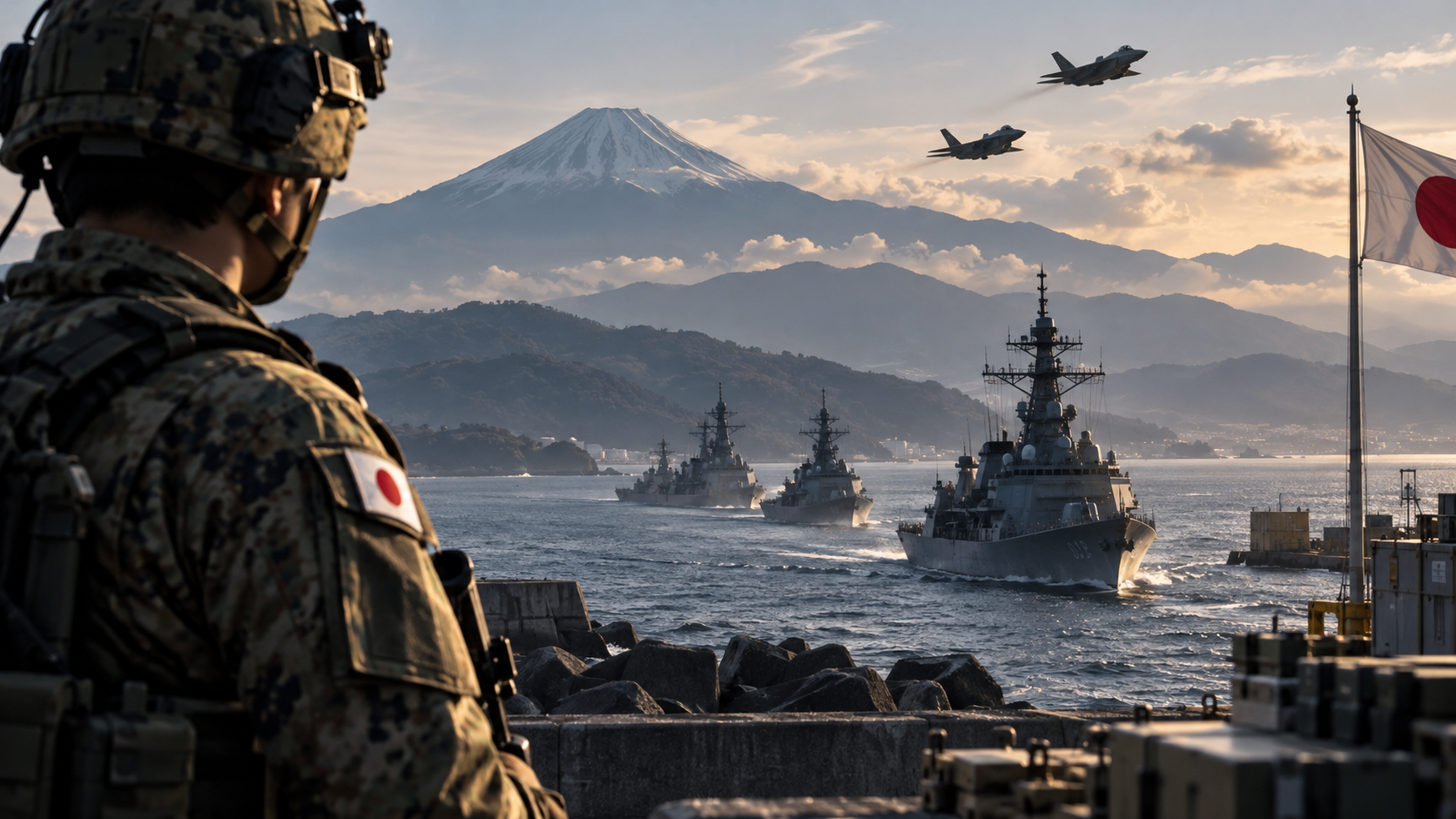
- FY2026 defense outlays exceeded ¥9 trillion ($57bn); government met 2% of GDP target ahead of schedule - sustained top-line demand for defense suppliers
- Personnel shortfalls, uniformed staffing only ~90% of target, while defense manufacturers are exiting or shrinking - execution risk for industrial capacity
- China imposed export controls on ~1,100 dual-use items, including gallium, germanium and rare earths; Reuters found no gallium, dysprosium, terbium or yttrium to Japan in June - supply shock

Oct 27, 202610:52 AM ET40
The 2026 white paper, "Defense of Japan," shows that money is not an impediment for its defense buildup. The constraints now sit in places the budget cannot reach directly: the number of people willing to serve, the number of companies willing to build for the Self-Defense Forces, and the geography that China is testing. Uniformed staffing sits near 90% of target. Defense manufacturers are withdrawing or shrinking. The wager is that Tokyo can close those gaps with higher pay, new recruitment routes, export orders and a shift toward unmanned systems that need fewer people per unit of deterrence. The beneficiary is Washington, which gets a more capable partner that builds its own weapons and shares the load. The problems exist for any Japanese firm that exits the sector before the orders arrive. The spending is a real driver of the outlook. The minister's foreword says the government reached the 2% of GDP goal set in the current National Security Strategy ahead of schedule, counting the initial and supplementary budgets together. The FY2026 total, including costs for US force realignment and the Okinawa SACO program, exceeded 9 trillion yen ($57 billion) for the first time. The three strategic documents will be revised within this year. The Alliance Is Becoming a Production Relationship The paper calls the Japan-US Alliance "a key pillar" of national security policy. The current phase is about industry as much as operations. In April, the two sides held the fourth Defense Industrial Cooperation, Acquisition and Sustainment plenary and upgraded the framework to "DICAS 2.0." Both sides described the goal as producing defense equipment "more rapidly and at a greater scale." Missiles are a major focus. A feasibility study on the AIM-120 AMRAAM, run with Mitsubishi Electric and Raytheon, led both governments to identify circuit card assembly as part of the co-production scope, with final assembly in Japan under discussion. For the SM-3 Block IIA, the two sides confirmed measures to increase output roughly fourfold. The PAC-3 MSE is under review for co-production with a focus on production efficiency. Defense ministers Shinjiro Koizumi and Pete Hegseth agreed in late May, on the sidelines of the Shangri-La Dialogue, to accelerate joint production of advanced missiles. Repair work points the same way. A Japanese yard repaired a US Navy Aegis destroyer homeported on the US mainland for the first time, at Maizuru in December 2025. A pilot will test Japanese manufacture and repair of F100 and F110 engine components toward US Air Force certification. The supply chain working group covers critical materials and small unmanned aircraft. Tokyo gains industrial capacity and a place in US supply chains. Washington gains production that does not depend on American lines alone. That is the strongest argument for why the US wants the buildup to succeed, and it also means that US firms and US budget decisions now shape Japan's defense industry. Japan-China Relations Have Moved Into Economic Coercion The security dispute now has an economic layer. The Congressional Research Service's October 2026 profile of US-Japan relations describes Japan-China ties as the most strained in more than a decade. The trigger was Prime Minister Sanae Takaichi's November 2025 remark that a Chinese attack on Taiwan could be a survival-threatening situation for Japan. Beijing responded with a ban on Japanese seafood, cooler cultural exchanges, reduced outbound tourism to Japan and new export controls. The export controls are the sharpest tool. On January 6, China announced restrictions on dual-use goods bound for Japanese military end users and for military uses, covering critical minerals and rare earths. The control list covers roughly 1,100 items, including gallium, germanium and rare earths. Reuters reported in July that China sent no gallium, dysprosium, terbium or yttrium to Japan in June, extending a squeeze that had lasted for months. For an industrial
Sign in to leave a comment and join the discussion.
Sign Up Free