

Last time I said I do not usually write these.. the response to the high-yield list was outstanding so I will be doing these monthly.
This one is about income that compounds, the five dividend growth stocks I would invest in today.
Every selected company on this list had to carry a Buy or better from GNG's rating, the GNG Quant Rating and Wall Street at the same time, raise its dividend for at least ten straight years, and have analysts expecting at least 7% a year of dividend growth from here. From what survived, I took the strongest grower in each sector, as long as the price still left real room to run, with at least 15% of upside to GNG's fair value. The yields are lower than last time by design, and to be blunt a couple of these may not look like a classic dividend stock at first glance.
The Market Regime, and Where Dividend Growth Sits in It
At the September 30 close, where the last edition left off, the 10-year Treasury yielded 5.29%.. the Fed had just raised rates for the first time since 2023 ( and if anybody saw today's news.. yay), and the variables I said would decide the next leg were Hormuz, the Fed and private credit.
All three are still live, but the market found a new worry on its own. On October 21 Meta reported a quarter in which $34.9 billion of capital spending ran past $32.8 billion of operating cash flow, and the next day the Nasdaq fell 2.6% while the 10-year yield dropped below 5%. By the October 26 close it was 5.00%, and 27 of the 29 basis points it gave back came from real yields rather than inflation expectations.
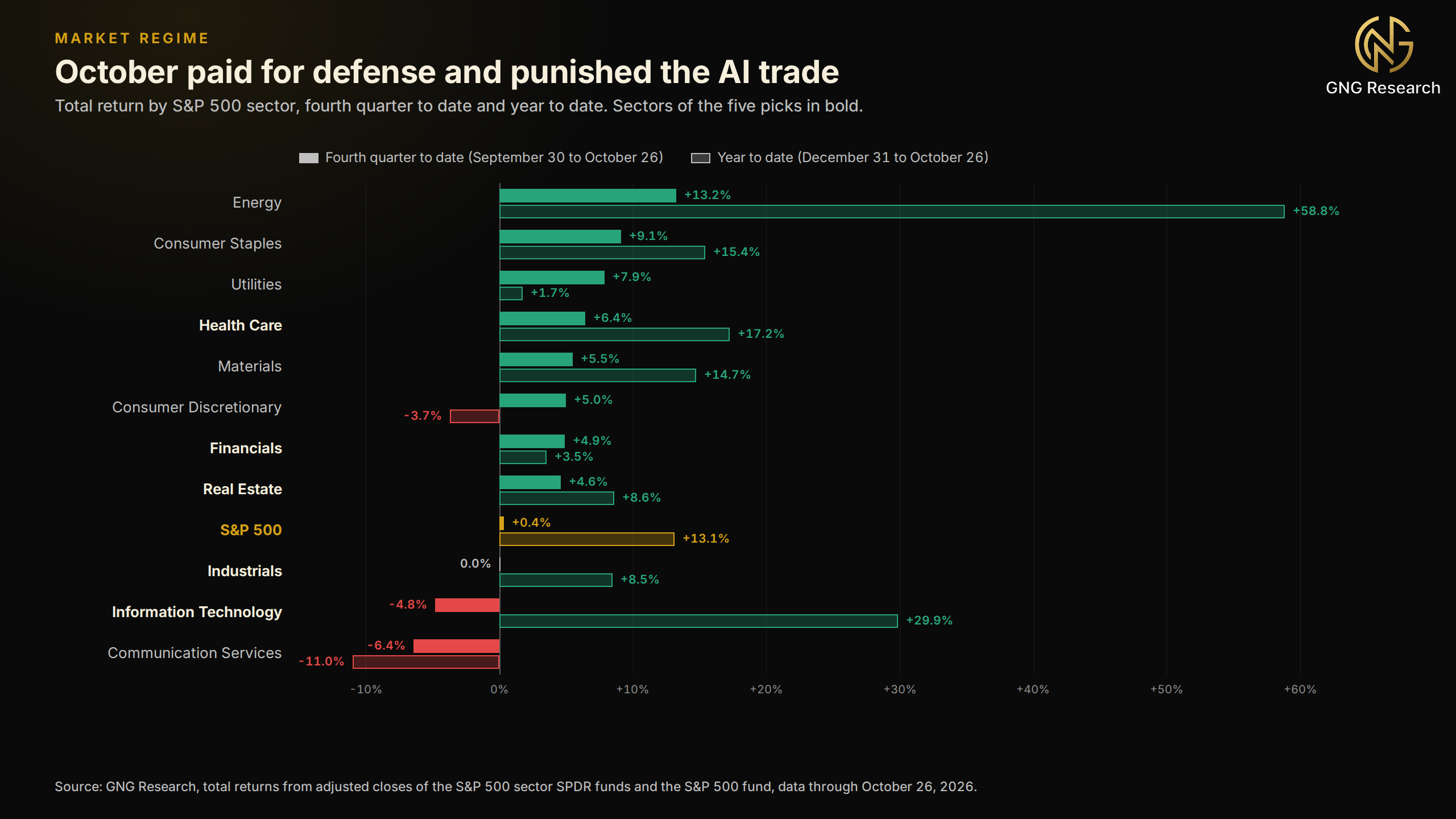
October paid for defense and for oil, and charged the AI trade for both. From September 30 to October 26 energy returned 13.2%, consumer staples 9.1%, utilities 7.9% and health care 6.4%, while technology lost 4.8% and communication services 6.4%. Semiconductors took the worst of it, with the iShares Semiconductor ETF down 13.5% for the quarter so far.
The S&P 500 fund barely moved, up 0.4% with dividends, while the equal-weight version gained 4.5%. Of the five picks' sectors, health care, financials and real estate beat the index, industrials went nowhere, and technology, Broadcom's home, sat at the center of the selloff, as Figure 1 shows.
The oil shock did not fade with the AI scare. The December Brent contract rose 18% to $115.81 as October became the worst month of the war for attacks on shipping around Hormuz. Inflation followed the barrel. September consumer prices rose 0.6% in the month and 3.7% over the year, gasoline alone was up 9.1% in the month and core inflation rose to 2.6%, while September payrolls grew by just 29,000. Futures responded by moving the next hike rather than cancelling it, with about a 90% chance of a hold at the October 28 meeting and about 72% to 76% for a hike on December 9.
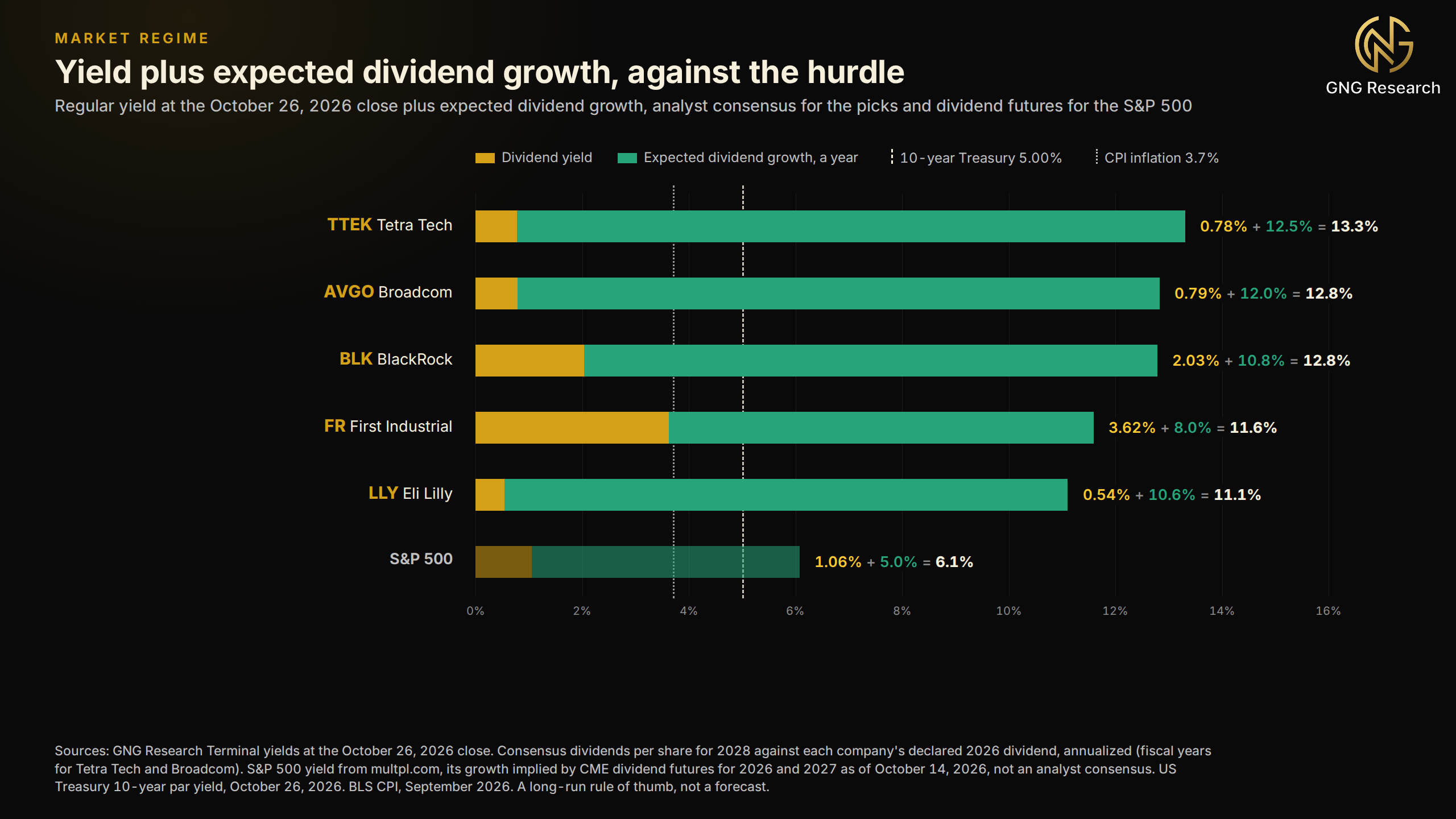
The harder question is what a dividend growth stock has to beat. The S&P 500 yields 1.06%, and dividend futures imply dividend growth of about 6% this year and about 4% in 2027, after 5.5% in 2025. Yield plus growth comes to roughly 6%, against a 10-year Treasury at 5.00% and inflation at 3.7%. A stock yielding under 2% needs its dividend to grow faster than 3% to 4.5% a year just to match the Treasury on this measure, and faster still to pay for the equity risk, which is why this list leans on growth rather than starting yield. Figure 2 sets each pick's current yield plus its expected dividend growth against the same two lines.
These thThe first is how the AI buildout gets paid for. Consensus has hyperscaler capital spending rising from $763 billion this year to about $1.3 trillion in 2027, Meta's free cash flow just turned negative, and hyperscaler bond spreads widened back to July levels, so Microsoft and Alphabet on October 28 and Amazon on October 29 matter well beyond those three stocks, Broadcom included.
The second is the Fed and real yields. The real 10-year has fallen 27 basis points since September 30, which helped lift real estate and long bonds, and a December hike that pushed it back toward 2.9% could undo that quickly. The third is Iran after the midterms. A White House official said the US would not strike before November 3, mediators were in Tehran on October 26, and an escalation would run through oil into headline inflation and the Fed, while a deal could drain the oil premium just as fast.
Credit sits under all three.. High-yield spreads widened 26 basis points in October even as Treasury yields fell Fitch's private credit default rate reached a record 6.3% in August, and redemption requests eased at several of the biggest non-traded credit funds but stayed above their 5% quarterly caps.
To me the data shows a market that is paying for cash flow it can see, pricing duration more kindly than it did in September, and charging more for anything that needs new capital to grow.
In Research Terminal
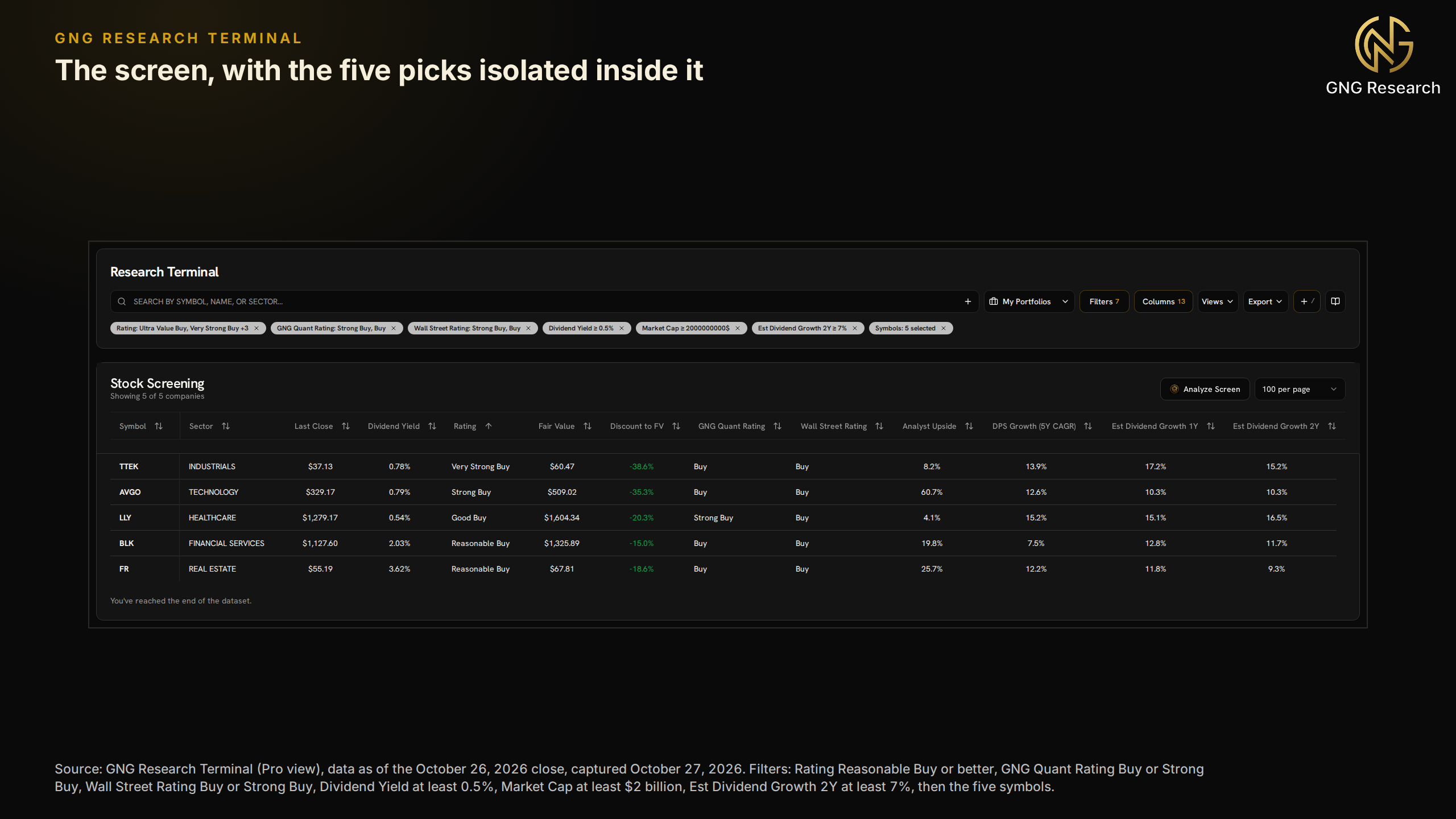
Every pick offers at least 17% of upside to GNG's fair value, and in every case Wall Street's mean target also sits above the price, by as little as 4% for Lilly and as much as 61% for Broadcom.
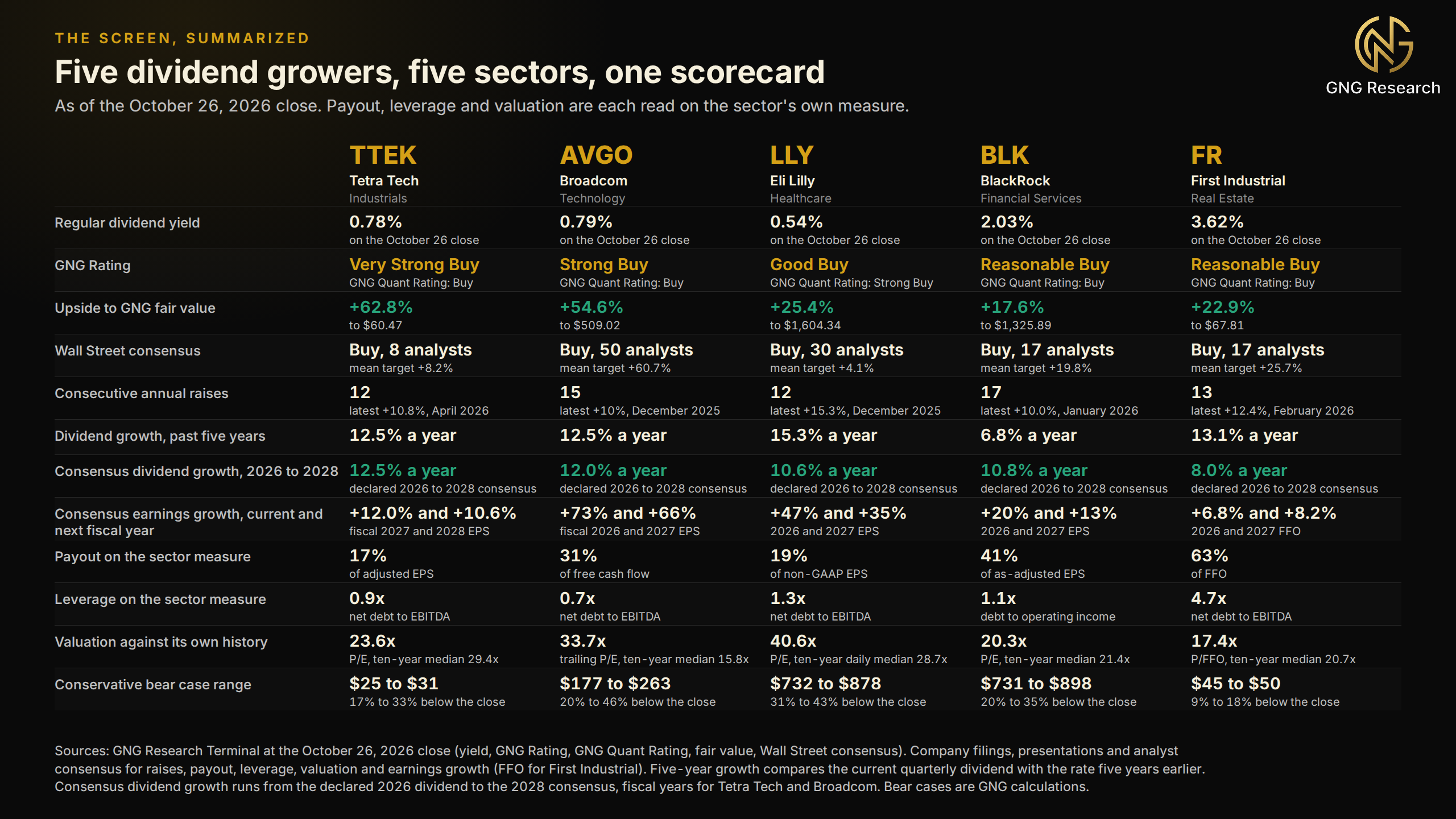
Dividend growth only lasts while earnings grow underneath it, so Figure 4 reads each payout on the measure its own sector uses. Tetra Tech pays out 17% of adjusted earnings, Lilly 19% of non-GAAP earnings and Broadcom 31% of free cash flow, which leaves all three room to keep raising faster than they earn for years. BlackRock pays 41% of as-adjusted earnings, with consensus earnings growth of 20% this year against a dividend path of about 11% a year. First Industrial is the one that needs its cash flow to keep pace, at 63% of FFO, since FFO and the dividend are expected to grow about 7.5% and 8% a year.
Tetra Tech (TTEK)
Tetra Tech is a consulting and engineering firm of about 25,000 people that says more than 85% of its revenue is tied to water. At the October 26 close of $37.13 the shares yield 0.78% and GNG rates them Very Strong Buy.
The dividend has risen every year since its 2014 start, and the company calls July's $0.072 quarterly declaration its 45th consecutive double-digit year-over-year increase.. What I find most compelling is a dividend compounding at about 12.5% a year on a payout under a fifth of earnings, from a business whose core is growing again after losing virtually all of its USAID contracts in 2025.
Industrials were flat this quarter, but Tetra Tech has its own potential drawbacks.. Fears that AI will shrink the billable hours of design firms hit engineering consultants from late 2025 and turned pronounced in May when the shares touched $25.81. Washington is the other, with the government funded only through December 11 after what the chief executive called the longest shutdown in history. The shares have risen 44% from that May low.
Excluding USAID and State Department work and one-off disaster response, net revenue rose 8% in the June quarter, with U.S. federal and international clients each up 12%. Backlog, which counts only funded work, rose $208 million in the quarter to $4.49 billion, 5% above a year earlier, as the company's own chart in Figure 5 shows.
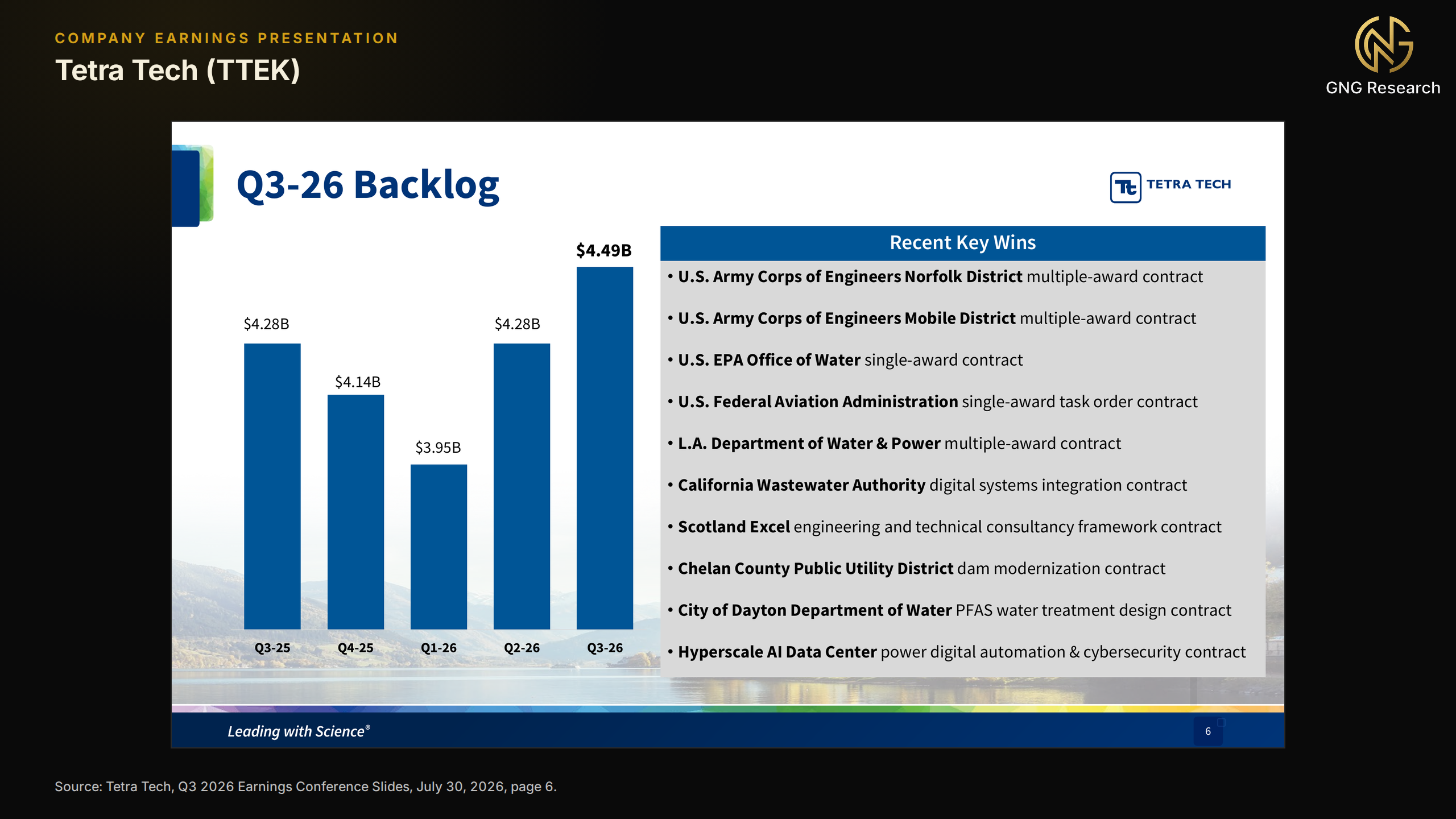
Management has raised fiscal 2026 adjusted EPS guidance at each report since November, from a range of $1.40 to $1.55 to one of $1.56 to $1.59, flat to up 2% on 2025 even as USAID-related and disaster revenue fell $482 million in nine months, because margins keep rising. Consensus expects growth to return, with EPS of $1.76 in fiscal 2027, 12% above the guidance midpoint, and $1.95 in 2028.
For a consultancy, dividend safety is about cash conversion, and operating cash flow has exceeded net income for 21 straight years. Free cash flow of $548 million over the past year covered dividends 7.9x, and the $0.274 declared for fiscal 2026 is 17.4% of the guidance midpoint.
The last five raises ranged from 10.8% to 15.0%, each declared in late April or early May so on that pattern the next comes in the spring not on November 11 (If relevant.. just a pattern I saw). Only four analysts publish dividend estimates, averaging $0.306 for fiscal 2027 and $0.347 for 2028, up 11.7% and 13.3%, still under 18% of expected earnings, so earnings growth funds the path.
Buybacks come on top, $200 million in the nine months to June at an average $31.29, and on September 10 the board lifted the authorization to $898 million, about 9% of market value. Over the past year Tetra Tech generated $567 million of operating cash flow, raised the dividend 11% and held a net debt target of 1.0x to 2.0x EBITDA, as its capital allocation slide in Figure 6 shows.
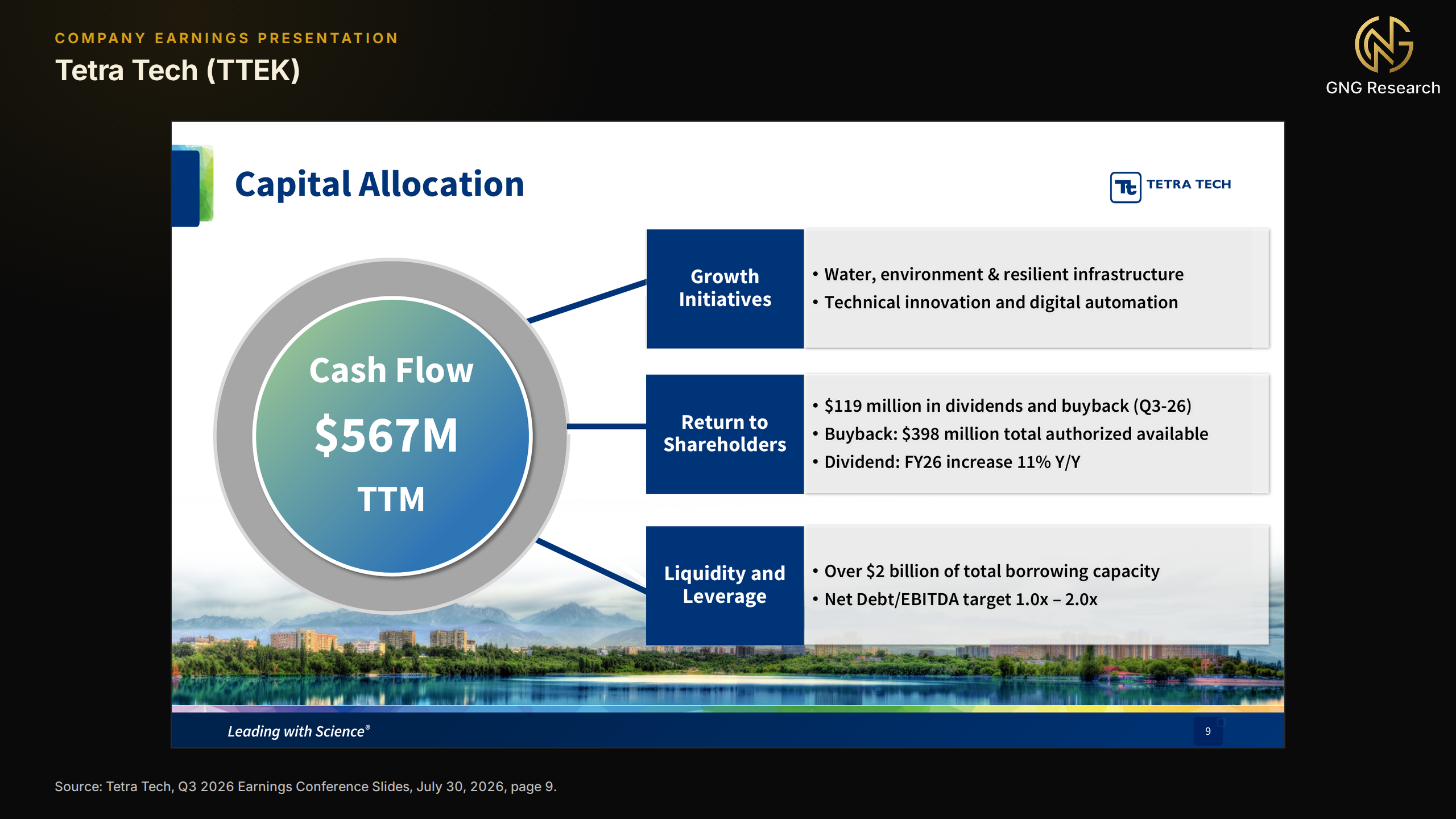
Net debt was 0.88x EBITDA at June 28 and covenant leverage 1.24x against a 3.50x limit. Its filings cite no agency credit rating, and the one large maturity is $575 million of 2.25% convertible notes due August 2028, against $231 million of cash and $564 million of available revolving credit, plus a $400 million accordion needing lender approval.
Tetra Tech trades at 23.6x the fiscal 2026 guidance midpoint and 21.1x 2027 consensus, against a median of 29.4x trailing adjusted EPS at its past ten year-ends, with a low of 19.6x in 2018. EV to EBITDA is 15.7x against a ten-year median of 19.0x. On GNG's forward multiples, Jacobs at 17.2x and Stantec at 14.4x trade below Tetra Tech's 20.6x, so the discount is to its own history, not to peers.
GNG's model value of $60.47, 62.8% above the close, applies Tetra Tech's own five-year median multiples, about 28.5x earnings and 37.6x free cash flow, to trailing and fiscal 2028 consensus figures, while its discounted cash flow models sit near $25. So I read it as a re-rating case, not a twelve-month target. Wall Street rates TTEK a buy, with five of eight analysts at Buy or better and a $40.17 mean target 8.2% above the close, about 22.8x 2027 earnings, which to me prices federal and AI risk that past multiples cannot. Consensus EPS barely moved in the past month, and the GNG Quant Rating is Buy. I think the market is still pricing Tetra Tech for a federal problem it has largely worked through.
What could go wrong
A funding lapse after December 11 would stall task orders already slowed by federal contracting staff cuts, and budget proposals have targeted the state revolving funds that co-fund municipal water work. The roughly $66 million a quarter of remaining State Department work could end. AI could compress billable hours in the 43% of net revenue billed on time and materials, and nearly half of net revenue comes from abroad, so a stronger dollar or a slower U.K. water cycle would show quickly. Fiscal 2027 guidance on November 11 is the next test.
The conservative bear case
It would likely start with a funding lapse after December 11 or a 2027 budget that cuts water co-funding, while a recession slows commercial clients and new AI tools deepen the sell-off in design firms. Tetra Tech's November outlook would point to flat net revenue, the State Department work would end and margin gains would stall. Analysts would follow. Consensus 2027 EPS would fall 11.5%, from $1.76 to $1.56, below the most bearish analyst's $1.61, targets would slide from the $40.17 mean, and two or three Buy-to-Hold moves would tip the consensus to Hold.
At 19.6x, the lowest year-end multiple of the past decade, $1.56 of EPS implies about $31, and at 15.8x, the average forward P/E of Jacobs and Stantec, about $25, just below the May low. The range is $25 to $31, 17% to 33% below the October 26 close, with a yield of 0.9% to 1.2%. The dividend would take only 18.5% of stressed EPS, and leverage would stay near 1.2x after another $200 million of buybacks. At today's dividend, a year of payments would offset just 2% to 5% of the decline and two years 5% to 9%, the cost of owning a low yielder for its growth.
The thesis survives because a payout under a fifth of earnings funds double-digit raises through a flat year. It breaks if the board cuts or skips the spring raise or raises less than 10%, if net revenue excluding USAID and the State Department falls year over year for two straight quarters, if backlog drops below December 2025's $3.95 billion, or if net debt stays above 2.0x EBITDA, the top of the company's target, for two straight quarters. This is the read on today's data, not a forecast.
Broadcom (AVGO)
Broadcom designs custom AI accelerators for Google, Anthropic, OpenAI and Meta, the Ethernet switches that link them and, since buying VMware, private cloud software. At the October 26 close of $329.17 the shares yield 0.79% and GNG rates them Strong Buy. Last December's 10% raise to $0.65 a quarter was the fifteenth consecutive annual increase since Broadcom began paying dividends in fiscal 2011. What I find compelling is AI revenue that more than tripled last quarter, at 16.8x next year's consensus earnings.
This quarter through October 26, the iShares Semiconductor ETF fell 13.5% while the S&P 500 fund rose 0.4%, as the debate moved from AI demand to how the spending gets financed. Broadcom closed 31.6% below its June 2 record of $481.57. The slide began with a 12.6% drop on June 4, after management reiterated rather than raised its fiscal 2027 AI outlook, and deepened in October, when Anthropic's IPO prospectus spotlighted Broadcom's agreement to lend it up to $42 billion, financing skeptics call circular. Yet fiscal 2027 consensus has held near $19.62 a share since mid-July, so the multiple did the falling.
Third-quarter revenue rose 86% to $29.6 billion as AI semiconductor revenue more than tripled to $16.7 billion, and management guides fourth-quarter revenue to $34.8 billion with $21.7 billion from AI, as the company's own release in Figure 7 shows.
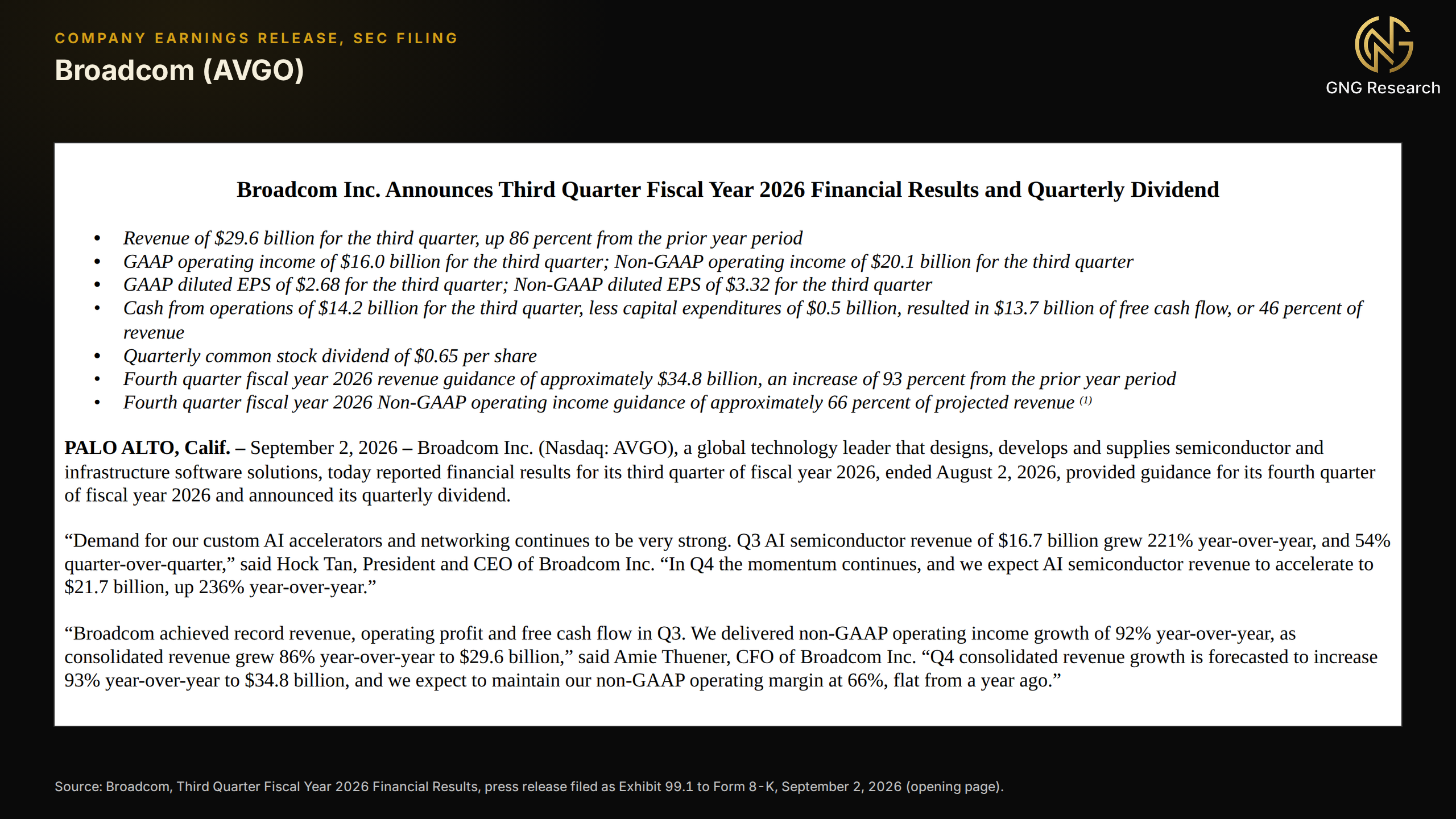
That puts fiscal 2026 AI revenue near $58 billion, from about $20 billion, and management's outlook is about $115 billion for fiscal 2027 and $230 billion for 2028, anchored by Google's long-term TPU agreement from April. Software, mostly VMware, grew 29%. Consensus revenue of $178.3 billion for fiscal 2027 already assumes that doubling and more.
Free cash flow is the dividend test here, and it is not close. Dividends of $12.1 billion over the past four quarters took 31% of $39.4 billion of free cash flow, 3.3x coverage. The company tied last year's 10% raise to fiscal 2025's $26.9 billion of free cash flow, as its release in Figure 8 shows, after raises of 14%, 12%, 14% and 11%, a 12.5% annual rate over five years.
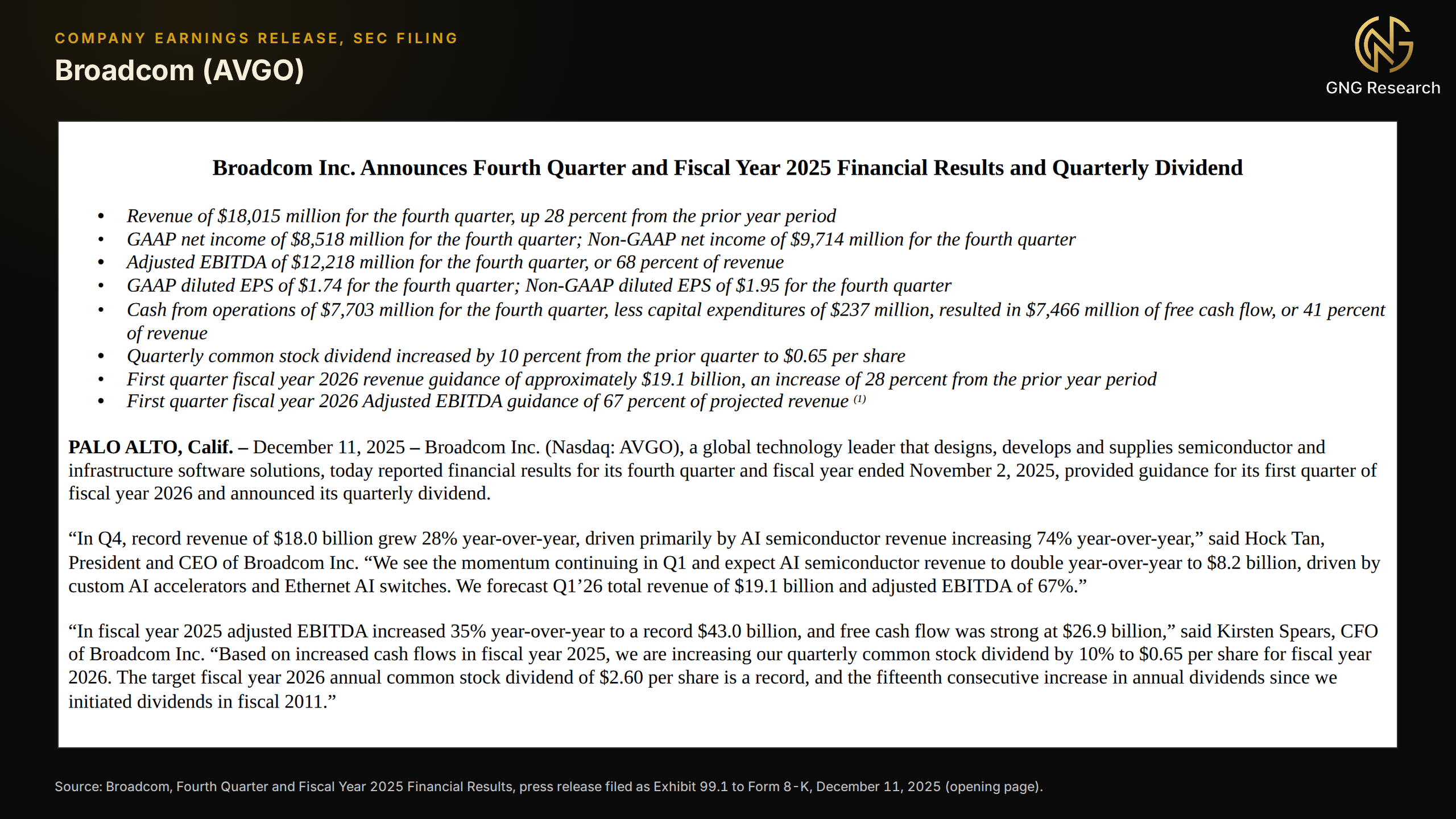
Broadcom last stated a 50% payout target for prior-year free cash flow in 2022. The fiscal 2026 rate absorbs 46% of that cash flow, and the same share of the $48.9 billion fiscal 2026 consensus would fund about $4.71 a share. Consensus models only $2.93 for fiscal 2027 and $3.26 for 2028, up 12.7% and 11.4%, so the path looks conservative, though the board held last year's raise to 10% when free cash flow grew 39%. Earnings fund either path, since $2.93 is 15% of the $19.62 consensus EPS.
Net debt was $35.4 billion at August 2, about 0.7x EBITDA, with nothing due in fiscal 2027. Moody's rates the senior debt A3 and S&P and Fitch A-, all with positive outlooks.
P/E on reported earnings is the wrong valuation metric for Broadcom, whose GAAP results carry $8.0 billion a year of acquired-intangible amortization, so my preferred methodology is adjusted earnings and EBITDA. The shares trade at 33.7x trailing adjusted EPS, about 2x the 15.8x median of the past ten fiscal year-ends, but at 16.8x the fiscal 2027 consensus, near that median if the consensus arrives, and enterprise value is 13.4x that year's consensus EBITDA. The 2.5% free cash flow yield would rise to 5.3% on that consensus, near its 5.4% trailing decade median, while NVIDIA trades near 13x comparable earnings, Analog Devices 24x, Texas Instruments 29x and Marvell 31x.
GNG's model value is $509.02, 54.6% above the close, from four earnings and sales multiple methods spanning $346.68 to $869.64, while its discounted cash flow value of $226.02 sits below the price, so I read it as the payoff if growth arrives, not a floor. Wall Street rates AVGO a buy, with 47 of 50 analysts at Buy or better and a $529.10 mean target 60.7% above the close. Consensus EPS of $11.81, $19.62 and $30.61 through fiscal 2028, growth of 66% and 56%, moved up 0.2% and down 0.5% for 2026 and 2027 in the past month. The GNG Quant Rating reads Buy. Personally, I think the market prices Broadcom as if the AI cycle has peaked while the company keeps raising its outlook, and I find that gap extremely compelling.
What could go wrong
The five largest end customers bought about 55% of third-quarter revenue, and Broadcom's April filing says Anthropic's added consumption depends on its "continued commercial success." Broadcom also helps finance that demand, backstopping up to $29 billion of lease payments, ready to take up to $42 billion of Anthropic notes and, after the October 26 close, backing the reported $43.5 billion senior slice of a new $63 billion vehicle, a risk Moody's says rises as deals stack up. Evercore ISI argued in June that Google is shifting some TPU work to MediaTek, gross margin is guided to 73% from 78% a year earlier, and China, 17% of fiscal 2025 revenue by shipment, sits under export rules that change with little notice. The same few customers drive the growth, the financing and the risk.
The conservative bear case
It would likely start in credit, with the 10-year Treasury back above its October high of 5.31% and a December Fed hike lifting the cost of the debt funding AI build-outs. Broadcom's next reports would show Anthropic slowing its 2027 TPU deployment after a weak IPO, more TPU volume moving to MediaTek, gross margin below 70% and inventory building against $126.8 billion of purchase commitments. Analysts would follow, cutting fiscal 2027 EPS about 15% toward the lowest estimate, $16.66, trimming targets and moving to Hold, while Moody's and S&P turned their outlooks stable over the backstops and AI funds saw outflows.
At 15.8x, the decade's median year-end multiple of trailing adjusted EPS, $16.66 implies about $263, and at 10.6x, its 2018 low, about $177. The range is $177 to $263, 20% to 46% below the October 26 close, with a yield of 0.99% to 1.47%. Even the lowest fiscal 2027 free cash flow estimate, $55.5 billion, covers the consensus dividend about 4x. At today's dividend, a year of payments would recoup only 2% to 4% of the decline, and two years 3% to 8%, so the dividend is no cushion here.
The thesis survives there because the next raise rests on fiscal 2026 cash flow, about two thirds booked, and net debt is under 1x EBITDA. It breaks on a dividend cut or a skipped raise at the December 9 results, free cash flow covering the dividend under 2x over trailing twelve months for two straight quarters (3.3x today), debt held above 2x EBITDA, any payment under a backstop, two agencies cutting the senior debt below the A category, or TPU commitments shrinking enough that fiscal 2027 AI revenue falls below fiscal 2026's $58 billion. This is the read on today's data, not a forecast.
Eli Lilly (LLY)
Eli Lilly is the world's most valuable drugmaker, built on tirzepatide, sold as Mounjaro for diabetes and Zepbound for obesity. At the October 26 close of $1,279.17 the shares yield 0.54% and GNG rates them a Good Buy, so this is a dividend growth case, not an income case. The board has raised the dividend every year since 2015, by about 15% in each of the last eight, to $1.73 a quarter. What I find compelling is a dividend that takes a fifth of earnings at a company whose earnings analysts expect to double from 2025 to 2027.
Health care returned 6.4% this quarter through October 26, against 0.4% for the S&P 500 fund, and Lilly rose 10.6% as the 10-year Treasury eased to 5.00%. Policy risk has narrowed. Lilly's November 2025 deal with Washington set a $245 Medicare price for tirzepatide in return for three years of tariff relief and no future pricing mandates, while GUARD, a proposed Medicare Part D model that benchmarks prices abroad, is still pending.
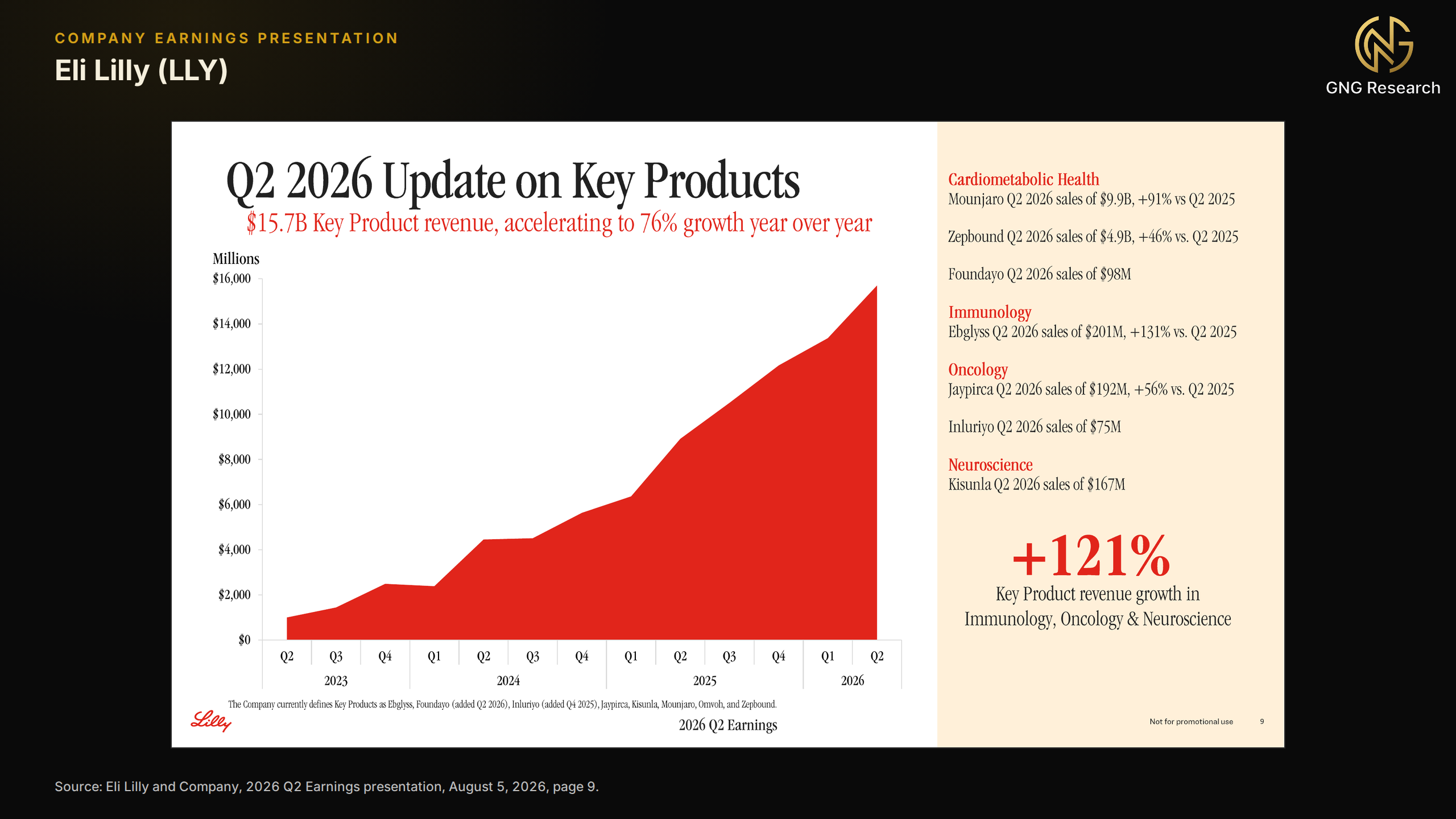
Lilly reports the third quarter on October 29, so this rests on the second. Revenue rose 48% to $23.0 billion, with volume up 60% and price down 13%, and Key Product revenue reached $15.7 billion, up 76%, as the company's own chart in Figure 9 shows. Medicare's GLP-1 Bridge opened coverage to about 20 million eligible patients from July 1, and retatrutide posted 28.3% weight loss at its top dose in Phase 3, with a US filing due in early 2027. Revenue guidance rose to $85 billion to $87 billion, and EPS guidance of $35.50 to $36.50 absorbs $3.03 a share of acquired research charges.
The third quarter has to show US price erosion, 9% before rebate adjustments in the second, staying below volume growth, and the Foundayo pill gaining ground. Consensus 2026 EPS fell 3.2% in a month to $35.65 as acquisitions closed after June, since their research charges count in non-GAAP EPS, while 2027 and 2028 rose 0.7% to $48.09 and $55.05, growth of 47%, 35% and 14%.
The $6.92 annual rate is 19% of 2026 consensus EPS and 22% of trailing EPS of $31.49, against the 40% to 60% typical of large drugmakers, and the past year's $5.8 billion of dividends used 32% of free cash flow. After a flat 2010 to 2014 at $0.49 a quarter, the dividend has risen 12 straight years, 15.3% a year over the last five. Raises come in December. Against the $6.92 declared for 2026, the 2028 consensus dividend of $8.46, from 11 analysts, implies about 10.6% a year and would be about 15% of 2028 consensus EPS.
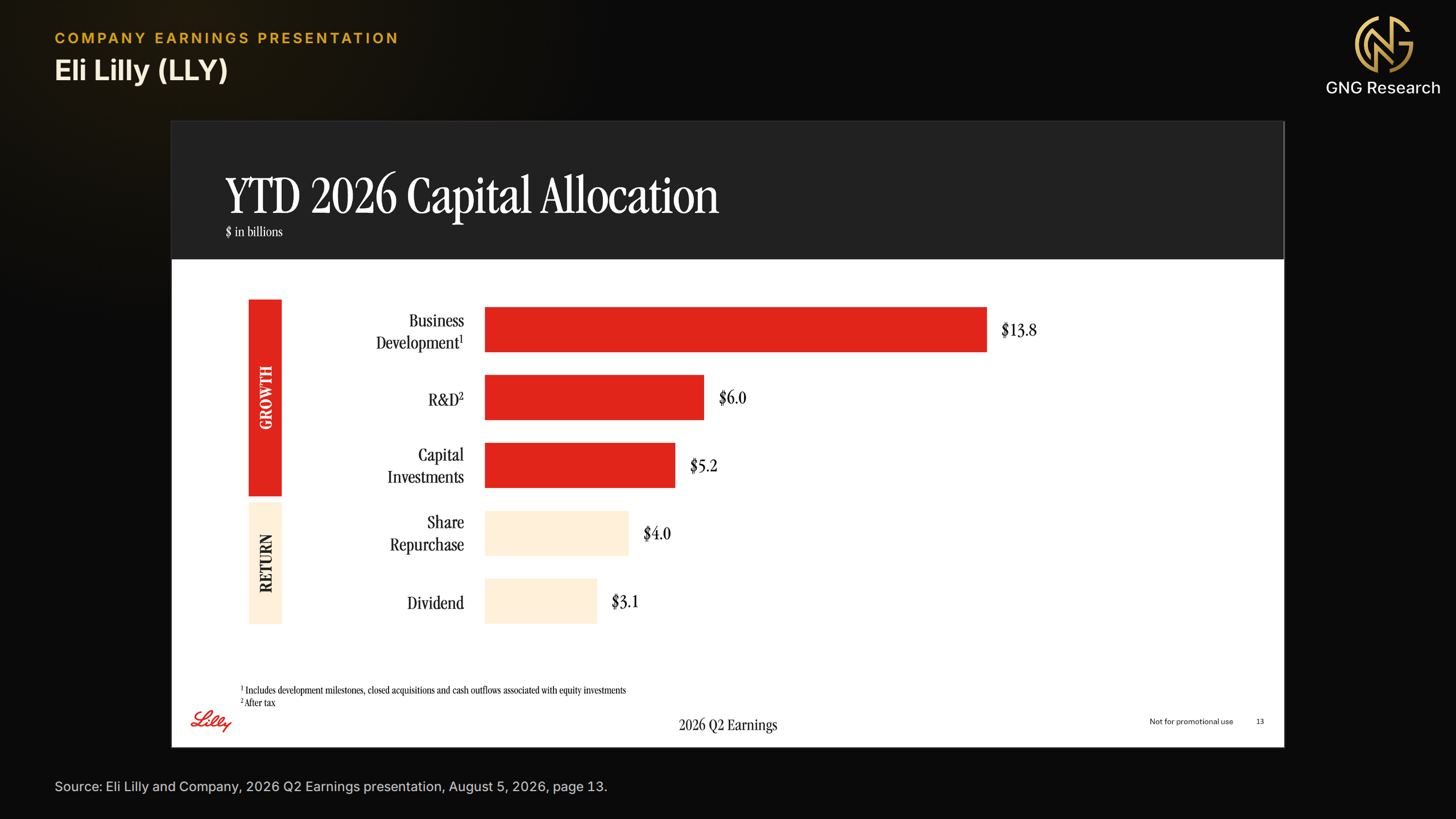
Growth gets the cash first, as Figure 10 shows, $25.0 billion on deals, research and plants in the first half against $7.1 billion returned, $3.1 billion as dividends. Net debt of $46.0 billion was 1.3x trailing EBITDA at June 30, S&P raised Lilly to AA- on April 30 and Moody's rates it Aa3, and $6.5 billion of notes due in 2027 and 2028 plus $5.3 billion of commercial paper compare with $10.1 billion of unused credit lines.
For large pharma my preferred methodology is price against non-GAAP earnings, checked against free cash flow, and Lilly is expensive on both. It trades at 35.9x 2026 and 26.6x 2027 consensus EPS, and its trailing 40.6x sits below a five-year median of 48.4x but above a ten-year median of 28.7x that includes its slow years. On 2027 earnings, Johnson & Johnson trades at 22.0x, AbbVie at 17.4x, Novartis at 15.5x and Novo Nordisk at 11.9x. The free cash flow yield is 1.6%. The premium buys growth no peer matches.
GNG's model value of $1,604.34, 25.4% above the close, applies a P/E of about 42x to trailing and 2027 consensus EPS and blends the results, while its other main methods span $1,209 to $2,180. Wall Street rates LLY a buy, 25 of 30 analysts at Buy or better, but the $1,331.55 mean target sits only 4.1% above the close. The Street sees less room. Targets trail a 56% gain over twelve months, and the mean equals 27.7x 2027 EPS, well under GNG's 42x.
The GNG Quant Rating reads Strong Buy on growth and profitability. I think this is one of the few large-cap dividends with room to keep compounding at double-digit rates for years. History is never guaranteed to repeat.
What could go wrong
Mounjaro and Zepbound sold $14.9 billion, 65% of second-quarter revenue, and price is falling while volume carries the growth. The chief financial officer expects Zepbound's price to fall as CVS restores formulary access, and second-quarter rebate gains and a $250 million milestone will not recur. Foundayo's $98 million of quarterly sales trailed about $485 million for Novo Nordisk's earlier Wegovy pill. GUARD or a new Congress could push pricing further, and every acquisition charge lands in non-GAAP EPS. Or to put it simply, at 36x this year's earnings the price assumes Lilly keeps winning.
The conservative bear case
It would likely start on November 3 with a Democratic sweep, a Congress that writes most-favored-nation pricing into Medicare law, GUARD finalized to cover Part D incretins, and a December Fed hike that lifts the 10-year above 5.3%. Lilly's next reports would show US tirzepatide prices falling faster than volume grows, Foundayo still trailing, and another large acquisition charge. Analysts would follow. Consensus 2027 EPS would slide about 17% toward the most bearish analyst's $39.92, targets would fall from the $1,331.55 mean, several Buy ratings would move to Hold, S&P could trade its positive outlook for stable, and momentum funds would sell.
At 18.3x, Lilly's lowest year-end multiple of the past decade, set in 2017 before tirzepatide, that estimate implies about $732 a share. At Johnson & Johnson's 22.0x, the richest 2027 multiple among large drugmakers, it implies about $878. The range is $732 to $878, 31% to 43% below the October 26 close, for a yield of 0.79% to 0.95%. At today's dividend, a year of payments would recoup only 1.3% to 1.7% of the decline, and two years 2.5% to 3.5%, so the dividend is no cushion here.
The thesis survives that range. The $6.92 dividend would be 17% of stressed EPS, or 20% after a 15% raise, $17 billion of free cash flow, S&P's 2026 projection, would cover that bill 2.4x, and net debt would be 1.0x the lowest 2027 EBITDA estimate. It breaks on a cut, a skipped raise or one below 10%, dividends above 35% of non-GAAP EPS for two straight years, net debt above 2x EBITDA for two straight quarters, a downgrade below AA- at S&P or Aa3 at Moody's, US tirzepatide revenue falling year over year for two straight quarters, or a safety finding that stops the retatrutide filing. This is the read on today's data, not a forecast.
BlackRock (BLK)
BlackRock is the world's largest asset manager, paid mostly in base fees on $15.5 trillion of client assets in iShares ETFs, active and index funds, private markets and cash. At the October 26 close of $1,127.60 the shares yield 2.03% and GNG rates them Reasonable Buy. In January the board raised the dividend 10% to $5.73 a quarter, after raises of about 2% in 2024 and 2025. What I find compelling is a dividend that takes 41% of as-adjusted earnings, paid by a business whose as-adjusted EPS rose 21% in the first nine months.
Fees follow markets, so the regime shows up fast. The 10-year Treasury yield closed October 26 at 5.00%, with another Fed hike priced for December, and market moves cut BlackRock's fixed income assets by $117 billion last quarter even as clients added $78 billion. The sharper stress is private credit, where Fitch's U.S. default rate hit a record 6.3% in August and non-traded BDCs left $8.2 billion of third-quarter redemption requests unmet. Blackstone and Carlyle lost 17% and 29% over the past year, dividends included, while BlackRock returned 3.3%, with private markets only 11% of its base fees.
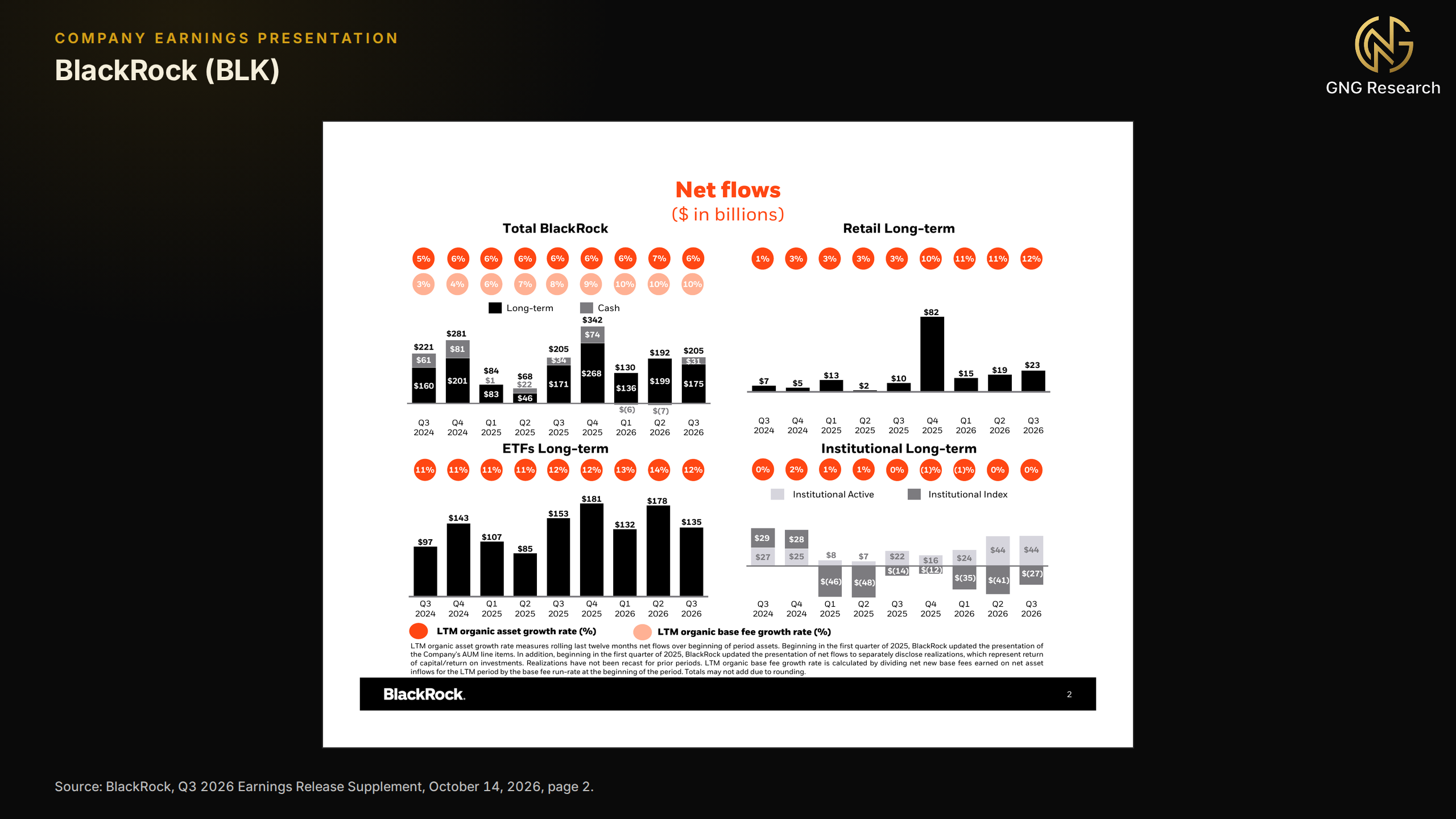
On the micro side, the growth is organic. Clients added $869 billion over twelve months, and organic base fee growth held at 10% for a third straight quarter, twice the company's 5% target, as the company's own chart in Figure 11 shows. iShares took $135 billion last quarter and technology contract value grew 12%. The as-adjusted operating margin widened 3.2 points to 47.8%, and as-adjusted EPS rose 38% to $15.93, helped by investment gains that will not recur every quarter. Consensus already expects much of this, with as-adjusted EPS of $57.71, $65.45 and $74.76 for 2026 through 2028, about 16% a year from 2025's $48.09.
For an asset manager, the test is the share of as-adjusted earnings and free cash flow the dividend takes. The $22.92 annual rate is 41% of trailing as-adjusted EPS of $55.53, down from 55% in 2022, when an 18% raise met a 10% fall in earnings. Raises then slowed to about 2% while earnings caught up and BlackRock bought Global Infrastructure Partners, Preqin and HPS, until January's 10%, which management tied to "durable earnings expansion", as Figure 12 shows with $1.45 billion of buybacks through September. Free cash flow outside consolidated funds was $8.2 billion over the year to June, and dividends and distributions took 44% of it.
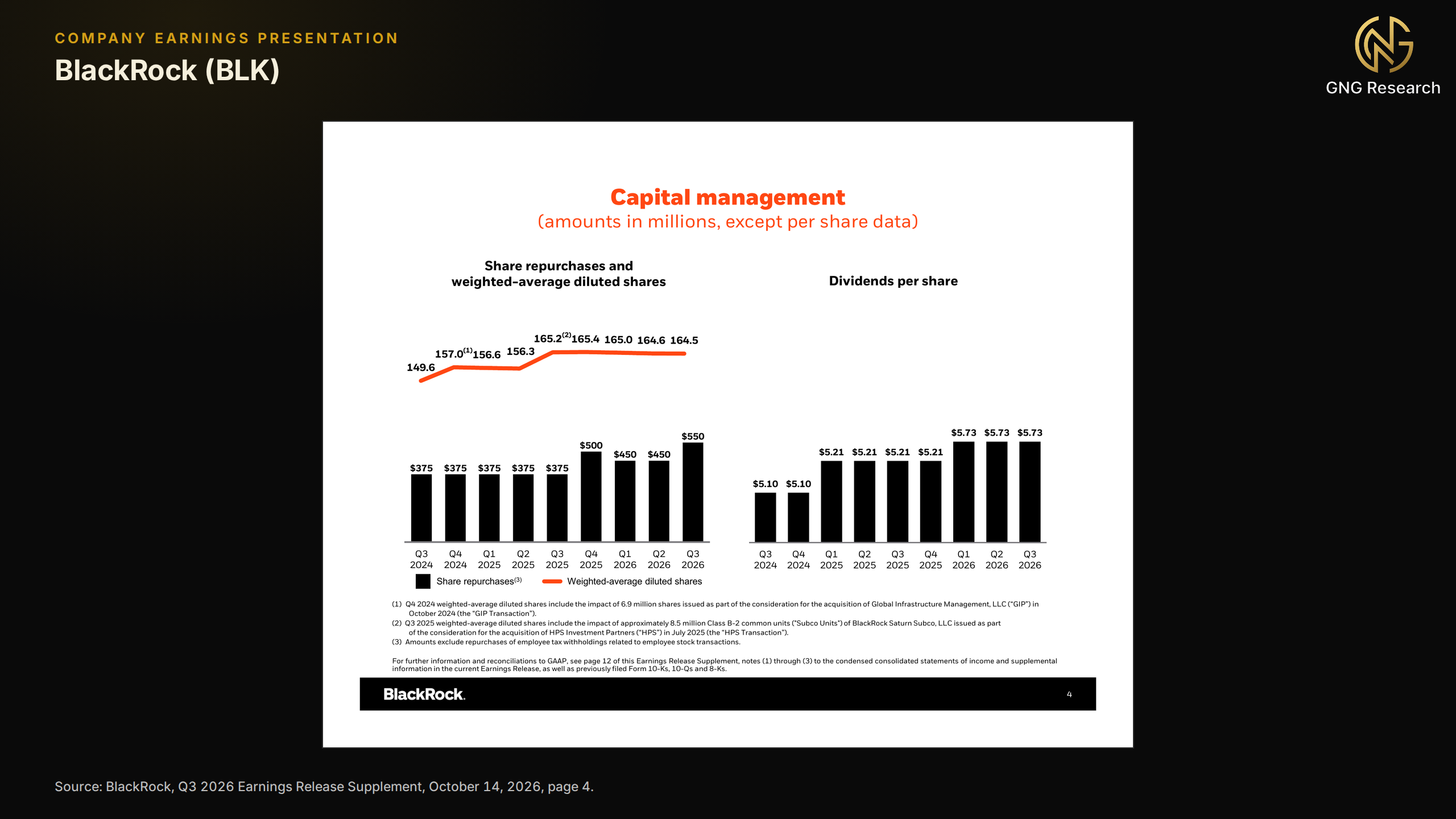
The payment history shows no cut since the first dividend in 2003, a flat 2009 and a higher annual total every year since, 16 straight through 2025 with a 17th under way. Long-term debt of $12.8 billion at June 30 was about 1.1x trailing as-adjusted operating income, against $10.2 billion of cash outside consolidated funds and an undrawn $6.3 billion credit line, with $1.5 billion due before 2029. S&P and Moody's rate the senior debt AA- and Aa3, both stable. Consensus puts the dividend at $28.12 for 2028, about 10.8% a year from today's rate, with the payout drifting toward 38%. History is never guaranteed to repeat.
P/B is the wrong valuation metric here, because acquisition goodwill and intangibles of $62.6 billion exceed BlackRock's $57.6 billion of equity, so my preferred methodology is P/E on as-adjusted earnings. BlackRock trades at 20.3x trailing EPS and 19.5x the 2026 consensus, below the 21.4x median of its past ten year-ends and above the 14.6x trough of 2018. Blackstone fetches 19.5x 2026 earnings, Apollo 13.0x, and T. Rowe Price and Invesco about 10x, so the premium to traditional managers buys 20% growth this year against about 5% at T. Rowe Price.
GNG's model value of $1,325.89, 17.6% above the close, applies BlackRock's five-year median P/E of about 20.3x to the 2027 consensus EPS of $65.45, so it prices the path consensus already expects. GNG's trailing earnings, book and dividend methods sit between $928 and $1,125, so the upside depends on that growth arriving. Wall Street rates BLK a buy, with 16 of 17 analysts at Buy or better and a $1,351.00 mean target 19.8% above the close, and 2026 and 2027 EPS estimates rose 1.4% and 0.4% in a month. The GNG Quant Rating reads Buy. To me, earnings compounding faster than the dividend is what makes the next decade of raises believable.
What could go wrong
BlackRock's earnings move with asset prices, and another Fed hike or a further rise in long yields would keep marking down a $3.4 trillion bond book. Private credit is the newer risk. HPS Corporate Lending Fund holders asked to redeem 11.5% of shares last quarter against a 5% limit, CFO Martin Small said "we still have redemptions in the queue", and Fitch cut BlackRock TCP Capital, a lender BlackRock manages, to BB in January. GAAP EPS ran a third below the as-adjusted figure last quarter, mostly on acquisition charges. In short, if markets fall, BlackRock's earnings fall with them, whatever the flows.
The conservative bear case
It would likely start with Fed hikes in December and 2027, the 10-year above its October high, and a second wave of private credit defaults that keeps BDC redemption queues full. BlackRock's next reports would show AUM falling with markets, organic base fee growth below the 5% target, thinner performance fees and slower private markets fundraising toward its $400 billion goal. Analysts would follow. Consensus 2027 EPS would slide about 6% toward the most bearish analyst's $61.59, price targets would fall from the $1,351 mean, some Buy-rated analysts would move to Hold, an agency could turn its outlook negative, and bond and private credit funds would see outflows.
At 14.6x, BlackRock's lowest year-end P/E of the decade, that estimate implies about $898 a share. A repeat of 2022, the decade's worst year, would instead cut trailing EPS 9.7% to $50.12, implying about $731 at the same multiple. The range is $731 to $898, 20% to 35% below the October 26 close, with a yield of 2.6% to 3.1%. The dividend would take 37% to 46% of stressed EPS, coverage of 2.2x to 2.7x, and debt would stay near 1.2x to 1.3x as-adjusted operating income. Because the yield is low, at today's dividend a year of payments would offset only 6% to 10% of the decline, and two years 12% to 20%.
The thesis survives inside that range, because the dividend stays covered more than 2x, the senior debt stays in the AA category and BlackRock raised through every market since 2010, 2022 included. It breaks if the board cuts the dividend or skips a January raise, if the dividend passes 60% of trailing as-adjusted EPS for two straight quarters, if debt passes 1.5x trailing as-adjusted operating income, if S&P or Moody's moves the senior debt out of the AA category, or if HPS Corporate Lending Fund suspends repurchases. This is the read on today's data, not a forecast.
First Industrial Realty Trust (FR)
First Industrial owns and develops about 73 million square feet of warehouses in 15 U.S. logistics markets. At the October 26 close of $55.19 the shares yield 3.62% and GNG rates them Reasonable Buy. The board has raised the dividend every year since reinstating it in 2013, 13 straight increases, most recently by 12.4% to $0.50 a quarter in February. What I find compelling is 13% annual dividend growth since 2021 on a payout near 63% of FFO, in shares priced below every year-end multiple of the past decade.
Real estate returned 4.6% from September 30 to October 26 as the 10-year Treasury yield eased to 5.00% from 5.29%, yet FR fell 7.3%, nearly all after its October 21 report. With the yield 1.38 points under the 10-year, growth has to carry the case. CBRE's third-quarter figures help, with net absorption of 104.6 million square feet, the most since late 2022, against 79.4 million of completions, 6.4% vacancy and asking rents up 3.6%.
The engine is the rent roll. Cash rents on new and renewal leases rose 16.2% to 58.3% in every year from 2021 to 2025, and cash same store NOI grew 5.3% to 10.1% a year, as the company's own chart in Figure 13 shows. Leases starting in 2026 rose 40.5% through September, cash same store NOI guidance rose to 6.5%, and in-place leases step up about 3.4% a year. Occupancy, at 94.1% against a 95.5% year-end target, and $146 million of developments at a 7.9% expected yield add more.
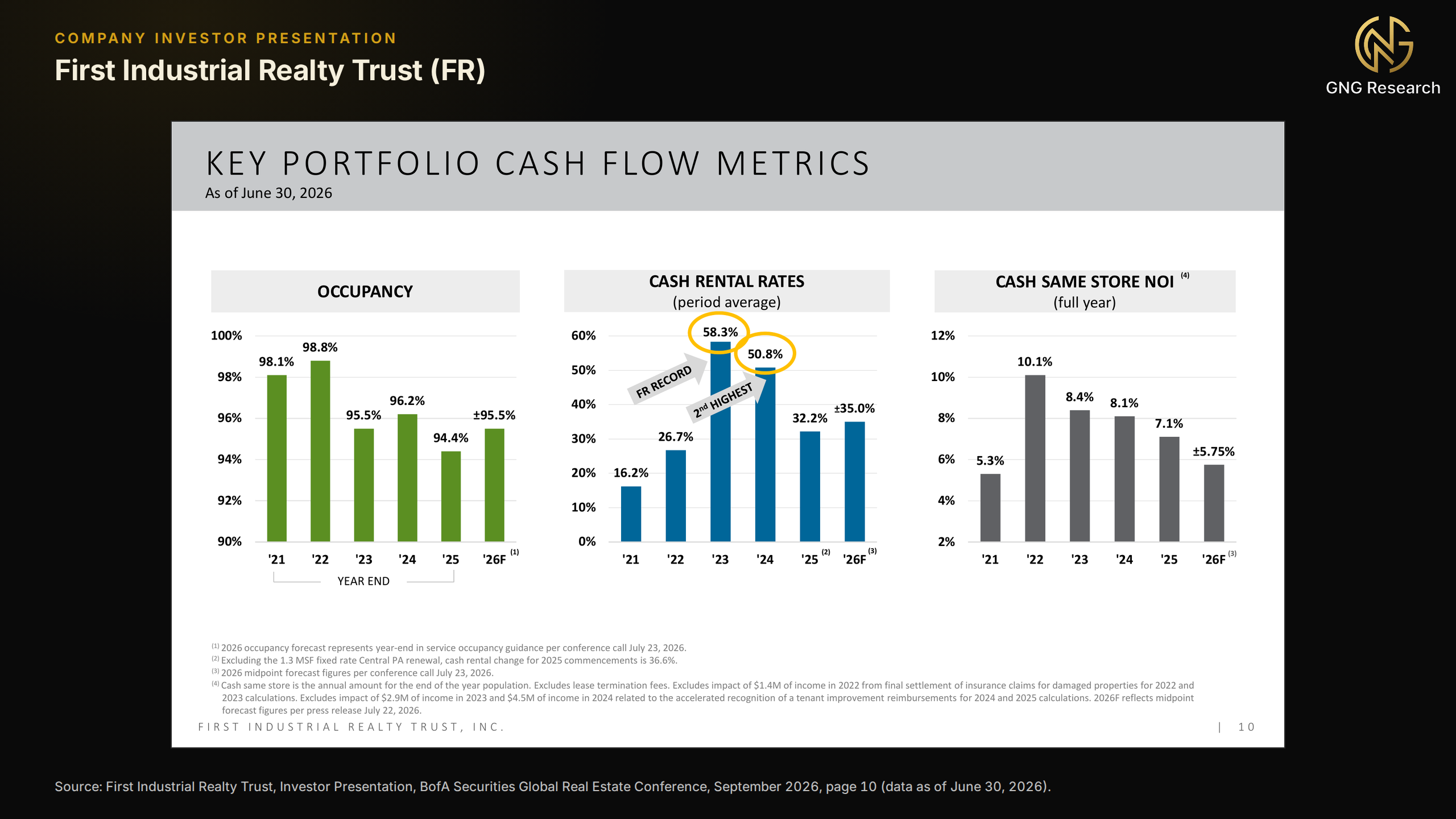
The catch is 2027. Renewals signed for next year, 45% of expirations, carry a 16% cash increase, and management expects the full year to land near it because 68% of that rent was signed from 2022 onward, near the peak, though above 20% outside Southern California. The gap to market rent is closing, so growth after 2027 leans on 3% to 5% market rent growth and on leasing 1.7 million square feet of development space.
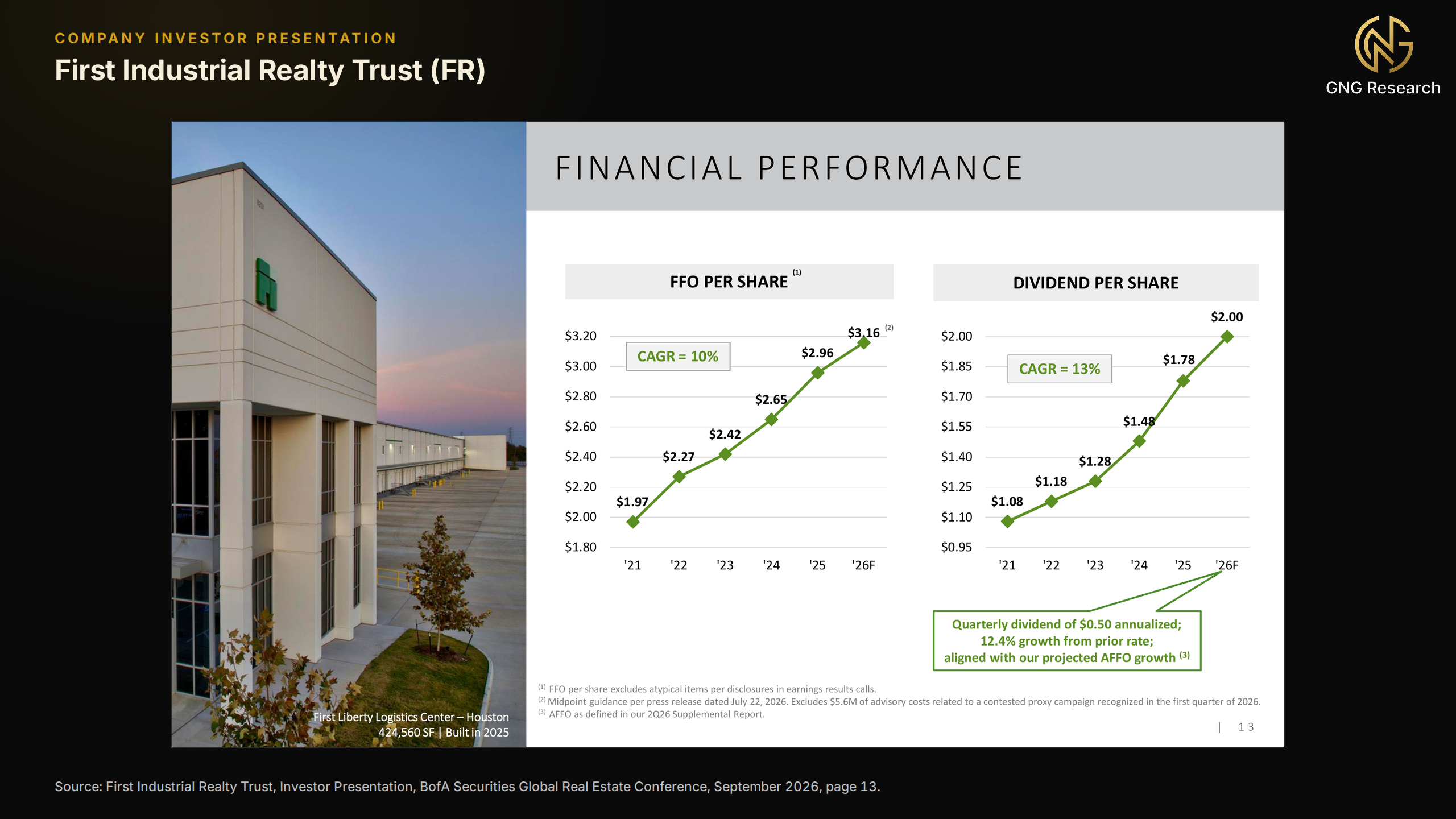
For a REIT, the right test is FFO. FR guides 2026 FFO to $3.15 to $3.19 a share before $0.04 of one-time proxy-contest costs, so the $2.00 dividend takes 63%, close to 2025's 60%, and the company calls the latest raise aligned with projected AFFO growth, as Figure 14 shows. AFFO, which also deducts leasing costs, carried a higher 79% payout over the past four quarters. Consensus sees the dividend at $2.17 in 2027 and $2.33 in 2028, about 8% a year, with FFO up 6.8% this year and 8.2% next, which keeps the payout near 64%.
Net debt was 4.7x annualized adjusted EBITDA at September 30, and S&P, Moody's and Fitch rate the senior notes BBB, Baa2 and BBB+, all stable. About $522 million matures through 2028, against $648 million of undrawn credit line.
P/E is the wrong valuation metric for a REIT that booked $126 million of property-sale gains this year, so my preferred methodology is price to FFO. FR trades at 17.4x 2026 guidance and 16.1x the 2027 consensus, under the 20.7x median of its last ten year-ends. Prologis fetches 20.1x and EastGroup Properties 20.8x their 2026 guidance, and Rexford Industrial, guiding same-property cash NOI growth below 1%, 15.7x. The price implies a cash cap rate of about 6.0%, above the 5.1% in-place cash yield FR paid for a leased Pennsylvania building in the third quarter.
GNG's model value of $67.81, 22.9% above the close, blends trailing and 2027 price to operating cash flow and dividend yield against FR's own history, four methods spanning $58.66 to $79.83. Wall Street rates FR a buy, with 10 of 17 analysts at Buy or better and a $69.38 mean target 25.7% above the close, though Raymond James cut to Outperform from Strong Buy on October 23 and its target to $71 from $86. Since the report, consensus FFO slipped 0.3% for 2026 and 0.6% for 2027, and dividend estimates held. The GNG Quant Rating reads Buy. I think a 7% one-day drop on one soft spread figure priced in more slowdown than the cash flows show.
What could go wrong
The mark-to-market could fade faster. Chief executive Peter Baccile said two or three more soft years could bring negative roll-downs across the sector, and 31% of FR's net rent expires in 2028 and 2029. In Southern California, the 324,000 square-foot First Rider building has sat empty since early 2025. Development leasing has slipped too, with space in Denver and Nashville still unleased.
Swaps on $575 million of term loans expire in 2027, costing $0.01 to $0.02 a share. Also just to put it bluntly, the $250 million buyback authorized in March sits unused, while Land & Buildings, which lost its spring proxy fight, argued FR trades about 100 basis points of cap rate wide of its closest peers.
The conservative bear case
It would likely start with rates, as the Fed hikes in December and the 10-year climbs back above its October high of 5.31%, while tariffs and oil holding above $115 cut goods volumes and push net absorption back below completions. FR's next reports would show occupancy sliding to about 92%, December's development leasing slipping again, 2027 renewals settling in the low teens and cash same store NOI growth slowing toward 2%. Analysts would follow. Consensus 2027 FFO would fall 7% to 10% from $3.42, targets would drift from $69.38 toward the low $50s, more Buys would turn Hold, and income funds would trim REITs, though 4.7x leverage leaves the agencies little reason to move.
Stressed 2027 FFO would land between $3.07 and $3.17 a share, flat to 3% below this year. At Rexford Industrial's 15.7x, the flat case implies about $50, and at 14.6x, the decade's lowest closing multiple, set in the April 2025 tariff selloff, the deeper case implies about $45. The range is $45 to $50, 9% to 18% below the October 26 close, yielding 4.0% to 4.4%. FFO would still cover the dividend 1.5x to 1.6x and AFFO about 1.2x, and at today's dividend a year of payments would recoup only 20% to 39% of the decline, two years 39% to 77%, a smaller cushion than a high yield gives.
The thesis survives inside that range because the dividend stays covered, the ratings stay investment grade and the multiple already sits near its ten-year floor. It breaks if the board cuts the dividend or skips the annual raise made every year since 2014, if trailing four-quarter AFFO stops covering the dividend at two straight quarter ends, if net debt stays above 5.5x EBITDA, Fitch's downgrade level, for two straight quarters, if two agencies cut the senior notes to BBB- or Baa3, or if in-service occupancy stays under 92% for two straight quarters while renewal cash rents turn negative. This is the read on today's data, not a forecast.
Looking Ahead..
Here are key events to watch that may contribute one way or another on the performance of the five picks discussed in this article:
The Fed decision on October 28, with futures pricing a hold, and the same evening's reports from Microsoft and Alphabet, followed by Amazon on October 29, the next read on the AI spending behind Broadcom. (this already happened.. Sorry, I read this article the other day but still decided to publish I can edit it with an update tomorrow if requested.)
Lilly's third-quarter report on October 29, the first test of whether US price erosion keeps running below volume growth.
The midterm elections on November 3, the October jobs report on November 6 and October CPI on November 10.
Tetra Tech's fiscal fourth-quarter report and 2027 outlook on November 11. Its next dividend raise customarily comes in late April or early May.
A busy second week of December. Lilly holds its Innovation Day on December 7 and customarily announces its annual raise in early December, the Fed meets on December 8 and 9 with a hike priced at about 72% to 76%, Broadcom reports its fiscal fourth quarter on December 9, when its annual raise is customarily announced, and federal funding runs out on December 11.
BlackRock's fourth-quarter report around January 13 with its customary January raise, and First Industrial's fourth-quarter report and dividend declaration in early February.
Thanks for reading and being here. I will answer comments as I see them, so leave questions and pushback below. Thanks for being a part of GNG.
Sign in to leave a comment and join the discussion.
Sign Up Free