
Can 30 dividend stocks yield 4% and grow that income 6.5% a year? The barbell plan behind my retirement accounts, with every position real.
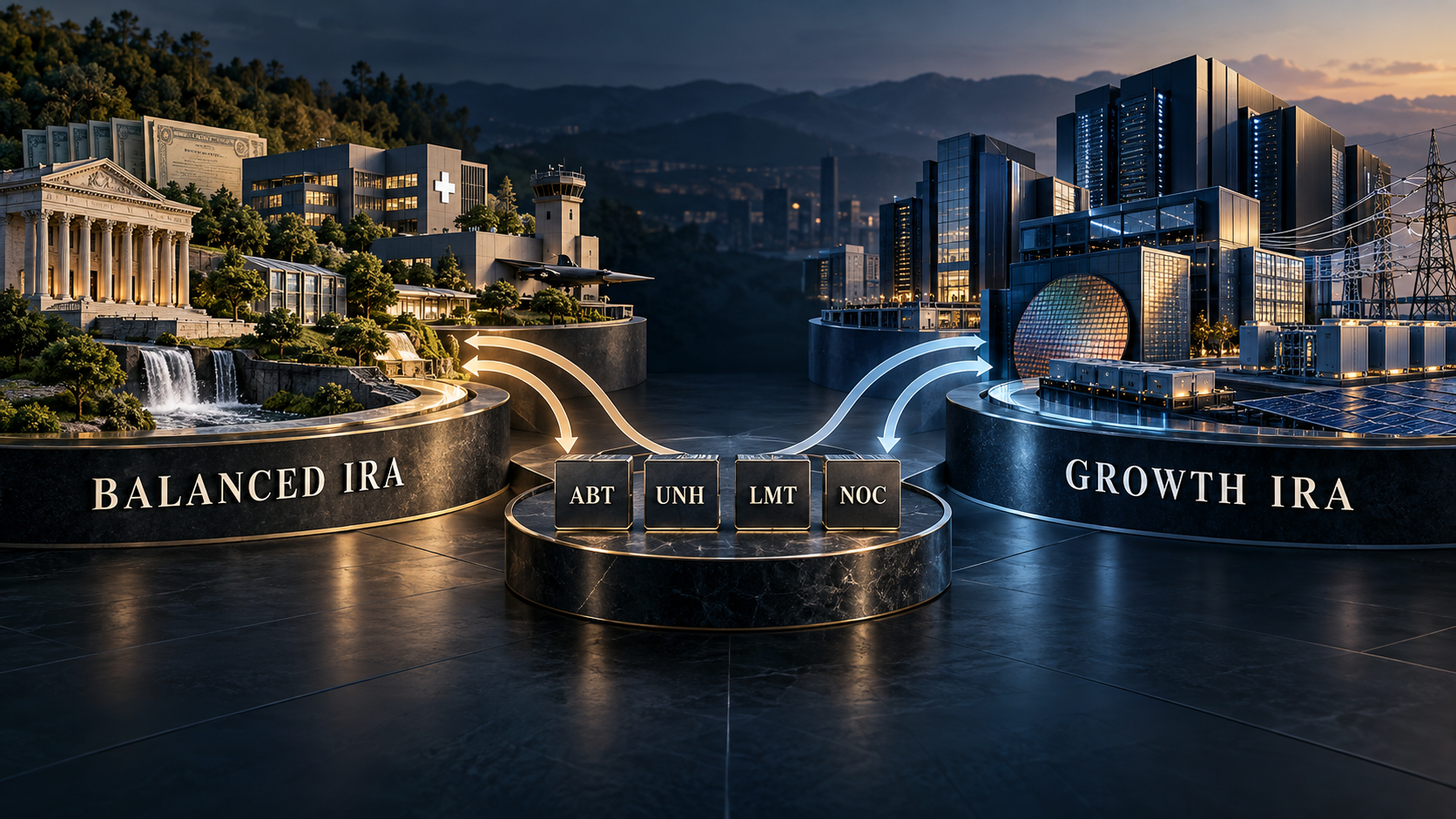
In the third quarter, my Growth IRA sold Abbott Laboratories (ABT) and UnitedHealth Group (UNH) and trimmed Lockheed Martin (LMT) and Northrop Grumman (NOC).
As of October 1, all four were still sitting in my Balanced IRA, paying me dividends.
You could read that as a man who can't make up his mind. I read it the other way, and explaining why takes a whole series.
Can roughly 30 dividend stocks yield about 4% and still grow that income at least 6.5% a year?
The machine behind September's lesson
Last month I published a long piece on income investing and sequence risk. Its central lesson was that the lasting damage in a downturn comes from having to sell into it, because anything sold near the bottom misses the rebound and stops paying dividends for good.
That piece also went out of its way to avoid being a portfolio reveal, with no balances, no position sizes and no trades. This series goes the other way and shows the machine I built to stay out of the forced seller's chair. Every position below is real and sits in my own accounts, and I'll date every number, because these portfolios move and the figures will drift the day after this publishes.
There's also a date hanging over all of it. In early 2027 I turn 59 1/2, the age at which IRA withdrawals generally escape the 10% additional tax that applies to early distributions. That doesn't make anything tax-free, and I was careful to say so last time. It does mean the income these accounts produce stops being a theoretical figure and becomes money I can reach.
Let me lay out the route. We'll start with the household's three accounts and the idea that ties them together, which is the barbell inside the Balanced IRA. Then comes the DGTR engine that runs the income end, the names it holds, the gaps I haven't closed, the Growth IRA and the roadmap. If you only read one section closely, make it the barbell.
Three accounts, three jobs
Account | Approx. Weight | Holdings | Its job | ||||
|---|---|---|---|---|---|---|---|
Balanced IRA | 75% | 51 (Oct 1, 2026) | A growth-and-income barbell. Its income end, the DGTR sleeve, is the subject of this series. | ||||
Vulcan Active Growth IRA | 25% | 39 (Oct 3, 2026) | The published model portfolio and the home of concentrated growth conviction. |
The Growth IRA, my published model on GNG Research, holds my most concentrated growth conviction. The taxable account is the biggest of the three and runs on different rules, so I'm leaving it alone until the two capstones at the end, because taxes change enough of the answers that mixing them in now would muddy everything else.
That leaves the Balanced IRA, where this series lives. Because it's tax-sheltered, the usual arguments about qualified dividends and which account a REIT belongs in don't apply, so it's the cleanest laboratory I have for running a dividend-growth process with real money. It's also the account where the balancing act is easiest to see.
The Balanced IRA is a barbell
The Balanced IRA runs as a barbell, with an income end, a far end and ballast between them. The DGTR sleeve, the subject of this series, is one of those ends.
Sign in to leave a comment and join the discussion.
Sign Up Free