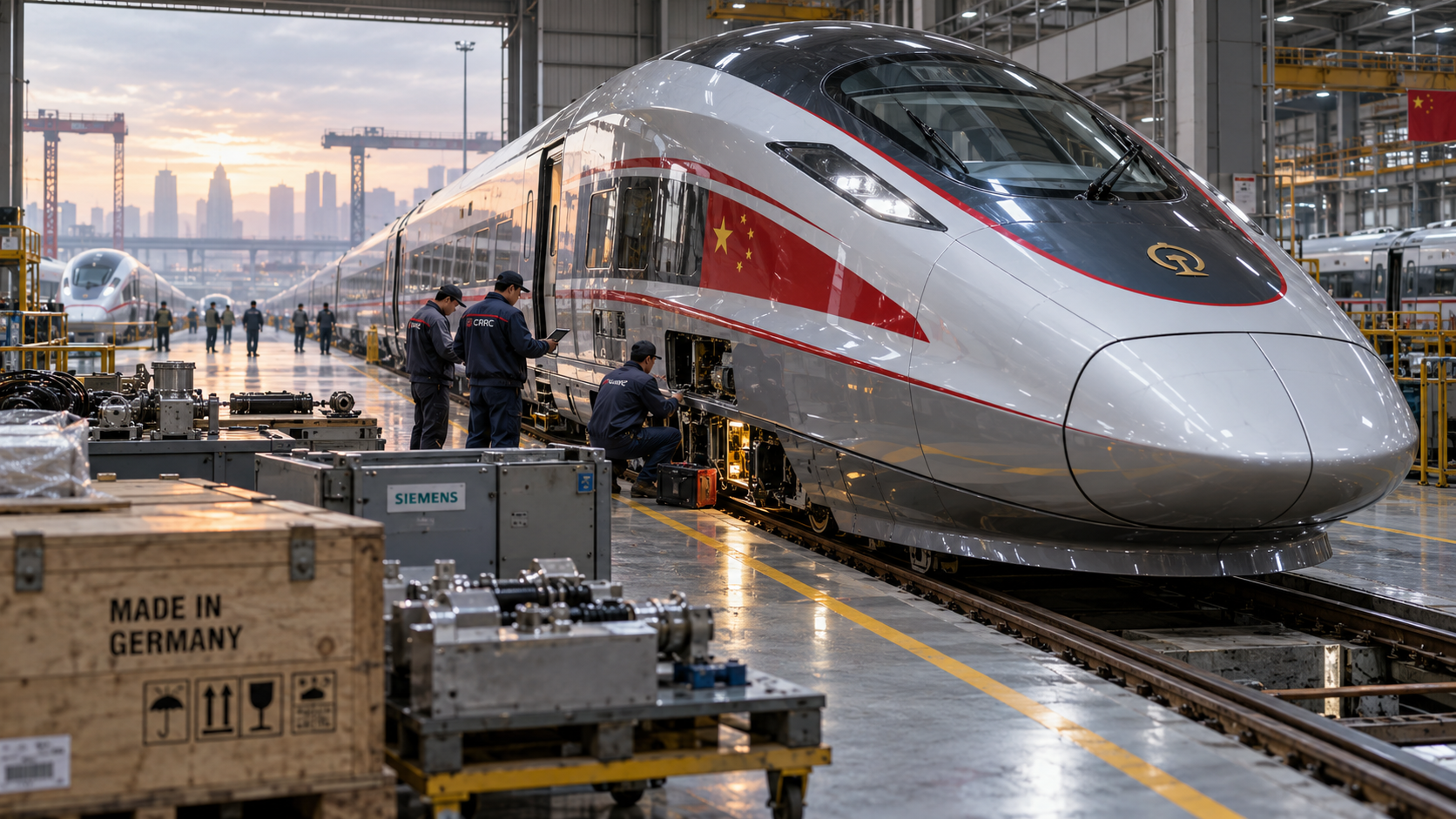

Germany's industrial model is being dismantled in China, and then rebuilt there with German parts
Every Chinese bullet train has a German or Japanese ancestor. In the 2000s China bought trainsets from Kawasaki, Siemens, Alstom and Bombardier, on condition that the know-how came too. The CRH2 was a Shinkansen derivative. The CRH3 was Siemens's Velaro. Beijing then merged its two state rolling-stock makers into CRRC in 2015, and the new giant now bids against its own teachers. That same year it beat Japan for Indonesia's Jakarta-Bandung line, which opened in 2023. It has since supplied or built track and rolling stock in Laos, Kenya and Ethiopia, usually with Chinese state financing that Siemens and Kawasaki can't match.
German executives treat this as a railway story. It's a template. Foreign firms bring technology in, Chinese firms absorb it, and the foreign firms are squeezed out of the market they paid to enter. Machine tools, power equipment, chemicals and cars are following the same sequence, in roughly that order of difficulty.
Cars are furthest along. Volkswagen sold about a third of its vehicles in China in 2023 and still describes the country as a growth market. Yet China overtook Japan as the world's largest car exporter that year, led by BYD, Chery and SAIC, and Chinese brands now take most of their home market's electric-car sales. Volkswagen's response has been to partner with Xpeng for software and to build "in China, for China", which is a way of paying for a seat at the table while the table is being rebuilt. BASF is spending around €10bn on a chemicals complex in Zhanjiang. Siemens, Mercedes and the Mittelstand machinery makers have similar sums sunk into plant, tooling and process knowledge that can't be shipped home.
That immobility is the exposure. Beijing has spent five years assembling the legal means to act on it. The 2021 Anti-Foreign Sanctions Law lets the state retaliate against foreign firms and anyone who complies with foreign sanctions. Exit bans have kept foreign employees in the country during commercial disputes. In 2023 police raided the Shanghai office of Capvision, questioned staff at Bain, and detained employees of the due-diligence firm Mintz Group, all within weeks. Data-localisation rules mean a foreign subsidiary's customer and production data increasingly sits where the state can reach it.
Outright expropriation is unlikely, because it would end the investment inflow Beijing still wants. The likelier route is slower. Forced joint ventures, licence delays, "buy Chinese" procurement rules and security reviews can transfer control without a single seizure. The trigger would probably be a crisis, over Taiwan or over sanctions, when a government that already regards foreign-owned capacity as hostage collateral decides it's cheaper to hold it than to release it. Companies operating in Russia in 2022 learnt what a forced exit costs. Chinese planners watched the same events.
Germany's exposure goes beyond the factories inside China. For two decades its exporters earned their surplus by selling machinery and cars to China, then to third markets that China's own demand had lifted. That second leg is the one now closing. Chinese firms build machine tools, wind turbines, trains and electric vehicles to a standard that emerging markets in South-East Asia, Africa and Latin America find adequate, at a price they find attractive, and with a credit line attached. German exporters lose the Chinese market first, then the markets they once sold into around it. Germany's trade surplus with China has already become a deficit.
The production technology is changing the geography as well. Automation, additive manufacturing and digital twins let factories be built smaller and nearer to customers, which weakens the economics of shipping heavy goods from a single high-wage country. Even without a Chinese competitor, the old export model would be getting harder. With one, it has no obvious successor.
None of this is a secret in Berlin or Wolfsburg. The boardroom reasoning is that the Chinese market is too large to leave, and so every year of staying deepens the dependency that makes leaving impossible. It is a rational choice at each step and a bad strategy in total.
Sign in to leave a comment and join the discussion.
Sign Up Free