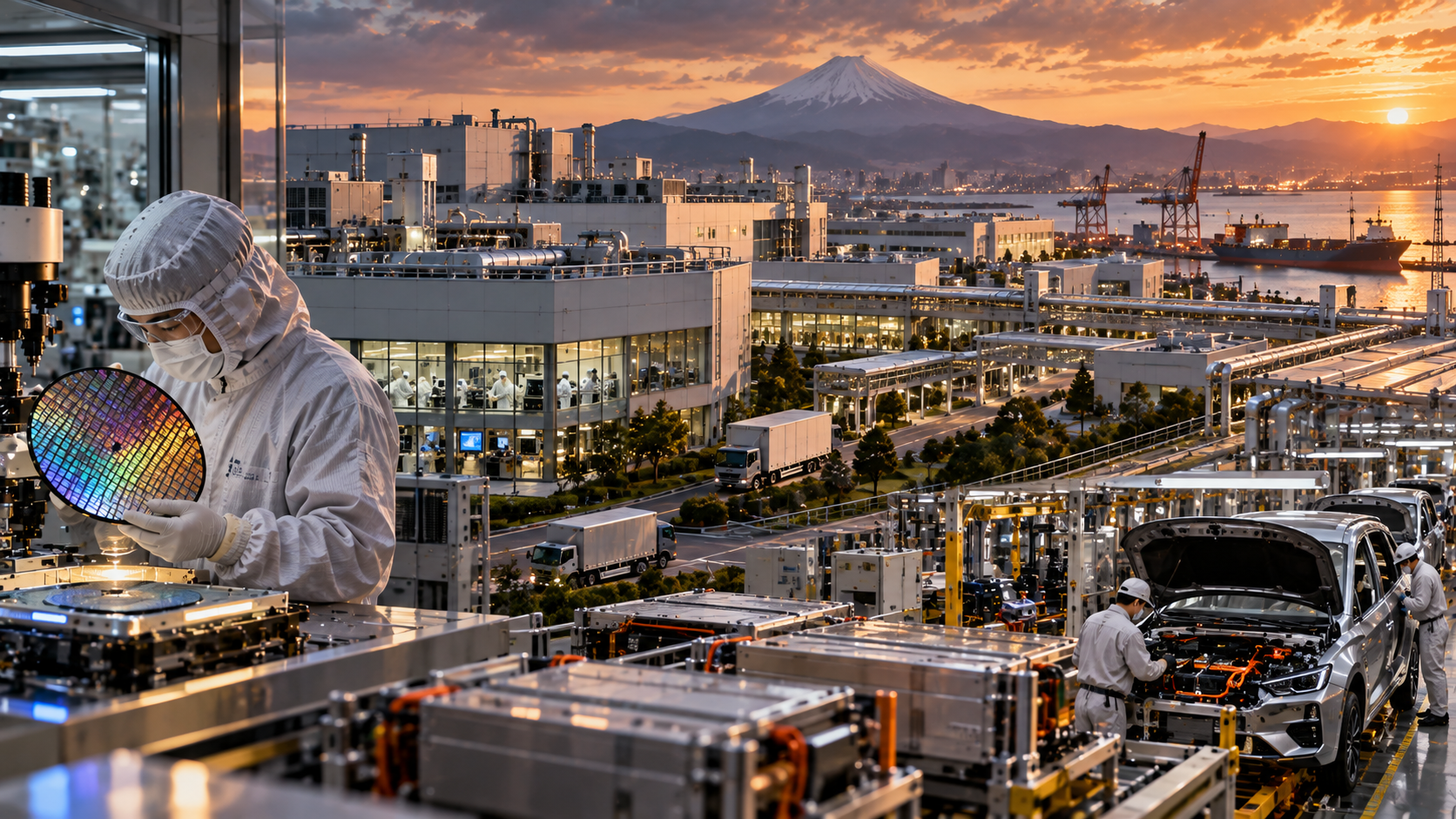
The past eighteen months have fundamentally reshaped where manufacturing capital flows on the global stage. Japan's industrial champions have begun consolidating around integrated supply chains for semiconductor fabrication, automotive powertrains, and battery technology. This shift, driven by genuine material constraints rather than financial engineering, has profound implications for both operating companies and capital allocators who must now think in terms of manufacturing clusters rather than isolated production facilities.
Consider the mechanics at work in Japan's semiconductor sector. Sony Semiconductor Solutions and Renesas Electronics, historically separate operations, have moved toward deeper integration of manufacturing footprint. Sony's image sensor production for automotive applications feeds directly into supply chains serving Toyota, Honda, and Nissan. Renesas, after its own consolidation wave, now operates foundries producing microcontrollers that power everything from industrial machinery to electric vehicle power management systems. The operational reality is that these manufacturers are physically locating adjacent facilities and synchronizing inventory down to weekly batches. This is not vertical integration in the 1970s sense. It is supply chain fusion driven by the singular constraint: semiconductor lead times remain stubbornly long, and the only way to manage this constraint is to collapse distance and communication delays between customer and supplier.
Companies competing in electronics manufacturing now face a binary choice: participate in these consolidated regional ecosystems or maintain standalone operations at genuine competitive disadvantage. Sony's continued investment in dedicated image sensor fabs near Renesas facilities represents not charitable partnership but ruthless efficiency calculation. For operating executives at automotive companies like Toyota, this means accepting that sourcing decisions are no longer purely about component cost but about guaranteed supply security within these manufacturing clusters. Toyota's recent expansion of in-house semiconductor capability does not signal vertical integration ambitions. It signals an attempt to ensure participation in Japan's consolidation wave on favorable terms.
The automotive powertrain story reinforces this pattern. Nissan and Subaru have entered manufacturing partnerships for electric vehicle platforms that share underlying battery architecture and powertrain modules. Historically, automotive companies viewed such arrangements with suspicion, fearing technology leakage. Today, the constraint is different: battery cell procurement. Global lithium supplies remain tight, and the companies that have secured long-term contracts with battery makers like Panasonic and AESC now have structural advantages in vehicle cost curves. Nissan's recent partnership with Subaru to co-develop EV platforms is not a merger. It is a mutual recognition that the real competitive advantage lies upstream, in the materials supply chain, not in differentiated automotive design. Both companies benefit from pooled battery procurement power and shared manufacturing infrastructure for battery assembly and thermal management systems.
This consolidation pattern extends directly to the operating mechanics that executives must monitor. Panasonic, Japan's largest battery manufacturer, has begun concentrating EV battery production in factories that also feed Toyota and Nissan simultaneously. The operational efficiency gains are genuine: shared thermal management infrastructure, pooled quality control systems, and consolidated supply of raw materials arriving at a single facility. But these gains require a fundamental shift in how competing automotive companies think about capacity planning. If Toyota and Nissan both depend on the same Panasonic facility, then both companies face genuine supply volatility if that facility experiences any disruption. The mitigation strategy is dual-sourcing, but dual-sourcing becomes expensive if the second source is geographically distant or technologically inferior. Thus we observe Japanese automotive executives increasingly comfortable with regional consolidation, where multiple competing manufacturers share infrastructure but maintain distinct output specifications and delivery schedules.
The battery material supply chain reveals an even more acute constraint. Lithium and cobalt procurement remains the hard binding constraint on automotive EV production volumes. Japanese manufacturers have moved aggressively into sourcing partnerships with South American lithium producers and Central African cobalt mines. Sony, through its battery materials division, and Sumitomo Metal Mining, through mining operations, have secured long-term supply contracts that effectively lock in raw material costs for the next decade. This is not speculation or financial hedging. This is operational control of material flows. A company without long-term lithium supply agreements cannot reliably forecast vehicle production costs beyond twelve months, making capital planning impossible.
For several Japanese industrial firms, supply chain consolidation is not optional strategy. It’s the cost of competing in capital-intensive manufacturing. Companies that maintain standalone operations, even if they produce superior technology, now face structural disadvantages in procurement that offset engineering advantages. Nissan's decision to deepen partnerships with Renesas and Sony reflects this reality. It is not a reflection of Nissan's engineering weakness but of the industry's realization that material supply chains matter more than product design differentiation.
The implications for investors require different framing. The consolidation wave creates defensible competitive positions for participants, but not through traditional moat mechanisms. Sony and Panasonic enjoy advantageous positions not because they have patented technologies but because they control manufacturing clusters that would be prohibitively expensive for competitors to replicate. A new entrant attempting to compete in automotive EV batteries would need secure lithium supplies, access to thermal management infrastructure, and partnerships with automotive assemblers. The barrier isn’t intellectual property – it’s physical distance and material scarcity.
This creates different valuation implications for different classes of companies. Japanese conglomerates with manufacturing footprints across semiconductors, batteries, and materials benefit from reduced capital intensity per unit of output. Sony may generate higher returns on manufacturing capacity because that capacity serves multiple product lines drawing from shared input streams. For automotive manufacturers like Toyota and Nissan, consolidation reduces uncertainty in sourcing but increases their dependence on partnership stability. A breakdown in partnership with Sony or Panasonic becomes an operational crisis, not merely a commercial dispute.
The global competitive dynamic deserves emphasis. American and European manufacturers attempting to source independently face material disadvantages. Tesla's vertically integrated battery operations reduce partnership dependence but require massive capital allocation to mining, refining, and cell production. Volkswagen's joint ventures with battery partners provide supply security but create technology leakage risks and strategic vulnerability if partnership deteriorates. Japanese manufacturers have navigated this tension by creating consolidated ecosystems where distinct corporate entities maintain operational autonomy while coordinating on material flows and manufacturing schedules. This is more efficient than full vertical integration but more binding than market contracting.
The bottleneck now emerging is not technology or design. It is raw material supply and the logistics of regional manufacturing clusters. Companies positioned within Japan's consolidated semiconductor and battery ecosystems have structural advantages that will persist as long as material scarcity persists. Companies outside these ecosystems must either build competing consolidated networks, which requires capital and time, or accept disadvantageous sourcing positions. The realpolitik of global manufacturing now turns not on which company builds the best product but on which company controls the material streams feeding manufacturing clusters.
Sign in to leave a comment and join the discussion.
Sign Up Free