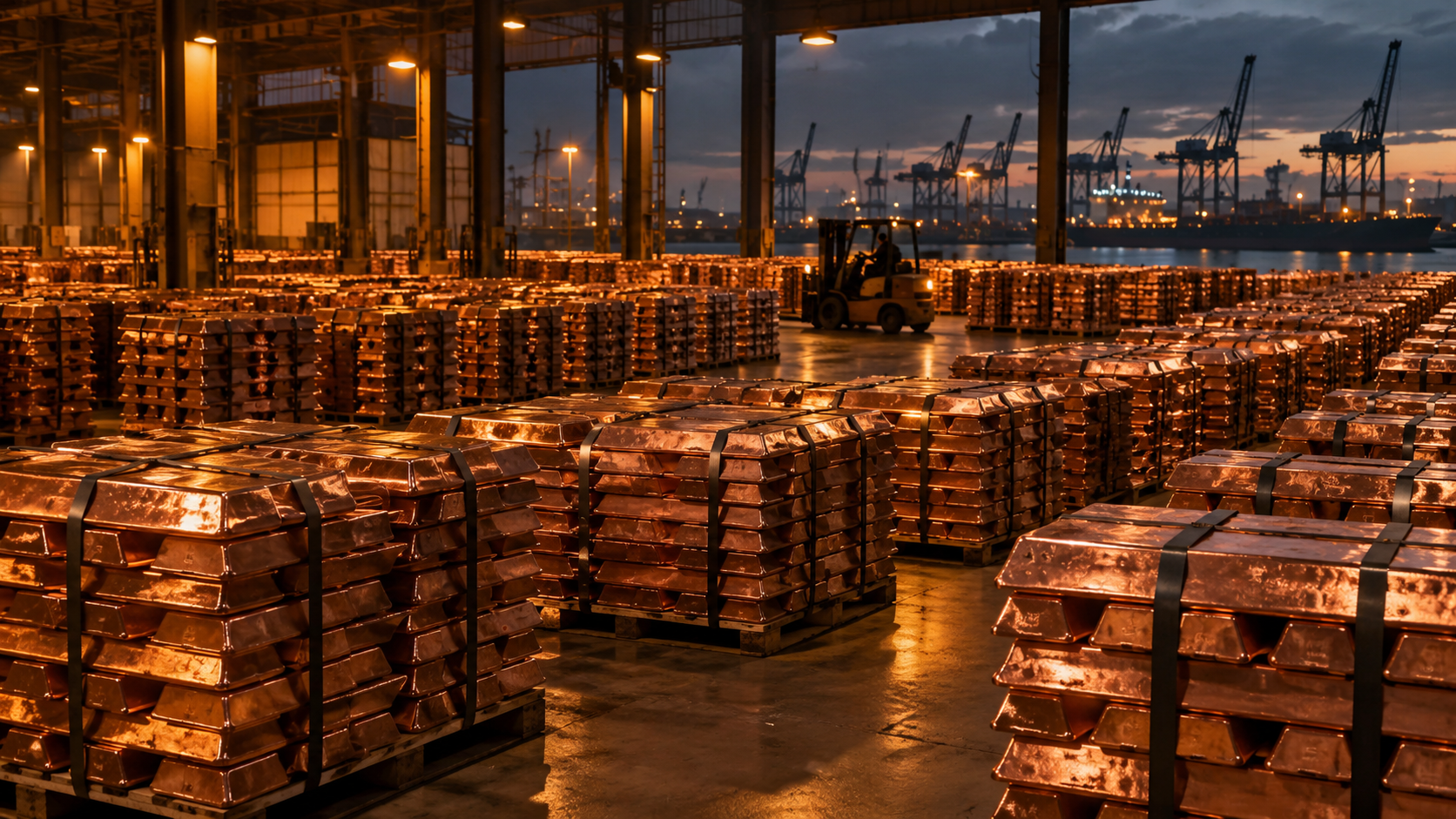

The copper market faces a paradox that reveals a deeper structural fracture in the global industrial system. Global inventories stand at record highs - 1.04 million tonnes in October, up 83% year-on-year - yet producers outside the United States report acute supply shortages, premiums hitting record levels in Shanghai, and physical allocations rationed to buyers. The mechanism is straightforward: US tariff policy and warehouse arbitrage have trapped 70% of the world's visible exchange copper inside American borders, leaving the rest of the globe to compete for scraps. Behind this fragmentation sits a harder reality: global corporate leverage remains elevated at 2.9x, interest rates sticky above historical norms, and capital expenditure commitments in mining have stalled under tariff uncertainty. The wager is whether US protectionism designed to secure domestic supply will instead trigger a refining capacity crunch, a wave of defaults in copper-dependent sectors, and a commodity spike that destroys the very industrial base the policy intended to protect.
The copper bottleneck is not accidental. From February 2025 onward, Washington's Section 232 investigation into copper imports pushed traders to front-load shipments into COMEX warehouses ahead of threatened 15-30% tariffs on refined cathodes. By October, COMEX held 718,000 tonnes - nearly 70% of all exchange-listed copper worldwide and more than double the facility's previous record dating to 1990. The premium spread between COMEX and London Metal Exchange prices collapsed after the July 2025 tariff announcement excluded refined cathodes, yet 77% of all metal shipped to COMEX after February 2025 arrived after that tariff exclusion, signaling that traders expected future policy reversals or hedge costs that made the warehousing arbitrage worthwhile despite vanishing spreads. Globally, combined London and Shanghai inventories sat at only 319,000 tonnes, 11% below their long-term average. Exclude the 130,000 tonnes stored in US-controlled New Orleans and Baltimore LME facilities, and true available copper outside North America falls to roughly 190,000 tonnes - a 94% collapse in liquid supply relative to the 2015-2024 average.
This geographic lock-up has fractured price signals into competing regimes. The International Copper Study Group forecasts a global refined surplus of 104,000 tonnes in 2026. Goldman Sachs, reading the same data differently, estimates a deficit of 950,000 tonnes outside the United States and targets copper prices of $14,700 per tonne by year-end. Shanghai's Yangshan cathode premiums have climbed above $200 per tonne - a signal of acute scarcity to Chinese smelters - while producers in Latin America and Africa report constrained shipments. Neither figure is wrong. One describes a statistical global aggregate. The other describes the operational reality for manufacturers outside the tariff perimeter. A factory in Europe or Asia competing for allocations at record premiums now faces a structural disadvantage versus US-based producers with direct COMEX access. Manufacturing offshoring, already under pressure from tariff math and labor costs, will accelerate into the US tariff zone, further raising the stakes for policy reversal. The longer copper remains bottlenecked, the more likely a disorderly unwind if Washington abandons Section 232 duties - a scenario that could flood the market and crater prices in 2027.
Capital expenditure in mining has not recovered from this policy fog. New discoveries in copper take 17-18 years to reach production, and ore grades are declining globally. The International Energy Agency projects a 30% copper supply gap by 2035 if investment patterns do not shift. Yet capex has stalled. First Quantum Minerals hired 1,000 workers in anticipation of restarting the Cobre Panama mine, shuttered since 2023, but the project remained in negotiation limbo in October. Democratic Republic of Congo and Zambia face drought-linked electricity rationing that could disrupt two of the world's largest copper producers. The market is rationing supply through price - copper rose 46% year-on-year to above $6.40 per pound by October - but this ration does not flow cleanly. US tariff walls channel scarcity margins to domestic refiners and consumers while exporting the pain. Meanwhile, the AI boom and clean energy transition are demanding copper at rates that outpace capacity growth in every region except the US tariff zone.
This backdrop frames the real vulnerability: corporate balance sheets. Global corporate leverage declined slightly to 2.9x in 2026 from 3.0x in 2025, according to Fitch Ratings, a marginal improvement that masks regional divergence. North America and Asia-Pacific leverage will continue declining through 2027, Fitch forecasts, because operating cash flows remain resilient. Europe, the Middle East, Africa, and Latin America are tightening leverage is projected to rise. The problem emerges in the composition of that cash flow and the cost of capital. OECD data shows that 65% of global corporate debt due between 2026 and 2028 carries interest rates of 4% or lower - a legacy of the 2020-2023 rate environment. When that debt refinances in a higher-rate regime, cash flow improvement turns to cash flow pressure. Add copper costs that have doubled since 2023 and the arithmetic breaks. An electric vehicle battery manufacturer, a data center builder, or a power grid operator pays 40-50% more for copper feedstock than the cost basis embedded in contract prices agreed in 2024. Gross margins compress. Refinancing risk accelerates.
Manufacturing offshoring, already underway, will concentrate inside tariff-protected zones. A Bain & Company survey found that just 36% of companies are continuing investment in offshore manufacturing, with 64% slowing or halting foreign expansion. Nearshoring to Mexico, Guatemala, and Vietnam - the geographic arbitrage play for companies escaping China tariffs - will shift again toward US-based production once US tariff walls on refined copper are factored into landed-cost math. A plant in northern Mexico is now at tariff disadvantage versus one in Texas or Arizona. This dynamic will drive a wave of announced capex into North America and a corresponding freeze on emerging-market industrial development. Copper demand in emerging markets will face rationing through price - only high-margin projects will justify the cost - while low-margin commodity processors will move to North America or shutter entirely. The immediate effect is geographic concentration of industrial capacity in the tariff zone. The long-term effect is a fragmented global supply chain that can no longer respond efficiently to shocks.
Grid and refining bottlenecks are amplifying the fragmentation. US refining capacity utilization stands near all-time highs. The OECD and J. Safra Sarasin estimate that 10% of global petroleum refining capacity has been lost due to geopolitical conflict and maintenance backlogs. A similar dynamic is emerging in copper refining. The global refined-cathode shortage outside the US is already visible in the Shanghai premium spike and in physical-market handoff failures - deals moving to cash settlement or supply-chain-financed warehousing rather than immediate delivery. A data center operator in Dublin or a grid operator in Germany negotiating copper for 2027 faces extended lead times and premium costs. Cobre Panama's restart would add 300,000 tonnes of annual cathode output and relieve pressure, but negotiations remain stuck and geopolitical risk in Panama itself is rising. No other major greenfield copper project is expected to reach production before 2030. The premium structure will persist.
The timing collision is the critical variable. US corporate debt with 4% coupons begins refinancing in earnest in 2027. Copper prices are signaling that supply outside the US will remain tight through 2027 and possibly 2028. A refinery or manufacturer relying on COMEX access has operational advantage. Those outside face a cash-flow squeeze. By 2028, if Washington's tariff decision on refined copper remains in place, the COMEX premium could widen again as speculative positioning normalizes post-election and as 2027 capex commitments mature into shipments. If tariffs are abandoned, inventory unwinds will be disorderly, copper prices could fall 25-40%, and US-based producers and refiners will face margin compression and potential covenant violations. The spread between a US-privileged and a non-privileged supply chain will narrow, but the adjustment will be destructive.
The constraint is that tariff policy and commodity supply have become inseparable from financial stability. The Federal Reserve's capacity utilization data shows manufacturing operating at 75.9% of capacity in September, a rate 2.3 percentage points below the long-run average. This slack appears sufficient. But it masks geographic and sectoral fragmentation. Primary metals capacity utilization stands at only 68%, while mining has moved to 87.5%. US refining hit 84%. The aggregate slack is real, but it is distributed unevenly. A refiner in Rotterdam has no slack. A mining operation in Zambia has no slack. A power grid operator competing for allocated copper in Shanghai has no slack. A US-based producer with COMEX access has 2-3 years of runway before refinancing risk and capex overcapacity collide. The wager plays out in 2027-2028. Either Washington sustains tariff protection and accepts the reality of a bifurcated global supply chain, losing export markets and triggering retaliatory barriers in Europe and Asia. Or tariffs are removed, copper floods the market, equity values in US refineries and mining-adjacent sectors fall 30-40%, and non-US producers capture margin briefly before facing their own refinancing crisis when rates stay sticky at the lower end.
Sign in to leave a comment and join the discussion.
Sign Up Free