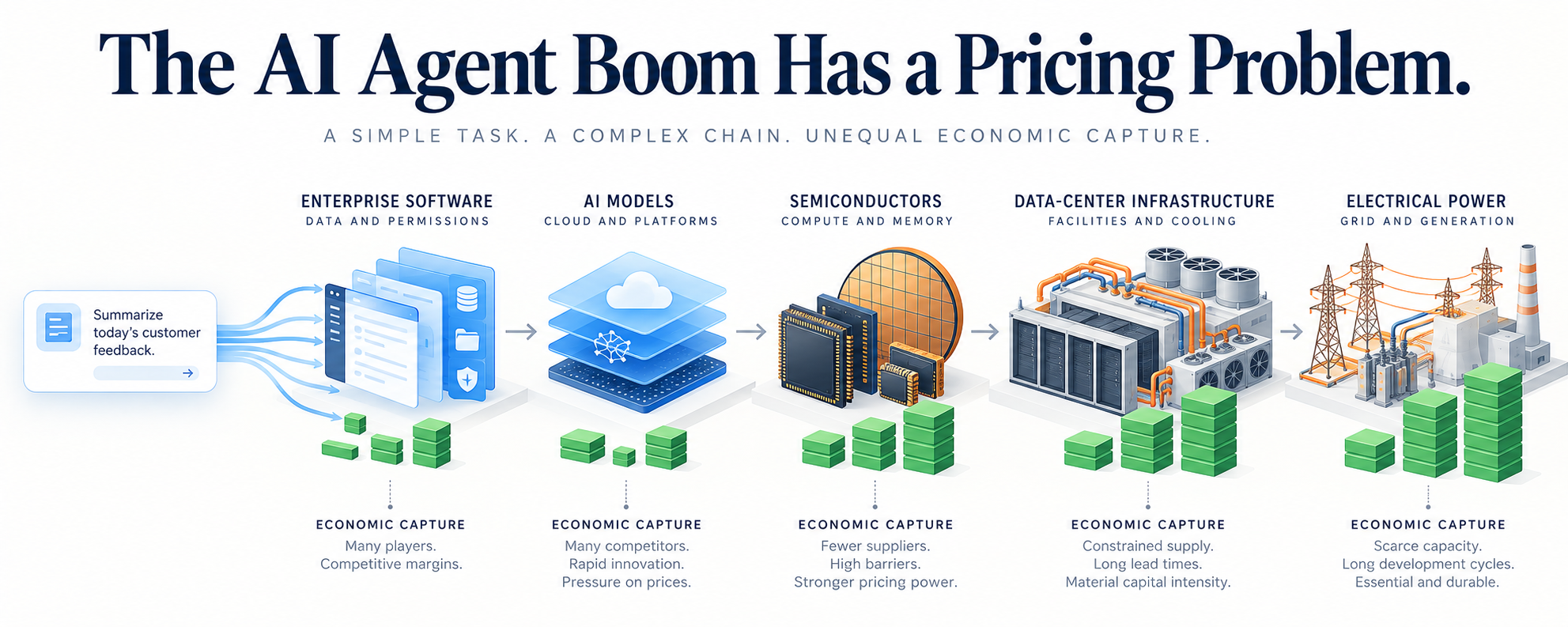

NVIDIA (NVDA) reported $89.0 billion of Data Center revenue for the quarter ended July 26, up 117% from a year earlier. Worldwide cloud infrastructure spending reached $143.4 billion in the June quarter, growing 43%, its fastest pace in eight years.
Over the past 12 months, ServiceNow (NOW) fell 27% and SAP (SAP) fell 22%. AI agents are supposed to need both.
"The boom is real and software is on sale, so buy software" is too lazy to be the argument.
How much agent growth is already priced into each layer of the AI stack?
That question is harder than it looks, and I think the answer splits the market into three camps.
Let me take it in order: what an agent actually does, how far adoption has really gone, where the money is landing today, and then which stocks already reflect all of it. I'll close with five risks, the triggers I'm watching, and how I'd size exposure.
What an AI Agent Actually Does
Give a chatbot a question and you get text back. Give an agent a goal, access to a few business systems and permission to use them, and it plans the steps, calls the tools, checks its own work and keeps going until the job is done or it gets stuck. In practice that means writing and testing code, updating a customer record, filing an IT ticket or booking a flight. On paper that sounds like a modest upgrade.
Meta Platforms (META) launched a consumer version on September 8. It runs inside its own secure virtual machine and asks permission before it sends an email or buys anything, which shows how seriously even the builders take the downside. That's the consumer version. Enterprise agents go further, with access to payroll systems, purchasing tools and customer databases that a single bad action can damage.
So why isn't every company running on agents already? Arithmetic gets in the way. Suppose an agent picks the right action 98% of the time, which sounds excellent, and then chain 30 of those steps together. The odds of a clean run fall to about 55%.
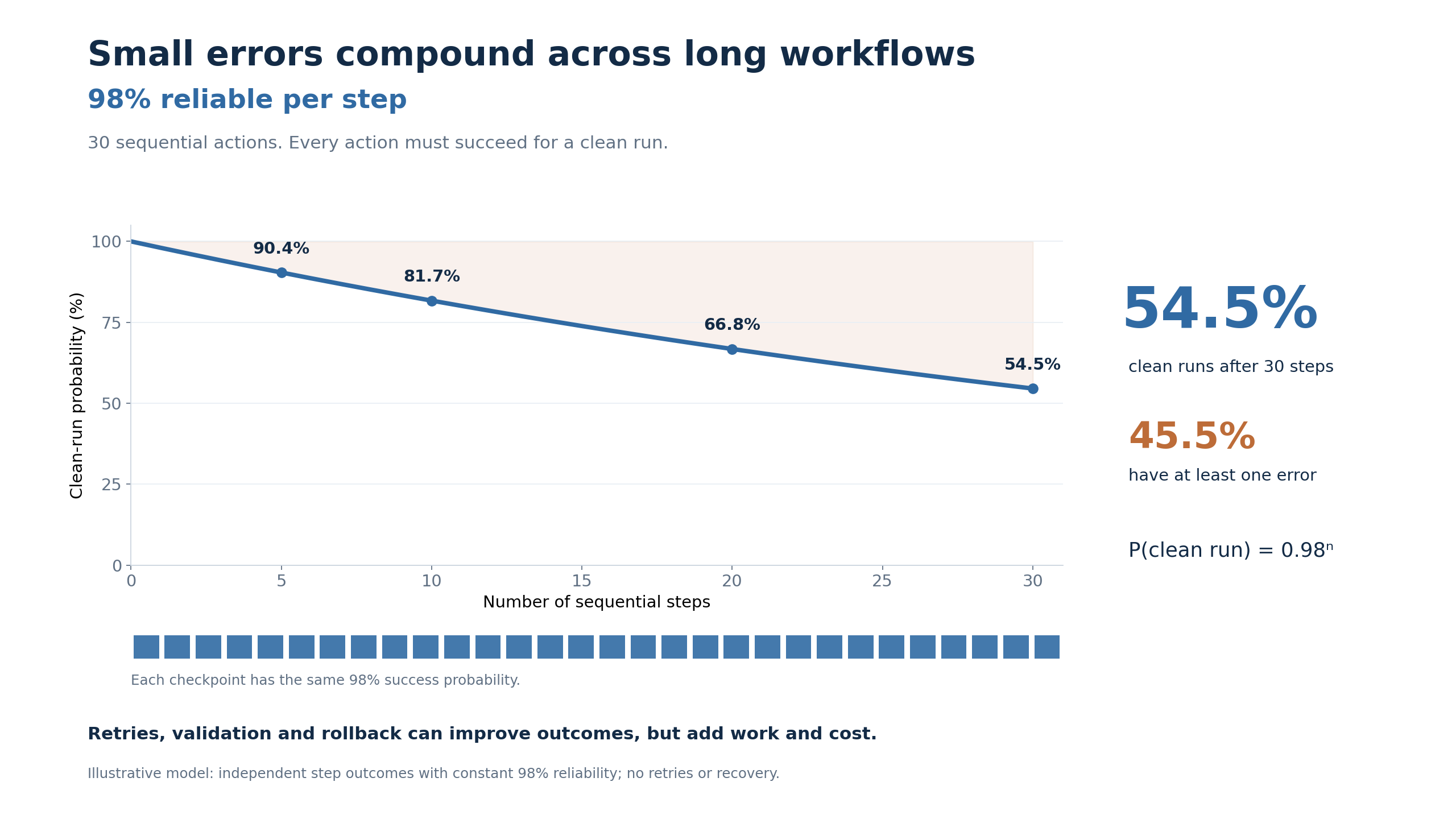
Real systems retry failed steps and roll back mistakes, so the true failure rate is lower than that. Even so, the math explains why the first agents that stick live in work with built-in checks. Software is one, because test suites catch mistakes before they ship. IT operations is another, since every action leaves a log someone can audit.
How Far Adoption Has Really Gone
Survey numbers on AI adoption are all over the place, and most of them can be true at once. McKinsey's latest State of AI survey, published August 25, found that 88% of organizations use AI regularly in at least one function. Only about 6% qualify as high performers with company-wide profit impact, and nearly two-thirds haven't started scaling AI across the enterprise. Other surveys land elsewhere because each one measures a different stage of the same rollout.
Agents lag further behind. A study of more than 500 of the world's largest companies by Infosys and HFS Research, published in April, put the share that has scaled agentic AI at 14%. Fourteen percent is a small club for a technology this loudly promoted. And 60% of all the companies surveyed said their most advanced agents still follow rules instead of making their own decisions.
Before you read that as a bubble, I'd push back a little. Low penetration is what the early part of an adoption curve looks like, and the early wins are showing up in dull places. IT operations and customer support lead on measurable outcomes, cited by 50% and 42% of respondents. Nobody writes breathless headlines about ticket routing.
Dull, repetitive, auditable work is where corporate budgets move first.
My read is that 2027 brings bounded delegation.
Agents will handle approved, low-risk steps on their own, while humans keep signing off on anything that moves money, hires someone or touches a patient. That path is slower than the demos imply, and I'd still expect it to reshape where software revenue comes from over the next two years.
Where the Money Is Landing Today
So far, most of the money has gone to the companies that build and rent the hardware. Broadcom (AVGO) reported $16.7 billion of AI semiconductor revenue in its fiscal third quarter, up 221%, and guided to $21.7 billion for the next one. The cloud unit at Amazon (AMZN) grew 36.7% in the June quarter and earned $16.6 billion of operating income, while Google Cloud, part of Alphabet (GOOGL), grew 82%.
Agents should push that demand higher. One user request can fan out into dozens of planning calls, data lookups and verification passes, and each of them runs on somebody's chips, sitting in somebody's data center and drawing power from somebody's grid connection. A coding agent can now grind on a single assignment for hours. Chat was a light workload.
Agents aren't.
Unit costs are falling fast.
In September, Anthropic cut the price of cached reads on its newest model by 75%, a change aimed squarely at long-running agent work. If you're wondering why falling prices haven't shrunk the market, volume is the answer. Cheaper tokens haven't cut the total bill so far, because agents burn through far more of them than a chat window ever did.
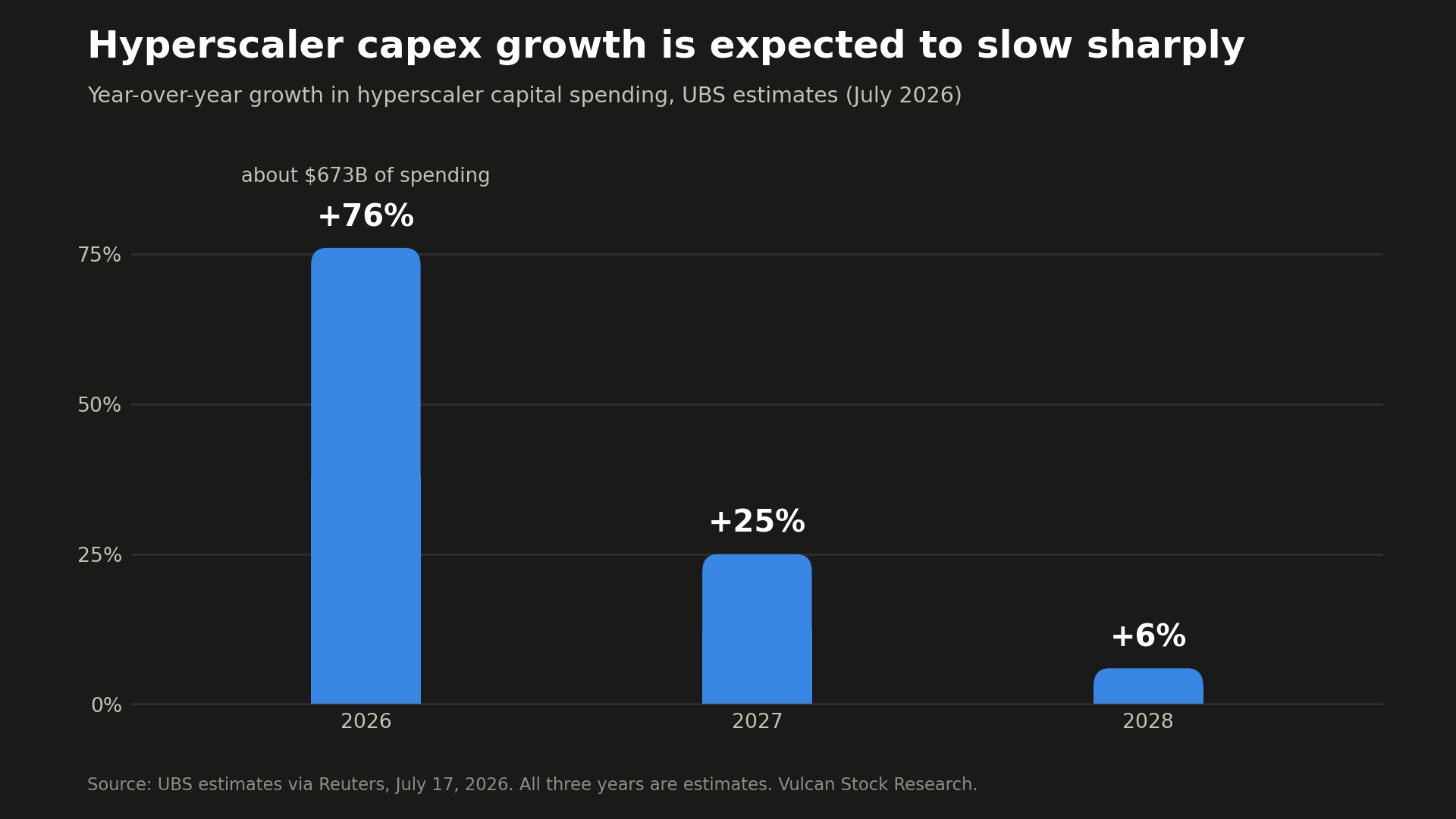
One number to keep in mind for the rest of this piece is the growth rate of capital spending. In July, UBS estimated that hyperscaler capex would rise 76% this year to about $673 billion, then slow to 25% growth in 2027 and 6% in 2028. Slower growth off a base that large still means a lot of dollars, but chip stocks tend to trade on the rate of change, and that rate is expected to drop hard.
The Stack, Simplified
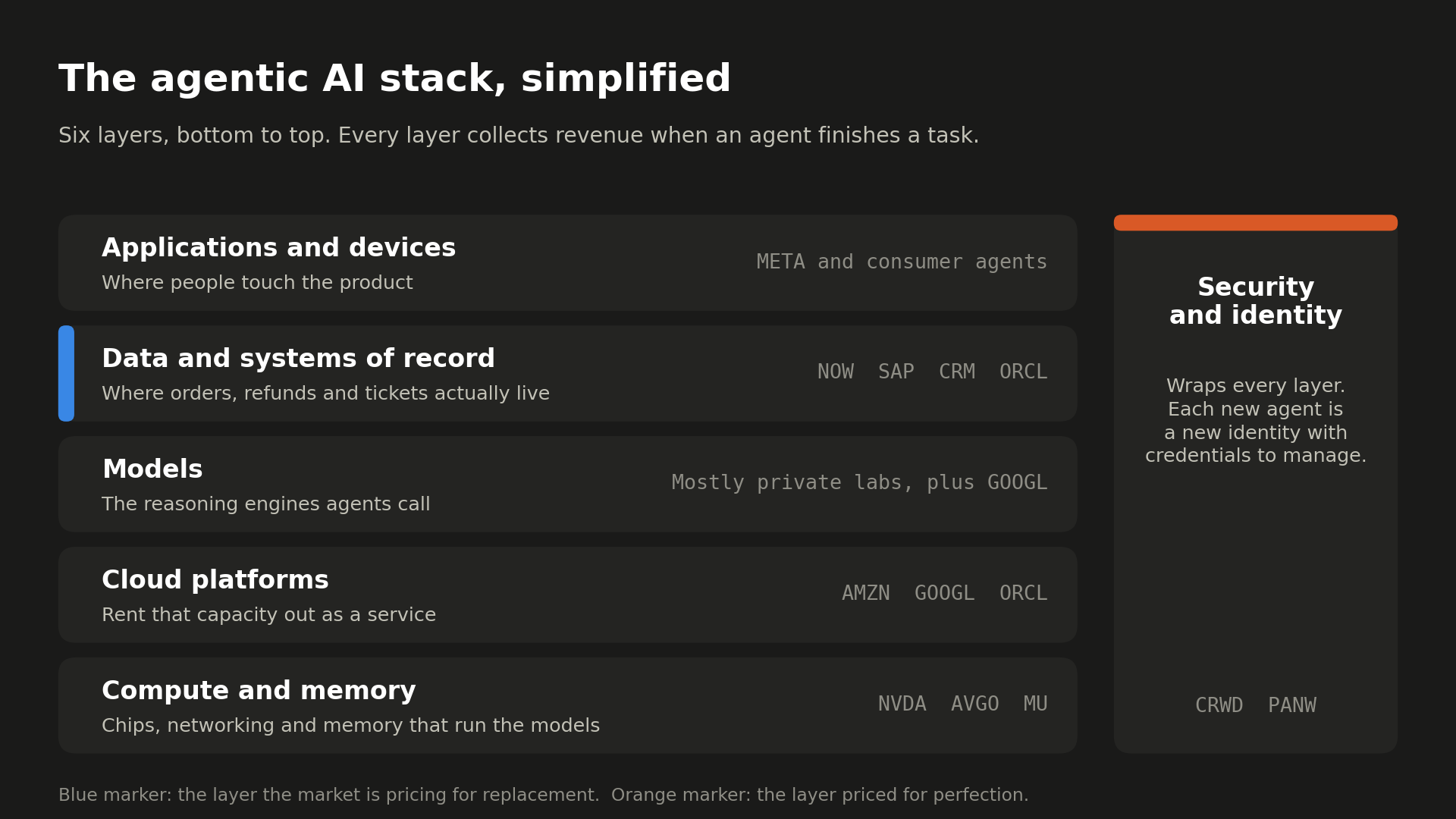
It helps to picture agentic AI as a stack. Compute and memory sit at the bottom, with the cloud platforms that rent that capacity above them. Next come the models, then the data platforms and systems of record where business transactions actually happen. Security and identity wrap around all of it, and applications and devices sit on top, where people touch the product.
Every layer collects revenue when an agent finishes a task. Pricing power goes to whoever controls something scarce, whether that is chip capacity, trusted business data or the permission to act.
I'd underline that last one. The agents that matter most economically will be the ones trusted with the most valuable permissions, like changing an order, issuing a refund, patching a server or moving money. Those permissions live inside systems of record run by ServiceNow, SAP and Salesforce (CRM), which is why the sell-off in those names is the most interesting contradiction in this market. Permission is harder to copy than a model.
The obvious objection is that agents could make those companies smaller, and it's a fair one.
If one agent does the work of five people, a customer buys fewer seats, and seat licenses are how most enterprise software gets paid. Agents can also sit on top of an application and make its screens irrelevant, which weakens the vendor's grip on the customer relationship. The bull case depends on pricing. Vendors that move from charging per human to charging per task or per outcome keep the economics, and vendors that defend the old seat model get squeezed.
ServiceNow and Salesforce are each already selling usage-based agent products. Over the next few quarters, their disclosures should show whether that revenue offsets any lost seats.
Priced for It, and Priced Against It
Let's put numbers on all of this. The table below uses closing prices from Friday, September 25, and the forward figures rest on analyst consensus estimates, so treat them as expectations that can move.
Company | Layer | Forward P/E | PEG | 12-month return |
|---|---|---|---|---|
CrowdStrike (CRWD) | Security | 208.3 | 8.40 | +112% |
Palo Alto Networks (PANW) | Security | 94.3 | 2.01 | +87% |
NVIDIA (NVDA) | Compute | 24.9 | 0.48 | +27% |
Broadcom (AVGO) | Compute | 19.4 | 0.36 | +5% |
ServiceNow (NOW) | Systems of record | 27.8 | 1.01 | -27% |
SAP (SAP) | Systems of record | 33.1 | 1.17 | -22% |
Salesforce (CRM) | Systems of record | 14.0 | 0.78 | -4% |
Oracle (ORCL) | Data and cloud | 17.8 | 0.81 | -55% |
Accenture (ACN) | Services | 12.4 | 1.33 | -24% |
Infosys (INFY) | Services | 13.3 | 1.82 | -37% |
Source: GNG Research data as of the September 25, 2026 close. Forward P/E and PEG use analyst consensus estimates.
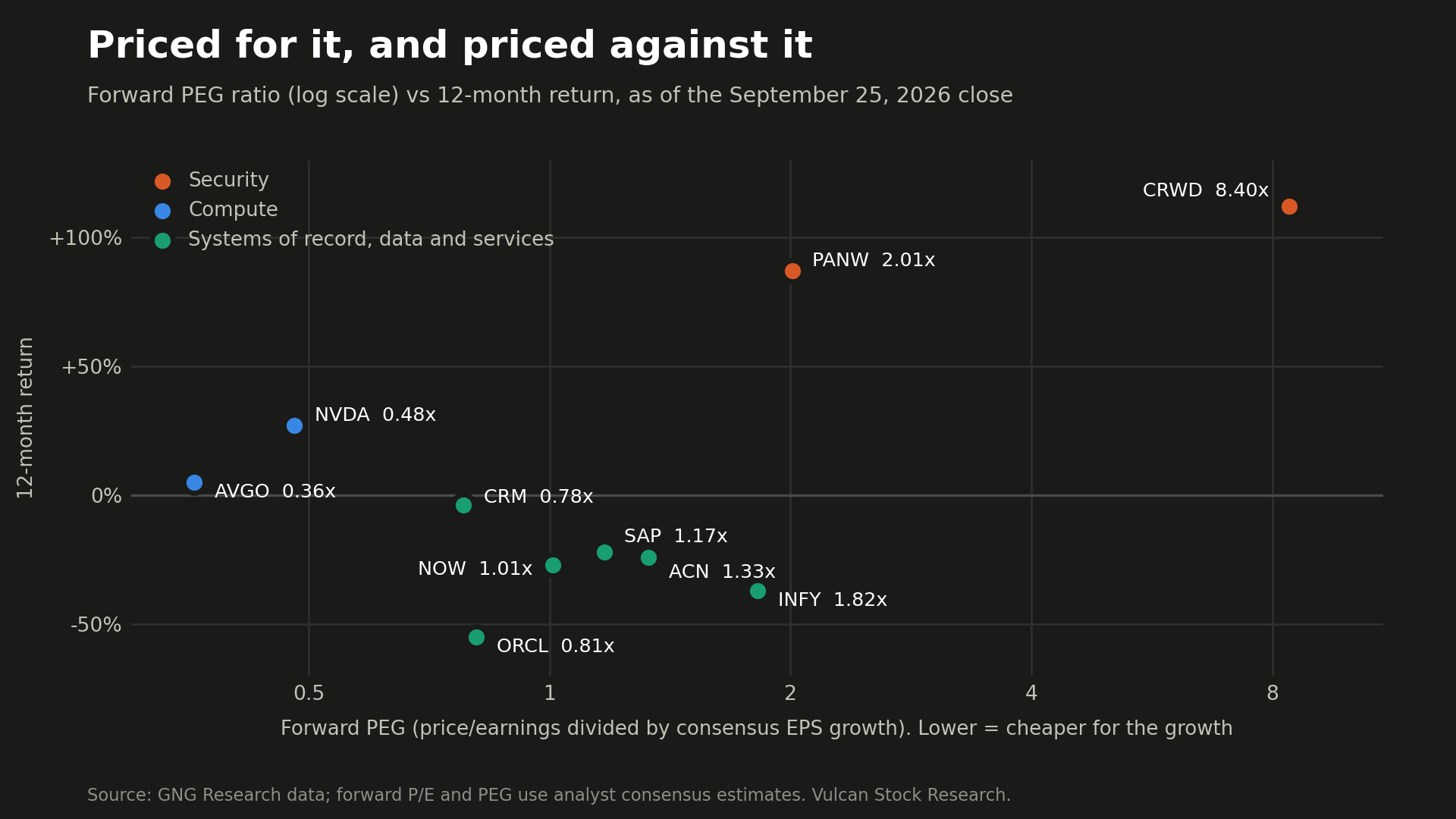
Security sits at the expensive end. CrowdStrike (CRWD) sells for about 208 times forward earnings and Palo Alto Networks (PANW) for 94 times, after gains of 112% and 87% in 12 months. I think the security case is one of the soundest in AI, since every new agent is a new identity with credentials someone has to manage and watch. The trouble is that the market already agrees with me.
At 208 times earnings, even a good quarter can disappoint.
Systems of record sit near the other end. Salesforce trades at 14 times forward earnings, a PEG of 0.78, and ServiceNow at about 28 times with a PEG near 1.0. Analysts still expect ServiceNow to grow revenue about 23% next year, so the market is pricing doubt about how long that growth lasts, with no collapse in the numbers yet. Neither company has reported a quarter that looks like a business in decline.
Services companies look priced for the downside already. Accenture (ACN) goes for about 12 times next year's earnings and Infosys (INFY) for 13, after falling 24% and 37% since last September. Agents automate the billable hours both firms sell, so cheap here may stay cheap until they prove they can charge for outcomes instead of time. That's a big if.
Oracle (ORCL) deserves its own warning.
Its contracted backlog reached $664 billion, but it spent $28.5 billion on capex in its latest quarter against $23 billion of operating cash flow, $11.4 billion of which came from customer prepayments, and trailing free cash flow has been negative by more than $20 billion since at least March. Backlog is a promise. Cash pays the bills, and right now Oracle's cash is leaving faster than it comes in. On September 24, it sent a force majeure notice on its New Mexico data center campus after a gas pipeline slipped to February 2027, although the company says the project remains on schedule.
So is compute the bargain in the group? Broadcom and NVIDIA carry PEG ratios under 0.5, but those ratios lean on consensus estimates that expect earnings to keep climbing with capex. If the UBS spending path is right, those estimates are the numbers most likely to come down. I'd rather buy these names on bad capex headlines than on good ones.
Power Is the Layer Most Investors Skip
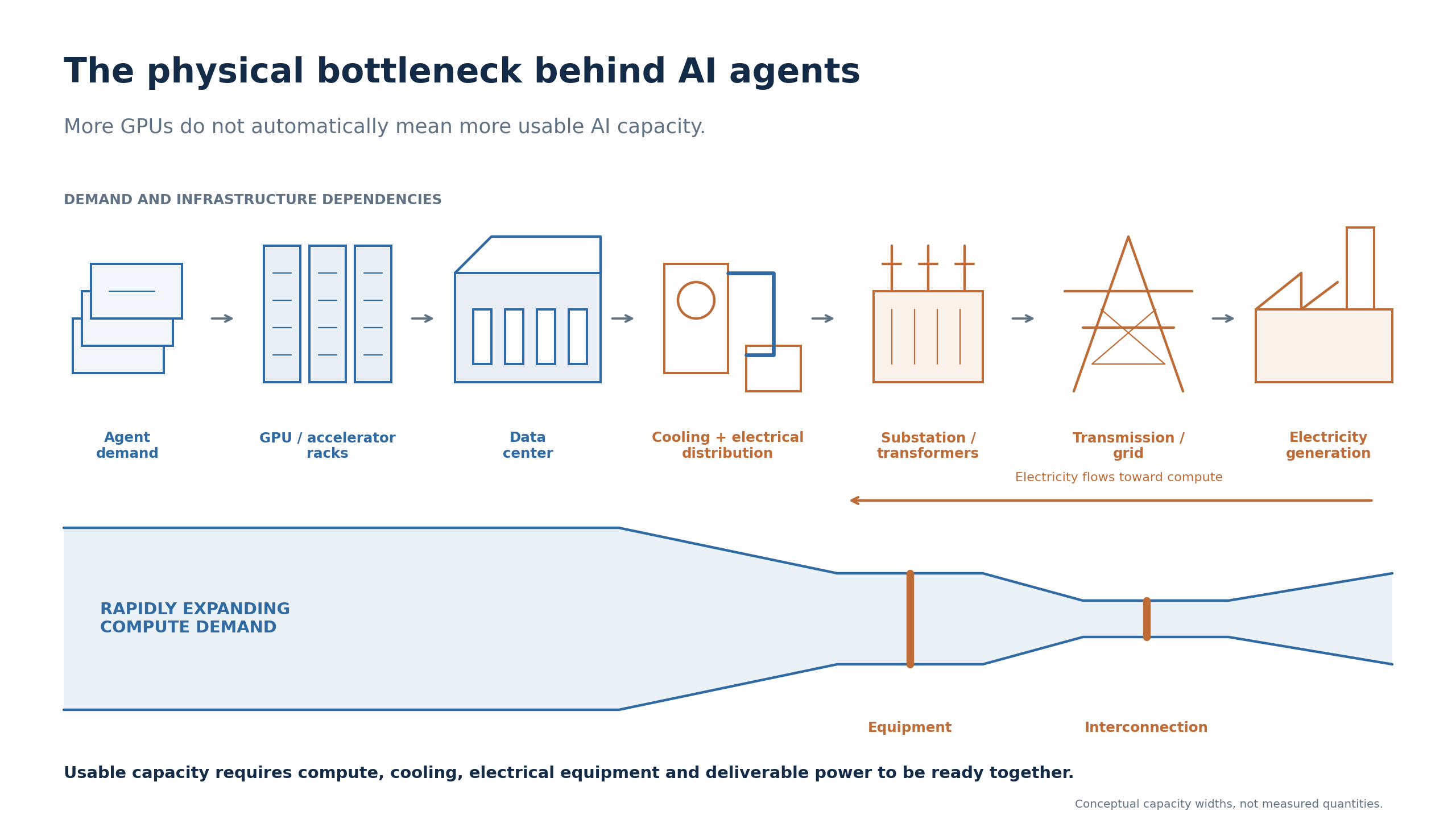
If power sounds like a side issue in an AI article, Oracle's week says otherwise. Its pipeline problem points at the constraint that gets the least attention. Agents run on electricity, and grid connections, transformers and gas turbines all carry long waits right now.
That's why I'd put power and cooling on the list next to the chip names. Vertiv (VRT), which sells the power and liquid-cooling gear that goes inside AI racks, is valued at around 28 times forward earnings, which works out to a PEG of 0.84. GE Vernova (GEV), which builds turbines and grid equipment, trades near 39 times, and Eaton (ETN) near 28. The market has started to price these industrial names as AI suppliers, and I think that shift has further to run.
None of them is cheap. Their multi-year equipment backlogs do give more visibility than most chip forecasts, and the Oracle notice shows why customers will pay up to secure delivery slots.
Memory is the other bottleneck, and it has already run.
Micron (MU) is up roughly 570% over 12 months and trades at about 7 times forward earnings, which looks cheap until you remember that memory earnings tend to peak right before they fall. It is scheduled to report on September 30, and I'd weigh any comment on pricing and contract terms above the headline beat. Memory makers have a long record of adding capacity into booms, and that habit has ended past cycles. Historically, a single-digit P/E on memory stocks has more often marked a peak than a bargain.
Five Risks, and What Would Trigger Each
Capex slows faster than expected. If the largest cloud spenders guide 2027 capex growth below the 25% UBS path, compute and memory multiples would likely compress first. That's the trigger I'm watching most closely for NVIDIA, Broadcom and Micron. Micron's guidance on September 30 is the first test.
Seats shrink faster than agent revenue grows. The test for the systems of record is subscription growth. Two straight quarters of ServiceNow subscription growth below 15%, or Salesforce below 8%, would tell me usage pricing isn't covering the lost seats. Both thresholds sit well under what analysts currently expect, so crossing either one would be a real signal.
Security names miss a priced-for-perfection bar. CrowdStrike needs years of fast growth to justify its multiple, and consensus expects revenue to grow about 25% next year. Growth slipping below 20% would probably hit the stock far harder than the business. Palo Alto faces the same math at 94 times.
Power and permitting delays spread. One force majeure notice is a data point. A second hyperscale project citing power delays within the next two quarters would be a pattern, pushing revenue to the right for chip and cloud names while helping equipment suppliers that can deliver. Oracle's delayed gas pipeline, now due in February 2027, is the first one I'd track.
An agent failure changes the rules. A prompt-injection attack or runaway agent that causes a large, public loss could slow adoption through regulation or plain corporate caution. I'd treat a single disclosed agent-driven loss above $100 million at a public company as the signal to drop the aggressive case. I haven't seen one yet.
How I'd Position Around This
Before we go further, one caveat.
Exact buy and trim zones need a full single-name valuation run, and this piece is about the map of the stack. What follows is how that map changes my posture, layer by layer. Our single-name narratives carry exact zones where we've run them. Treat this as the first filter.
For compute and memory, I'd hold what you own and add only on weakness tied to capex headlines. The business momentum is real, and some of the cycle risk already shows up in those low PEGs. For security, a starter position is as far as I'd go. The thesis is strong, but CrowdStrike and Palo Alto need pullbacks before the math works for new money.
Systems of record are where I'd build in stages. Salesforce at 14 times and ServiceNow at 28 times price a replacement story the operating numbers don't show yet, and the subscription triggers above tell you when to stop. One of my deep dives on Salesforce (CRM) covers that name's backlog in more detail. Start small and add as the disclosures come in.
Power equipment belongs in the core infrastructure bucket next to the chips. For the services firms and Oracle, I'd wait, because cheap can get cheaper when the business model or the cash flow is in question.
You might call that a lot of caution for a boom this size, and fair enough.
The reason is correlation. These stocks tend to fall together, so the sizing matters as much as the picks.
Vulcan's AI Economy model caps a core AI holding at 7% of a portfolio and a speculative one at 2%, before adjustments for volatility. Once combined AI exposure passes 30% of the portfolio, the model trims every individual cap by a fifth, because a single capex headline can hit the whole cluster at once. My AI Spine article covers this.
What I'm Watching Into 2027
If you want exposure to the part of the boom that is already paying, look at compute and power, sized for a cycle. If you want the contrarian bet, the systems of record offer the widest gap between sentiment and operating results. And if you want the cleanest long-term thesis and can wait for a better price, security is the one to stalk.
Five signposts will tell me which camp is winning. I'm watching how long agents can work unattended, whether software vendors start reporting revenue per task instead of per seat, and who ends up issuing identities to agents; I'm also tracking whether consumer agents get permission to spend money, and whether AI revenue keeps pace with AI capex.
The market has already picked winners in this stack, and my bet is that it has crowned a few of them two years early. It has also written off a few others that agents can't do the job without, and I'd expect that second mistake to pay better over the next 18 months for anyone willing to build positions in stages.
Master Metrics Table
Company | Layer | Close 9/25/26 | Forward P/E | PEG | 12-month return | FCF margin (TTM) |
|---|---|---|---|---|---|---|
NVIDIA (NVDA) | Compute | $225.07 | 24.9 | 0.48 | +27% | 42% |
Broadcom (AVGO) | Compute | $352.81 | 19.4 | 0.36 | +5% | 44% |
Micron (MU) | Memory | $1,082.28 | 7.0 | 0.16 | +570% | 29% |
Vertiv (VRT) | Power and cooling | $253.31 | 27.8 | 0.84 | +79% | 26% |
GE Vernova (GEV) | Power generation and grid | $957.25 | 38.8 | 1.86 | +53% | 30% |
Eaton (ETN) | Electrical distribution | $439.86 | 27.6 | 2.67 | +19% | 13% |
CrowdStrike (CRWD) | Security | $252.13 | 208.3 | 8.40 | +112% | 28% |
Palo Alto Networks (PANW) | Security | $374.74 | 94.3 | 2.01 | +87% | 39% |
ServiceNow (NOW) | Systems of record | $135.62 | 27.8 | 1.01 | -27% | 31% |
SAP (SAP) | Systems of record | $210.68 | 33.1 | 1.17 | -22% | 23% |
Salesforce (CRM) | Systems of record | $234.02 | 14.0 | 0.78 | -4% | 34% |
Oracle (ORCL) | Data and cloud | $137.10 | 17.8 | 0.81 | -55% | -40% |
Accenture (ACN) | Services | $176.11 | 12.4 | 1.33 | -24% | 17% |
Infosys (INFY) | Services | $10.53 | 13.3 | 1.82 | -37% | 19% |
Forward P/E and PEG rest on analyst consensus estimates. Oracle's Altman Z-score stood at 1.59 at the September 25 close, below the 1.81 level usually read as financial distress.
Research for this article was assisted by AI tools. Figures were checked against company releases and the sources below.
References
Source | Link |
|---|---|
Synergy Research Group, "Q2 Cloud Market Passes $143 Billion; Highest Growth Rate in Eight Years" | |
NVIDIA, "NVIDIA Announces Financial Results for Second Quarter Fiscal 2027" | |
Broadcom, "Broadcom Inc. Announces Third Quarter Fiscal Year 2026 Financial Results" | |
Amazon, "Amazon Q2 2026 earnings report: Read the release" | https://www.aboutamazon.com/news/company-news/amazon-earnings-q2-2026-report |
Quartz, Alphabet second-quarter 2026 earnings coverage | https://qz.com/alphabet-google-second-quarter-earnings-revenue-cloud-072226 |
McKinsey, "The State of AI: Global Survey 2026" | https://www.mckinsey.com/capabilities/quantumblack/our-insights/the-state-of-ai |
Infosys, "Infosys-HFS Report Shows Only 14% of Enterprises Have Scaled Agentic AI; IT Operations (50%) and Customer Support (42%) Lead Outcomes" | https://www.infosys.com/newsroom/features/2026/enterprises-scaled-agentic-ai.html |
Meta, "Introducing Muse" | https://about.fb.com/news/2026/09/introducing-muse-personal-ai-agent/ |
VentureBeat, "Anthropic's Claude Fable 5.1 and Mythos 5.1 arrive with a 75% cost reduction for Fable cache reads" | |
Resultsense via Reuters, "Investors position for a slowdown in AI capex growth" | https://www.resultsense.com/news/2026-07-17-hyperscaler-capex-investors/ |
ERP Today, "Oracle Q1 FY27 Results" | https://erp.today/oracle-q1-fy27-results-664b-backlog-ai-contracts/ |
SiliconANGLE, "Oracle issues force majeure notice to developer of New Mexico data center over energy delays" | |
Yahoo Finance, "Oracle blows investors away with 22% hyper growth, but cash flow crunches to negative $24.7 billion" | https://finance.yahoo.com/news/oracle-blows-investors-away-22-234802787.html |
Sign in to leave a comment and join the discussion.
Sign Up Free