

I’m not breaking any news when I say that our own Adam Galas has been consistently bullish on Big Tech, and on Nvidia (NVDA) in particular. Although I still believe in a rotation and have invested mostly in cyclical value, I think he is right, and I want to add something to the call.
It’s not another stock pick but a macro frame for why the biggest objection to owning these names, the one you hear everywhere right now, gets the story backwards.
Jordi Visser just laid out the cleanest version of that frame I have seen. I am using his thesis as the base, and then I ran the specifics through GNG Research's own data (with support from our terrific AI systems) to see whether it survives contact with the numbers. Spoiler: it does.
So this is a bullish thesis on new findings, offered as food for thought more than a table-pounding buy.
As I consider this a crucial Big Picture development, you can view this as a “Blue Sky” analysis from me, as I’m addressing some of my concerns (I have written before that I am not a huge Mag-7 fan), and assess why it’s perfectly valid to be bullish on these companies.
And obviously, I’ll also give you the risks.
Let’s get to it!
The Framework Is Right
Allow me to start with what Mr. Visser gets correct, because the whole thing hangs on it.
Demand for compute is not human. It is a machine, as weird as that may sound. Think about it like this: a human consumes on a linear scale, one query at a time, bounded by attention and hours in the day. We use the computer for very specific tasks and shut it down the moment we’re done. Simple.
An agent consumes on an exponential scale, running multi-step reasoning in the background, spawning sub-tasks, calling other agents. When AI moves from a chat box you basically summon to an operating system that runs without being asked, the token curve (demand for AI computing power) goes vertical.
Basically, these are computers that run nonstop.
Goldman, cited by Visser, models token consumption rising 24x as that shift happens. And even if they are off by a few turns, they are almost certainly right about the trend and the fact that it’s violent.
Supply cannot handle this. You build a fab with human labor. You lay concrete, wind copper, permit a substation, and wait four years for a grid connection. Supply is linear because physics is linear. So you get exponential demand meeting linear supply, and the price of the scarce thing goes up and stays up. That is a version of my Physical Stagflation thesis. That thesis is essentially based on suddenly rising demand meeting subdued supply growth (especially compared to the demand trends).
The demand is also not speculative. Dylan Patel's own firm went from $100,000 of enterprise API spend last November to roughly $11 million annualized today. That’s one of the best examples of how AI has hit the real economy and what this means for costs (and pricing power!). The bear thesis claims that enterprises are cutting AI on bill shock have it backwards. They are cutting legacy software to fund AI.
That is a very important part of the thesis!
It’s also why the framework is not in dispute here. The stocks are. And the stocks are where I think the consensus objection is wrong.
The Objection Everyone Is Making
Here is the pushback, and it is a serious one, so I want to state it fairly before I take it apart.
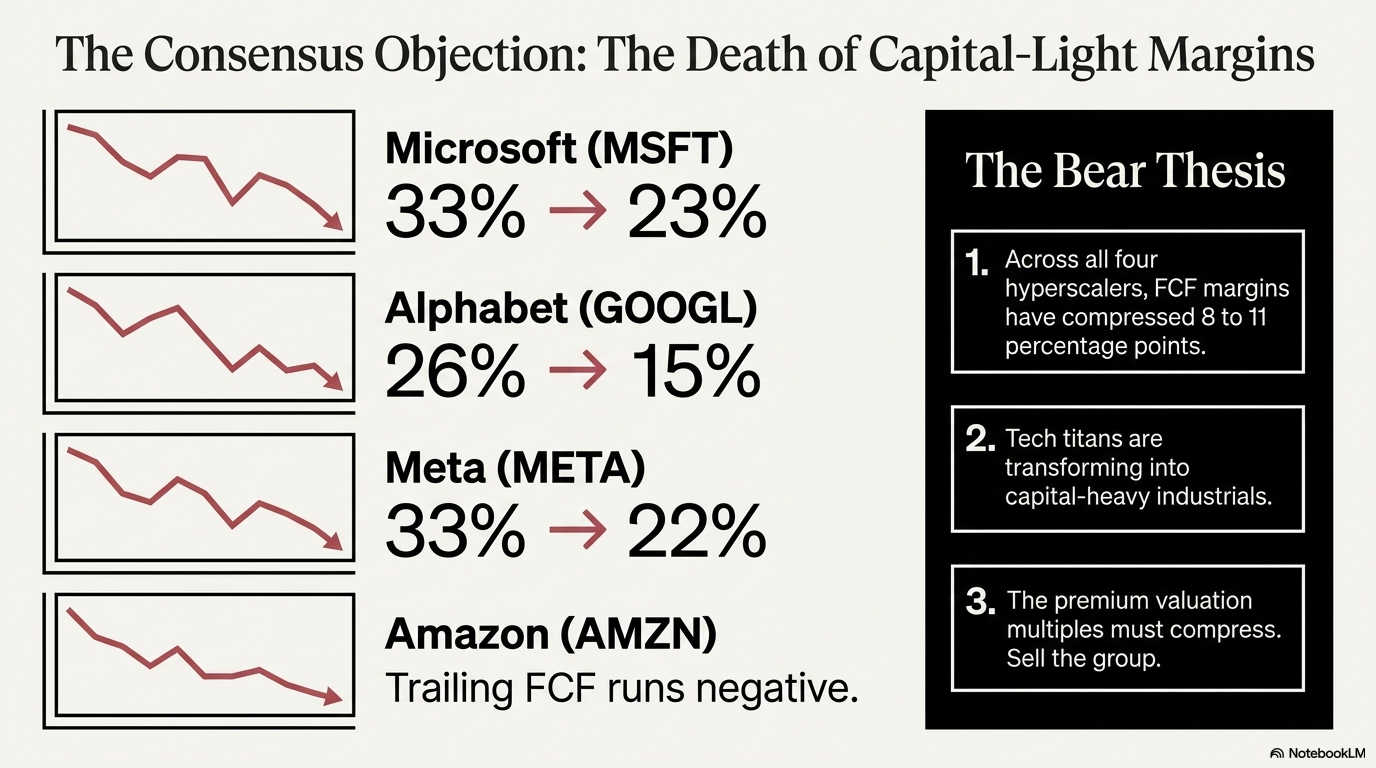
The capital-light era is over. GNG Research's data is very direct about it. Free cash flow margins across all four hyperscalers have compressed 8 to 11 percentage points from their peaks. Microsoft (MSFT) went from a 33% FCF margin to 23%. Alphabet (GOOGL) went from 26% to 15%. Meta (META) from 33% to 22%. Amazon (AMZN) ran its trailing free cash flow slightly negative.
These businesses earned their premium by turning revenue into cash with almost no reinvestment.
That is ending.
On the surface, they are becoming capital-heavy industrials that happen to sell ads and cloud, and the bearish conclusion follows cleanly: the premium multiple has to come in, so sell them.
If that were the whole story, it would be right. It is not the whole story.
Why The Objection Breaks Down
The situation is much more complex than one might think.
Free cash flow fell because CapEx is being spent now, up front, while the revenue it supports is recognized later. The simplest example is the fact that it takes years to build a hyperscaler campus. Big Tech is spending capital now for future returns. And all of this spending is based on backlog.
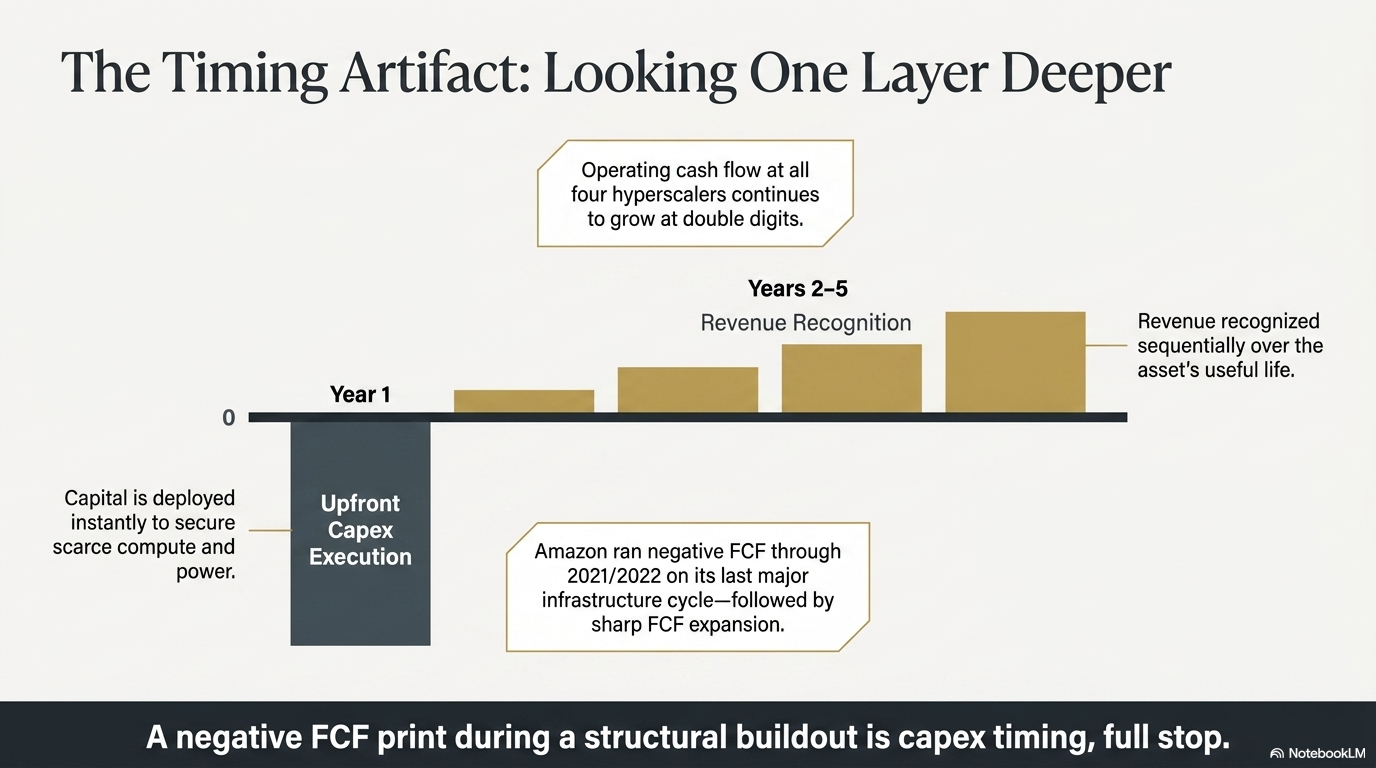
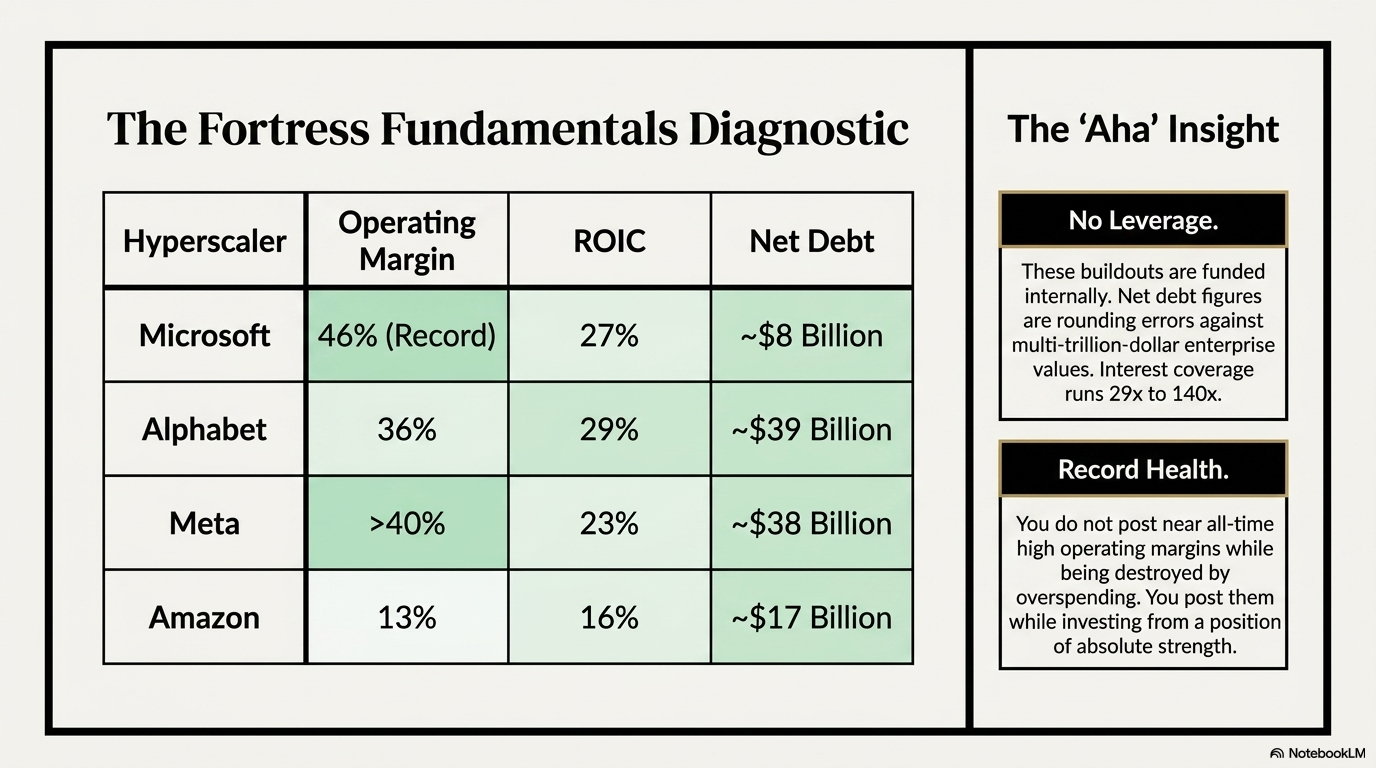
Even better, operating cash flow is still growing at double digits at all four. And the number that actually measures whether a business is healthy, the operating margin, is at or near all-time highs across the board. GNG data puts Microsoft at a 46% operating margin, Alphabet at 36%, Amazon at 13%, and Meta above 40%. You do not post record operating margins while your business is being destroyed by overspending. You post them while you invest from a position of strength.
Return on invested capital says the same thing. GNG's numbers show ROIC of 27% at Microsoft, 29% at Alphabet, 23% at Meta, and 16% at Amazon. Every one of those sits well above any reasonable cost of capital. They are not lighting money on fire. They are earning high returns on an enormous and growing capital base, which is a very different and much better problem to have.
Basically, these companies are proving to be geniuses in capital allocation. Now, the economy is giving them new places to invest. Unless they are massively overestimating AI demand and pricing risks, odds are they end up generating shareholder value.
And they are doing it without leverage. At least, to a large extent.
This is the part that quietly kills the objection. If the Mag-7 were funding a $725 billion CapEx wave with debt, I would be worried. They are not. Net debt is trivial. Roughly $8 billion at Microsoft, $39 billion at Alphabet, $17 billion at Amazon, $38 billion at Meta. Those are rounding errors against multi-trillion-dollar enterprise values. Interest coverage runs from 29x to over 140x. This entire buildout is being funded out of internal cash flow, even if we’re increasingly running into some equity sales that I expect to continue.
Amazon is the tell. Its trailing free cash flow is negative right now, and the skeptics will wave that around. But Amazon ran negative free cash flow through 2021 and 2022 on its last big infrastructure cycle, and free cash flow expanded sharply on the other side. Its operating cash flow today is healthy.
So, what does this mean?
It means:
The Moat Got More Expensive.
The end of the capital-light business model is, in general, bad news for valuation multiples. After all, a business that doesn’t need many assets to generate a dollar tends to get a higher valuation than a company that needs way more assets for that dollar. It essentially means that way more profit ends up in shareholders’ pockets over time. At least, on paper.
There’s just one issue.
When compute is the binding constraint on the entire economy (it sounds dramatic, but you get my point), and securing it costs $200 billion a year, capital intensity becomes a moat.
Ask how many companies on earth can self-fund a $190 billion annual CapEx budget out of operating cash flow, at a 46% operating margin, with almost no debt. The answer is four, maybe five.
That is the barrier to entry. The capital-light era let a hundred software companies compete on code. The capital-heavy era replacing it lets almost no one compete, because almost no one can pay the toll.
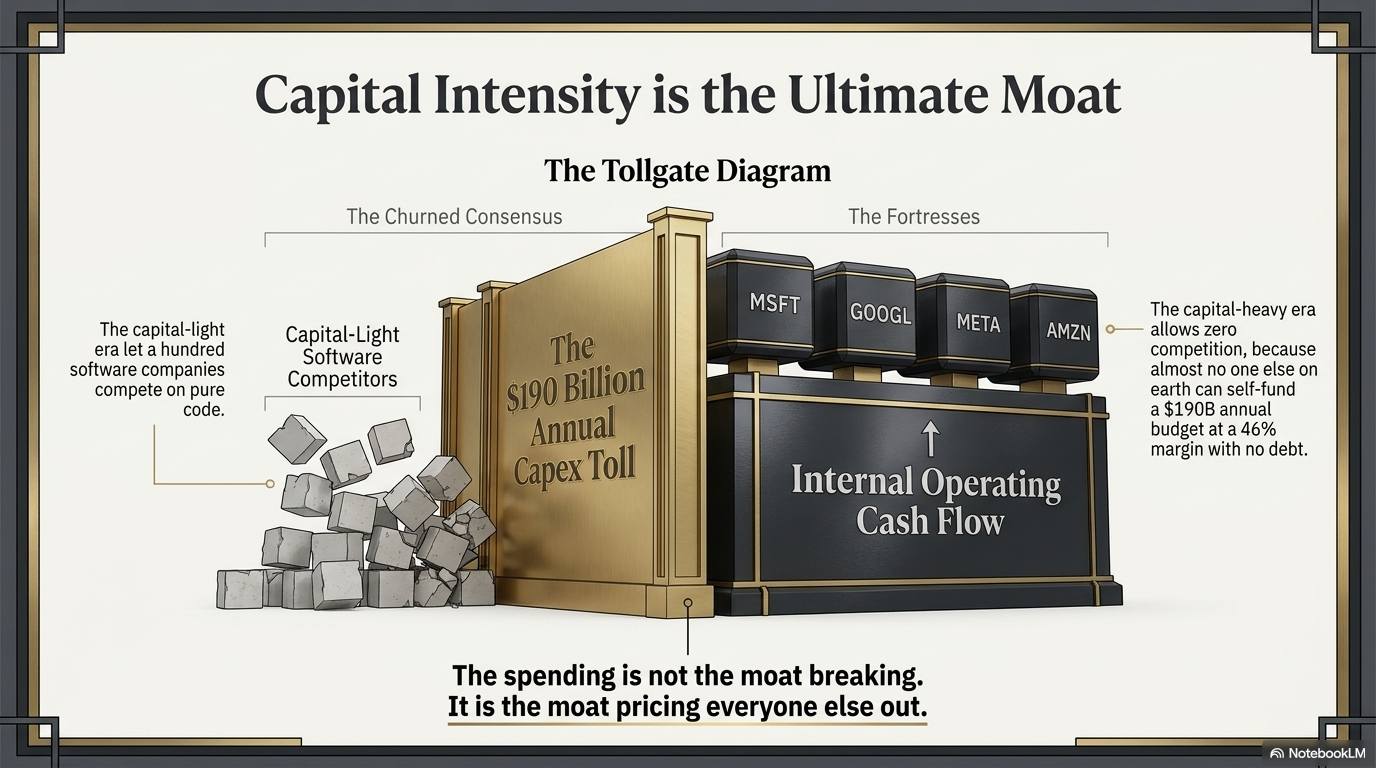
This means that the spending everyone is flagging as a warning is not the moat breaking. This is essentially a moat that prices others out.
And it is not a speculative capacity. GNG's own research, our Tokenomics 2 piece, put the hyperscaler RPO cloud backlog at $2.1 trillion, growing 185% a year. That is the capacity contracted before the concrete is poured. That said, I will be honest about the asterisk because it matters.
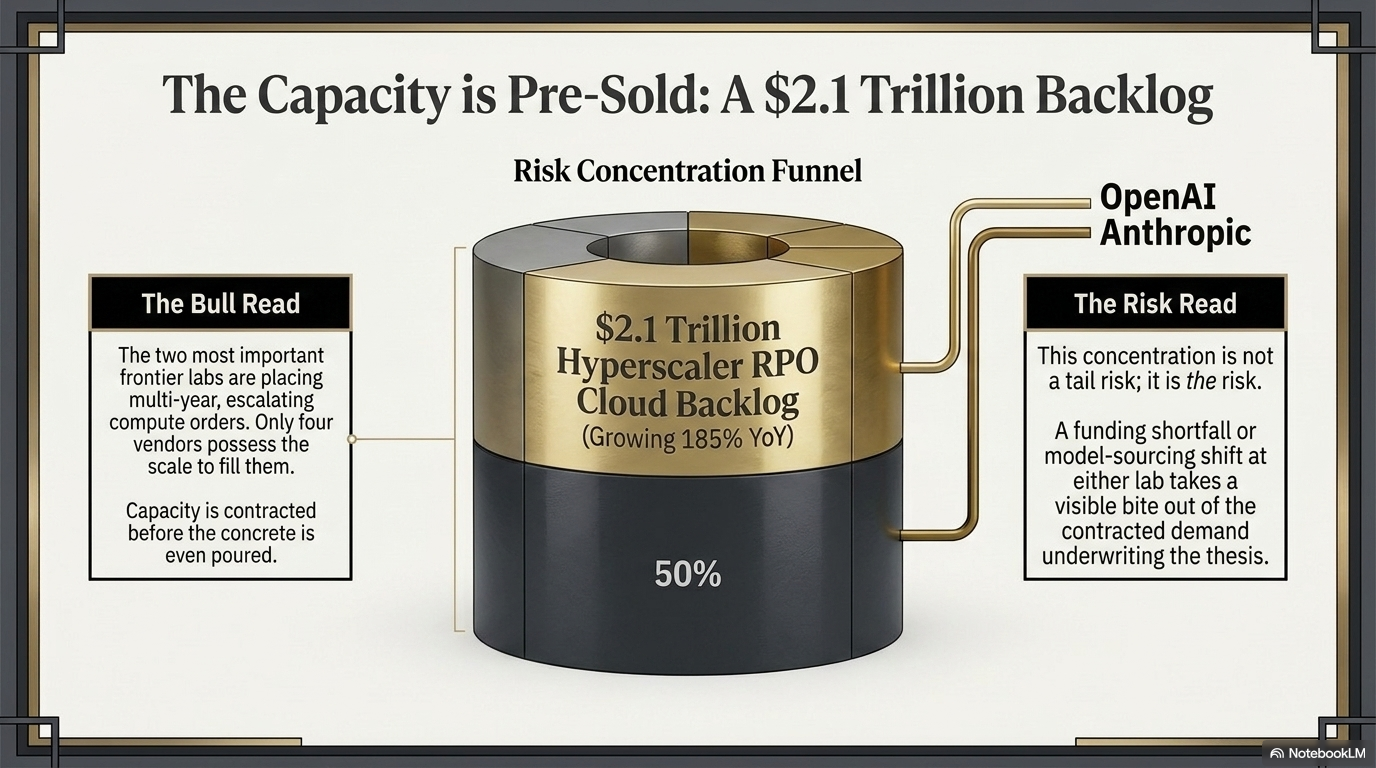
Roughly half of that backlog is OpenAI and Anthropic. That is real concentration risk, and I will come back to it. But the bull read is that the two most important frontier labs in the world are placing escalating, multi-year compute orders, and the only vendors big enough to fill them are the four names in question.
The Scarcity Runs Through The Platforms
The natural long-scarcity instinct is to skip the tech entirely and buy the power and the gas directly.
There is a real case for that, and I find it genuinely attractive. But on its own it misreads who captures the energy bottleneck.
The hyperscalers are not victims of the power constraint. They are integrating straight into it. Meta contracted Williams (WMB) to build on-site natural gas generation for its Ohio data center campus. Google has gone directly to NextEra (NEE) for gigawatt-scale supply. When the grid connection takes four years and a gas turbine takes eighteen months, the company that can pre-buy the molecule and build behind the meter wins the scarcity and passes it to no one.
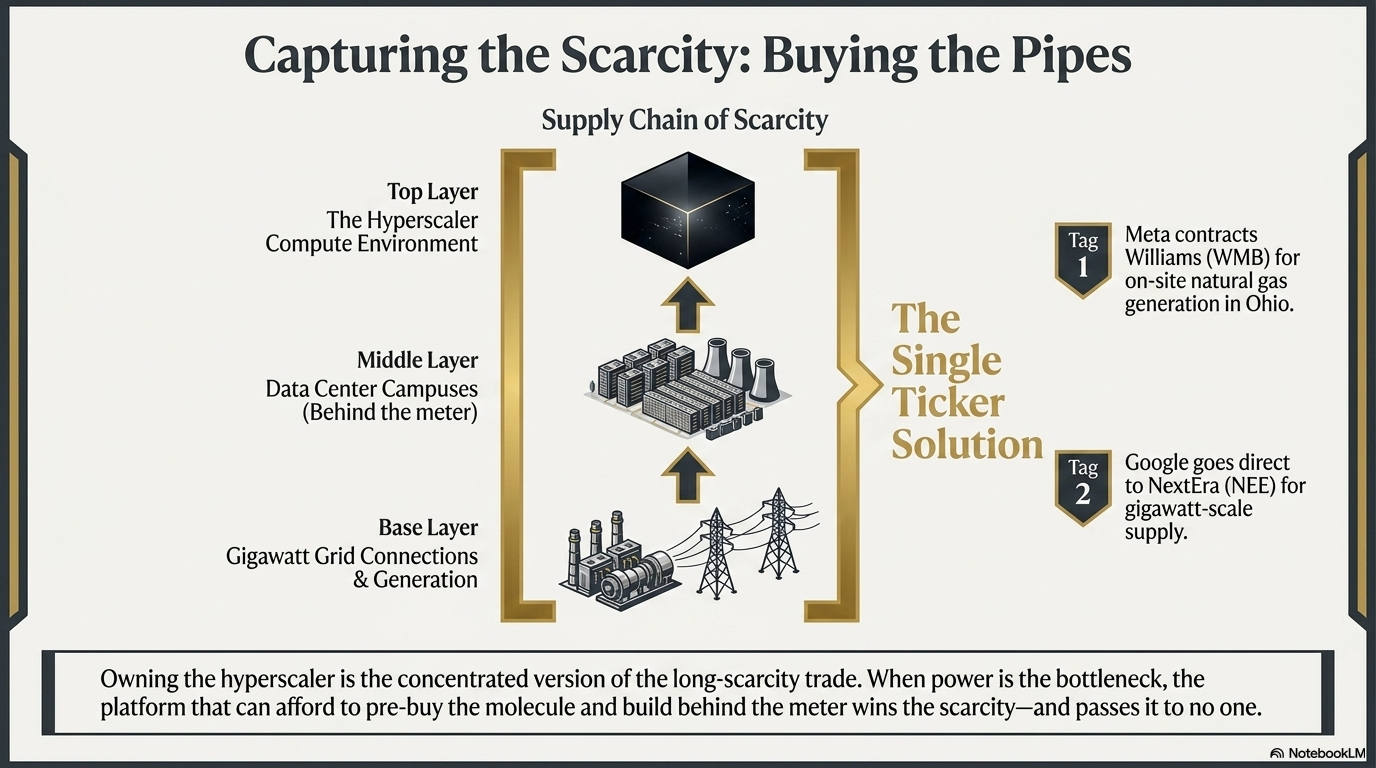
So owning the hyperscaler is not the opposite of the long-scarcity trade. It is the concentrated version of it. You get the compute demand and the power lock-in in a single ticker, funded by a balance sheet that can afford to corner both. The midstream and power names are still a fine way to play the theme. But the platforms are buying the pipes.
And just to avoid confusion, I am as bullish as ever on energy and power producers.
The Chips Are The Leveraged Expression
This is where my macro frame and Adam's bottom-up work meet, because Visser's actual picks are the pure-play, and GNG's data supports him, though not uniformly.
Honesty requires the "not uniformly."
Nvidia (NVDA) is the cleanest, and it is exactly the name Adam has been loudest on, as most of you will know. It trades at a 23x forward multiple, below its own five-year AI-era average, with a PEG of 0.63.
This for a business running a 47% free cash flow margin, a 63% net margin, and a 77% ROIC, with data center revenue up roughly 75% year over year. GNG's model rates it Very Strong Buy and puts fair value about 40% above the current price.
Memory is where I add a caveat. Micron (MU) shows a 6x forward P/E and a 0.14 PEG, which look absurd until you remember why. Its operating margin has gone from a 10% five-year average to 80% today.
Those are cycle-peak earnings, and the low multiple is the market pricing the reversion, not missing it.
GNG rates Micron a Hold for exactly that reason, even as the quant model flags Strong Buy.
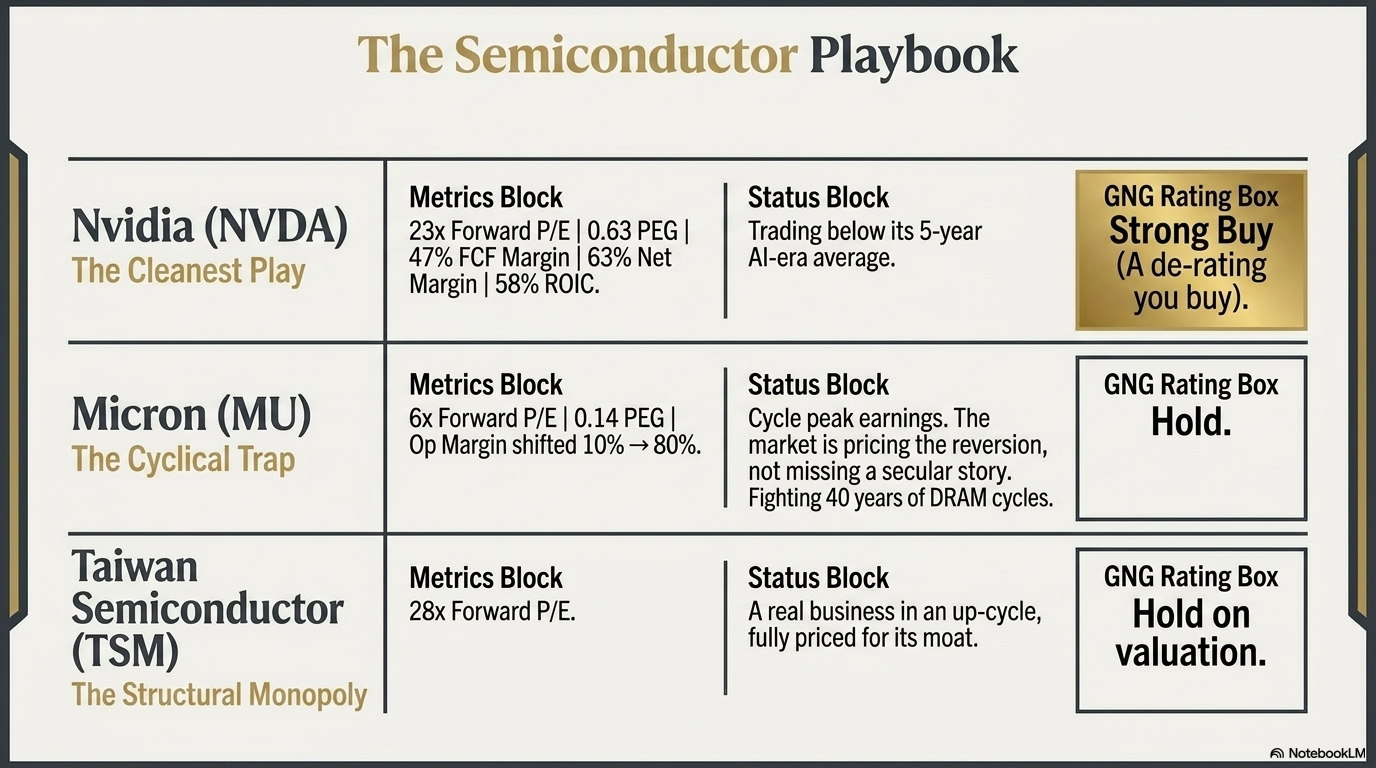
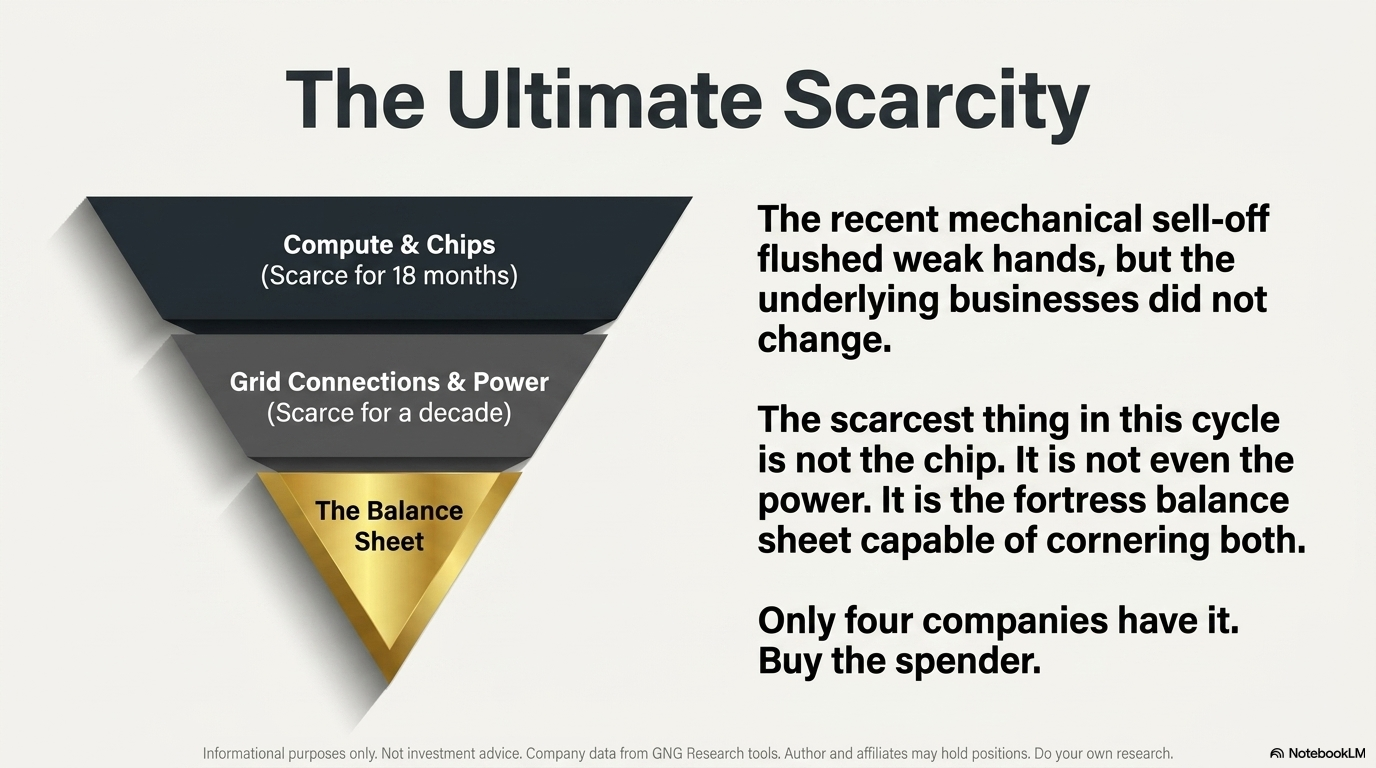
I would rather own the demand than the commodity. Taiwan Semiconductor (TSM) is the structural monopoly at 28x forward, priced for its moat, GNG-rated Hold on valuation. These are real businesses in a real up-cycle. But the chip is scarce for eighteen months and the platform is scarce for a decade.
Where I Could Be Wrong
A bullish thesis is only worth reading if it names its own weak points, so here they are.
The backlog concentration is the real risk. If half the $2.1 trillion is OpenAI and Anthropic, then a funding shortfall or a model-sourcing shift at either lab takes a visible bite out of the contracted demand that underwrites the whole case.
The token curve is the other one. The case needs agentic consumer AI to actually arrive and consume the way Goldman models it. If the product layer stays immature and the 24x demand step-function slips two years to the right, the CapEx gets ahead of the revenue, and the FCF compression stops looking like timing and starts looking like a problem.
And memory is genuinely cyclical. Anyone buying Micron at peak margins for a secular story is fighting the last forty years of the DRAM cycle.
But the core of it holds.
Operating margins at record highs, ROIC well above cost of capital, a fortress balance sheet funding the whole thing internally, and a contracted order book measured in trillions. That is not the profile of a business the market should be treating as an overspending industrial. And the recent selloff that made everyone nervous was mechanical, not fundamental.
Please know that systematic funds had their worst stretch since December 2023, retail handed back most of a rally, and roughly 87% of semiconductors hit oversold. The weak hands got flushed.
Takeaway
I believe the market is making a costly mistake by treating AI infrastructure spending as value destruction instead of value creation.
While free cash flow has come under pressure, the fundamentals that actually matter - operating margins, returns on invested capital, fortress balance sheets, and massive contracted demand - remain exceptionally strong.
To me, the biggest hyperscalers are building their moats.
That doesn't eliminate the risks, and I highlighted the ones that matter most, but it does reinforce my long-term conviction.
As this investment theme continues to evolve, I'll keep digging into the data and sharing the opportunities I believe are worth owning.
Sign in to leave a comment and join the discussion.
Sign Up Free