
Creditors are asking who pays for the AI buildout. Across NVIDIA, Alphabet, Meta, Nebius and CoreWeave, that answer separates my strongest idea, my speculative addition and the stock I'm still watching.
Nebius (NBIS) grew second-quarter revenue 454% from a year earlier. On 70% of the deals it signed that quarter, customers prepaid 50% to 60% of the related capital spending.
The stock still lost a quarter of its value in five sessions.
The easy read is that AI demand cracked. Second-quarter results don't show it. The stress surfaced in the bond market, where Reuters reported the yield on a CoreWeave (CRWV) bond issued in June had climbed from 9.675% to roughly 15%.
That moves the question from demand to money:
How much of the AI boom will reach each shareholder after the bill is paid?
This week I added two percentage points to Nebius in the Vulcan growth model portfolio on GNG. That brought it to a full position.
The Nasdaq fell 4.5% this week, including 2.1% on Friday. An addition made into that kind of week has to defend itself, so here's where my review landed. NVIDIA (NVDA) is the strongest growth-at-a-reasonable-price candidate of the five. Alphabet (GOOGL) and Meta Platforms (META) have operating businesses big enough to carry their spending, though that spending now eats far more of their cash. Nebius is a speculative growth holding with real evidence behind it and a lot left to prove. CoreWeave's financing burden keeps it on my watchlist.
Which raises a fair objection. If NVIDIA ranks first, why did the new money go to Nebius?
Sizing. NVIDIA was already a full position in the model, so it didn't need more. Nebius wasn't. The ranking shows which business I trust most today. The addition shows where there was still room.
None of that makes Nebius a safe stand-in for NVIDIA. It's a very different kind of holding, and the funding question explains why.
Why one bond matters
A 15% yield on one CoreWeave bond doesn't mean all of CoreWeave's debt suddenly costs 15%. Existing debt keeps its terms. It does mean buyers now want far more compensation to hold that obligation, and that can make the next borrowing or refinancing harder.
For AI clouds, that matters because they spend before they earn. Buildings, power and GPUs have to be in place before a customer can use any capacity. Demand can be strong and shareholders can still come out behind if deployment slips, borrowing gets expensive or new shares soak up the upside.
That's also why I don't lean on P/E or PEG ratios for the two clouds. Analysts expect both to lose money next year. Growth at a reasonable price, or GARP, works for the profitable names here. For Nebius and CoreWeave, the better questions are where the cash comes from, what it costs and how many shares will divide the result.
Same buildout, different bill
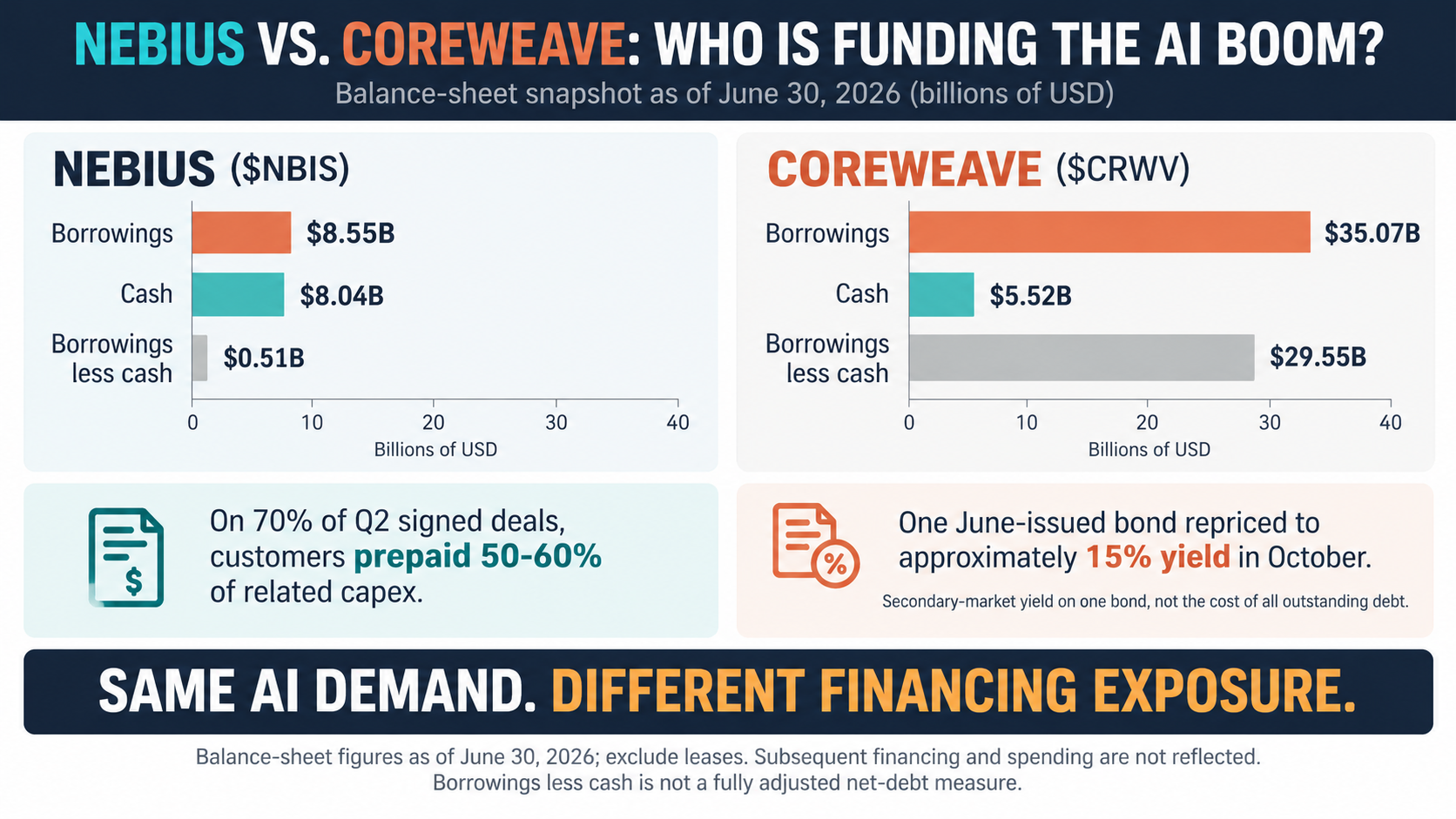
CoreWeave is the cautionary case, and demand isn't its problem. Second-quarter revenue reached $2.58 billion and backlog topped $100 billion. But net interest expense came to $640 million, against $128 million of adjusted operating income. Cash from operations of $679 million was far below the $6.42 billion it spent in cash on equipment and software.
Capital hasn't dried up. CoreWeave's $4.2 billion convertible financing in September shows that. The issue is the cost of that capital and how much of it keeps piling up.
Nebius is building the same kind of capacity with a different funding mix, and that difference is most of my case.
Those prepayments mean customers are helping fund the capacity they want to use. The June balance sheets show how far apart the two companies started. Nebius had $8.55 billion of borrowings against $8.04 billion of cash. CoreWeave had $35.07 billion against $5.52 billion, before counting leases. Both have raised and spent money since, so treat those as dated snapshots, not estimates of today's liquidity.
In August, Nebius completed a $5.75 billion convertible offering alongside an announced exchange of older debt involving about 15.8 million shares.More funding buys time to execute. It also adds claims on whatever value that execution creates.
Now the part that keeps me honest about those prepayments. Picture a homebuilder collecting deposits before pouring foundations. The deposits pay for construction. They aren't profit, and the house still has to get built.
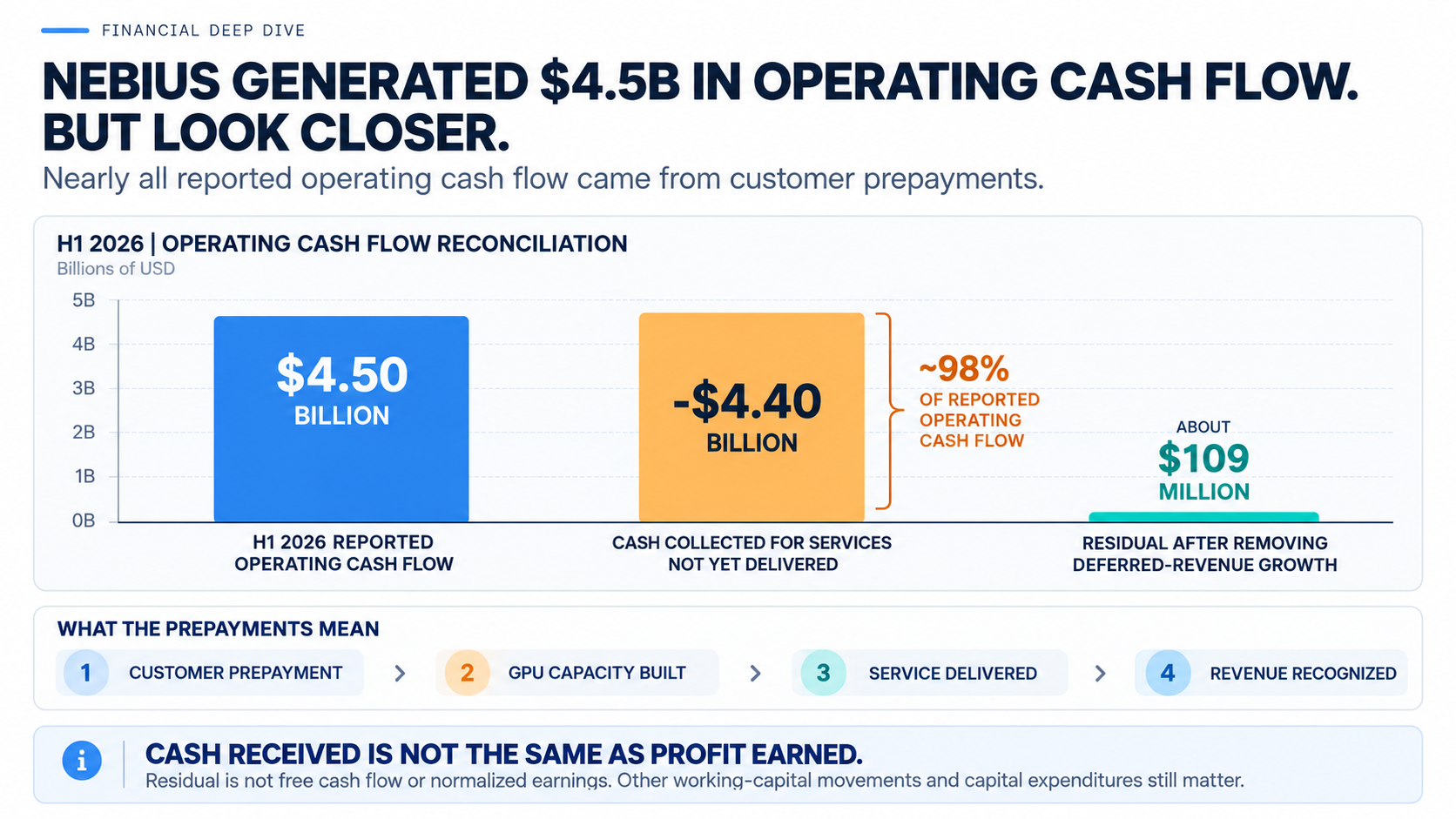
Nebius generated $4.50 billion of operating cash flow in the first half, and $4.40 billion of it came from growth in deferred revenue: cash customers paid for service Nebius still owes them. Strip that out and about $109 million remains, before other working-capital effects or any capital spending.
The valuation still assumes a steep ramp. Using June's share count, adjusted only for that announced exchange, Friday's $165.47 close implies roughly $47.6 billion of equity value. That's about 15 times the midpoint of management's $3 billion to $3.4 billion revenue guidance for 2026.Treat it as a rough check. It leaves out other shares issued since June and any potential conversion of the new notes, so it isn't a verified fully diluted market value or a fair-value estimate.
Management's $7 billion to $9 billion year-end revenue run-rate target measures something else. A run rate annualizes the pace of revenue at a point in time. It isn't a full year of recognized revenue, so dividing by it shrinks the multiple while answering a different question.
At full weight, I'm also holding a stock with a 48% drawdown over the past year and short interest near 19% of its float, per Stock Rover. The position has to be judged with that volatility in view.
For the addition to work, deployments have to become recognized revenue, funding has to stay manageable and growth has to survive on a per-share basis. A large order book can't establish that. Neither can an attractive adjusted EBITDA margin, which says nothing about returns once the GPUs need replacing.
Alphabet and Meta: strong businesses, thinner cash
Both platforms have operating businesses large enough to support their investment plans. Their question is how much cash that spending leaves for shareholders.
Alphabet's second-quarter operating income grew 30%, but reported net earnings also benefited from enormous unrealized investment gains. A low headline P/E therefore makes the operating business look cheaper than it is. At $340.59, GOOGL trades at about 22.6 times the $15.08 consensus estimate for 2027 EPS. That's a better baseline than this year's unusually high earnings, though it's still a forecast. Second-quarter capital spending also exceeded operating cash flow by $5.86 billion. I remain constructive: a quality hold with selective additions, and I'm making no bargain claim.
Meta's advertising engine is still strong, with second-quarter revenue up 28%. But company-defined free cash flow was just $784 million, because capital spending absorbed most of its operating cash. Operating margin fell too. Legal and severance charges contributed, so pinning the whole decline on AI would be misleading.
At $709.33, META trades at about 20.8 times the 2027 consensus estimate. That multiple is reasonable only if the spending turns into earnings and cash returns, and estimates are drifting the other way: both the current-year and 2027 forecasts have fallen over the past 90 days. Meta reports October 21. 'm holding and will reassess spending and margins with those results.
Where the spending lands
On the other end of all this spending sits the company selling the chips. NVIDIA's second-quarter fiscal 2027 revenue rose 106% to $96.2 billion, and it reported $21.3 billion of free cash flow.
At $214.13, the shares trade at roughly 23 times the $9.31 analysts expect it to earn this fiscal year. The next-fiscal-year estimate has risen from $12.76 to $15.91 over 90 days. Rising estimates at a moderate multiple is what I want in a GARP candidate, though that later estimate needs considerably more growth to show up.
NVIDIA still depends on its customers' ability to pay. Its $2 billion investment in CoreWeave shows the relationship runs deeper than selling chips. Strong current profits don't insulate future orders from a financing slowdown.
So the ranking and the addition don't contradict each other. NVIDIA's case rests on earnings that exist today and estimates that have been rising, and it already had its full weight. Nebius's case rests on capacity that has yet to become recognized revenue. It got the open room, and it carries much more to prove.
What would change my view
Stock | Research stance | Evidence that matters next | Next report |
|---|---|---|---|
NVDA | Strongest GARP candidate; consider staged additions | Earnings revisions stay positive and orders convert into cash | Nov. 18 |
GOOGL | Quality hold; selective additions | Operating earnings grow without relying on investment gains | Oct. 28 |
META | Hold through the upcoming results | Spending produces improving earnings and cash returns | Oct. 21 |
NBIS | Speculative growth holding; addition made, now full position | Capacity becomes revenue without excessive financing or dilution | Nov. 10 |
CRWV | Watchlist | Better cash coverage of interest and expansion needs | Nov. 9 |
My shorter-term Logic Dictates Alpha [LDA] view, which weighs estimate revisions and momentum among other inputs, adds caution. NVIDIA's annual earnings revisions are supportive. Meta's have weakened, and expected next-year losses at Nebius and CoreWeave have deepened over 90 days. Those are timing diagnostics from a focused review, not a completed LDA ranking, and they say nothing about whether this week's lows will hold.
The strongest challenge to my Nebius position is that the company could grow fast while shareholders still get disappointing returns. Delayed capacity, weaker customer economics, faster hardware obsolescence or repeated dilution could each produce that outcome.
I'll judge the addition on those operating and financing results. A rebound in the share price alone wouldn't validate it, and a further decline alone wouldn't disprove it.
If you hold any AI stock through this selloff, three checks carry over: who funds the buildout, what that money costs and how many shares will split what's left.
I track these decisions and the evidence behind them in the Vulcan growth model portfolios on GNG.
Sign in to leave a comment and join the discussion.
Sign Up Free