
Introduction
I read a lot of portfolios.
Some of you share them in the comments. Some of you email them. Some of you just mention two or three names and ask what I think. And over the years, I have noticed something that keeps coming back.
People own the same supply chain without realizing it.
One reader owns Boeing (BA) and GE Aerospace (GE). Another owns NVR (NVR), Builders FirstSource (BLDR), and RH (RH). Someone else owns Archer-Daniels-Midland (ADM) and PepsiCo (PEP). Another owns Fair Isaac (FICO) and a big mortgage lender.
None of these combinations is wrong. Some of them are actually very smart. But they are often something different from what the owner thinks they are.
If you think about it, five unique tickers can be one big bet.
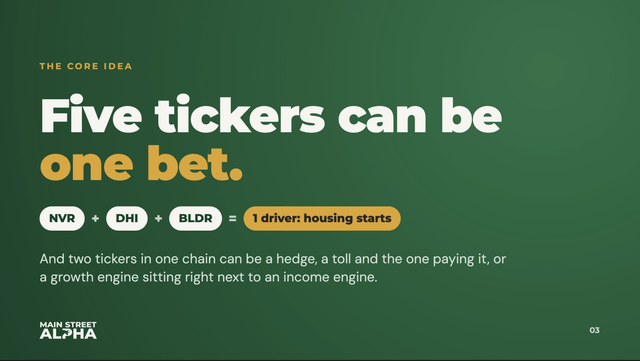
And two tickers in the same chain can be a hedge, a toll and the person paying the toll, or a growth engine sitting next to an income engine.
Yesterday, we broke down the aerospace supply chain stage by stage. Today, I want to zoom out. In this article, I will give you the three questions I ask about every supply chain, four types of "pairs" you can build (or accidentally build) inside one chain, and then walk through six chains: aerospace, housing, food, credit, power, and healthcare. Each comes with income and growth ideas. Then I will show you how to map your own portfolio in about 15 minutes, and I will map mine, including the parts I am not entirely comfortable with.
None of this is time-sensitive. I will not give you entry prices. This is about structure, which matters for decades.
So, let's dive in!
The Three Questions I Ask Every Supply Chain
As some of you know, my Master's degree focused on Purchasing & Supply Management. I spent years learning how companies buy things. It turns out that is one of the best ways to understand how companies make money, because every purchase is somebody else's sale. And funny enough, it was also my ticket into the financial industry, as people needed supply chain experts when the pandemic hit in 2020. I wasn't an "expert" as I was about to graduate, but (combined with my financial background), it offered a unique opportunity.
Anyway, here are the three questions:
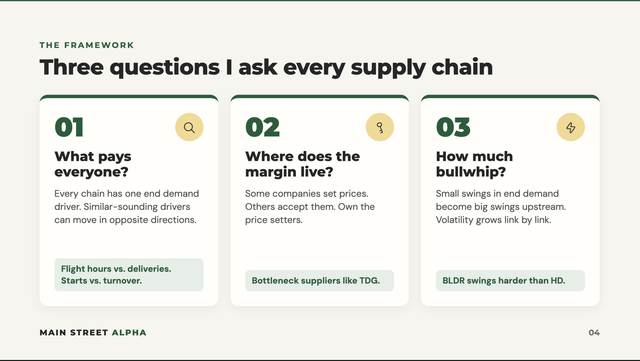
Here are the details:
1. What is the end demand driver?
Every chain has one thing that ultimately pays everyone. For aerospace, that is flight hours (how much planes actually fly). For homebuilders, it is housing starts (new homes breaking ground). For a furniture company, it is often existing home turnover (people moving). These sound similar. They are completely different numbers that can move in opposite directions.
2. Where does the margin live?
In every chain, some companies set prices and others accept them. There is a framework from purchasing called the Kraljic Matrix, developed by Peter Kraljic in 1983. I brought it up briefly yesterday. It sorts everything a company buys by two things: how much it matters to profits and how hard it is to source. The most interesting box is "bottleneck items." These are parts that are cheap relative to the final product but nearly impossible to replace.
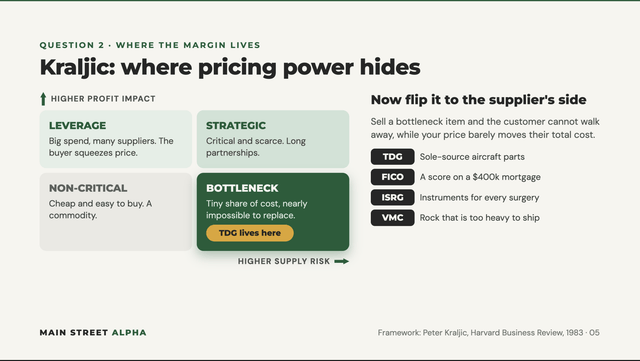
Now, flip that around and look at it from the supplier's side.
If you sell a bottleneck item, you have pricing power. Your customer cannot walk away, and your price barely moves their total cost. That is the entire TransDigm (TDG) business model in one sentence. It is also why I score oligopoly power so heavily in TOLL+M and pricing power in PLOW+M.
Also, some of my professors back in early 2020 turned out to be great investors as well, as they knew exactly where to invest when the stock market went south. It's why I cannot say often enough how important it is to understand supply chains.
3. How much "bullwhip" is there?
This is my favorite supply chain concept, and I rarely see it in investment research.
In the 1990s, Procter & Gamble noticed something strange about Pampers. Babies use diapers at a very steady rate. Retail sales were stable. But orders from retailers to P&G swung wildly, and P&G's orders to its own suppliers swung even more.
That is the bullwhip effect. Small moves in end demand turn into big moves upstream, because every link in the chain over-orders when things look good and slashes orders when things look bad.
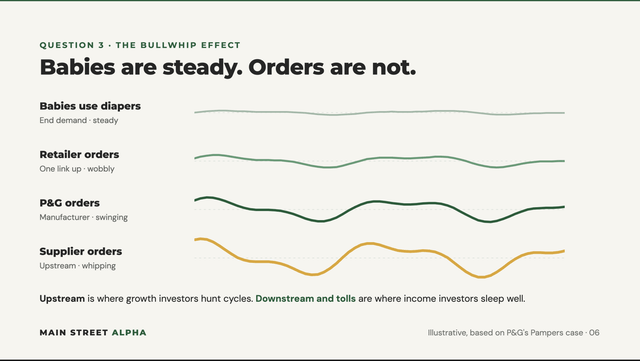
For investors, the implication is simple:
Upstream companies (raw materials, components, building products) are more cyclical. That can be great for growth investors who buy them at the bottom of a cycle.
Downstream companies, aftermarket businesses, and toll collectors see steadier cash flows. That is usually where income investors want to sit.
Sign in to leave a comment and join the discussion.
Sign Up Free