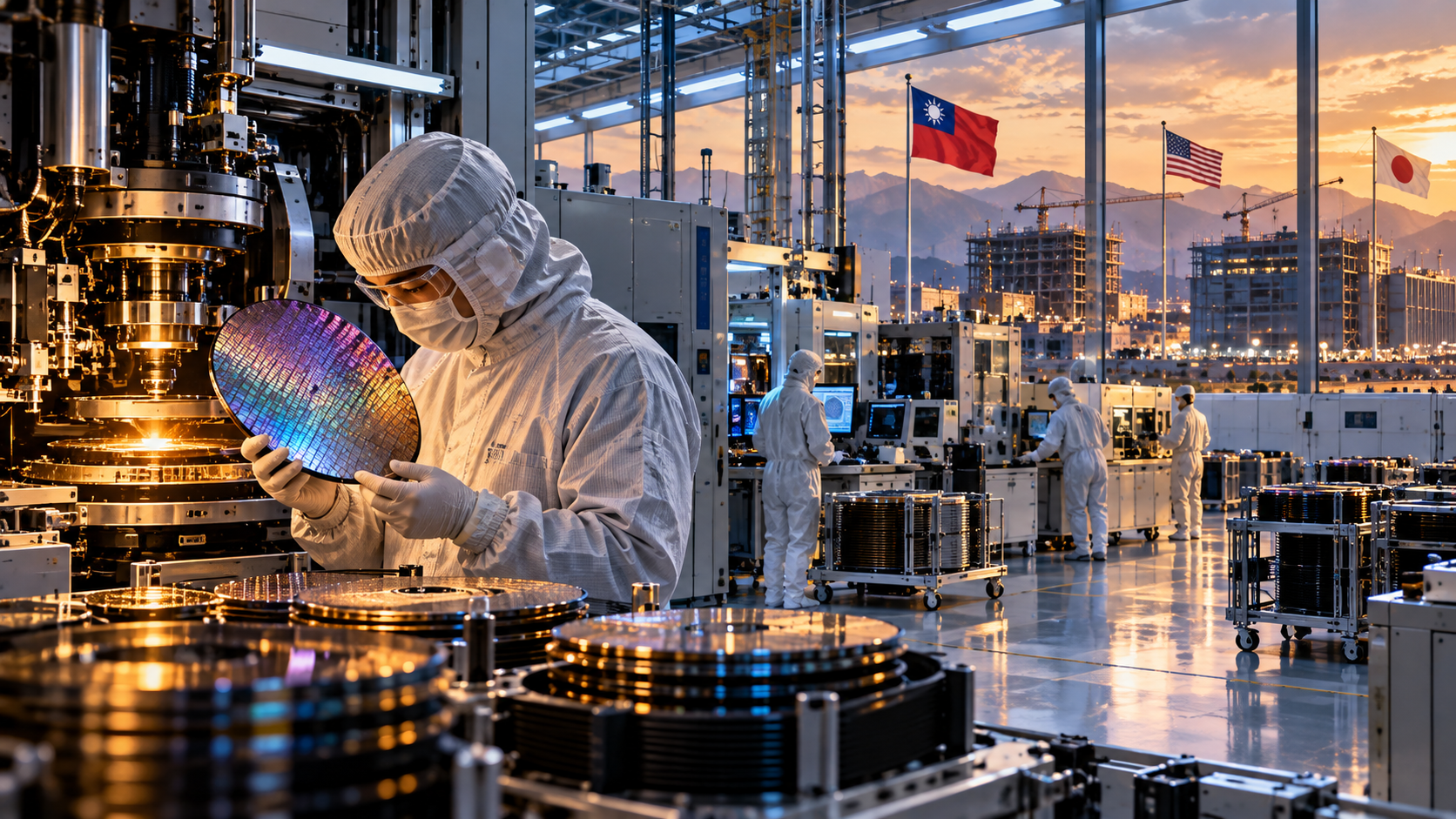
The semiconductor industry stands at an inflection point that transcends typical cyclical patterns. Global chip production capacity is consolidating around two geopolitical poles, while the underlying physical constraints of advanced fabrication have become the binding constraint on everything from automotive assembly to data center deployment. The binding constraint is not demand but rather where, how, and at what cost new wafers will be manufactured as the window for redundancy closes.
Taiwan Semiconductor Manufacturing Company commands roughly 54% of the global foundry market by revenue, with an even larger share in advanced process nodes below 7 nanometers. This concentration reflects genuine technological leadership and operational excellence. Yet TSMC's dominance also masks a fundamental vulnerability: the company is geographically concentrated in Taiwan, a territory whose political status remains contested and whose supply chains for raw materials, rare earth elements, and specialized gases depend on imports from politically fragile regions.
The firm is expanding advanced fabs in Arizona and Japan to hedge this geographic risk. TSMC's Arizona Fab 1 began N4 production in late 2024, while the Kumamoto fab in Japan is operational. However, overseas expansion carries material cost penalties. TSMC disclosed that building advanced fabs outside Taiwan incurs substantially higher capex and operating expenses due to labor costs, utility pricing, and environmental compliance. The Arizona expansion alone represents a cumulative investment exceeding $165 billion across multiple fabs and packaging facilities, far exceeding the cost of equivalent capacity in Taiwan.
Samsung Electronics, the world's second-largest foundry operator and a major memory chip producer, faces a different but equally material constraint. The company has bet heavily on advanced packaging and heterogeneous integration, where multiple chiplets are bonded together rather than manufactured monolithically. This approach theoretically reduces the pressure on sub-5-nanometer node capacity. However, Samsung's capital intensity has risen sharply. The firm is investing over $40 billion annually across its semiconductor divisions, with substantial portions directed toward memory technology that faces structural oversupply in DRAM and NAND flash. Samsung's fabs in South Korea remain subject to energy constraints and geopolitical tensions with North Korea that periodically disrupt transportation and utility infrastructure. The company's ability to compete with TSMC on cost in mature nodes has eroded, pushing Samsung toward higher-margin but lower-volume specialty chips.
The physical bottleneck is photolithography. Only the Dutch company ASML manufactures extreme ultraviolet lithography tools capable of producing sub-5-nanometer chips. ASML's order book extends multiple years into the future. New fabs cannot be built without these machines, and ASML's production capacity for EUV tools is fixed at roughly 30-40 units annually. This is the real constraint on global semiconductor capacity growth, not silicon wafer supply or cleanroom construction. Every fab planned by TSMC, Samsung, Intel, or China's SMIC competes for slots on ASML's delivery schedule.
This capacity bottleneck has downstream consequences for industries far beyond semiconductors. Automotive suppliers have learned this painfully over the past two years. A modern electric vehicle requires 3000-4000 semiconductor components, more than double the count in conventional combustion engines. Supply disruptions in mature automotive-grade chips cascaded into production halts at Mercedes-Benz, Ford, and Volkswagen. The contracts that bind automotive suppliers to chipmakers reveal the structural imbalance: semiconductor manufacturers retain pricing power and can dictate allocation, while auto suppliers must maintain 60-90 days of inventory to protect production schedules. This inventory carry is expensive, and spot prices for mature node chips have remained elevated well above pre-pandemic levels despite announced capacity expansions.
We should examine the balance sheets of TSMC and Samsung through the lens of capital intensity and return on invested capital. TSMC's capital expenditure as a percentage of revenue has risen from 25-28% historically to 33-35% in 2024-2025, as the company funds overseas expansion. The company's return on invested capital has compressed from 22-25% to 18-20% over the same period. This is still exceptional by most standards, but it reflects the real cost of geopolitical diversification. TSMC cannot indefinitely expand capex as a percentage of revenue without depressing returns. The Arizona and Japan facilities will take years to reach full utilization and cost parity with Taiwan operations.
Samsung's semiconductor division faces more acute pressure. The company's return on invested capital in semiconductors has fallen below 15%, down from 18-20% five years ago. This reflects both overcapacity in memory chips and the high cost of competing with TSMC in logic foundry services. Samsung's overall return on equity has been sustained only by strong performances in consumer electronics and display panels. Samsung faces a genuine strategic choice: continue defending memory chip market share through aggressive capex that depresses returns, or retreat toward specialty memory products and heterogeneous integration where margins are thicker but volumes are constrained.
Automotive companies and consumer electronics manufacturers must assume that advanced chip allocation will be rationed by price and contractual commitment. Companies that have committed to sole-source relationships with TSMC or Samsung enjoy allocation priority, but at the cost of locked-in unit prices that are 20-30% above spot market rates for commoditized nodes. Companies pursuing multi-source strategies face higher purchasing costs and complexity but retain flexibility to redirect orders as supply conditions shift.
The contract structures between chipmakers and customers have shifted materially. Long-term supply agreements now include capacity commitment clauses that require customers to purchase minimum quantities even if demand falls. These agreements also contain take-or-pay provisions that penalize customers for underutilizing allocated wafer starts. The economic logic is transparent: TSMC and Samsung need demand certainty to justify their capital expenditures. The cost of this certainty is borne by downstream manufacturers in the form of higher unit costs and constrained flexibility.
The intermediate-term trajectory is toward regional semiconductor ecosystems rather than a truly integrated global supply chain. Europe is investing in onshore capacity through the European Chips Act, though cost competitiveness remains a question mark. The United States is subsidizing TSMC and Intel to build domestic capacity, but these facilities operate at structural cost disadvantages compared to Taiwan. China is pursuing autarky in semiconductor design and fabrication, with mixed technical results but substantial capital allocation. None of these regions will achieve true independence in advanced semiconductors within the next five years. The outcome is likely a bifurcated supply chain: mature nodes and commodity chips will be produced regionally, while leading-edge advanced nodes remain concentrated in Taiwan and South Korea.
TSMC's valuation premium versus other semiconductor equipment and foundry operators is justified by its technological leadership and operational execution. However, the company faces margin compression as it invests globally at lower returns. Samsung offers a value opportunity only if the company successfully executes its retreat from commodity memory and shifts toward specialty chips and advanced packaging. Intel's path remains highly dependent on whether the U.S. subsidy regime continues and whether the company can execute a multi-year technology recovery. The real optionality lies not in which chipmaker wins, but in recognizing that semiconductor manufacturing in 2025-2030 will be fundamentally different from the model that has prevailed since the 1980s.
The offshore expansion of chipmaking (Arizona, Japan, and possibly Singapore) solves the geopolitical risk problem at the cost of higher unit economics. Customers shifting orders to these newer fabs pay implicit geography premiums embedded in pricing. Over time, as these facilities reach volume and cost curves improve, the premium may compress. Until then, companies face a structural arbitrage: negotiate Taiwan-based TSMC capacity at lower absolute cost but accept concentration risk, or source from Arizona fabs at higher cost but with geographic diversification. This choice reshapes capital allocation across supply chains. Electronics manufacturers with pricing power pass the cost through to customers. Those without pricing power absorb the margin compression and compete on operational efficiency elsewhere. The semiconductor supply crisis is effectively being monetized and priced into every downstream balance sheet.
Sign in to leave a comment and join the discussion.
Sign Up Free