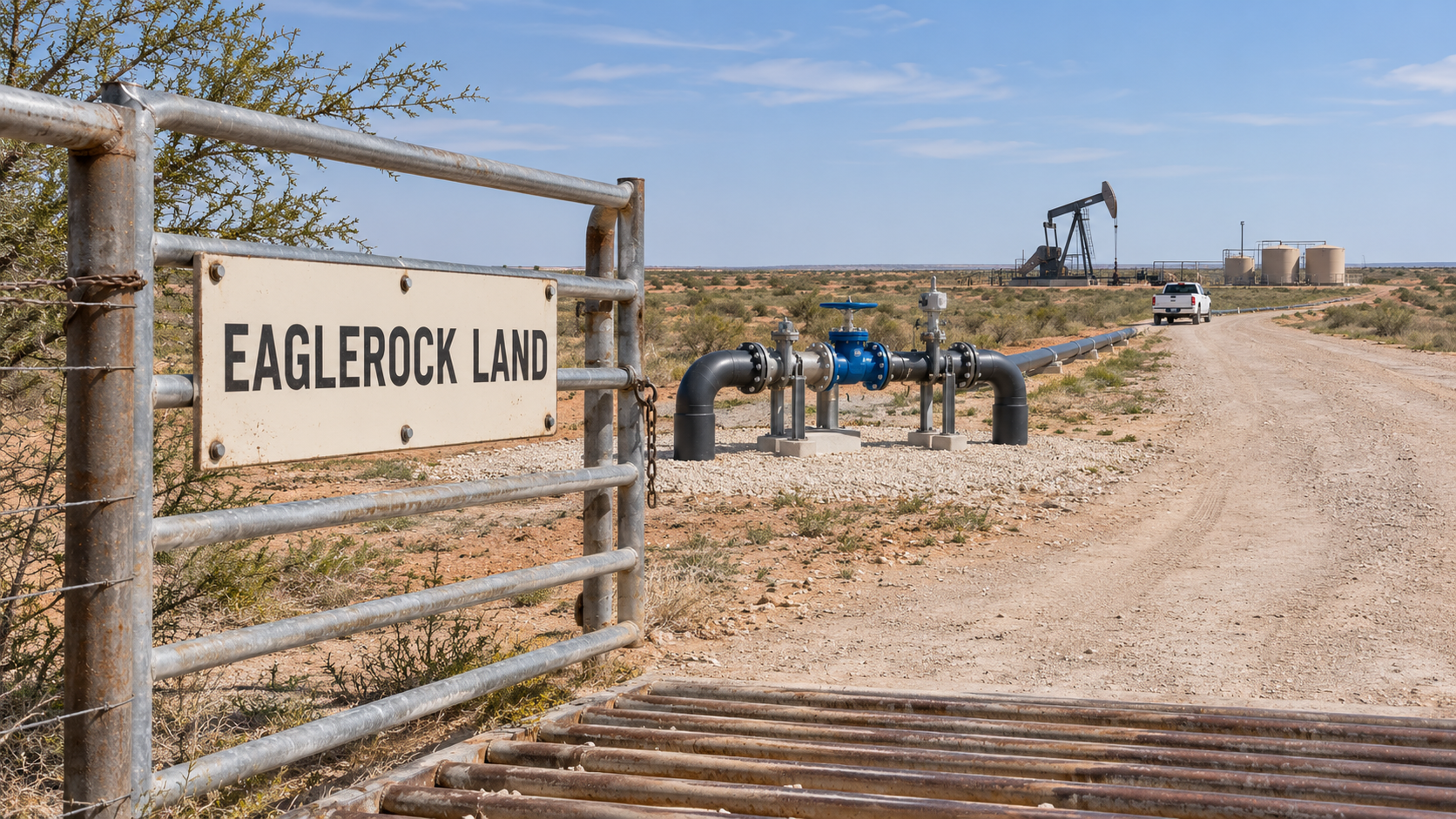

Introduction
I have a confession to make.
I am usually the last person to jump on a TV trend. I work too much for that - and my attention span is way too short (I need to work on that, I've been told).
But after what felt like the hundredth person told me to watch Landman, I gave in. I watched both seasons within two weeks, I believe.
No spoilers, I promise.
What I will say is that the show makes the land itself feel like a character. Almost everything comes back to the same question: who controls the dirt, the water, and the right to cross it?
Honestly, if you care even a little bit about oil and gas, this is a must-watch. It's one of my all-time favorite shows. And even if you don't care about it but like a good storyline, this one could be for you.
Anyway, going back to the oil, as many of you know, the question of who controls the land has been at the core of my investment strategy for years. It's why LandBridge (LB) and Texas Pacific Land (TPL) are my two biggest holdings.
And on Monday, real life delivered a plot that could have come straight from a Taylor Sheridan writers' room. Sheridan is the producer of Landman and a bunch of other shows, including the ones below:

Diamondback Energy (FANG) agreed to buy the Midland Basin assets of Double Eagle, which is a private oil company run by two former Texas Tech football players, Cody Campbell and John Sellers. Their team has started and sold several shale companies over the years. This is the second time they have sold a big chunk of assets to Diamondback.
On the surface, that's a normal shale deal.
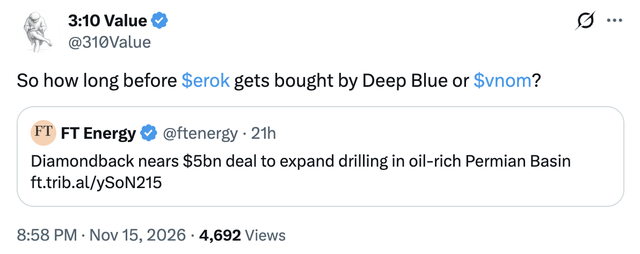
But one of my friends on X (3:10 Value, @310Value) immediately asked the question that made me reshuffle my publishing schedule:
"So how long before $erok gets bought by Deep Blue or $vnom?"
He's referring to EagleRock Land (EROK), a Permian surface landlord that went public in May. I have covered it before. He's also referring to Deep Blue, the Midland Basin water business Diamondback is taking over with KKR (KKR), and Viper Energy (VNOM), Diamondback's mineral and royalty subsidiary.
Is a takeover likely? Probably not, at least not anytime soon. He knows that, too. But I love how he thinks. And the more I dug into the filings, the more I realized that his question points to something very real: Diamondback very likely just bought EagleRock's most important customer.
So, in this article, I'll explain the Diamondback deal, the hidden link to EagleRock, three ways this could play out (including the Viper angle), and what it all means for EROK's valuation.
So, as we have a lot on our plate today, let's dive right in!
Diamondback (FANG) Spent $5 Billion On The Barnett
Let's start with the deal itself.
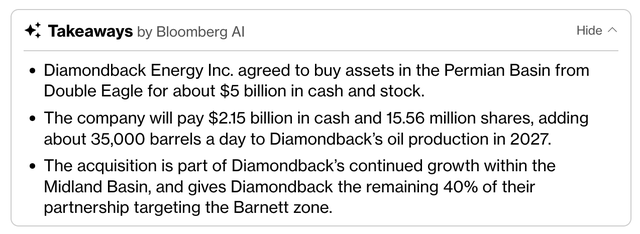
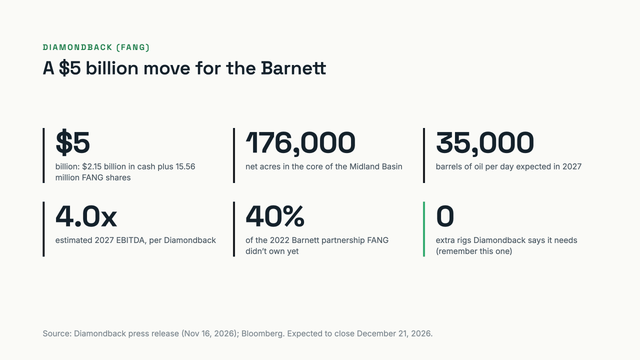
Diamondback agreed to acquire certain subsidiaries of Double Eagle IV Midco and Double Eagle V Midco for $2.15 billion in cash and roughly 15.56 million FANG shares. That's roughly $5 billion in total. This is the summary from Bloomberg:
Here's what Diamondback gets:
Roughly 176,000 net acres in the core of the Midland Basin.
Expected 2027 oil production of about 35,000 barrels per day (92,000 barrels of oil equivalent per day, 38% oil).
More than 1,200 gross (495 net) horizontal drilling locations, with 68% of the acreage undeveloped.
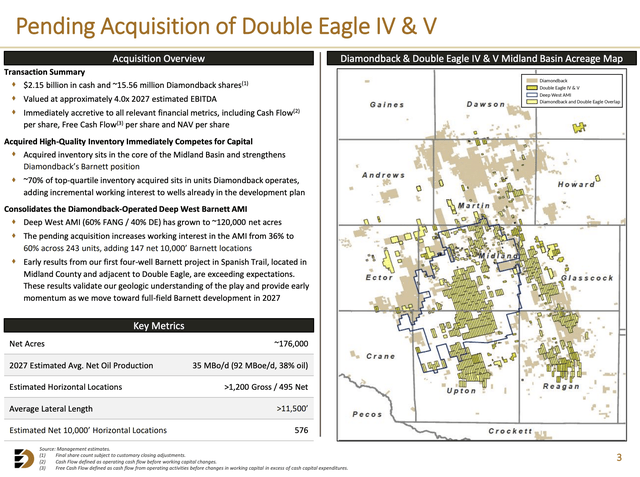
Diamondback values the deal at roughly 4.0x estimated 2027 EBITDA and calls it immediately accretive and leverage neutral. It's expected to close on December 21.
There's also a strategic angle.
In 2022, Diamondback and Double Eagle formed a partnership to develop the Barnett, which is a deeper, relatively underdeveloped layer of oil-soaked rock in the Midland Basin (part of the Permian). Diamondback is now buying the 40% it didn't already own.
"In 2022, as Diamondback gained subsurface understanding of the emerging Barnett zone in the Midland Basin, we decided to combine that understanding with the differentiated land expertise of the Double Eagle team." - Kaes Van't Hof, CEO of Diamondback, via Bloomberg
The Barnett results are what make the price make sense. On its 3Q26 earnings call, Diamondback said that the play, which was funded with its own cash flow at very low acreage prices, is "probably one of the best investments we've ever made." The company is moving into full-field Barnett development in 2027.
And here's the line from the press release that I believe matters most for EagleRock shareholders:
"Diamondback does not need to add a rig or materially alter our development plan as a result of this transaction." - Diamondback
That's great for FANG shareholders. Capital discipline is why Diamondback reinvests only around 30% of its operating cash flow. But for anyone collecting fees on that acreage, it means something else. Hold that thought.
The Hidden Link: Double Eagle Is EagleRock's Largest Shareholder
This is where it gets interesting.
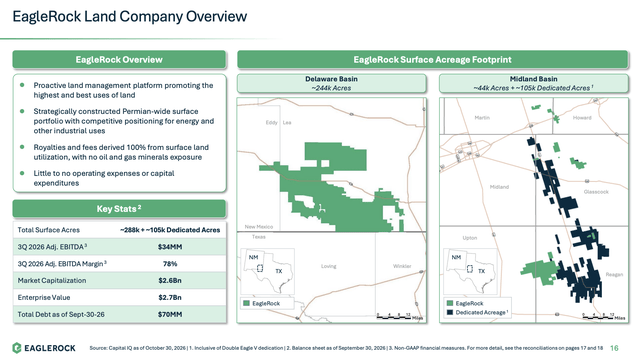
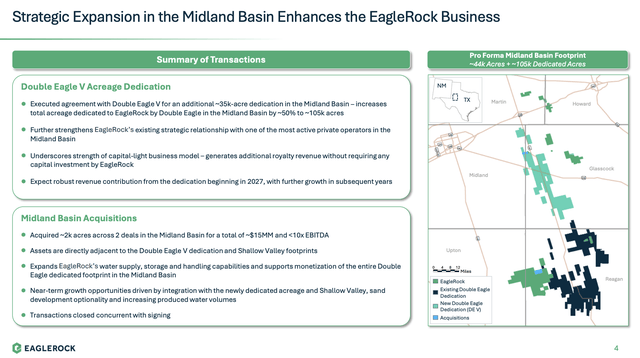
EagleRock owns or controls roughly 288,000 surface acres across the Delaware and Midland sub-basins of the Permian. That's roughly 244,000 acres in the Delaware Basin and 44,000 acres in the Midland Basin, plus another 105,000 "dedicated" acres. 100% of its revenue comes from surface use (water sales, water handling royalties, easements, caliche, and more). It owns no oil and gas minerals.
And its largest shareholder is... Double Eagle.
Let me walk you through the timeline, because it's quite something:
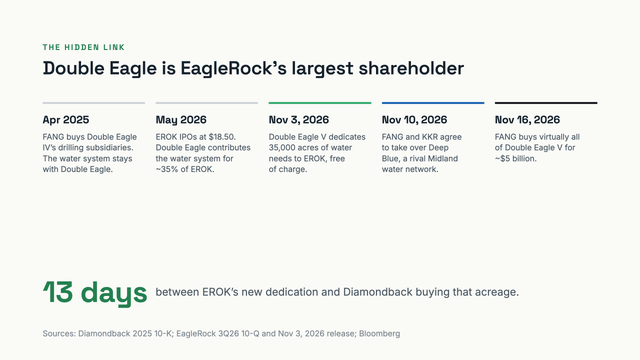
April 2025: Diamondback closes its first Double Eagle acquisition ($3.1 billion in cash and roughly 6.84 million shares). The entities it bought were the drilling subsidiaries. The water system stayed with Double Eagle.
May 2026: EagleRock goes public at $18.50 per share. At the IPO, Double Eagle contributes that water system (the DE Flow system) to EagleRock in exchange for roughly 45.9 million units. That makes Double Eagle the largest shareholder with roughly 35% of the company.
November 3, 2026: EagleRock announces a new 35,000-acre dedication from Double Eagle V in Midland and Glasscock Counties. That brings the total Double Eagle acreage dedicated to EagleRock to roughly 105,000 acres.
November 16, 2026: Diamondback buys "virtually all" of Double Eagle V, according to Bloomberg.
That's 13 days between the dedication and the sale.
What's a dedication? In this case, Double Eagle committed the water needs on that acreage to EagleRock's system. That includes supply water, produced water takeaway (the salty water that comes up with oil), and recycling. No land changes hands, and EagleRock pays nothing for it. Under the new agreement, EagleRock receives 50% of the net proceeds from the water system serving that acreage through the end of 2035.
Management called it 100% margin revenue, starting in 2027.
On the 3Q26 call, one analyst asked the obvious question: why would Double Eagle give this away for free? Pretty good question, right?
The answer was that Double Eagle is EagleRock's largest shareholder and a strategic partner. Fair enough. It's worth noting that the dedication was unanimously approved by a committee of independent board members.
I'm not accusing anyone of anything here. I think it's smart business. But today, the timing tells a story.
Here's what we know and what we don't know:
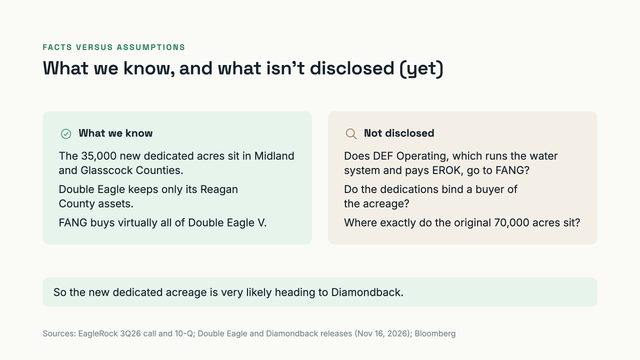
What we know: The 35,000 dedicated acres are in Midland and Glasscock Counties. Double Eagle says it is keeping only its "remaining Reagan County assets." Bloomberg reports Diamondback is buying virtually all of Double Eagle V.
What that implies: The new dedicated acreage is very likely heading to Diamondback.
What we don't know: Neither press release mentions EagleRock, water, or dedications. We don't know whether DEF Operating (the Double Eagle affiliate that operates the water system and pays EagleRock its royalties) goes to Diamondback or stays with Double Eagle. And I could not find disclosure on whether these dedications bind a buyer of the acreage. Midstream dedications are often structured that way, but I want to see it in writing.
Now, why does this matter so much?
It matters so much because Double Eagle is a huge customer. In 3Q26, EagleRock reported roughly $20.5 million in related-party revenue. That's roughly 47% of its $43.3 million in total revenue. The DE Flow water agreement alone generated $13.4 million. And the company's single largest customer accounted for 38% of quarterly revenue.
Think about that for a second.
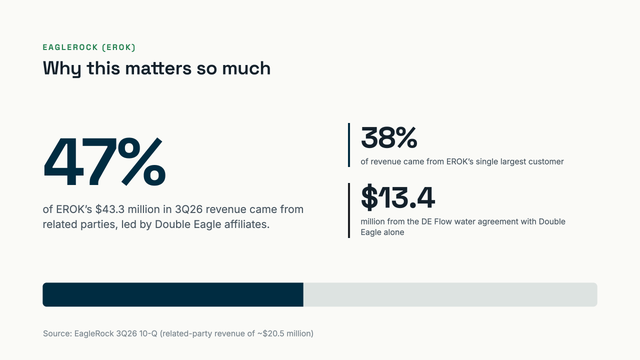
Nearly half of EagleRock's revenue is tied to a company that just sold its Midland drilling business to one of the largest operators in the Permian.
Deep Blue: Diamondback's Own Water Network
And this is where my friend's tweet gets really clever.
Just six days before the Double Eagle deal, Diamondback and KKR agreed to buy Five Point Infrastructure's 70% stake in Deep Blue Midland Basin, which is a water infrastructure network managing more than 2.2 million barrels of water per day. Diamondback already owned the other 30%. Once the deal closes, Diamondback and KKR will own Deep Blue 50/50. Note that Five Point is also the company behind LandBridge (LB) and WaterBridge (WBI).
The price wasn't disclosed. According to a Reuters source, it's roughly $2.1 billion for the 70% stake. That implies roughly $3 billion for the whole thing. KKR is funding its part mainly through KKR Global Infrastructure Investors V.
On its 3Q26 call, Van't Hof talked about Permian "mega themes" like power, data centers, and gas demand. He also said this:
"A company like Diamondback out in West Texas can aid in that process, whether it's we own surface, we control gas, we can work with midstream partners to get to sites." - Diamondback 3Q26 Earnings Call
So, here's the situation:
Diamondback now co-owns one of the biggest water networks in the Midland Basin.
It is (very likely) buying acreage whose water needs are dedicated to a different water system, owned by EagleRock.
It owns surface rights itself and is close to launching a power project on its Bryant Ranch, which has "water and gas teed up and ready to go."
If I'm Diamondback, I'm not thrilled about paying a toll to someone else's system when I have my own next door.
And when a company with a balance sheet doesn't like paying a toll, it usually has two options: live with it, or buy the toll booth.
Who Could Buy EROK? Three Scenarios
Let me be clear: I'm not predicting a deal. These are scenarios. Think of them as food for thought.
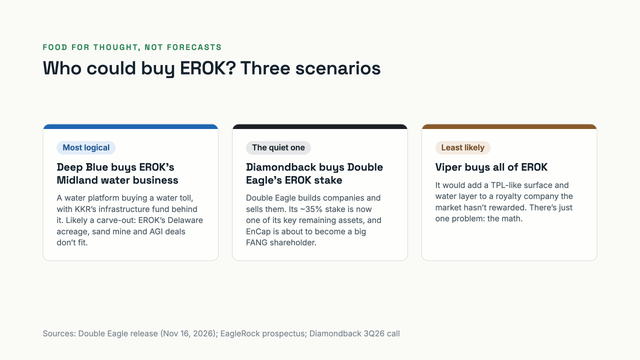
Scenario One: Deep Blue Buys EagleRock's Midland Water Business
In my humble opinion, this is the most logical scenario.
Deep Blue is a water business buying a water business. KKR's infrastructure fund is the perfect owner for fee-based, long-duration water royalties. And it would end the awkward situation where Diamondback's acreage is dedicated to someone else's pipes.
The problem is that Deep Blue only cares about the Midland Basin. Most of EagleRock's acreage is in the Delaware Basin (New Mexico and Texas). EagleRock's sand mine on Intrepid Ranch, its New Mexico acid gas injection deals (AGI wells, where midstream companies inject waste gas underground), and its power ambitions don't fit Deep Blue.
So, if this happens, I would expect a carve-out of the Midland water system. A takeover of the entire company seems less likely. That could still be a great outcome for EROK shareholders if the price reflects the multiple infrastructure buyers pay for this kind of asset.
Scenario Two: Diamondback Buys Double Eagle's Stake
This is the quiet scenario.
Class B units (mostly held by the pre-IPO owners) represent roughly 80% of EagleRock's total shares. Double Eagle alone owned roughly 35% at the IPO.
The Double Eagle team builds companies and sells them. That's their business model. Now that most of their Midland drilling assets are going to Diamondback, their EagleRock stake is one of their most important remaining assets.
They could keep it. They still run a multi-rig program in Reagan County, and they may start yet another Double Eagle venture with EagleRock as its land and water partner.
Or they could sell it. And the most natural buyer for a block of EagleRock is the company that now operates on its dedicated acreage.
Funny enough, incentives are lining up. EnCap, the private equity firm backing Double Eagle, said it looks forward to "becoming a significant shareholder" of Diamondback.
Scenario Three: Viper Buys EagleRock
This is the scenario my friend mentioned, and it's the one I find the most interesting to think about - and it isn't even close.
Viper owns mineral and royalty interests in the Permian. In 3Q26, it generated $596 million in adjusted EBITDA and $520 million in free cash flow. It has $2.4 billion in net debt, and roughly 38% of its royalty acreage is operated by Diamondback.
Here's the thing, though.
Viper recently switched to a fixed $0.50 per share quarterly dividend, moving away from its old variable payout. That's a clear signal it wants to attract long-term income investors.
And Diamondback is not happy with how the market values Viper (this is super important to understand). On the 3Q26 call, Van't Hof said this when asked about using Viper for data center deals:
I think we could debate if Viper has a lower cost of capital right now than Diamondback. I think the market hasn't rewarded Viper as much as it should have this year. - Diamondback 3Q26 Earnings Call
So, what would make the market reward Viper?
Look at TPL. It has minerals, surface, and water, and its premium valuation is built on the fact that its surface and water businesses aren't purely tied to oil prices. So many people ask me why TPL never seems to be cheap. Well, this is the answer. And it also doesn't have any debt. That helps, too.
Adding EagleRock's surface and water business would give Viper a "TPL layer." That's fee-based revenue that doesn't depend directly on oil prices. It fits a fixed-dividend story. And Diamondback has used Viper's balance sheet to get "some significant deals done" this year, as Van't Hof put it.
There's just one problem: the math.
The chart below comes from EagleRock's own investor presentation.
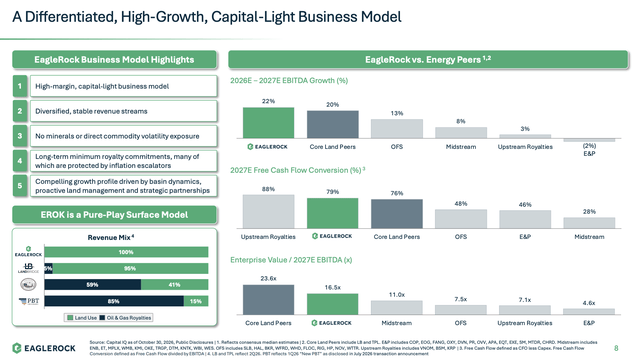
As we can see:
Core land peers (LB and TPL) trade at 23.6x 2027E EBITDA, with expected 2026-2027 EBITDA growth of 20%.
EagleRock trades at 16.5x, with expected growth of 22%.
Upstream royalty companies (VNOM, Black Stone Minerals (BSM), Kimbell Royalty Partners (KRP)) trade at 7.1x, with expected growth of 3%.
E&Ps, including Diamondback, trade at 4.6x.
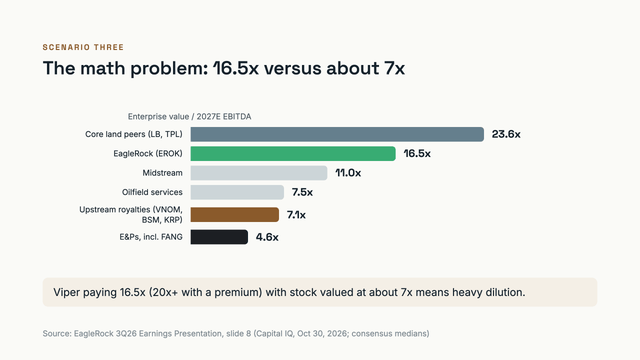
If Viper used its own shares, it would be buying a company valued at 16.5x EBITDA with a currency valued at roughly 7x. Add a takeover premium of 25-30%, and Viper would be paying more than 20x. That's a lot of dilution.
That only works if the market re-rates Viper because of the deal. That is possible, but that's a bet on sentiment, and Diamondback doesn't like those bets - in general.
Moreover, Van't Hof said something else on the call that I don't want to ignore:
...public-to-public or large-scale M&A seems harder to get done in this environment than easier. - Diamondback 3Q26 Earnings Call
EagleRock is a public company. So, while I love the idea, I agree with my friend: it's a low-probability scenario. Scenarios one and two make much more sense.
EagleRock Is Interesting Even Without A Takeover
I would never buy a stock because of takeover speculation alone. So, let's look at EagleRock as a standalone business.
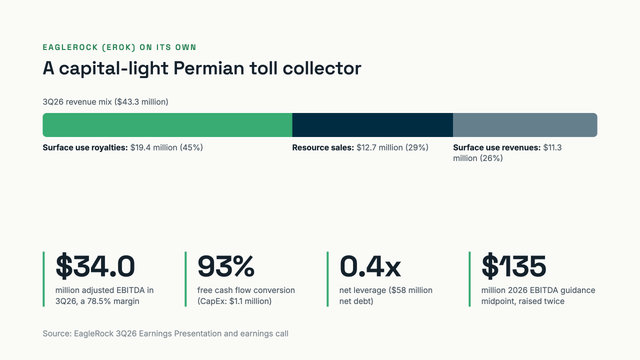
In 3Q26, EagleRock generated $43.3 million in revenue:
Surface use royalties: $19.4 million (45% of revenue). These are royalties from produced water takeaway, recycled water, disposal wells, and more.
Resource sales: $12.7 million (29%). This is mainly brackish water (non-drinkable groundwater used in fracking) and caliche (a hard sedimentary material used to build roads and well pads).
Surface use revenues: $11.3 million (26%). These are easements, access fees, pipeline and power rights, and similar payments.
Adjusted EBITDA came in at $34.0 million, a 78.5% margin. CapEx was just $1.1 million, which means free cash flow was $31.8 million. That's 93% of EBITDA converted into free cash flow. I know I say this a lot, but think about that for a second.
The company raised its 2026 EBITDA guidance for the second time to $133-137 million. For 2027, it expects 20% organic growth from its original 2026 baseline of $122 million. That's roughly $146 million before acquisitions and before the new Double Eagle dedication.
Management made it very clear it believes analysts are too low:
If I sit here looking at where I believe 2027 will end, I think estimates for 2027 in my mind, look conservative. - EagleRock 3Q26 Earnings Call
On top of that, the company has a lot going on:
A sand mine lease on Intrepid Ranch adds a royalty on sand volumes and extra water sales at no cost.
It signed one of two late-stage AGI deals in New Mexico on the day of its earnings call.
It says it's "making real progress on a power solution" on its land.
It pays down roughly $10 million in debt per month. Net debt is just $58 million (0.4x EBITDA).
There's also an important safety net that I want to highlight. The original DE Flow water agreement comes with a minimum royalty commitment of $40 million per year for the first five contract years (and $10 million per year for the last five). That's roughly 30% of this year's EBITDA guidance, guaranteed through roughly 2031, regardless of who drills the acreage.
So, what's it worth?
I cannot guarantee anything, but here's how I think about it.
Using the presentation numbers ($2.7 billion enterprise value at 16.5x), consensus 2027 EBITDA is roughly $164 million. If EagleRock simply traded at 20x 2027 EBITDA, which is still below LB and TPL, its enterprise value would be roughly $3.3 billion. That's roughly $24-25 per unit (on roughly 131.5 million total units). At the peer multiple of 23.6x, it would be closer to $29.
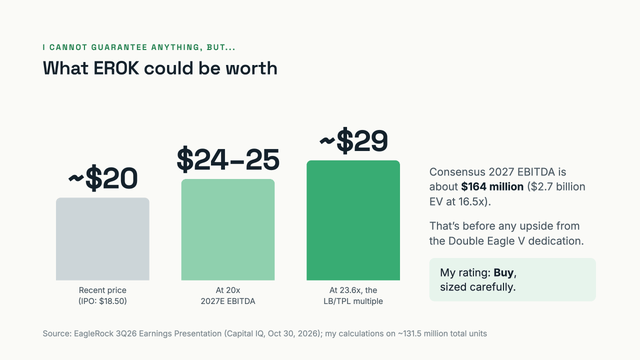
That compares to a price of roughly $20 recently (and an IPO price of $18.50). And that's before any upside from the Double Eagle V dedication, which management called "one of the most important things we've probably announced since inception."
As many of you know, I own LB and TPL. They represent a big chunk of my portfolio, so I don't need a third Permian land company. But EROK has been on my watchlist as a cheaper way to get LB-like exposure, and today's news makes it even more interesting.
I give EROK a Buy rating for investors who understand that this is a young, concentrated company with sponsor overhang. Needless to say, position sizing matters here.
Diamondback And Viper - Quick Thoughts
Since this article covers all three companies, let me briefly share my take on the other two.
Diamondback is one of the best-run E&Ps in the world, with what it calls the lowest cost structure in the basin. At 4.0x 2027 EBITDA, the Double Eagle deal looks like a good use of capital, especially with oil averaging roughly $95 this year, according to management.
Van't Hof also said he's "more in the higher for longer camp" when it comes to oil, which is in line with our long-standing view at Main Street Alpha. Needless to say, I like that.
The downside is that Diamondback is an E&P. Its cash flow depends on oil prices, and E&Ps trade at the lowest multiples in the energy sector for a reason. It's a great operator, but it doesn't check the boxes of my TOLL framework.
Viper is the income play. A fixed $0.50 quarterly dividend comes to $2.00 per year, a yield of roughly 4.4% based on where the stock traded after earnings. On top of that, it buys back shares. And it benefits from the fact that roughly 40% of the Permian's rigs were running on its acreage in 3Q26.
The risk is that Viper is a royalty company. Unlike surface landlords, it is directly exposed to oil and gas prices. That's why it trades at roughly 7x EBITDA, while surface landlords trade at 16-24x.
If Diamondback ever gives Viper a surface and water layer, Viper becomes the stock to watch. For now, I see it as a solid income stock with Diamondback's support.
Takeaway
In the Permian, the people who own the land usually win. That's the lesson of Landman, and it's the lesson of my own portfolio.
Diamondback just paid roughly $5 billion for Double Eagle's Midland assets, 13 days after Double Eagle dedicated 35,000 acres of water needs to EagleRock, and six days after Diamondback agreed to take over half of Deep Blue. That very likely makes Diamondback EagleRock's most important customer, with its own water system next door.
Will someone buy EagleRock? I don't know. The most logical buyer is Deep Blue, likely for a Midland carve-out. The quietest path is Diamondback buying Double Eagle's stake. And the most exciting (but least likely) path is Viper buying the whole company to add a TPL-like surface layer, which the math makes very difficult.
Either way, EagleRock is a high-margin, capital-light Permian landlord trading at a big discount to LB and TPL, with similar growth.
Personally, I love situations like this. The best ideas are often hidden in 10-Qs and call transcripts.
As for me, I'll keep my LB and TPL. But EROK just moved up my watchlist.
Stay tuned!
Sign in to leave a comment and join the discussion.
Sign Up Free