Seoul's Investment: Korea Balancing Washington, Beijing and Tokyo
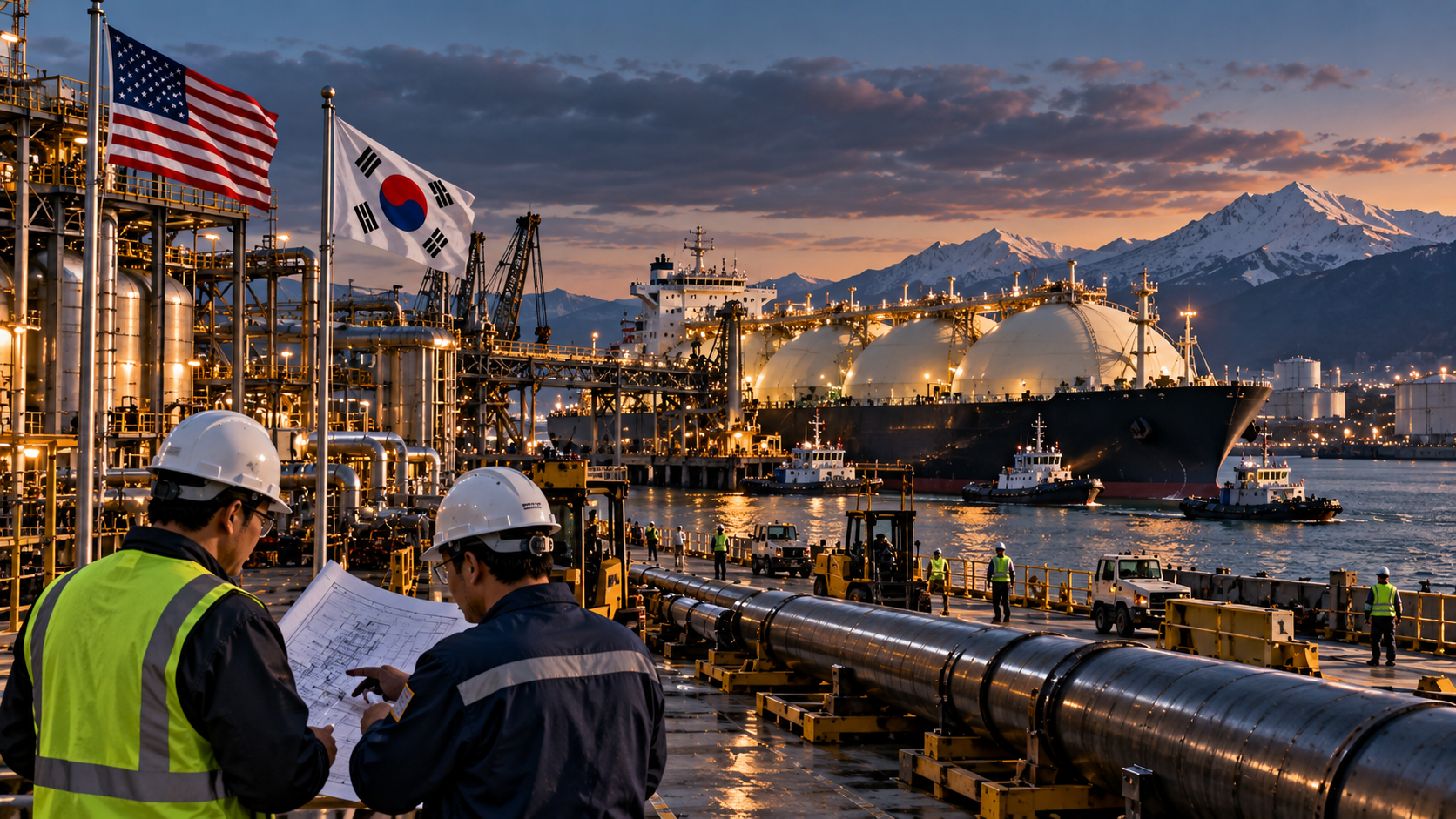
- Seoul pledged $350 billion of US investment but conditions projects on commercial viability - state must recover capital, agree return splits and absorb losses
- National Assembly capped outbound US investment at $20 billion annually, so the $350B program spans years and frustrates Washington's calendar-driven expectations
- Only the Texas gas plant (~$22.3B) is approved; Alaska LNG last public estimate $44B+ and eight reactors remain under Seoul's commercial viability review
Oct 23, 20264:04 PM ET120
Korea has pledged $350 billion of US investment in exchange for lower tariffs, and the first projects arrived with a condition Washington did not expect. Seoul will undertake only projects that are "commercially reasonable." The state must be able to recover its capital, agree on how returns are split and absorb losses if a project fails. That test is the binding constraint on the package, and it has nothing to do with China. The wager is that Korea funds projects that return cash and strengthen its own grid, and resists projects that move capital and risk onto American balance sheets. The October 1 announcement made the sequencing visible. President Trump said Korea would invest "up to $200 billion," including a $54 billion pipeline for Alaska LNG, a gas-fired plant in Texas and eight nuclear reactors. Seoul's industry ministry replied that "No decision has been made on whether to invest or on the size of the investment." President Lee Jae Myung said the commercial viability of the LNG project and the reactors must be confirmed before either proceeds. The Texas plant, at roughly $22.3 billion according to briefing materials cited by Politico, is the only project Seoul has approved. Alaska and the reactors remain under review. The Constraint Is Financial The National Assembly capped annual outbound investment to the US at $20 billion in March, according to Politico. At that cap, the full $350 billion runs well beyond the end of Trump's current term. Washington announces in calendar years, and Seoul disburses through legislative budgets. The mismatch is structural, and it explains why the pace has frustrated the administration. Alaska LNG shows the cost of that mismatch. The project's last public estimate was $44 billion, and the developer, Glenfarne, says costs have risen since. Glenfarne has signed no binding supply contracts. Japan's JERA and Tokyo Gas have signed preliminary agreements for a combined 2 million metric tons a year if the project is built. The Commerce Department fact sheet says the US "intends to provide assurances, to the extent possible" on offtake at economically viable prices. Washington would therefore carry part of the commercial risk that Seoul is declining to accept on its own books. Alaska's congressional delegation and the developer gain a financing anchor. The Korean state-run funds gain the power to set terms. American taxpayers carry the downside if LNG demand weakens during the 20-year delivery window. Semiconductors: The Investment Korea Prefers Chip investment follows a different logic. Samsung and SK hynix are building US capacity on commercial terms, outside the $350 billion package. SK hynix is building a $4 billion advanced packaging plant at Purdue University's West Lafayette site in Indiana. Samsung is investing a combined $37 billion at its Texas site, where its first Taylor foundry factory is scheduled to come online next year, according to Korea JoongAng Daily. Washington wants more. The Joongang Ilbo reports that a second round of US semiconductor tariffs would tie exemptions to local production, following the arrangement Washington reached with Taiwan. Lee has said that further US expansion "is a matter related both to the business decisions of the companies concerned and to South Korea's industrial strategy." That sentence describes a government that will weigh each request against its own domestic cluster. Memory economics explain the resistance. DRAM and NAND depend on dense clusters of equipment and suppliers, and moving that ecosystem to the US would raise costs for chipmakers and, through server prices, for American data center buyers. China: A Condition Routed Through Washington Reuters reported on October 14, citing two people familiar with the matter, that SK hynix is "seeking approval from Washington to export US chipmaking equipment to China to increase production there as a condition for building a factory in the US." The company seeking the license is Solidigm
Sign in to leave a comment and join the discussion.
Sign Up Free