
Introduction
Every REIT investor owns a business they never bought.
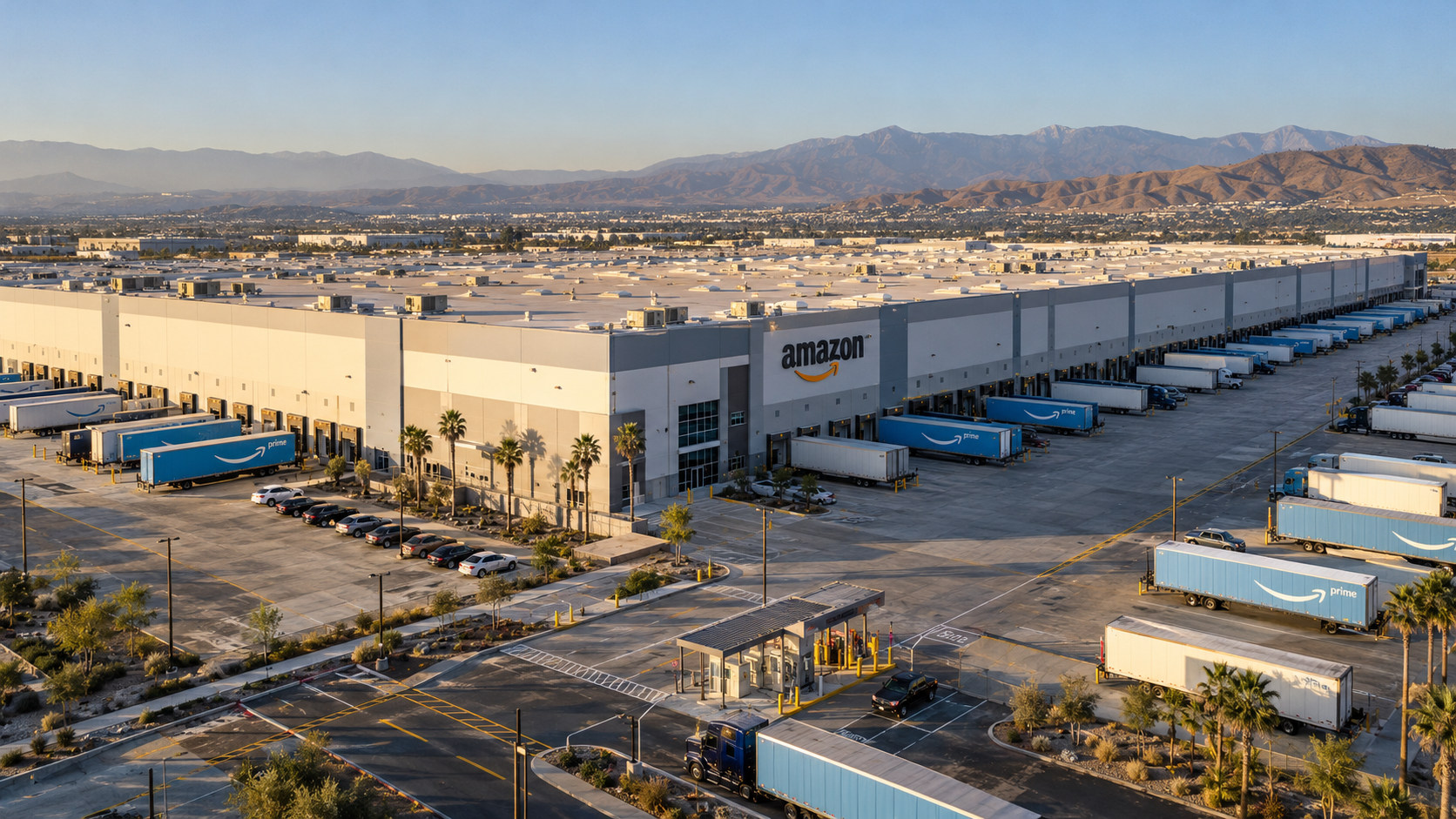
When you buy a net lease REIT, you buy the rent checks of hundreds of retailers. When you buy Prologis (PLD), you own a slice of Amazon's (AMZN) logistics network. When you buy a casino landlord, you are, essentially, lending money to casino operators with a building as collateral.
Most investors don't think about REITs this way. But it opens up a very useful question.
If I like a business, should I own the business itself, the real estate it operates from, or both?
It's also the natural follow-up to yesterday's article on the "hidden bond" in our portfolios. REITs are the textbook example of stocks that behave like bonds. Some deserve that label. Others don't.
In this article, I'll explain where rent sits in the pecking order, share my six-point landlord scorecard, and apply it to four pairs: Agree Realty (ADC) and Home Depot (HD), Prologis and Amazon, VICI Properties (VICI) and Caesars (CZR), and the towers and the carriers. Two come with live stories: Caesars is being taken private, and the towers may have just found a new tenant in SpaceX (SPCX).
So, let's dive in!
Who Gets Paid First
You know I like to keep it simple.
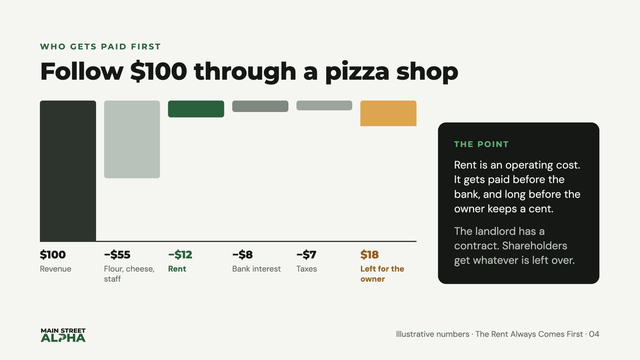
That's why we start with a pizza shop.
Before the owner sees a cent of revenue, the shop pays for flour, cheese, staff, and rent, among other things (but you get the point). Rent is an operating cost. It gets paid before the bank, and long before the owner. That's the entire idea behind this article.
To measure how safe that contract is, landlords use a metric called rent coverage. It's the tenant's EBITDAR (earnings before interest, taxes, depreciation, amortization, and rent) divided by the rent it pays. A coverage ratio of 2.0x means the tenant could see its operating cash flow cut in half and still pay the rent.
Let's assume a tenant generates $150 in EBITDAR and pays $100 in rent.
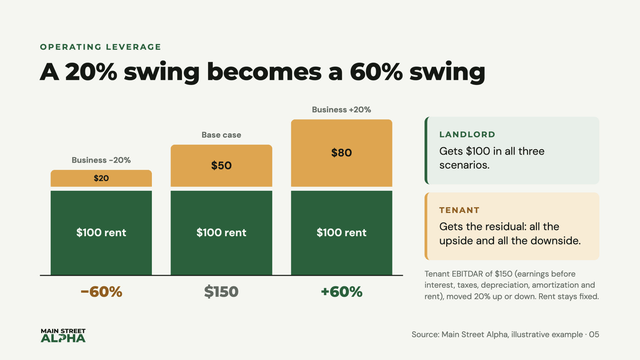
The landlord gets $100 in all three scenarios.
The tenant sees a 20% move in its business turn into a 60% move in what's left for shareholders. That's operating leverage (a fixed cost magnifying changes in revenue), and rent is one of the highest fixed costs out there.
As most of you know, owning the landlord means owning a senior, predictable stream of cash. Owning the tenant means owning the residual. There's just one problem with the landlord side. A lease is only as good as the tenant's ability, and willingness, to pay. In a U.S. bankruptcy, a tenant can reject leases it doesn't want. It will keep the profitable stores and hand back the keys to the bad ones.
The landlord owns the toll booth. The tenant owns the truck. If the truck has a great year, the toll booth still charges the same toll. If the truck breaks down, the toll booth needs another truck.
The Landlord Scorecard
Whenever I look at a REIT and its tenants, I go through six questions.
# | Question | What I Want To See |
|---|---|---|
1 | Coverage: how easily can the tenant pay? | Comfortably above 1.5x; anything near 1.0x is a red flag |
2 | Criticality: would the tenant fight to keep this site? | Profitable, hard-to-replace locations |
3 | Lease structure: what exactly did the tenant sign? | Net leases and master leases, backed by guarantees |
4 | Escalators: how does rent grow? | CPI-linked or market resets beat flat 1% bumps |
5 | Concentration: who pays most of the rent? | No single tenant the REIT can't live without |
6 | Spread: what does new growth earn? | Acquisition yields well above the cost of capital |
Source: Main Street Alpha
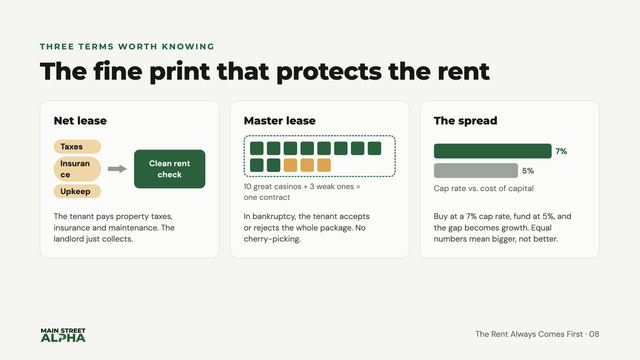
A net lease means the tenant pays property taxes, insurance, and maintenance. The landlord collects a clean check.
A master lease bundles many properties into one contract. In bankruptcy, the tenant has to accept or reject the whole package, so it can't keep the great casinos and dump the weak ones. And when a tenant gets sold, the lease and usually its guarantee move to the new owner.
Moreover, and this is extremely important, the spread is the engine of REIT growth. If a REIT buys a property at a 7% cap rate (annual property income divided by the purchase price) and funds it at 5%, the difference creates growth for shareholders. If the cap rate and the cost of capital are the same, the REIT is just getting bigger without getting better.
That's also why interest rates matter so much. Everyone can buy a property, but not many can get financing that leaves a decent margin. It explains why so many assets are being foreclosed on right now, as people thought they could buy cheap homes and make money on platforms like Airbnb. Initially, it worked. However, refinancing at 7% rates erased their margin.
Sign in to leave a comment and join the discussion.
Sign Up Free