Introduction
Every now and then, I come across a stock where the business and the stock price seem to live on different planets.
Uber Technologies (UBER) is one of them.
Over the past twelve months, gross bookings grew by more than 20% in every single quarter. Free cash flow passed $10 billion for the first time in company history. The share count went down. The CEO bought roughly $10 million worth of stock in the open market.
And the stock? It fell 28%.
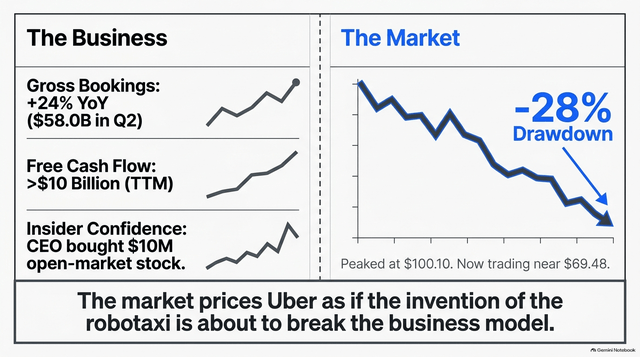
It's a bit like owning a hotel that's fully booked every single night, while the market prices it as if someone is about to invent teleportation, as silly as that may sound.
In this case, "teleportation" is autonomous driving. The market is worried that once the driver disappears, the companies that own the robotaxis will no longer need Uber.
What makes this so interesting is that some of the best investors on the planet are on opposite sides of this trade. Bill Ackman added to his position. David Tepper added to his. At the same time, Uber was one of the most-sold stocks among hedge funds in the second quarter.
Somebody is going to be very wrong here.
As most of you know, I don't own Uber. I'm a "toll road" guy who loves scarce physical assets, and Uber owns basically nothing. However, after running it through our new PLOW+M framework, I came away with a 70/100 score and one of the most fascinating long-term stories in the market.
In this article, I'll cover the smart money, the one question that decides the thesis, Uber's $10 billion pivot, valuation, and the dashboard I'm using to decide if and when I buy.
So, let's dive in!
The Smart Money Is Split On Uber
Let's start with Bill Ackman, because he's the name everyone brings up.
Pershing Square first bought roughly 30.3 million Uber shares in the first quarter of 2025. Back then, Ackman called it one of the best-managed and highest-quality businesses in the world.
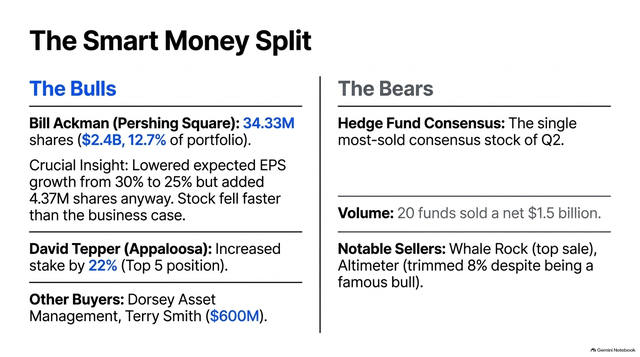
Since then, he has bought more. According to its most recent 13F filing, Pershing Square held 34.33 million shares as of June 30, 2026, after adding roughly 4.37 million shares in the second quarter (+14.6%). That made Uber the fund's largest disclosed position at roughly 12.7% of the reported portfolio. At today's price, that stake is worth roughly $2.4 billion.
Here's the part I found most interesting. When Pershing Square started buying, its thesis was built on 30% or greater annual EPS growth over the medium term. In its semiannual report released in August, that expectation was lowered to 25% per year over the next three to five years.
So, the biggest bull in the room lowered his growth assumption and bought more shares anyway. That tells me Ackman believes the stock has fallen a lot more than the business case.
He's not alone:
David Tepper's Appaloosa increased its stake by roughly 22% in the second quarter, making Uber its fifth-largest position.
Pat Dorsey's Dorsey Asset Management listed Uber among its top buys.
Terry Smith's Fundsmith owns roughly 8.9 million shares, worth more than $600 million.
And yet, the other side is just as loud. Whale Rock listed Uber among its top sales. Brad Gerstner's Altimeter, one of the most famous Uber bulls of the past few years, trimmed its stake by 8%. And one tracker that monitors 144 hedge funds found that Uber was the single most-sold consensus stock of the quarter, with 20 funds selling a net $1.5 billion.
A quick lesson, as many investors misread these filings. A 13F is a quarterly report that every U.S. investment manager with more than $100 million in assets has to file with the SEC. It shows long stock positions on the last day of the quarter and is filed up to 45 days later. It usually doesn't show short positions, hedges, or most options. In other words, it tells us what someone owned six weeks ago, not what they own today.
That's why I pay more attention to insiders, who have to report trades within two business days. On September 10, CEO Dara Khosrowshahi bought 141,000 shares at roughly $70.96, which was his first open-market purchase since 2022. In February, CFO Balaji Krishnamurthy bought roughly $1.6 million worth of stock.
Executives sell stock for many reasons (taxes, diversification, a new house). They usually buy for one reason, and that reason is that they expect the company to be worth more at some point in the future.
What Uber Actually Is - A $142 Billion Company With Almost No Assets
Uber is a demand aggregator.
This means it doesn't own cars, it doesn't employ drivers, and it doesn't cook food. It owns the app that connects people who want something (a ride, a burger, groceries) with people who can provide it. Every time those two sides meet, Uber takes a cut. It's basically one of the cornerstones of the gig economy. I'm not sure if that's a great thing for society (the gig economy), but it is what it is. I don't make the rules.
And the scale is ridiculous, with more than 300 million trips per week.
Metric | 2Q26 | 2Q25 | Change |
|---|---|---|---|
Gross bookings | $58.0 billion | $46.8 billion | +24% |
Trips | 3.87 billion | 3.27 billion | +18% |
Monthly active consumers | 208 million | 180 million | +16% |
Revenue | $14.19 billion | $12.65 billion | +12% |
Adjusted EBITDA | $2.82 billion | $2.12 billion | +33% |
Source: Uber 2Q26 earnings release
Revenue growth of 12% looks weak next to 24% bookings growth, but that's mostly accounting. A change to its business model in the United Kingdom reduced revenue by $1.1 billion in the quarter without touching bookings or profits.
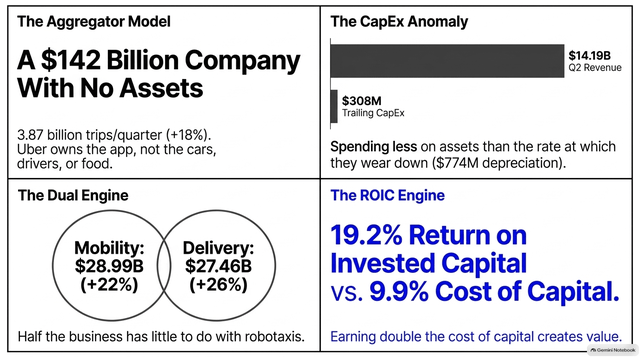
What I like most is the balance between its two engines. Mobility bookings grew 22% to $28.99 billion. Delivery bookings grew 26% to $27.46 billion. Keep that in mind, as roughly half of the business has very little to do with the robotaxi debate.
Then there's Uber One, which is its membership program, with more than 50 million members who account for roughly half of all bookings. It's basically a Costco membership for getting around town.
Now, here's what makes Uber so unusual.
Over the past twelve months, Uber spent just $308 million on CapEx, or 0.6% of revenue. Depreciation was $774 million. In other words, Uber spends less on its asset base than the rate at which that asset base wears down. If you showed me those two numbers without context, I would assume I'm looking at a company in slow liquidation.
Instead, bookings grew 24%.
That's the beauty of an aggregator. When Uber enters a new city, it doesn't need to build anything. It spends money on marketing and incentives, which go straight through the income statement. The result is a return on invested capital (how much profit a company makes on every dollar invested in the business) of 19.2%, compared to a cost of capital (the return investors demand to fund the business) of 9.9%. A company that earns double its cost of capital creates value. That's the simple version.
Free cash flow went from roughly $3.4 billion in 2023 (its first full year of operating profitability) to more than $10 billion over the past twelve months. Net debt is just $4.7 billion, or 1.9x EBITDA. There's no dividend, but the share count fell 2.3% over the past year.
Sign in to leave a comment and join the discussion.
Sign Up Free