
Introduction
I have been looking forward to publishing this article, as my most recent aerospace and railroad "masterclasses" were well-received. And I have to be honest: researching these topics teaches me a lot as well.
Today, we dive into yet another essential group of stocks.
I think I'm stating the obvious when I say that the U.S. power grid is the most important machine in the country. Without it, the economy would implode.
And it's running out of room.
It's why I think this may be the most important one yet. The grid sits underneath almost every theme we cover at Main Street Alpha: reshoring, AI, industrial demand, inflation, and even politics.
There's just one problem. It's also one of the most misunderstood corners of the market. Many investors buy "utilities" as a bond substitute, while others chase anything with "AI power" in the press release.
In this article, I'll follow the electron from the gas well to the server rack. I'll explain how every layer makes money, who sets the prices, where the supply chain is breaking, and which companies I believe are best positioned for income investors, growth investors, and everyone in between. I'll also score each layer using TOLL+M.
So, let's dive in!
The Spoiler: My Grid Scorecard
As usual, I'll start with the answer. Below is how I score each layer of the grid using TOLL+M (Tangible assets, Oligopoly power, Low incremental capital intensity, Long-duration cash flows, Macro alignment), with each pillar scored out of 20. I'm also giving away all tickers.
Layer | Tickers in this article | T | O | L (capital) | L (duration) | M | Total |
Gas midstream feeding power | (WMB) | 18 | 16 | 12 | 17 | 18 | 81 |
Regulated wires (transmission and distribution) | 19 | 19 | 6 | 19 | 14 | 77 | |
Merchant power generation | 18 | 14 | 11 | 13 | 18 | 74 | |
Grid equipment | 12 | 17 | 15 | 10 | 19 | 73 | |
Grid construction | (PWR) | 8 | 15 | 17 | 11 | 19 | 70 |
The result that surprised me the most is the second row.
Regulated utilities own the purest monopolies in the entire economy. Yet they score just 6 out of 20 on capital intensity. That's simply how the business model works, and understanding why is the key to the entire sector.
Follow The Electron
Here's the simplest explanation I can give. If I can't explain it to a 16-year-old (the one with the short attention span I keep bringing up), I don't understand it myself.
Step 1: Fuel. Natural gas is the largest source of U.S. electricity. It travels through pipelines from basins like the Haynesville, the Marcellus, and the Permian to power plants. Nuclear, coal, wind, and solar fill in the rest.
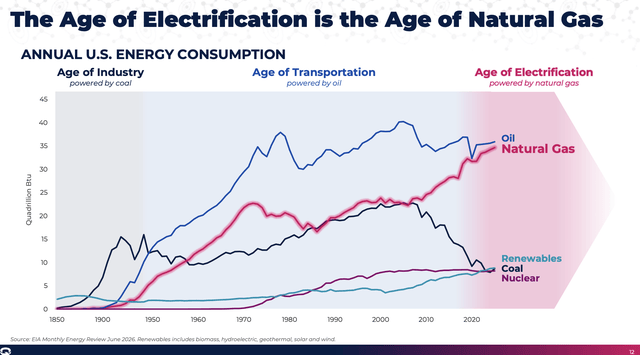
Even on a total energy consumption basis (including electricity), natural gas is about to become the biggest source, as we can see below.
Step 2: Generation. Power plants turn fuel (or uranium, wind, and sunlight) into electricity. Some plants are owned by regulated utilities. Others are owned by "merchant" generators that sell power into wholesale markets at whatever the market pays.
Step 3: Step-up and transmission. Right next to the plant, a generator step-up transformer raises the voltage so the power can travel long distances with minimal losses. It then rides on high-voltage transmission lines (345 kilovolts to 765 kilovolts). These are the interstate highways of electricity.
Step 4: Substations. Closer to cities, substations step the voltage down again.
Step 5: Distribution. Local poles, wires, and smaller transformers carry power to homes and businesses. These are the local roads.
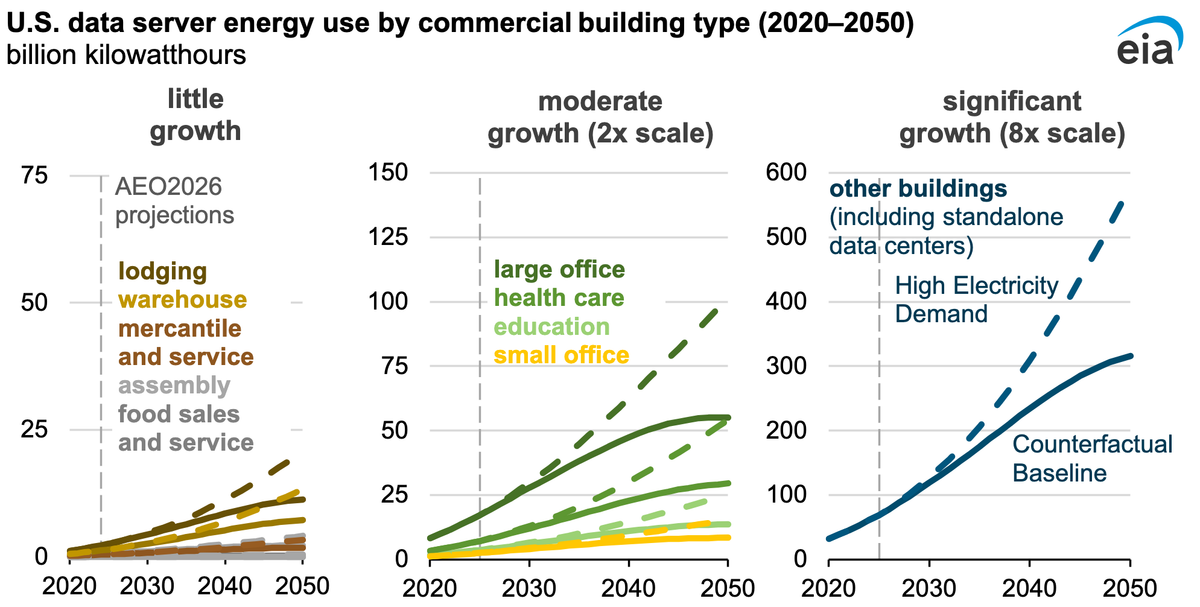
Step 6: The customer. Households, factories, and increasingly data centers, as most of you will know by now. The trend is quite something, as you can see below when it comes to data center demand growth.
Now, here's where many investors get confused.
The "grid operators" you read about in the news, like PJM (13 states plus D.C., more than 67 million people), ERCOT (most of Texas), and MISO (the Midwest), are not companies you can buy. They are non-profit organizations that run the wholesale markets, dispatch power plants, and plan the transmission system. They are the air traffic controllers of the industry.
What you can buy are the companies that own the pipelines, plants, and wires, the factories making the equipment, and the crews building it all.
One more distinction matters. In "vertically integrated" states (much of the Southeast and Midwest), one regulated utility owns the plants, the transmission, and the distribution. In "restructured" states (much of the Northeast, Illinois, and Texas), utilities mostly own the wires, while independent companies own the plants and compete in markets.
That's why two "utilities" can behave completely differently.
If you followed our railroad masterclass, one thing will sound familiar. A high-voltage line needs a right-of-way, years of permitting, and the approval of landowners, states, and regulators. Once it's built, it's practically impossible to replicate.
Sounds good, right? But that doesn't get us paid.
Sign in to leave a comment and join the discussion.
Sign Up Free