
The Underrated Value Of Friction
Roundabouts are mildly annoying.
You can't blow through them. You have to slow down, look left, wait for a gap, and merge with people who may or may not know how roundabouts work.
And yet when intersections in the U.S. are converted from stop signs or traffic lights into roundabouts, the Insurance Institute for Highway Safety finds that injury crashes fall by roughly three-quarters, and fatal crashes fall by even more.
The friction is the safety feature. Slowing everyone down is the whole point.
The people who wrote the U.S. Constitution understood this better than most. They deliberately built a system where it's hard to get anything big done quickly. James Madison put it plainly in Federalist No. 51:
"Ambition must be made to counteract ambition."
James Madison, 1788
Voters often find that frustrating. Markets tend to find it comforting.
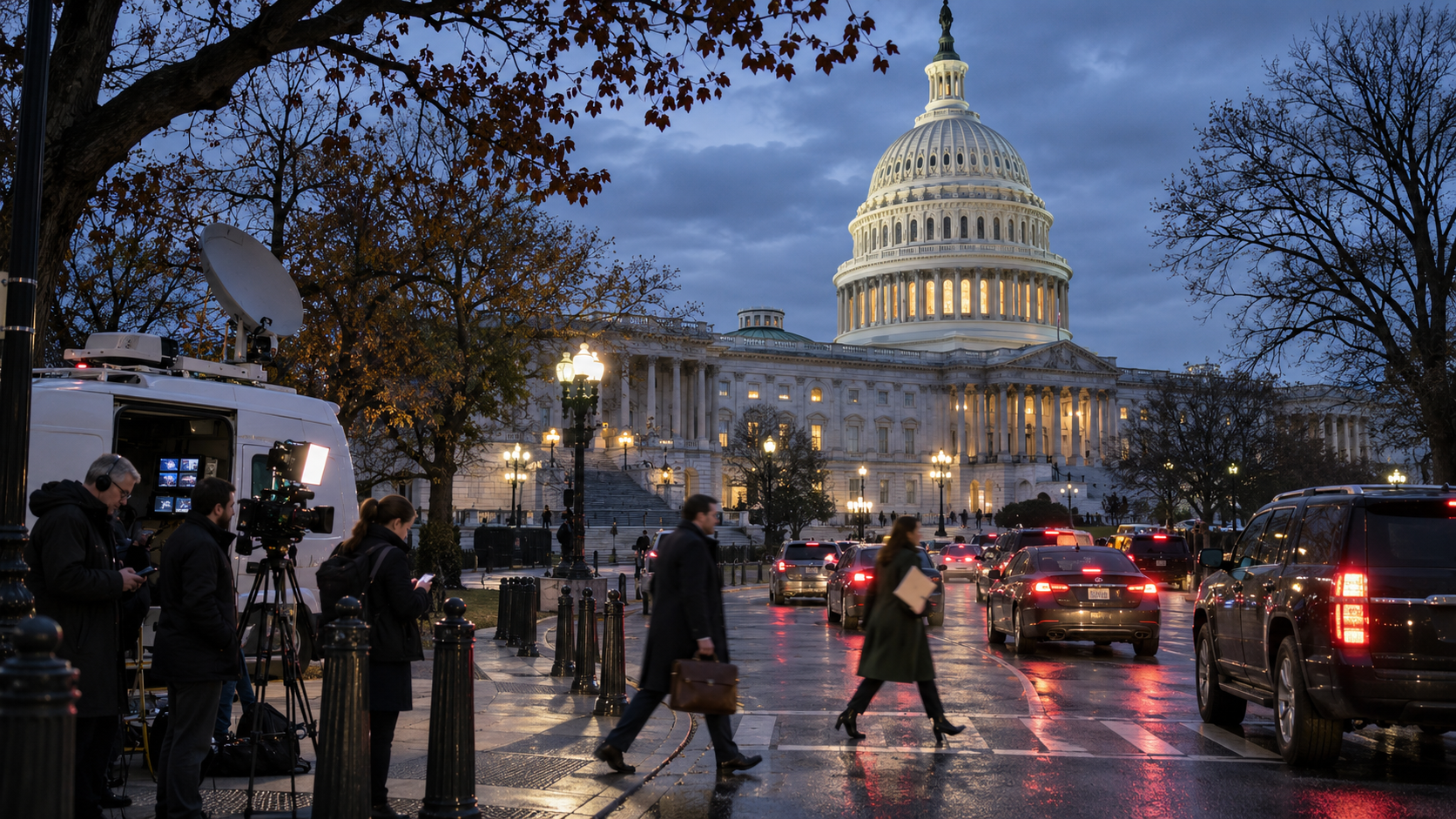
Which brings us to today. Americans are heading to the polls for the midterm elections, and the most likely outcome is a Congress that can't agree on much of anything.
Wall Street is quietly hoping for exactly that.
In this article, we'll walk through why markets like divided government, what the long-term numbers say, where gridlock stops protecting investors, and why the most important question may be the one almost every investor is skipping: if everyone already expects gridlock, who's left to buy it?
Why Investors Love A Congress That Can't Agree
When power on Capitol Hill is divided, sweeping bills tend to die before they ever reach the floor.
Big tax overhauls. Interventions aimed at specific sectors. Brand-new regulatory regimes. Each side's agenda runs straight into the other side's veto, and most of it gets neutralized by friction.
That sounds frustrating. For businesses, it's closer to a gift.
Think about a CFO trying to plan the next five years. She needs to model revenue, costs, CapEx (capital expenditures, meaning spending on things like factories, equipment, and data centers), and taxes. Under a divided Congress, she can do that without wondering whether a windfall tax suddenly lands in year three, or whether her industry becomes the target of a new regulatory regime halfway through a ten-year investment.
That's a big deal.
Companies can grow in imperfect conditions, as long as they can plan around them. A business can adapt to almost any tax rate. It struggles to adapt to a tax rate that might change every 18 months.
And investors price that in. When the range of possible outcomes narrows, the "uncertainty discount" investors apply to future cash flows gets smaller. A smaller discount means higher valuations for the same earnings. Investors pay for predictability, and they pay for it gladly.
The Numbers Back It Up
This isn't just a nice theory.
One European broker tallied S&P 500 annual returns from 1953 through 2026. Under divided government, the index averaged a gain of 14.3% per year, with positive years 81.3% of the time. Under single-party trifectas (one party controlling the White House, the House, and the Senate), the average was 9.6%, with positive years 73.1% of the time.
A large U.S. wealth manager's data series, which runs all the way back to 1928, points in the same direction: 13.5% per year under a divided Congress versus 11.4% under a unified one.
No one should treat this as a law of physics. Politics is only one input among hundreds. But two different datasets, covering different time periods, land in the same place, and the logic behind it is intuitive.
Some of the best stretches in modern market history happened under divided government.
After the 1994 midterms handed Republicans control of Congress during the Clinton presidency, Washington was about as combative as it gets. There were two government shutdowns between late 1995 and early 1996. Yet the S&P 500 rose more than 30% in 1995 alone, and the decade that followed included the first federal budget surpluses in a generation.
Messy politics. Great markets.
That combination shows up more often than people expect.
The Fiscal Side Matters Just As Much
Taxes and regulation are only half of the story. The other half is spending.
A split legislature has to bargain over appropriations, and bargaining sands the edges off both parties' wings. The largest spending programs from one side get trimmed. The deepest austerity from the other side gets softened. What survives tends to sit somewhere in the middle.
That's important because big swings in fiscal policy can move inflation, interest rates, and bond markets in ways that are very hard to predict. A Congress that can only agree on the middle of the road keeps those swings smaller.
With politicians boxed in, stock prices go back to following the things that drive them over the long run: earnings, productivity cycles, and the Federal Reserve.
That's where they should follow.
Over long periods, stock returns come from businesses growing their profits and from what investors are willing to pay for those profits. Politics can push prices around for a while. It rarely changes the long-term math. Gridlock simply makes that math easier to see.
There's Just One Problem: Everyone Knows
Here's the catch.
The gridlock trade isn't a secret.
A Democratic House combined with a Republican Senate is the outcome markets broadly expect tonight, and analysts say it's already reflected in prices.
That matters more than it seems.
Markets move on the gap between what happens and what investors expected to happen. Good news that everyone saw coming doesn't do much. It's already in the price, sitting there quietly since the polls started pointing in that direction.
This is one of the most counterintuitive lessons in investing. Being right about an outcome is only valuable if other people are wrong about it. If you correctly predict that the sun will rise tomorrow, you won't make any money, because everyone else predicted it too.
The same is true for tonight.
Gridlock Only Covers Congress
There's a second limit worth understanding.
Gridlock applies to legislation. It doesn't apply to the executive branch.
The White House keeps its grip on federal permitting, land use, and agency priorities regardless of who controls the House or the Senate. That means executive action in areas like AI and energy carries on, whatever happens in Congress.
For investors, this is a useful distinction.
Building a data center requires power. Power requires generation, transmission lines, and often pipelines. Almost every one of those projects needs federal permits, federal land access, or approval from a federal agency somewhere along the way. Those decisions largely run through the executive branch.
So while a divided Congress may freeze big tax and spending bills, it won't freeze everything. The policy engine behind the AI build-out and the energy infrastructure that feeds it keeps running through agencies and permits.
What I'm getting at is that "gridlock" is a partial description of Washington. Investors who assume nothing will change for two years may be surprised by how much keeps moving outside of Congress.
Friction Turns Into Noise When Deadlines Hit
The third limit is timing.
The same friction that stalls legislation becomes noise when hard deadlines arrive. Government funding has to be passed. The debt ceiling has to be dealt with. And when two sides who can't agree are forced to agree by a certain date, things can get loud.
One large U.S. brokerage expects more volatility around government funding and the debt ceiling under a split Congress.
History shows why.
In the summer of 2011, a divided Washington fought over the debt ceiling until the last possible moment. A deal was reached in early August, but days later, S&P downgraded U.S. government debt from its top AAA rating for the first time ever. The S&P 500 fell almost 20% from its spring high to its early October low.
It felt like the end of the world.
It wasn't. Stocks rallied in 2012, and the decade that followed was one of the best for U.S. equities on record.
Deadline fights matter a lot in the moment. But they tend to be noise around a long-term trend, and the investors who got hurt most in 2011 were usually the ones who sold in the middle of it.
So If Everyone Already Owns The Gridlock Trade, Who's Left To Buy It On Wednesday Morning?
Possibly no one.
If tonight goes the way markets expect, the most likely reaction is a shrug. The outcome is already priced, so there's no surprise to reward.
Gridlock still has value, though.
The benefit of divided government shows up slowly, over two years, in the form of things that don't happen: tax shocks that never arrive, sector interventions that never pass, fiscal swings that never materialize. Absence is hard to notice in real time. It compounds anyway.
There's also a reason why the post-midterm period has historically been kind to investors. The S&P 500 has been higher 12 months after every midterm election going back to the 1950s. Part of the explanation is simple: the uncertainty of the campaign is gone, and markets go back to focusing on earnings.
The real risk tonight sits in the outcome fewer investors are positioned for. If one party ends up with a clean sweep, markets would have to reprice a wider range of policy possibilities, in either direction. That's the surprise worth thinking about, because it's the one that isn't in prices yet.
For long-term investors, a few things are worth keeping in mind:
Trading election night is a game of guessing what others guessed. The odds of winning that game consistently are low.
Areas driven by executive action, especially energy infrastructure and the AI build-out, have their own policy engine. Congress is only part of their story.
Deadline fights over funding and the debt ceiling will likely create volatility. History suggests that volatility has usually been a better time to add than to sell.
Over the long run, earnings, productivity, and the Fed matter far more than who controls which chamber.
Takeaway
Markets like a Congress that can't agree on anything, and tonight's midterms are likely to deliver one.
The reason is simple. Gridlock kills sweeping bills, trims both parties' fiscal extremes, and gives businesses the one thing they need most: an environment they can plan around. The long-term data supports it, with divided government historically delivering higher average returns and more positive years than single-party control.
But the trade is crowded. A Democratic House with a Republican Senate is widely expected and largely priced in. Gridlock also stops at Congress, as the White House keeps driving policy in areas like AI and energy through permits, land use, and agency priorities. And deadline fights over funding and the debt ceiling could bring bouts of volatility.
So the opportunity is likely in letting the friction do its quiet work over the next two years, while prices follow what they should follow: earnings, productivity, and the Fed.
Sometimes the best thing Washington can do for investors is slow down.
Stay tuned!
Sign in to leave a comment and join the discussion.
Sign Up Free