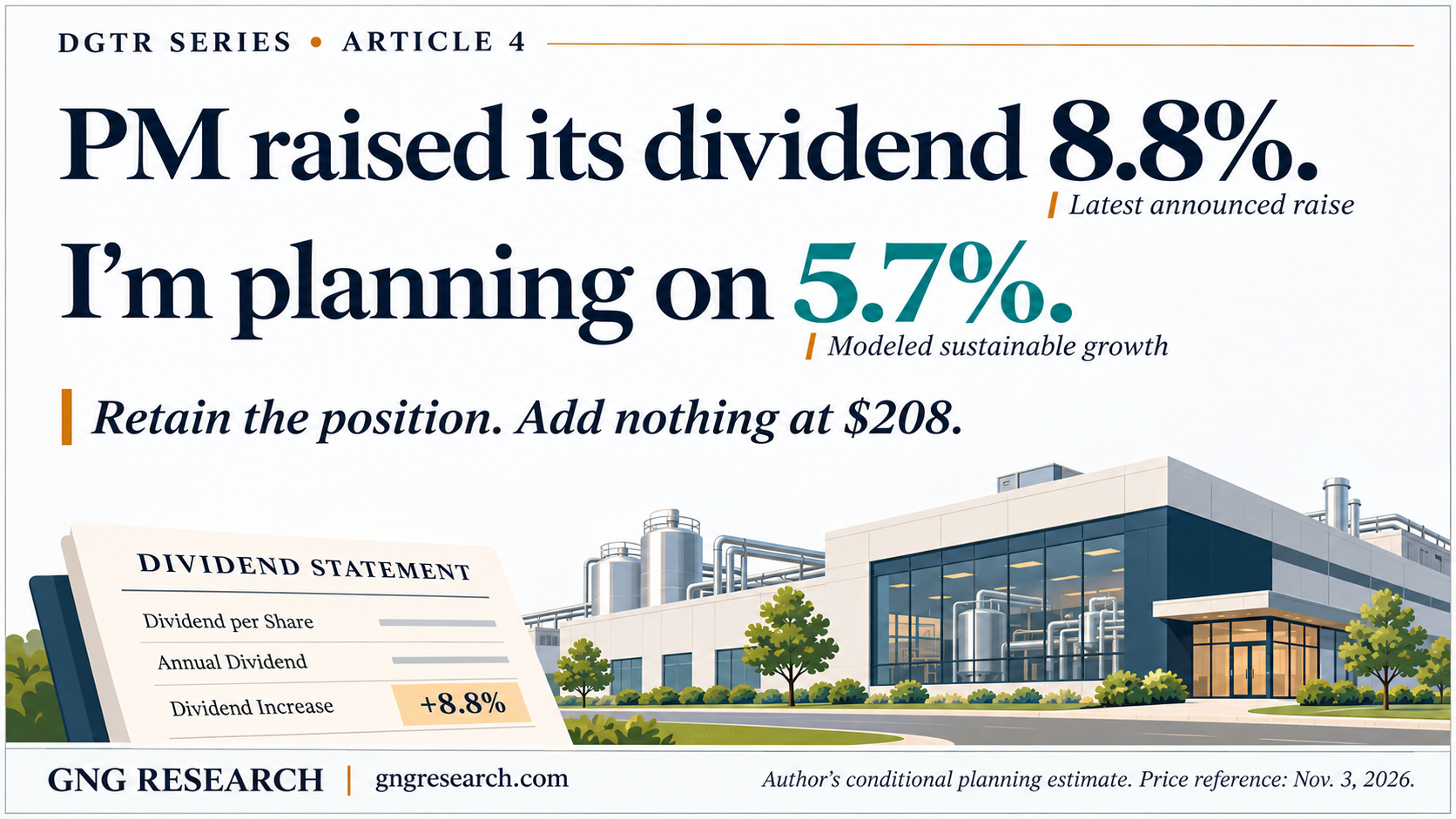

DGTR Article 4: what PM's smoke-free transformation earns, what the cash behind the check really looks like, and why I'm keeping my position without adding to it at $208.
On September 18, Philip Morris International (PM) raised its quarterly dividend 8.8% to $1.60, its 19th consecutive annual increase. On October 21 it reported quarterly adjusted operating income above $5 billion for the first time. The shares slipped 1.2% that day, then climbed to $208.03 by November 3.
I don't read much into either move. What caught my attention sat underneath the headline: this year, PM's dividend is growing faster than the cash that pays it.
So here's what I need to settle for my dividend sleeve.
Is roughly 5.7% dividend growth, bought at about 25 times earnings, enough to justify PM's place?
My answer as of the November 3 close: keep the full position, add nothing at this price, and write down now what would make me reduce it.
Three numbers drive that. My working estimate of sustainable dividend growth is about 5.7%, faster than the planning cases I used for BTI, Realty Income and VICI and still short of my 6.5% sleeve objective. After removing a one-time pension refund and payments to minority partners, free cash flow covered the dividend about 1.19 times over the first nine months, and my rough check on the new $6.40 annual rate lands near 1.1 times. And on my central cash-flow assumptions, today's price implies an annual return of roughly 7.1% to 7.7%, below the 8.5% I require for new money.
My three questions | Answer on November 3 data |
|---|---|
Is the dividend adequately covered? | Yes. Every version I calculated stays above 1.0x, but the normalized forward cushion is thin, near 1.1x. |
Is PM attractively priced for its return and risks? | Not for new money. The implied return sits below my hurdle, and that conclusion moves with the discount rate. |
Would more PM improve this sleeve? | No. It adds tobacco concentration, uses capital at a below-average yield, and no funding source improves the sleeve. |
The middle number is the one I'd want every PM holder to see. An 8.8% raise feels like momentum. Coverage near 1.1 times means the next several raises have to be funded by cash growth, with little cushion left to draw on. That's why my plan assumes 5.7%.
These are my judgments built on conditional models. Some consensus inputs lack confirmed dates and fiscal bases, so I treat valuation as a range and not as a target.
Sign in to leave a comment and join the discussion.
Sign Up Free