
Introduction
In January (before Main Street Alpha came to Seeking Alpha), we argued that the Fed was quietly being demoted from the driver’s seat. This does not mean we view the Fed as meaningless, but we think its monetary policy transmission is becoming less efficient. Our thesis was that Washington would take a more active role, using its balance sheet to steer capital into housing and AI while making it easier to borrow.
Since then, this plan has played out pretty well. Fannie Mae and Freddie Mac have stepped up their mortgage bond buying, and capital keeps pouring into AI, with Goldman Sachs expecting more than $750 billion of AI-linked debt this year. Also, banks kept credit flowing, with business loans growing at a 14.7% annualized rate in the second quarter.
QXO investors among us won't be surprised to hear that, even with the above, the housing market remains very weak. The 30-year mortgage rate has climbed from 6.01% in February to about 7.3% today, because markets, not the Fed, set long-term rates.
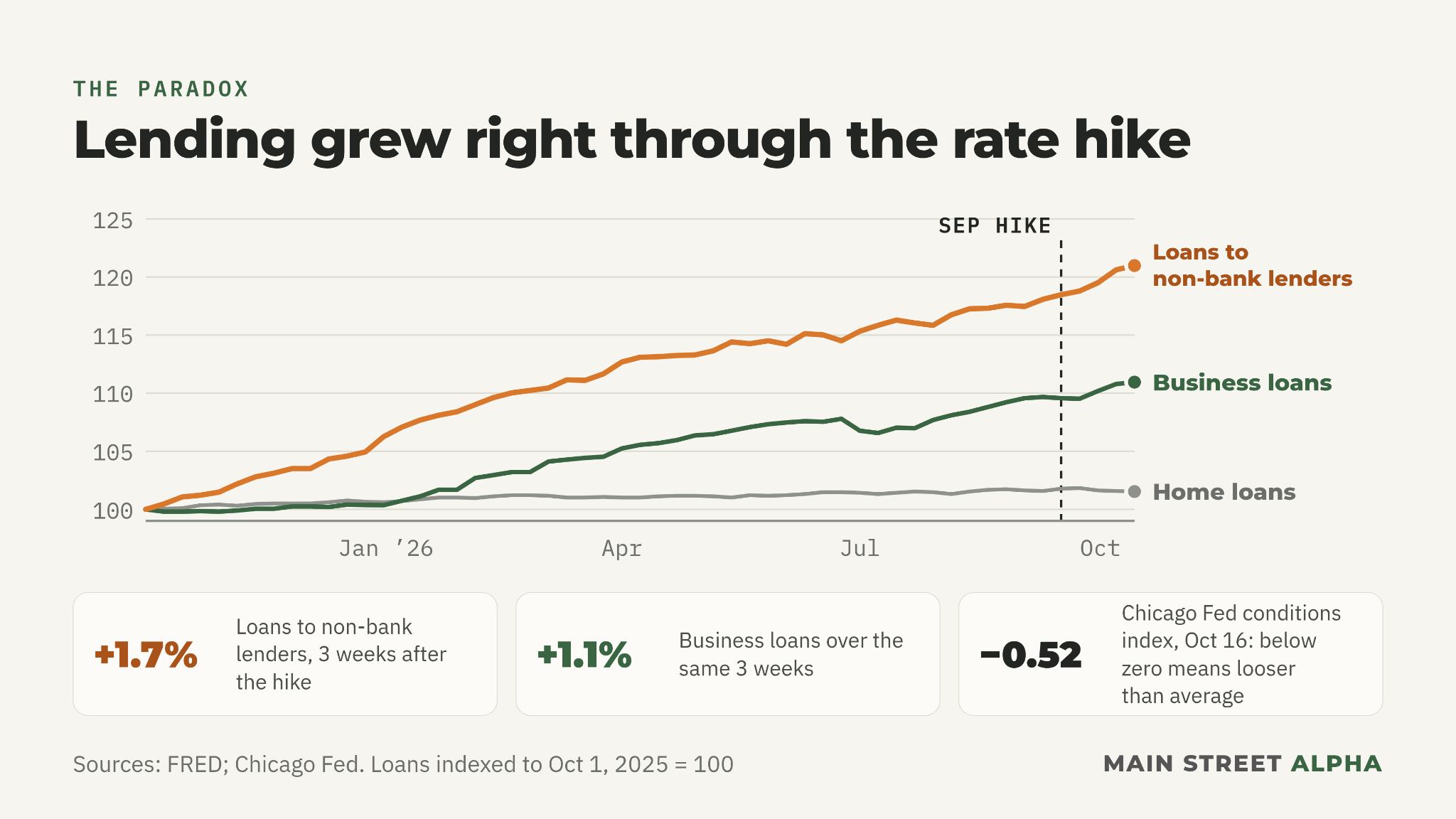
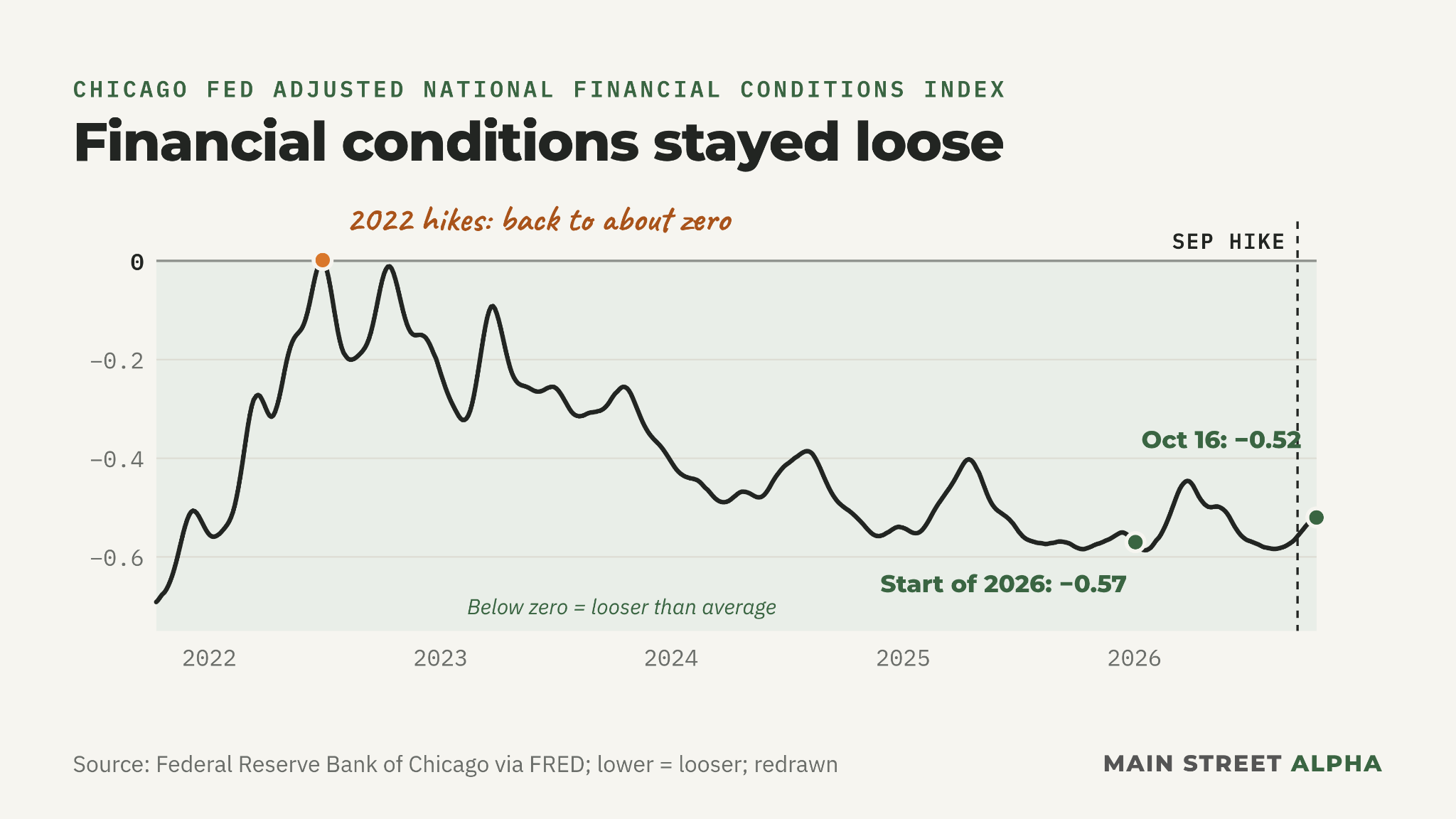
In September, the Fed hiked for the first time in about three years, yet lending kept growing as if nothing had happened. Financial conditions stayed loose too, which is unusual: during the 2022 hikes, the Chicago Fed's financial conditions index climbed to around zero.
Main Street Alpha
The Fed’s grip on the economy is loosening as private credit grows. Also, some well-known, cash-hungry companies are flooding the bond markets, driven by an insatiable need for capital to fund their expansions. Harley Bassman, who created the MOVE index of interest-rate volatility, put his finger on this in a MacroVoices interview recorded the day after the hike. In his view, private credit is taking business from banks, which weakens the Fed's grip. He argues that trust now matters more than the rate.
In this article, I’ll explain how that works, who ignores the price of money and who is quietly cracking, why it keeps rates higher for longer, and how I’m positioning for it. The Fed still has a brake, but it no longer holds the wheel, and that brake now has a lot more slack.
So, let’s dive in!
How The Fed Starves The Economy, And Why It’s Not Working Like Before
The Fed hiked rates, but lending didn’t stop. In the three weeks after the hike, loans to non-bank financial firms grew about 1.7%, and business loans grew about 1.1%. Financial conditions barely tightened either: the Chicago Fed's Adjusted National Financial Conditions Index (ANFCI) stood at -0.52 on October 16, close to the -0.57 it started the year at. In the ANFCI, a lower value means looser conditions, and a negative reading indicates conditions are looser than their historical average.
Main Street Alpha
The Old Playbook
Usually, when the Fed hikes, lending slows, so fewer loans are issued, meaning less monetary expansion and less spending. This is the classic scenario as Leo and Albert presented to us a few weeks back. The goal is to reduce debt-fueled spending and investment, which ultimately hits employment, eases buying pressure on certain goods, and can even reduce prices.
Rising rates make bank deposits more expensive because savers can earn more by investing in money market funds and Treasury bills. Higher rates also shrink the loan a borrower can qualify for. A household that spends 28% of a $100,000 income on its mortgage could borrow about $389,000 at February's 6.01% rate. At today's 7.32%, that drops to about $340,000, or 13% less.
The real pain comes when banks pull back hard, as they did in 1990–91, after the savings-and-loan collapse. The resulting credit crunch slows the economy and can trigger a recession, depending on how severe the lending pullback is.
Banks Now Lend To Lenders
Banks aren’t pulling back on lending; they are increasingly acting as upstream liquidity providers, not just direct lenders.
Fed research shows how this works. As tightening restricts bank lending, firms turn to BDCs (business development companies, the vehicles behind much of private credit), and the BDCs borrow more from the banks. During the 2022–23 tightening, bank commitments to BDCs grew 1.1 percentage points faster than commitments to other borrowers. BDCs' use of those credit lines rose 14.2 points more than other borrowers', and the rate premium they paid reached about 1.1 points.
Put simply, when the Fed tightened in 2022–23, banks steered more of their lending through BDCs rather than directly to companies. Banks like this business because the loans are senior and well secured, and they earn a premium on top. Depending on the credit facility arrangements, banks can also benefit from reduced capital requirements.
On the BDC side, tightening policy increases loan demand despite higher rates. These non-bank lenders step in to absorb unmet credit demand as banks tighten their standards. BDCs and other lenders can also offer more flexible terms, such as payment-in-kind (PIK) provisions, which borrowers often value, especially when policy is tightening.
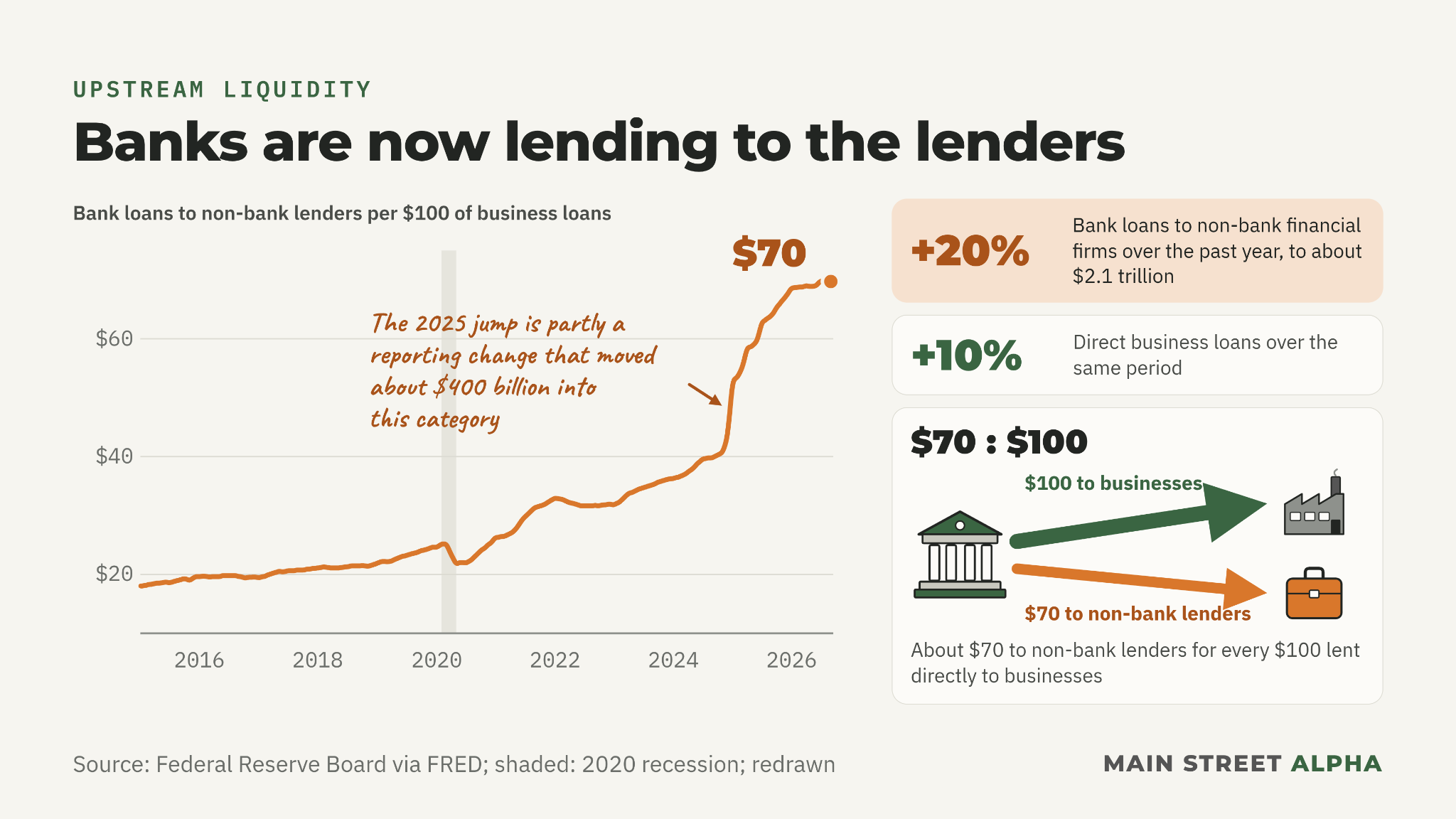
This year, banks are growing both kinds of lending, but lending to the lenders is growing twice as fast. Over the past year, bank loans to non-bank financial firms rose about 20%, to roughly $2.1 trillion. Business loans grew 10%. Banks now lend about $70 to non-bank financial firms for every $100 they lend directly to businesses.
The chart below shows these proportions; the 2025 jump partly reflects a reporting change that moved about $400 billion of existing loans into the non-bank category.
Main Street Alpha
Non-Banks Keep Raising Capital
Private credit lenders also benefit from increased activity when policy tightens. They step in wherever banks pull back, with one advantage: they use investor capital, typically locked up for years, unlike bank deposits, which can be withdrawn at any time. When rates rise, payouts increase for funds and companies that lend money, because their loan portfolios are mostly floating-rate. This attracts more capital from new and existing investors seeking extra income.
That money comes from three main places:
Institutions such as pension funds, endowments and sovereign wealth funds, which commit capital to funds for several years.
Insurers, which invest the premiums they collect on annuities and other policies.
Wealthy individuals, through semi-liquid funds and non-traded BDCs.
Insurers add a second engine. Higher rates let them offer savers better guaranteed rates on fixed annuities, boosting sales. US annuity sales hit a record $123.9 billion in the second quarter. The insurer then needs assets that pay more than it promised, and private credit fits that need. That's why the big managers have tied themselves to insurers: Apollo Global Management (APO) owns Athene, KKR & Co. (KKR) owns Global Atlantic, and Brookfield Corporation (BN) has built its own insurance business.
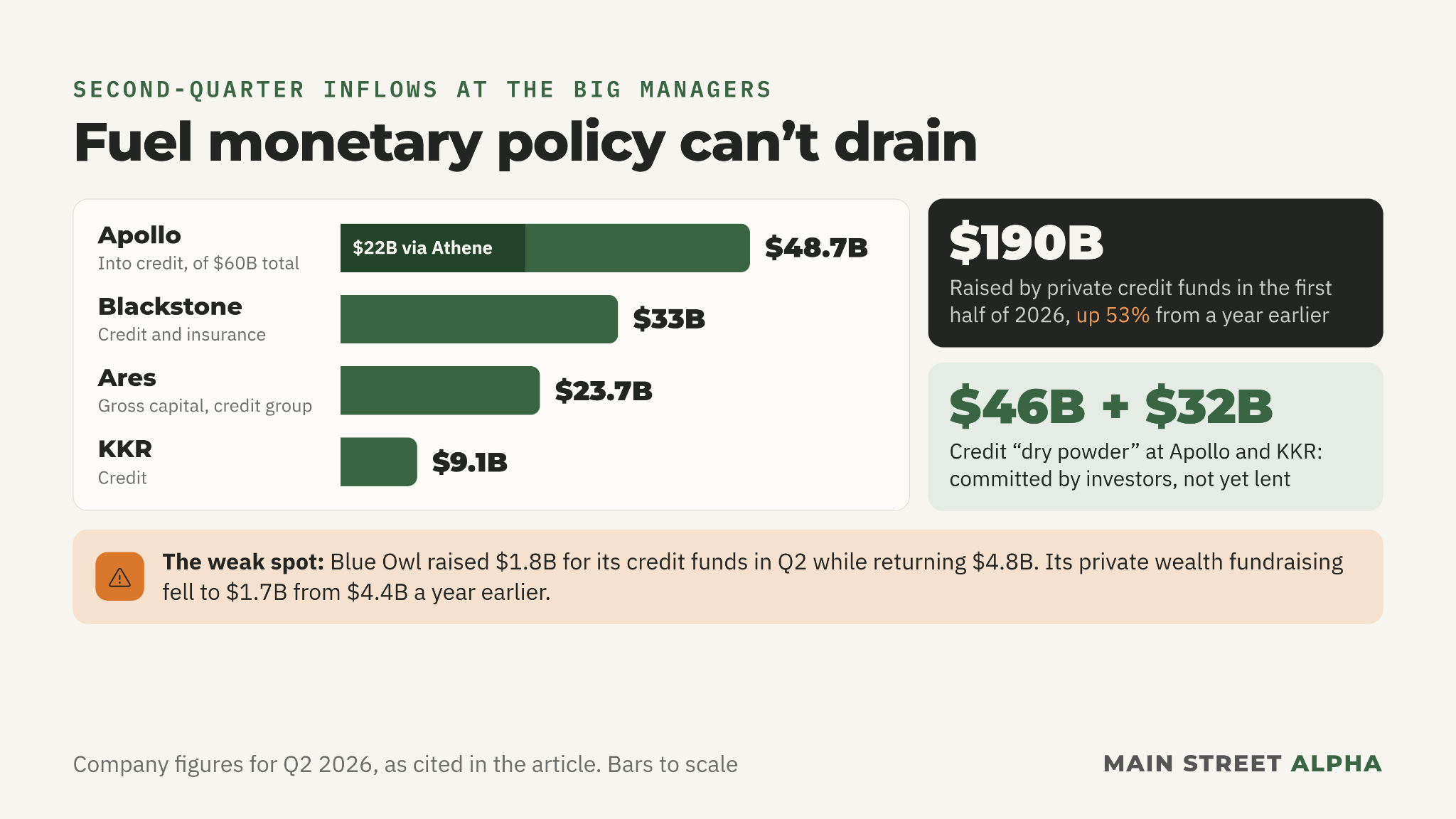
The second quarter shows how this played out. Private credit funds raised $190 billion in the first half of 2026, up 53% from the prior year. At the big managers, credit did most of the work. Apollo Global Management (APO) took in $60 billion, and $48.7 billion of it went into credit, including $22 billion that came through its insurer, Athene. Blackstone (BX) took in $33 billion in its credit and insurance business. Ares Management Corporation (ARES) raised $23.7 billion of gross capital in its credit group, and KKR & Co. (KKR) raised $9.1 billion in credit. Much of that money hasn’t been lent yet. Apollo holds $46 billion of credit “dry powder,” money investors have committed, but the funds haven’t invested, and KKR holds another $32 billion.
Main Street Alpha
The weak spot is wealthy individuals. Blue Owl Capital (OWL), which relies heavily on that channel, raised just $1.8 billion for its credit funds in the second quarter while returning $4.8 billion to investors. Its private wealth fundraising fell to $1.7 billion from $4.4 billion a year earlier. That money reacts to fears about credit quality, not to the Fed.
The Double-Edged Sword Of Disintermediation
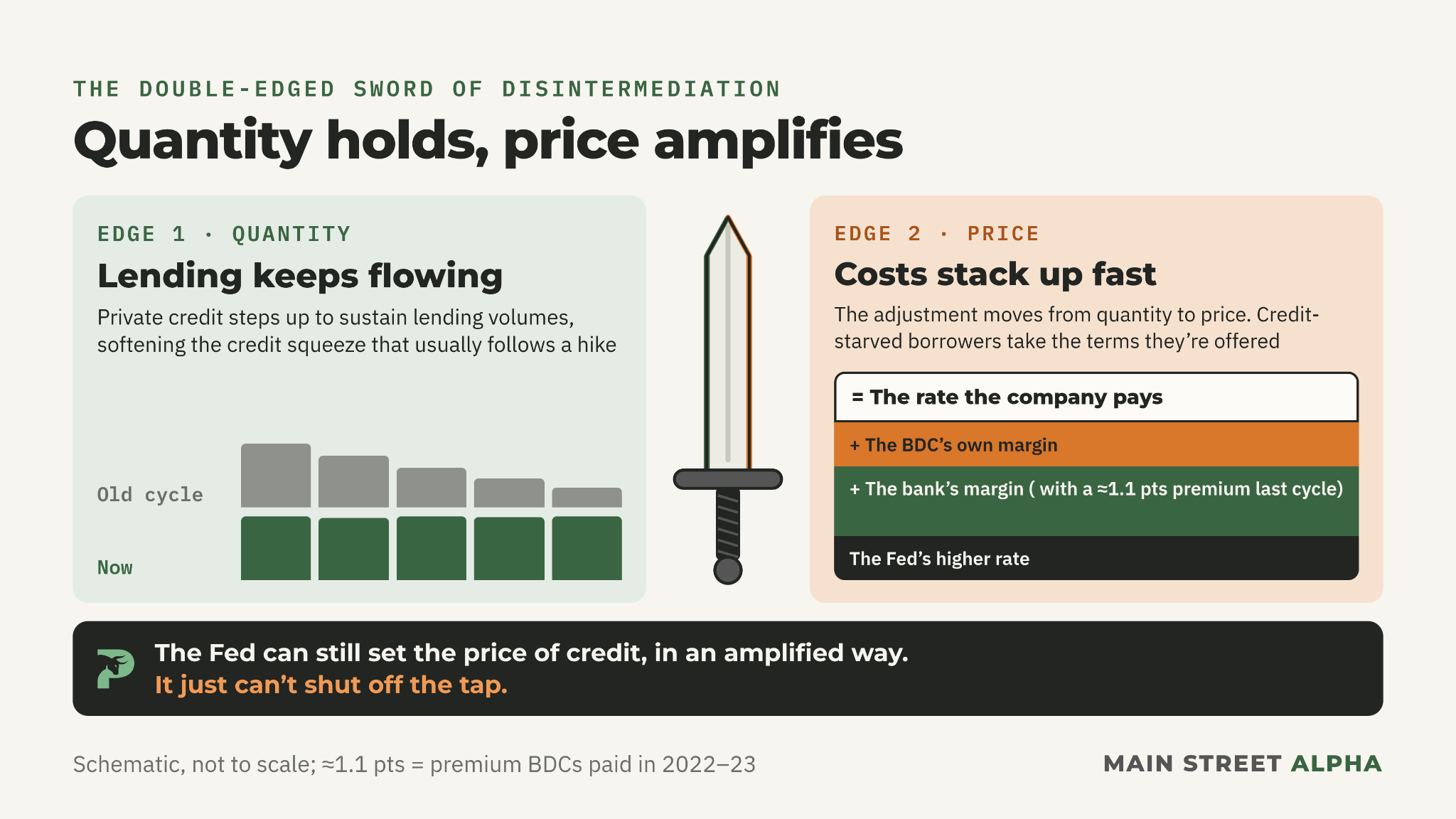
This new mechanism creates a tradeoff in the quantity-price relationship in credit markets. It mitigates the credit supply contraction that usually accompanies monetary tightening since private credit steps up to sustain lending volumes.
On the flip side, it amplifies interest rate transmission. That surprised me at first, because lending volumes hold up. But it makes sense once you see that the adjustment simply moves from quantity to price.
BDCs use their bank credit lines to fund part of their lending, and as I mentioned earlier, banks charged them about 1.1 percentage points more than other borrowers during the last tightening, on top of the hikes themselves. The costs stack up quickly: the bank adds its margin, then the BDC adds its own before lending to the company.
Main Street Alpha
Private credit lenders use investor capital, so they must offer attractive returns to attract it. As rates rise, more investors come in, because private credit’s risk-adjusted returns start to look more favorable.
Therefore, when banks tighten and rates rise, credit-starved borrowers have few options and must accept the terms private credit firms or BDCs offer. This amplifies rate transmission.
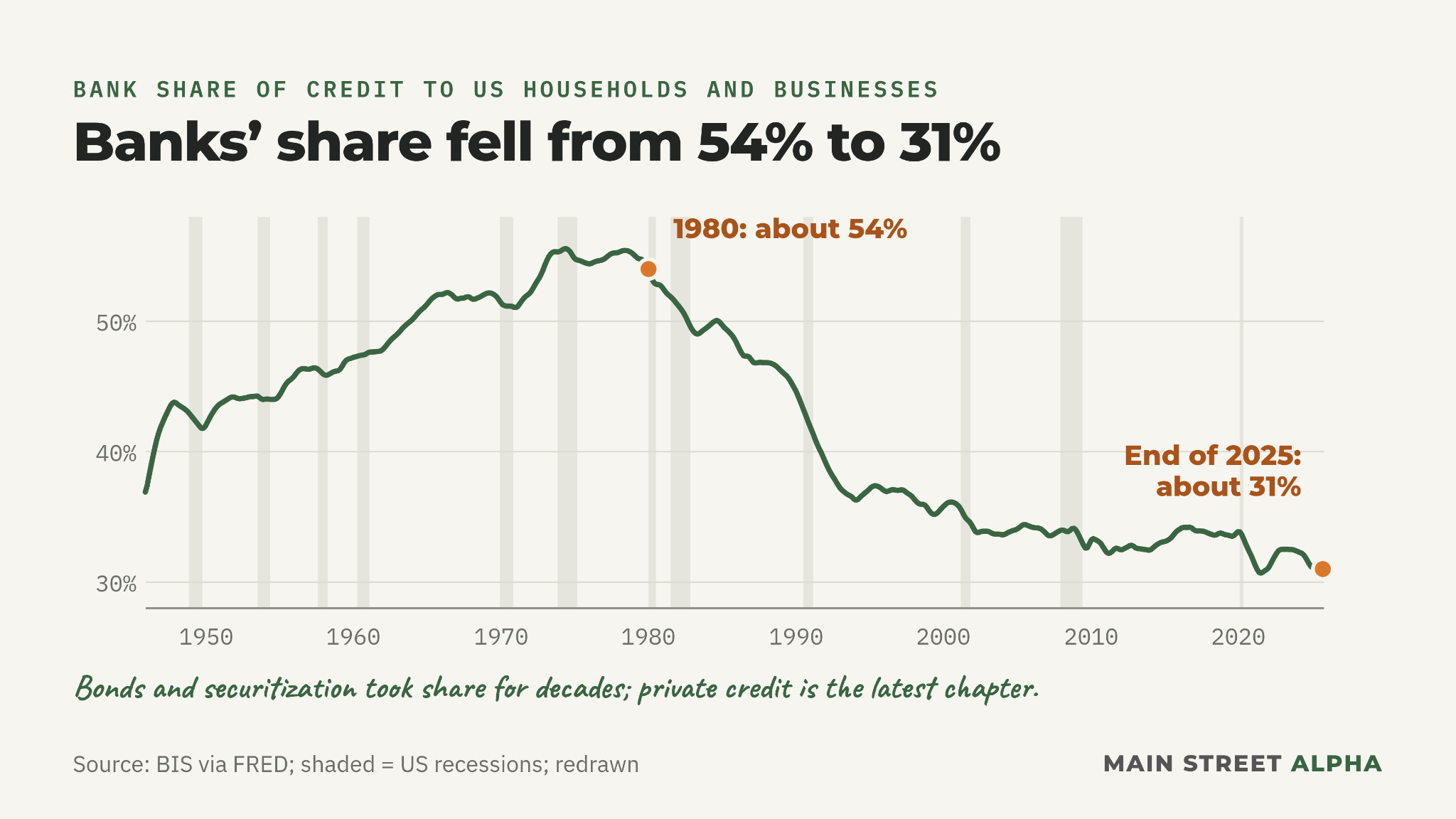
Disintermediation isn't new; private credit is just its latest chapter. Banks supplied about 54% of the credit to US households and businesses in 1980 and about 31% at the end of 2025, after decades of growth in bond markets and securitization.
Main Street Alpha
Price-Insensitive Borrowers Are Storming The Markets
From the start of the year to September, Goldman Sachs estimates AI-linked debt issuance reached $500 billion, with hyperscalers accounting for $194 billion. Over the same period, all US states, cities and school districts combined raised $473.8 billion, according to SIFMA, in what's shaping up to be a record year for municipal bonds. In 2027, Goldman Sachs estimates that AI-linked borrowing will reach about $1.2 trillion.
The scale is striking, but the bigger story is how little these borrowers care about the price.
Start with the math. Goldman expects Amazon (AMZN), Alphabet (GOOGL), Meta Platforms (META), Microsoft (MSFT) and Oracle (ORCL) to spend about $750 billion on capital projects this year, against roughly $778 billion of operating cash flow. The build-out eats nearly all the cash these companies generate, so they borrow to fund about a third of it.
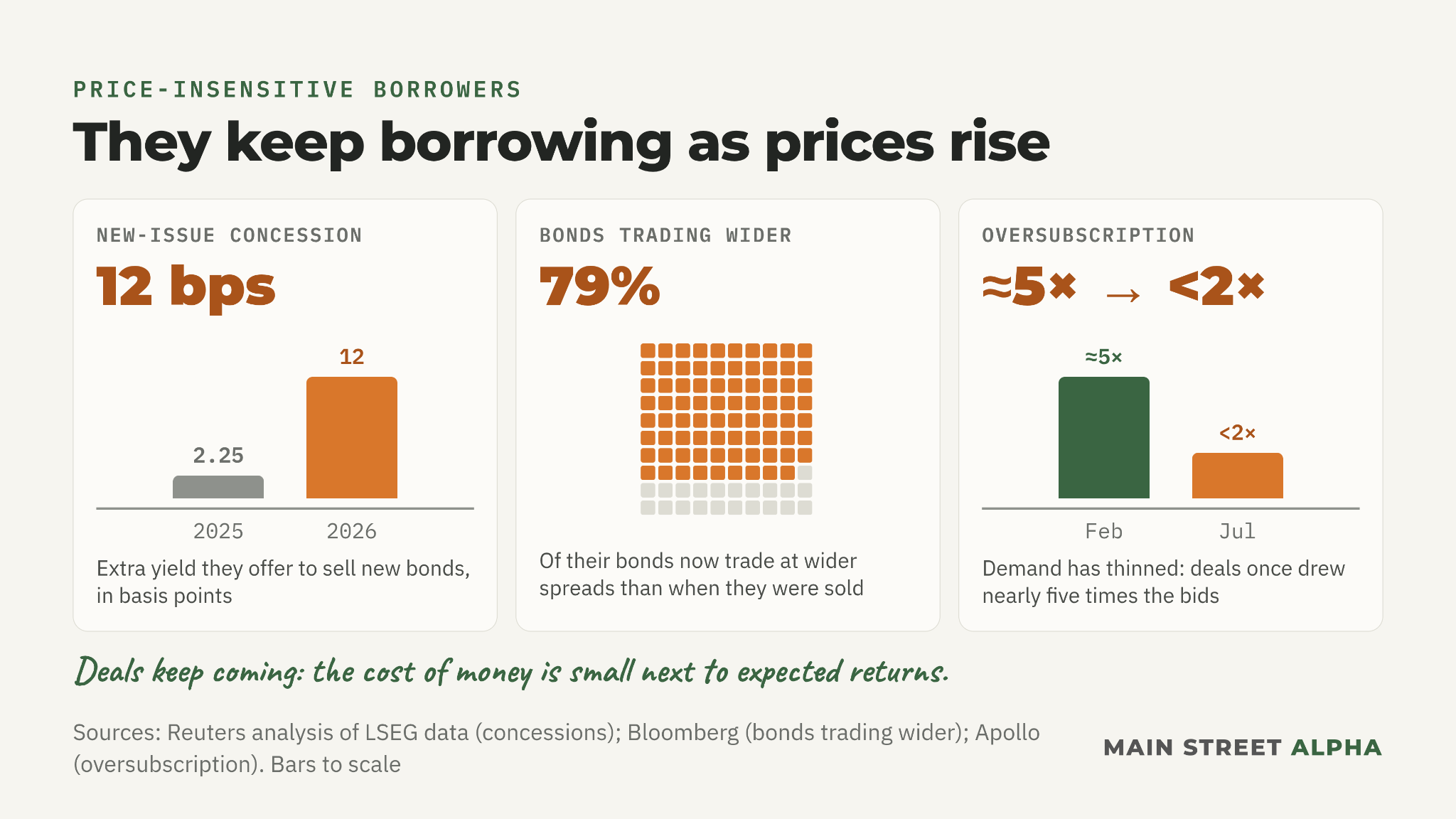
And they keep borrowing even as the price goes up:
The extra yield they offer to sell new bonds rose to 12 basis points this year, from 2.25 in 2025.
Roughly 79% of their bonds now trade at wider spreads than when they were sold, according to Bloomberg.
Demand has thinned. According to Apollo, deals went from nearly five times oversubscribed in February to under two times in July.
The deals keep coming anyway because the cost of money is small compared with what these companies expect to earn. TwentyFour Asset Management points to a 20-year average return on invested capital of 17.75%, against funding costs of 5.5% to 7%. If you expect to keep earning anything close to that, paying 7% instead of 6% doesn't change the decision.
Main Street Alpha
Bassman sees the same thing. “There’s just massive price-insensitive demand,” he told MacroVoices. In his words, “these guys are gonna borrow money at any rate, six, eight, ten, twelve.” He thinks the hyperscalers could absorb another 50 to 200 basis points and still stay solvent because of their massive, established cash-flow machines.
That doesn’t mean everyone wins. Bassman calls the race “Global Crossing from twenty-five years ago redux.” Global Crossing was the fiber-optic builder that went bust in 2002 after bandwidth prices collapsed. Only a few companies may emerge as winners. Still, Bassman thinks the bonds are "probably money good," so the risk sits with shareholders, and with everyone else who now has to compete with these borrowers for the same money.
Every dollar these giants borrow is a dollar someone else has to compete for. The pressure shows up first in the bond market. AI borrowers now make up almost a quarter of nonfinancial investment-grade bond supply, up from under 13% last year and 4% in 2024, according to PIMCO. They also borrow long. Since 2025, 41% of what the hyperscalers have issued matures in more than 15 years, against 16% for the broad corporate bond market, according to TwentyFour Asset Management. That puts them in direct competition with long-term government bonds for pension and insurance money.
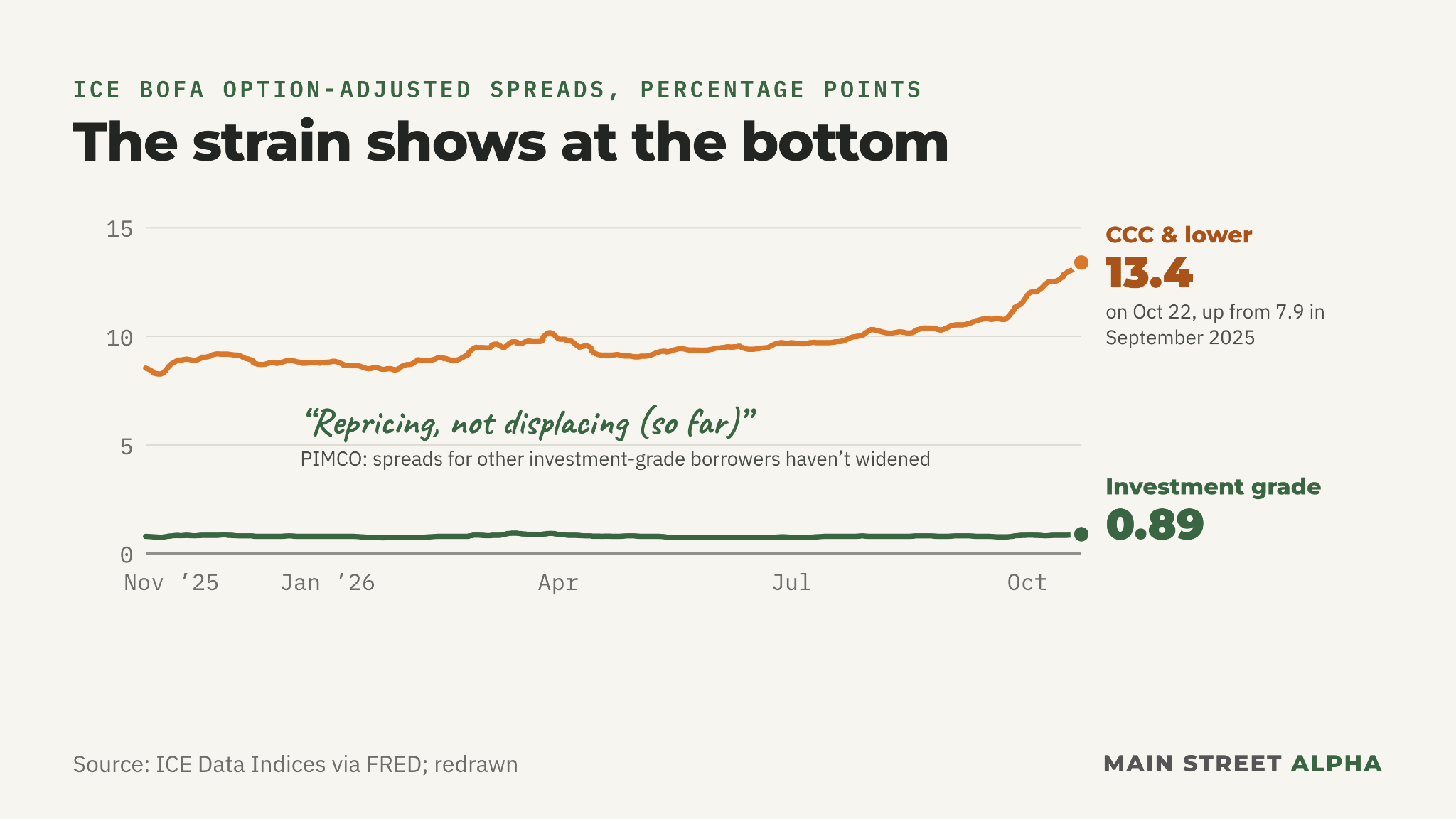
So far, the flood of AI bonds has mostly raised the giants’ own borrowing costs, not everyone else’s. Investors demanded more yield on hyperscaler bonds to absorb the supply, but PIMCO finds that spreads for other investment-grade borrowers haven’t widened. It calls this “repricing, not displacing (so far).” The strain shows at the bottom of the ladder instead. On Oct 22, the spread on CCC-rated bonds, the riskiest slice of the junk market, was 13.4 percentage points, up from 7.9 in September 2025. Investment-grade spreads, by contrast, were just 0.89 the same day.
Main Street Alpha
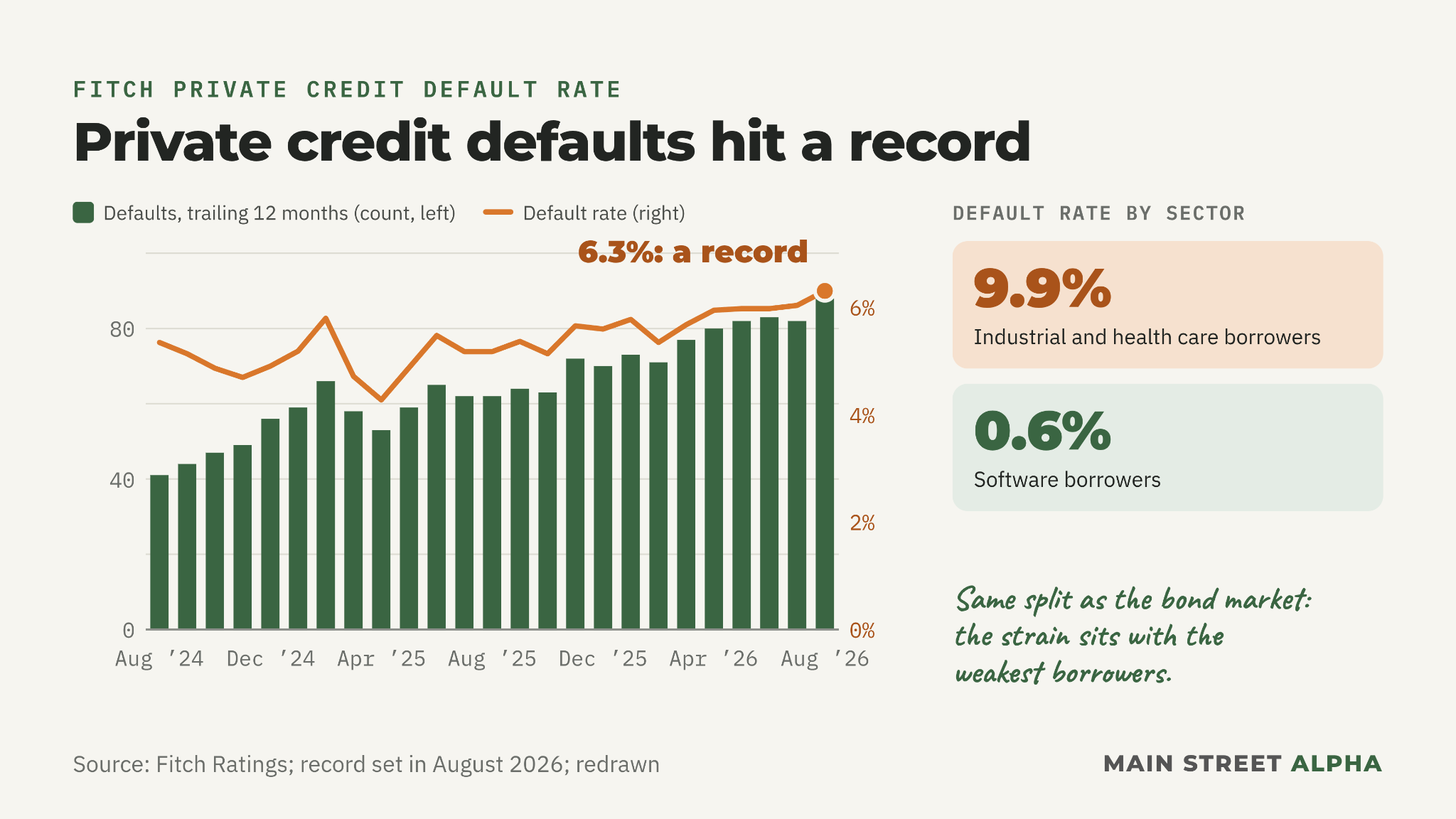
Private credit shows the same split. Fitch’s private credit default rate hit a record 6.3% in August. Industrial and health care borrowers defaulted at 9.9%, while software borrowers defaulted at just 0.6%.
Main Street Alpha
Higher For Longer Stays The Base Case
Putting these pieces together, the picture is clear: we can expect higher interest rates than the past 15 years, in line with what Leo argued back in January, before Main Street Alpha came to Seeking Alpha. The Fed's own September projections back that up, with the median official seeing no cut until 2028.
Both the Fed, trying to tame inflation, and the markets, continuously assessing disruption risk, persistent inflation, and risk-adjusted returns, are driving higher interest rates. Competition for capital is heating up fast as AI-linked debt has now reached muni-level scale, and Western governments are running large deficits that need funding.
However, less credit flows through the Fed’s volume-control channel: bank balance sheets. Capital that bypasses banks actually grows when rates rise because the proposed returns are attractive, and banks have become upstream credit suppliers, lending to BDCs at a premium.
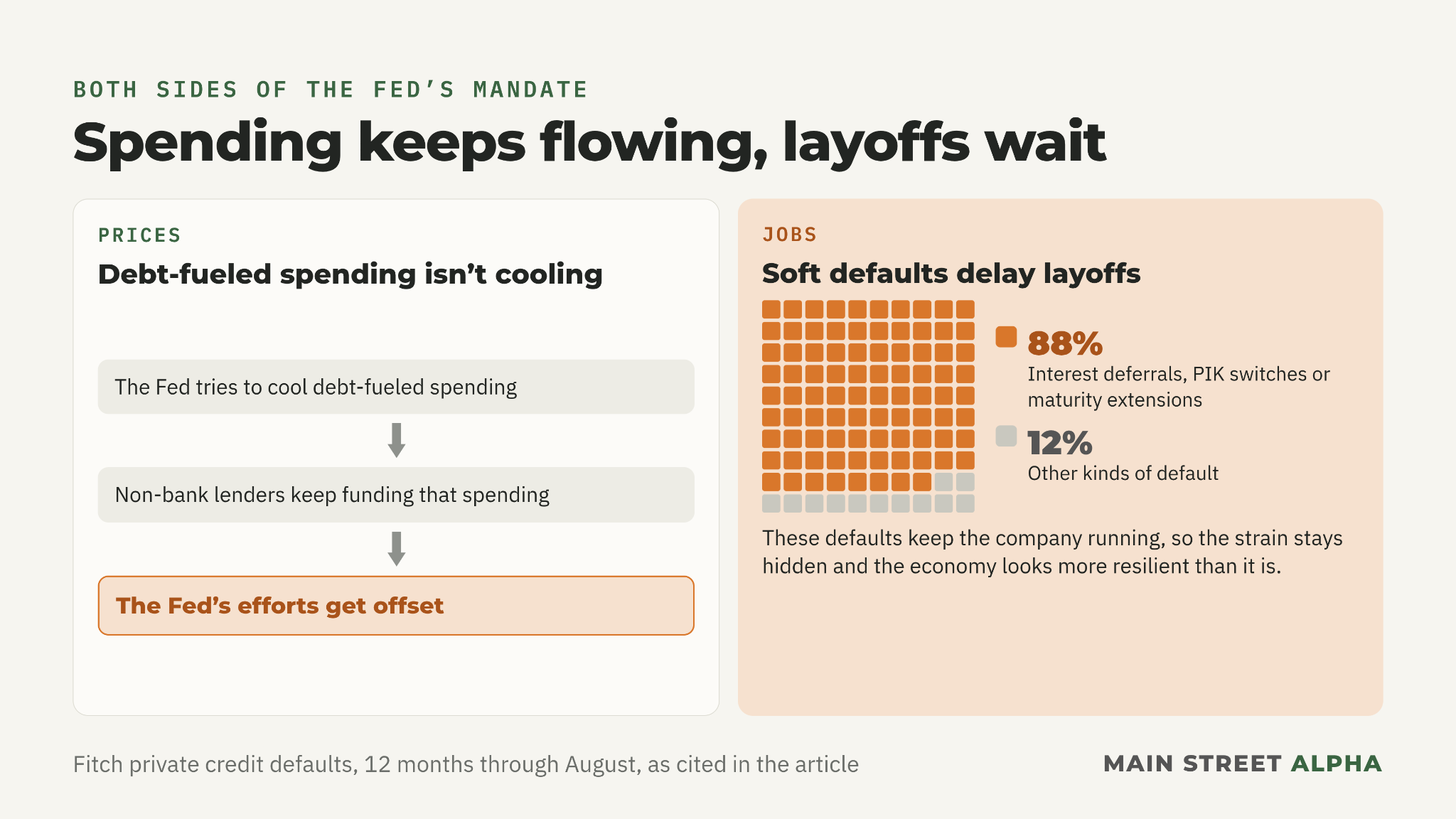
In short, the Fed is trying to tame inflation by cooling debt-fueled spending, but non-bank lenders keep funding it, offsetting the Fed's efforts.
On the employment side of the Fed's mandate, steady lending and borrower relief like PIK are delaying layoffs at struggling companies. In the 12 months through August, 88% of Fitch's private credit defaults were interest deferrals, PIK switches, or maturity extensions. These defaults keep companies running, so the strain stays hidden and the economy looks more resilient than it is.
Main Street Alpha
That leaves the Fed one option: tighten harder and stay tight longer, until its policy finally works its way into the parts of the economy it’s meant to slow. The catch is that the longer it holds, the more the burden falls on the borrowers who can’t sidestep it: homebuyers, small firms and leveraged factories.
There are three ways this could break. A lasting Hormuz deal could pull oil and inflation down fast, letting the Fed ease sooner. An AI spending slowdown, which Leo flagged on Oct 13, would take the most price-insensitive borrowers out of the market. If banks reprice their credit lines or lenders stop extending credit, the built-up stress arrives all at once, hitting BDCs first.
How To Invest In This Environment
This has been one of the main themes we have covered at Main Street Alpha. A lot of our top picks are either companies that benefit from this environment or ones that are insulated from it.
The bottom line is that we want to own companies that have already built their network, spent their CapEx, and repaid much of their debt, or have well-laddered maturities with no near-term refinancing needs.
Companies need either well-designed escalators that keep up with inflation or some nominal-linkage mechanism in their business model.
In TOLL+M terms, that’s low incremental capital intensity and long-duration cash flows. In LAND terms, it’s nominal linkage. A company that doesn’t need to refinance at today’s rates, and whose revenue rises with prices, is insulated from the Fed’s squeeze wherever it lands. Here’s how that translates into four groups.
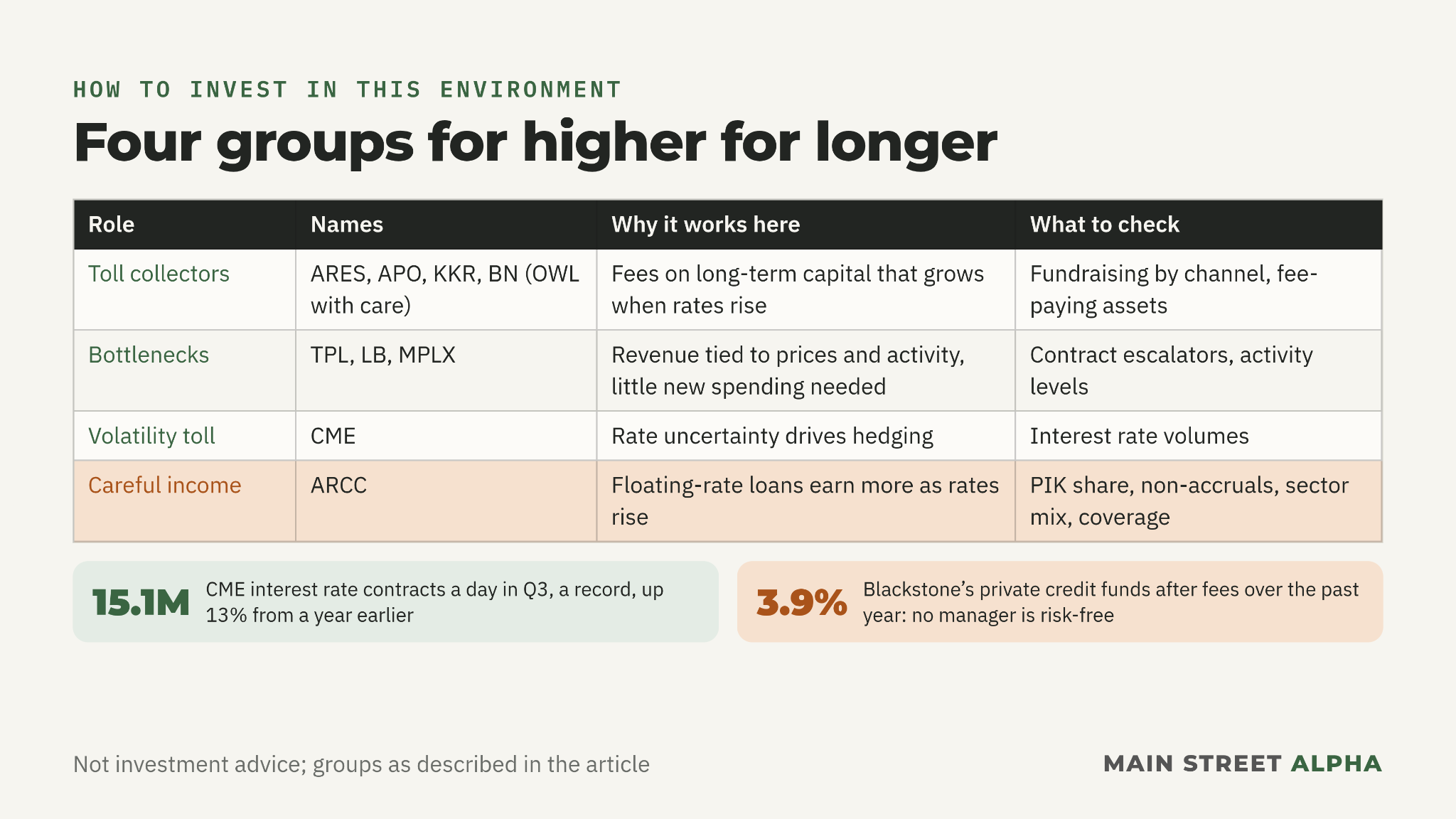
1. The toll collectors. If more of the economy’s credit flows around the banks, we want to own the toll booths on that flow, not the loans themselves. Asset managers like Ares collect fees on capital that's locked up for years, and as we saw above, that capital keeps growing. Apollo, KKR, and Brookfield Corporation (BN) add an insurance engine, because higher rates sell more annuities and those premiums end up in credit. Blue Owl is the one to watch most closely. It relies on wealthy individuals, and in the second quarter its credit platform raised $1.8 billion while returning $4.8 billion to investors. As Leo noted in June, it could re-rate quickly if sentiment improves. If it doesn’t, the fee base shrinks. None of these managers is risk-free, since credit losses hit their funds first. Blackstone’s private credit funds returned just 3.9% after fees over the past year.
2. The bottlenecks rates can’t fix. Texas Pacific Land (TPL) and LandBridge (LB) collect royalties, easement fees and water revenue from operators on their Permian land. Their revenue rises with prices and activity, and they need very little capital. MPLX (MPLX) runs fee-based pipelines, with many contracts that include escalators, and the regulator’s index for liquids pipeline rates is tied to producer prices. These names were at the center of our Oct 5 piece, and nothing here changes that view.
3. The volatility toll. CME Group (CME) runs the dominant marketplace for interest rate futures. When nobody knows how long the Fed will hold rates, everyone hedges. Its interest rate volume hit a third-quarter record of 15.1 million contracts a day, up 13% from a year earlier.
4. Careful income. BDCs like Ares Capital (ARCC) earn more as rates rise, because their loans float. But as Leo explained in April, ARES collects the toll while ARCC is the vehicle, so ARCC carries the credit risk this article describes. Before buying any BDC, check four things:
the share of income paid in kind (PIK) rather than in cash
non-accruals: ARCC’s rose to 2.4% at cost in Q2, up from 1.8% when Leo covered it in April
sector mix, since industrial and health care borrowers default at 9.9%
dividend coverage: ARCC earned $0.47 a share in Q2 against a $0.48 dividend
Main Street Alpha
What we’d be careful with
Long-duration bond proxies like Realty Income (O) and NNN REIT (NNN). Their value hinges on long-term rates, which the Fed doesn’t control, and the 30-year Treasury already yields about 5.3%.
Highly leveraged companies with near-term refinancing needs, especially on floating-rate debt. They were on our Oct 5 list of what to avoid, and they make up private credit’s borrower base.
High-PIK BDCs and gated non-traded funds. Their income isn’t fully cash, and your money can get stuck behind 5% quarterly withdrawal limits.
Takeaway
The Fed’s policy transmission isn’t broken; it has just become less efficient as more capital flows through private lenders using existing investor capital. The big private credit managers kept raising billions, even as long-term rates kept climbing. The first weeks of data after the September hike show the same thing: banks kept lending to businesses and, even faster, to non-bank lenders.
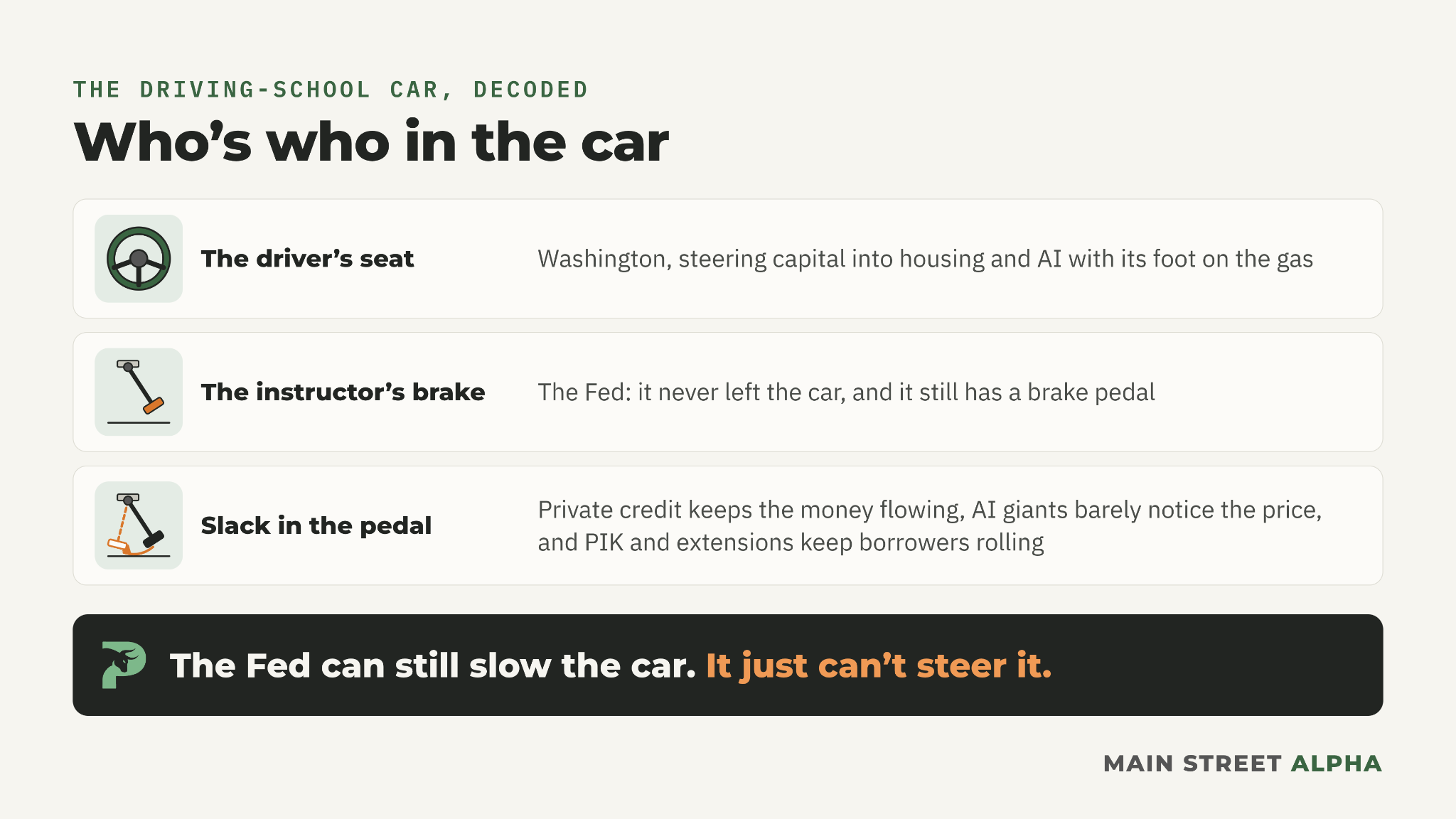
Think of a driving-school car. In January, we argued the Fed had been moved out of the driver's seat, and this article is the next chapter of that story. Washington took the wheel, steering capital into housing and AI with its foot on the gas. But the Fed never left the car. It moved to the instructor’s seat, and it still has a brake pedal. The problem is that the pedal now has much more slack. Private credit keeps the money flowing, the AI giants barely notice the price, and PIK and extensions keep struggling borrowers rolling. So the Fed has to press harder and hold the pedal down longer before the car slows. When the brakes finally bite, the passengers without seatbelts get thrown forward first: homebuyers, small businesses and leveraged factories. That’s why we want to own the ones buckled in, with networks already built, no refinancing wall, and prices that rise with inflation.
Main Street Alpha
Sign in to leave a comment and join the discussion.
Sign Up Free