

Introduction
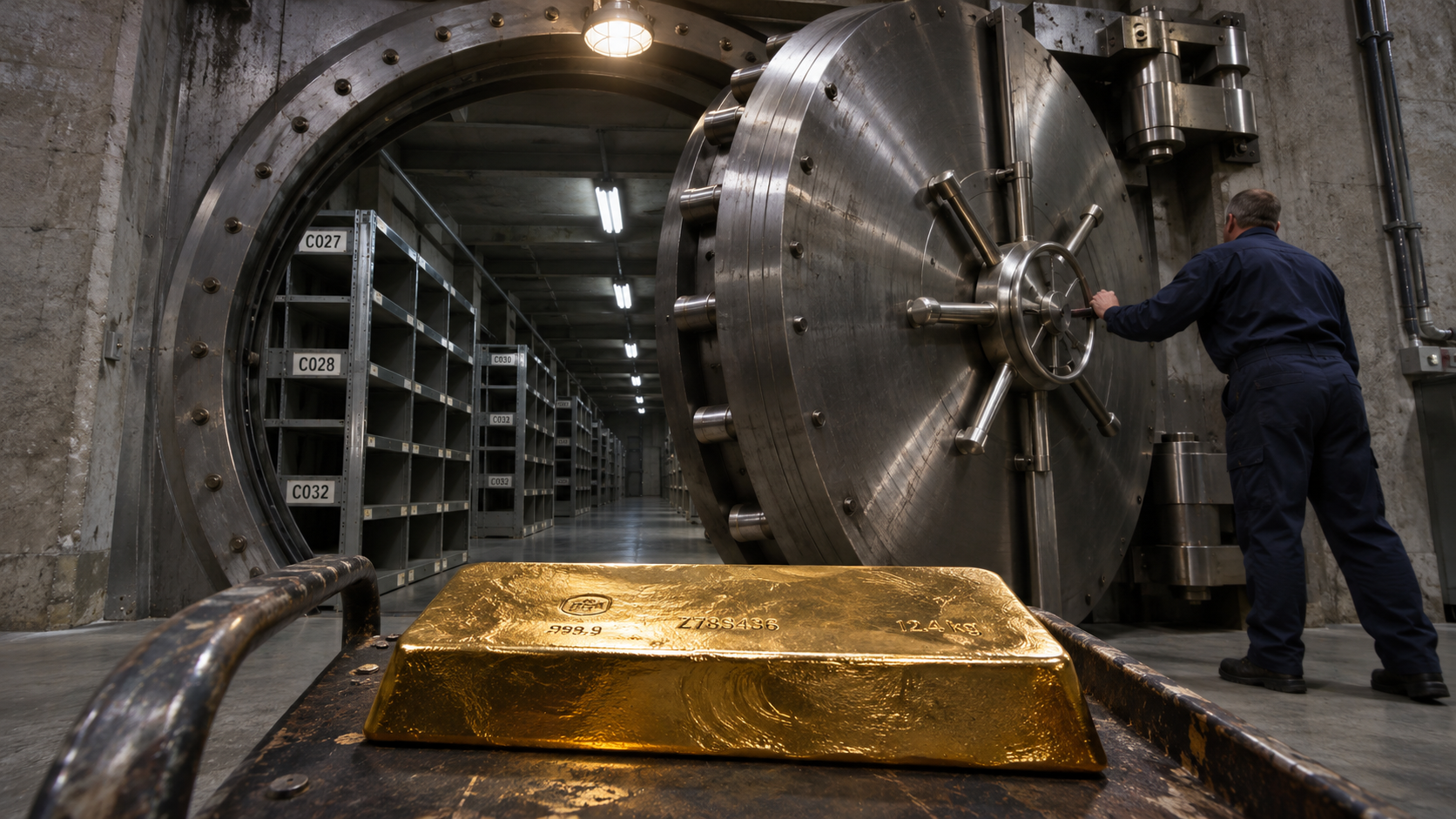
Try buying physical gold this week, and there's a good chance you'll hit a wall.
Albert's contacts in the bullion trade tell us that major bullion banks and several Asian platforms are struggling to deliver metal. What's on offer instead is paper, which is essentially securities and claims on gold that someone else holds.
The explanation going around the trade is even wilder.
The talk is that the Treasury, under Secretary Scott Bessent, is behind it, quietly shutting the escape hatches Americans would use to move wealth out of dollars.
I need to be very clear here. We cannot document that last part. We're telling you what's being said by people who sit very close to this market, and these are top-level sources. But we know it fits. And the fit is the story.
Last week, in "They Can't Help Themselves," we showed you why the fiscal math in Washington doesn't work without help. As many of you know, we (my business partners and I) have been in the "higher for longer" camp since 2020, with a government running the economy hot as a core part of that view.
This article is about what comes next. Historically, running it hot ends in financial repression (a government quietly forcing savers to fund its debt at rates below inflation).
I'll show you that three of the four pieces of that playbook are already in place, in public. Then I'll show you why Albert's intel looks like the fourth piece. After that, we'll look at what worked the last time America did this (the gold part surprised me), the one lens I'd use to sort every investment right now, specific ideas, income ideas, and how my own portfolio holds up.
To the many new members who joined us recently: welcome!
This is one of those articles where we do what Main Street Alpha is truly based on, which is using high-level intel for an actionable Big Picture profile. Some things may seem too "wild" to be true, but that's the world we currently live in.
So, let's dive right in, as we tell you what's going on!
The Two Halves Of Financial Repression
The best academic work on this topic comes from Carmen Reinhart and Belen Sbrancia. In their paper "The Liquidation of Government Debt," they describe financial repression as a mix of directed lending to the government by captive domestic buyers, caps on interest rates, regulation of cross-border capital flows, and a tighter connection between governments and banks.
I like to simplify it into two halves (they are crucial to understand, so I'll do my best to get the message across here):
Create forced buyers. Make sure someone always has to buy government debt, regardless of whether the yield makes sense.
Close the exits. Make it harder for savers to escape into assets the government doesn't control.
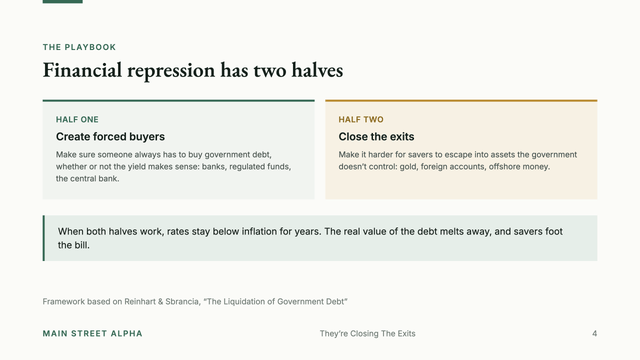
When both halves work, the government can keep rates below inflation for years. The real value of its debt melts away, and savers foot the bill.
Think about it: a government that is confident in its economy has no reason to care where its citizens park their savings. A government that needs steady demand for its debt and a stable dollar cares a great deal.
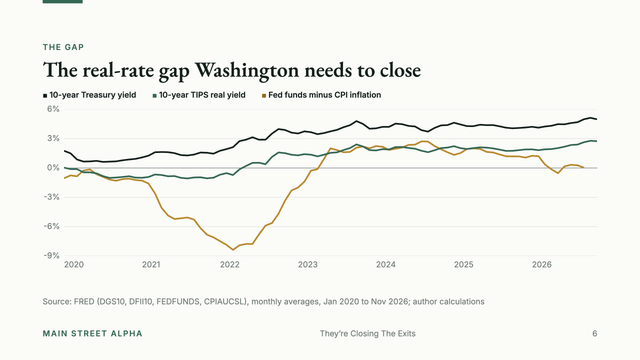
So, why worry about this now? Because the bond market isn't playing along yet.
The 10-year Treasury yields almost 5.10% while I am writing this. Inflation was 3.7% in September (the latest annual figure, as the 2025 shutdown left no October 2025 data to compare against). Monthly prints are running hot, too: prices rose 0.6% in September and 0.4% in October. More importantly, 10-year TIPS (inflation-protected Treasuries) yield 2.89%. That's the real return investors demand to lend to the U.S. government for a decade. It's a lot for a government with this much debt.
Funny enough, the short end is already at the edge of repression territory. The effective fed funds rate averaged 3.75% in September, basically the same as inflation. Cash earns next to nothing after inflation. The long end, however, where the government needs to refinance trillions of dollars, is still demanding a real return.
On top of that, one of the biggest buyers of the past two decades is walking away. China's Treasury holdings peaked in late 2013 and have fallen by more than half since then, according to the San Francisco Fed.
And while we have written in the past that China is using proxy countries to buy U.S. debt, we have a government that needs buyers, a bond market that demands a hefty real yield, and a former top customer that isn't a big tailwind anymore, either.
Three Of Four Pieces Are Already In Place
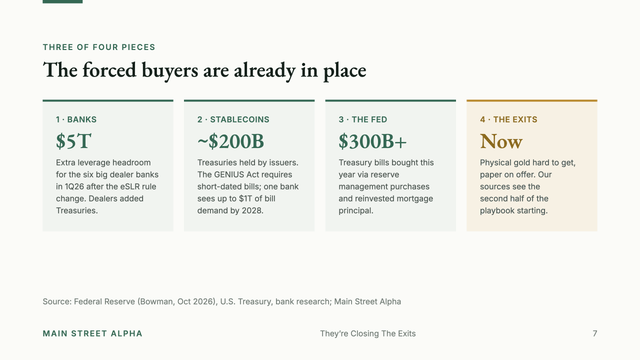
We believe that the forced-buyer half of the playbook has been built in plain sight over the past 18 months. Each step came with a sensible official explanation. When we put them next to each other, the picture changes.
Let me walk you through the components.
Piece one: the banks.
At the end of 2025, regulators finalized changes to the eSLR (the enhanced supplementary leverage ratio, a rule that forced big banks to hold capital against even the safest assets, including Treasuries). The new rule took effect in April 2026, and seven of the eight largest U.S. banks adopted it early.
According to the Federal Reserve's Vice Chair for Supervision, Michelle Bowman, the parent companies of the six big dealer banks gained nearly $5 trillion of additional leverage headroom in 1Q26 alone. Dealers increased their Treasury positions afterward.
And according to research from one major European bank, during the Iran conflict, big banks were able to absorb a portion of Treasuries that had no buyers.
Read that again. Treasuries that had no buyers.
Piece two: stablecoins.
The GENIUS Act, which was signed in July 2025, requires dollar stablecoins to be backed by safe, liquid assets. In practice, that means short-dated Treasury bills (93 days or less). Treasury now estimates stablecoin issuers hold close to $200 billion of U.S. government debt. One large bank expects stablecoin growth could create up to $1 trillion of additional T-bill demand by 2028.
Bessent himself said the GENIUS Act could become "an important feature of financing the U.S. government." Those are the Treasury Secretary's own words.
Personally, I never expected stablecoins to be this important.
Piece three: the Fed.
This year, the Fed has bought more than $300 billion of Treasury bills through so-called reserve management purchases and by reinvesting principal from its mortgage-backed securities. Officially, this keeps money markets running smoothly. But obviously, it's also demand for government debt.
So, banks have been freed up to buy Treasuries. Stablecoins are legally required to hold them. And the Fed is buying bills again.
That's three pieces.
The next one is where it gets really interesting.
The Fourth Piece: Closing The Exits
What Albert's sources describe is the second half of the playbook: making it harder for Americans to move savings out of dollars (yes, really). Dealers can't get metal, platforms offer paper instead of bars, and the explanation in the trade points straight at Treasury.
Sign in to leave a comment and join the discussion.
Sign Up Free